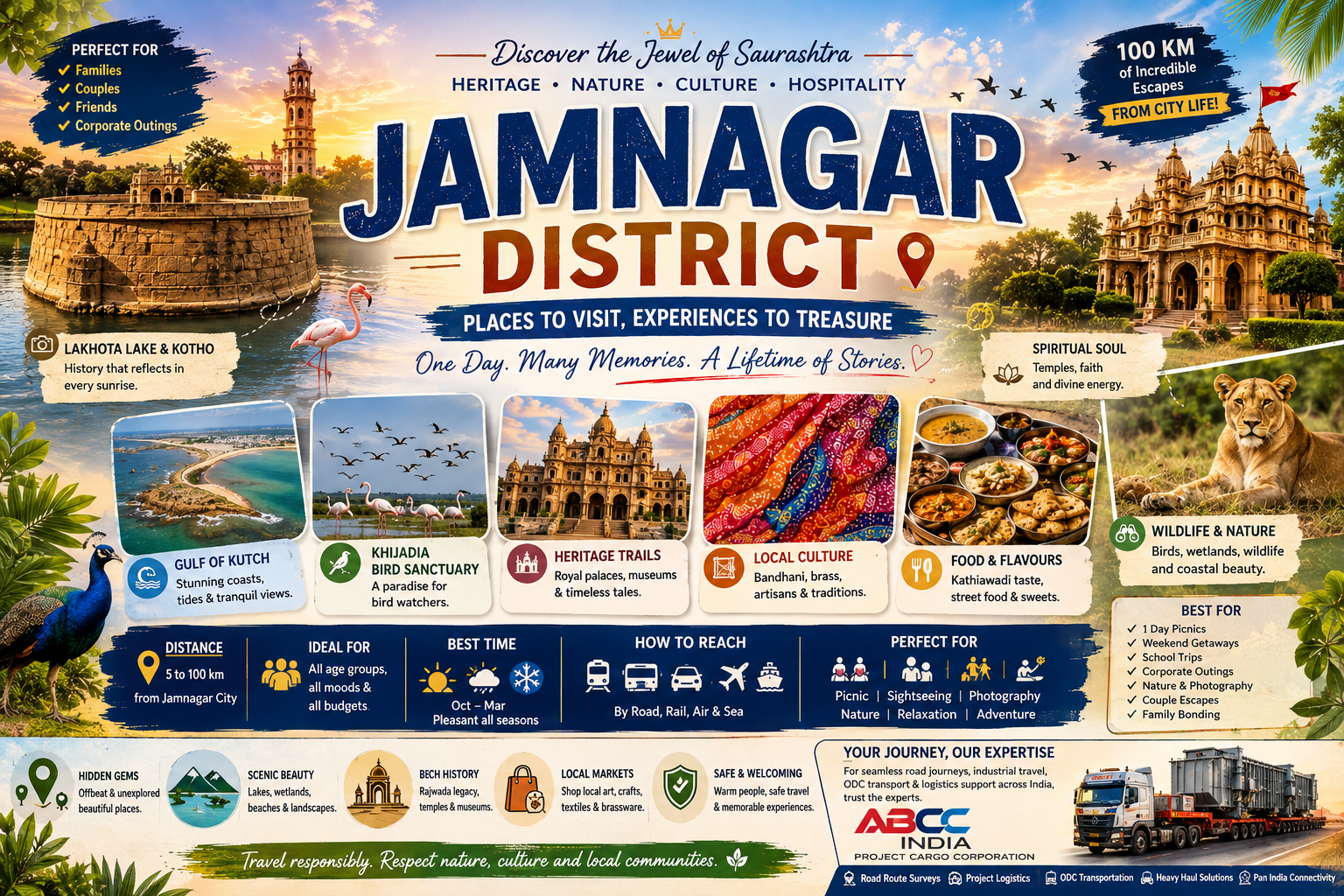
🦩 Places to Visit in Jamnagar District, Gujarat – The Ultimate Travel & Tourism Guide
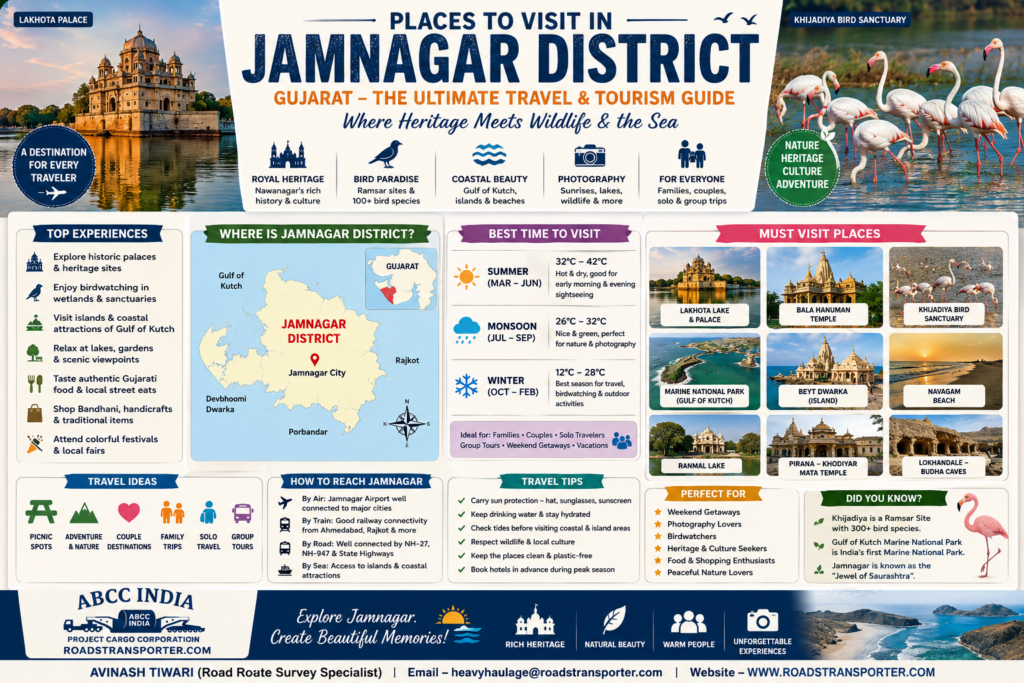
🌊 Introduction – Come, Let Jamnagar Surprise You

There are some journeys you plan because a destination is famous. Then there are journeys that quietly change your idea of what a place can be. Jamnagar District belongs to the second kind.
When I first began exploring this corner of Gujarat, I expected palaces, temples, old markets and the familiar warmth of a historic Gujarati city. I found all of those. But Jamnagar kept opening new doors.
One morning can begin beside a peaceful lake filled with birds. A few hours later, you can be looking across the Gulf of Kutch, where islands, tidal flats, mangroves and an extraordinary marine ecosystem create an entirely different landscape. By evening, you may find yourself walking through a busy market, watching the colours of traditional Bandhani textiles compete with the aromas of Gujarati snacks drifting from nearby shops.
That contrast is what makes the places to visit in Jamnagar District so interesting.
This is not simply a city sightseeing trip. Jamnagar District is a journey through royal heritage, wetlands, coastlines, temples, villages, bird habitats, marine landscapes and everyday Gujarati life. It rewards travelers who slow down, look beyond the obvious attractions and leave a little room in their itinerary for discovery.
If this is your first visit, come with curiosity rather than a checklist.
🦩 A Destination Where the City Meets the Wild

One of my strongest memories of Jamnagar is the feeling that nature is never very far away.
In and around Jamnagar city, Lakhota Lake gives the urban landscape a surprisingly calm heart. Walk around it at the right hour and the city seems to soften. Birds move across the water, local residents gather along the edges, and Lakhota Palace rising from the lake adds a distinctly historic silhouette.
But the real surprise begins when you travel toward the coast.
Jamnagar District lies along the Gulf of Kutch, a region known for remarkable coastal and marine biodiversity. The Marine National Park and Marine Sanctuary in the Gulf of Kutch give this part of Gujarat an identity unlike conventional beach destinations. Here, the attraction is not merely sand and sea. Tides expose and conceal an intricate world of reefs, mangroves, mudflats, creeks and marine life.
That alone makes Jamnagar worth considering for travelers searching for natural places, wildlife experiences, photography locations and offbeat tourist places in Gujarat.
Bird lovers have another compelling reason to visit. The Khijadiya Bird Sanctuary, a Ramsar Site, is one of the district’s outstanding nature destinations. Its combination of freshwater and saline habitats attracts an impressive variety of resident and migratory birds.
Standing quietly with binoculars while the morning light spreads across the wetlands feels very different from rushing between monuments. It is precisely this slower side of Jamnagar that many first-time visitors do not expect.
🏛️ History Is Not Locked Inside a Museum Here
Jamnagar’s historical character is equally difficult to ignore.
The city was historically known as Nawanagar, and its royal past still shapes its architecture and cultural identity. Lakhota Palace, old gateways, traditional neighborhoods, temples and heritage structures offer fragments of that story.
Yet I found Jamnagar most interesting when history appeared in ordinary moments.
It is in an old street where modern traffic passes a weathered façade. It is in a market where generations of craftsmanship survive beside contemporary shops. It is in conversations about the former princely state, local traditions and the changes brought by modern industry.
This mixture prevents Jamnagar from feeling like an open-air museum. It remains a living city.
For travelers interested in sightseeing, heritage tourism, local history and photography, that means you should occasionally put away the map and simply walk.
Some of the most memorable travel moments here are not necessarily marked by a large signboard.
🛕 Faith, Culture and Everyday Gujarat

Travel deeper into Jamnagar District and another layer becomes visible: spirituality.
Temples and sacred places are woven into local journeys, festivals and family traditions. The celebrated Bala Hanuman Temple beside Ranmal Lake is particularly associated with continuous chanting of the “Sri Ram, Jai Ram, Jai Jai Ram” mantra and has become one of Jamnagar city’s best-known religious landmarks.
But spirituality here is not limited to famous temples.
Smaller shrines, village traditions, local fairs and everyday rituals reveal how closely faith and community remain connected. If you travel respectfully and without rushing, these places can offer something that photographs alone cannot capture—a sense of participation in local life.
That makes Jamnagar appealing not only for sightseeing but also for family trips, senior-citizen travel, cultural tours, pilgrimage journeys and group vacations.
🚗 Jamnagar Is Different for Every Kind of Traveler

One reason I enjoy recommending Jamnagar District is that travelers can shape completely different trips from the same destination.
A solo traveler can spend mornings photographing birds, exploring heritage streets and finding quieter corners away from conventional tourist circuits.
Couples can combine lakeside evenings, heritage walks, coastal drives and relaxed meals to create a trip that feels personal without requiring a luxury resort itinerary.
Families can mix temples, lakes, museums, wildlife experiences and easy sightseeing. Groups can use Jamnagar as a base for wider excursions, while photographers can chase reflections, birds, architecture, markets, coastal landscapes, sunrise light and changing skies.
And if your idea of adventure travel is less about artificial thrill rides and more about entering landscapes shaped by tides, wetlands and wilderness, the district becomes even more rewarding.
Jamnagar is also a practical choice for weekend getaways and short Gujarat vacations, particularly when the itinerary is planned around realistic travel times rather than trying to cover everything in one day.
🌿 What About Waterfalls, Hills and Hidden Places?
This is where travel guides need to be truthful.
Jamnagar District should not be presented as a classic hill-station or waterfall destination. Its geography is better known for its coast, wetlands, lakes, islands, tidal environments, bird habitats and semi-arid landscapes.
Travelers searching specifically for dramatic waterfalls or high hills will generally find stronger options elsewhere in Gujarat.
But do not mistake the absence of mountain scenery for an absence of nature.
Jamnagar’s beauty is horizontal rather than vertical—the horizon across the Gulf, flamingos and other waterbirds in wetlands, mangroves meeting tidal water, reflections across lakes and enormous skies turning warmer toward sunset.
And this is where the district’s hidden gems, unexplored places and lesser-known attractions become especially interesting.
Some are not conventional “tourist spots” at all. They may be birding stretches, village landscapes, quiet coastal viewpoints or places that become interesting only during a particular season or tidal condition.
For first-time visitors, exploring such areas requires common sense. Coastal and marine environments can change dramatically with tides, and access or permissions may apply in protected areas. Local guidance and current official information should always take priority over an attractive social-media photograph.
📸 Come for the Attractions, Stay for the Small Moments

The photographs I remember most from journeys like Jamnagar are rarely the ones I planned.
A bird suddenly taking flight over still water.
A shopkeeper unfolding a brightly patterned Bandhani textile.
An elderly devotee entering a temple.
Fishing boats becoming silhouettes against the Gulf.
The reflection of Lakhota Palace changing as evening approaches.
A roadside cup of tea that somehow tastes better because you have been traveling all day.
These small experiences turn a list of Jamnagar tourist places into a real journey.
And that is how I invite you to explore this district.
Do not come merely to collect photographs or tick attractions off a list. Come to understand why a royal city grew beside this unusual coastal environment. Come to see how heritage, religion, industry, wildlife and Gujarati culture occupy the same landscape. Come hungry enough to explore local food, patient enough to watch birds, curious enough to enter an old market and flexible enough to follow a road that was not originally part of your plan.
Jamnagar may not reveal everything immediately.
Give it time.
🧭 Your Complete Jamnagar Journey Starts Here
In this Ultimate Jamnagar District Travel & Tourism Guide, I will take you beyond the obvious names and help you decide what is genuinely worth your time—from famous attractions and picnic spots to natural places, coastal experiences, heritage landmarks, wildlife areas, hidden gems and lesser-known destinations.
We will explore where to go, what to see, how much to budget, what local food to try, where to photograph sunrise and sunset, how to plan your itinerary, the best season to travel, transport options, family and couple-friendly experiences, solo-travel ideas, practical safety advice and useful travel tips for first-time visitors.
So keep your camera ready, but keep your curiosity even closer.
Jamnagar District is waiting—and the most interesting part of the journey begins beyond the places you already know.

Follow Our Facebook Page For Regular Travel Industry Updates :- CLICK HERE
Follow Our Whatsapp Channel For Regular Travel Industry Updates :- CLICK HERE
🗺️ Best Places to Visit in Jamnagar District, Gujarat

This list is restricted to Jamnagar District and avoids adding famous places from neighbouring Devbhumi Dwarka, Rajkot, Porbandar or Junagadh merely to reach 50 entries. Jamnagar District’s official tourism pages presently highlight Ranmal/Lakhota Lake, its monuments, Pirotan Marine National Park, Khijadiya Bird Sanctuary, Solarium and numerous religious sites; JMC additionally confirms its municipal parks and amusement facilities.

Budget is an approximate per-person local outing budget, excluding travel to Jamnagar, overnight hotel, private long-distance taxi and special boat/permit expenses.
| Place | Best Season | When to Visit | Why to Visit | Ideal For | Approx Budget | Travel Tip |
|---|---|---|---|---|---|---|
| 1. 🦩 Khijadiya Bird Sanctuary | Nov–Feb | 6–10 AM, 2–4 hrs | Jamnagar’s strongest birding/wildlife attraction; freshwater lakes, mudflats, creeks, salt pans and mangrove habitat | Family, Friends, Students, Solo, Gen Z, Seniors, Wildlife photographers | ₹100–₹800 | Carry binoculars and arrive early; sanctuary is about 10 km northeast of Jamnagar. |
| 2. 🏝️ Pirotan Island – Marine National Park | Oct–Mar | Tide/boat dependent; full day | Coral ecosystem, tidal flats, mangroves and marine wildlife | Friends, Couples, Students, Wildlife lovers | ₹1,500–₹4,000+ | Verify current permission, boat and tide requirements before leaving; official tourism places Pirotan about 18 nautical miles from Bedi Port. |
| 3. 🌊 Ranmal Lake / Lakhota Lake | Oct–Mar | Sunrise or 5–9 PM | Iconic Jamnagar landmark, migratory birds, gardens, heritage scenery and evening walks | All ages, Family, Couple, Solo, Seniors | ₹0–₹300 | Excellent low-budget sunset outing; combine with Lakhota Palace |
| 4. 🏺 Lakhota Palace & Archaeological Museum | Oct–Mar | Afternoon, 1–2 hrs | History, sculpture, coins, arms and impressive island-fort architecture | Family, Students, Seniors, Couples | ₹50–₹400 | Check current museum opening time/weekly closure before travelling. |
| 5. 🙏 Bala Hanuman Mandir | Year-round | Early morning or evening | Jamnagar’s famous devotional landmark beside Ranmal Lake | Families, Boomers, Seniors, Solo pilgrims | Free–₹150 | Combine with lake and museum for one easy half-day circuit |
| 6. ⚓ Rozi Port | Oct–Feb | Sunrise/sunset | Genuine seaside port, fishing/maritime atmosphere and photography | Family, Couples, Friends, Students | ₹100–₹500 | Gujarat Tourism identifies Rozi and Bedi as Jamnagar seaside day-trip/picnic locations. |
| 7. ⚓ Bedi Port | Oct–Feb | Morning/evening | Jamnagar’s maritime identity, coastal scenery and access point associated with marine tourism | Friends, Students, Photographers | ₹100–₹500 | It is also a working port—stay within permitted/public areas. |
| 8. 🏯 Bhujiyo Kotho | Oct–Mar | Daytime | Historic defensive architecture and old Jamnagar heritage | Students, Friends, History lovers | ₹0–₹200 | Verify current interior/restoration access |
| 9. 🚪 Khambhalia Gate | Oct–Mar | Morning/evening | Historic city gateway and excellent heritage photography | Couples, Students, Family, Solo | ₹0–₹150 | Include it in an old-city walking circuit |
| 10. 👑 Pratap Vilas Palace | Oct–Mar | Daylight | Important Nawanagar royal architecture | Couples, Students, Architecture lovers | ₹0–₹250 | Assume exterior viewing unless public interior entry is specifically confirmed |
| 11. 🏰 Darbargadh Palace Area | Oct–Mar | 9 AM–5 PM | Historic royal quarter, architectural details and old-city atmosphere | Family, Friends, Students, Photographers | ₹0–₹300 | Combine with nearby old markets |
| 12. 🕰️ Mandvi Tower | Oct–Mar | Morning/evening | Heritage landmark surrounded by traditional commercial life | Gen Z, Students, Foodies, Solo | ₹0–₹250 | Walking is easier than driving through congested old-city streets |
| 13. 🕰️ Pancheswar Tower | Oct–Mar | Morning/evening | Historic Jamnagar streetscape and architecture | Family, Students, Solo | ₹0–₹150 | Good short stop during a heritage walk |
| 14. ☀️ Solarium / Ranji Institute | Oct–Mar | Daylight | Unusual 1933 solar-therapy heritage structure commissioned in the Jam Saheb era | Students, Architecture enthusiasts, Gen X, Boomers | ₹0–₹250 | Check present visitor access before making a special trip. |
| 15. 🌿 Dhanvantari Mandir | Oct–Mar | Daytime | Architecture and Jamnagar’s long association with Ayurveda | Students, Seniors, Wellness travellers | ₹0–₹250 | Best combined with an Ayurveda-oriented city visit |
| 16. 💆 ITRA Ayurveda & Panchakarma Hospital | Year-round | Working hours/appointment | Genuine Ayurveda consultation and Panchakarma institution | Adults, Seniors, Students, Wellness travellers | Registration from about ₹50; therapies vary | This is medical Ayurveda, not merely a tourist massage spa; treatment should follow professional consultation. |
| 17. 🌳 Jam Ranjitsinhji Park | Jul–Mar | 10 AM–8 PM | Large gardens, lawns, children’s rides, food zone and picnic space | Gen Alpha, Family, Seniors, Couples, Corporate teams | Entry from ₹10; outing ₹50–₹500 | JMC says it is downstream of Ranjit Sagar Dam and closed Monday. |
| 18. 🎡 Sardar Vallabhbhai Patel Amusement Park | Oct–Mar | 3–10 PM | Game zone, paid/free rides, musical fountain, rain dance and family recreation | Gen Alpha, Gen Z, Families, Friends, Corporate teams | Entry from ₹10 + ride charges | Closed Tuesday. JMC confirms ride/game zones, but verify any specific bumper-car/dodgem ride before advertising it. |
| 19. 🕉️ Kashi Vishwanath Mandir | Year-round | Morning/evening | Major Shiva temple contributing to Jamnagar’s “Chhoti Kashi” reputation | Family, Seniors, Solo, Devotees | Free–₹150 | Avoid major festival rush if travelling with elderly visitors |
| 20. 🔱 Siddhnath Mahadev Mandir | Year-round | Morning/evening | Long-standing Shiva devotional site | Family, Seniors, Couples, Solo | Free–₹150 | Combine with Jamnagar’s other Shiva temples |
| 21. 🔱 Nagnath Mandir | Year-round | Morning/evening | Historic local Shiva devotion | Family, Boomers, Seniors, Pilgrims | Free–₹150 | Morning is quieter |
| 22. 🙏 Bhidbhanjan Mahadev Mandir | Year-round | Morning/evening | Well-established Shiva temple and devotional tourism | Family, Seniors, Solo | Free–₹150 | Festival periods can become crowded |
| 23. 🌳 Khijda Mandir | Year-round | Morning | Genuine historic/religious place officially included by the district | Family, Students, Seniors | Free–₹200 | Include with Khambhalia Gate/old-city sightseeing |
| 24. 🛕 Jain Derasar | Year-round | Morning | Jain architecture, religious heritage and peaceful atmosphere | Families, Students, Seniors | Free–₹150 | Ask permission before interior photography |
| 25. 🛕 Swaminarayan Mandir | Year-round | Morning/evening | Temple architecture and peaceful devotional atmosphere | All generations, Families, Couples, Seniors | Free–₹200 | Respect dress and photography rules |
| 26. 🕌 Jama Masjid | Year-round | Outside main prayer times | Jamnagar’s multi-faith architectural and cultural heritage | Students, Culture travellers, Solo | Free | Avoid sightseeing during congregational prayers |
| 27. 🕌 Ratanbai Masjid | Year-round | Daylight | Islamic architectural and community heritage | Students, History/architecture travellers | Free–₹100 | Dress respectfully |
| 28. 🪯 Gurudwara | Year-round | Morning/evening | Sikh religious heritage and peaceful community atmosphere | All ages, Family, Solo | Free | Cover your head and follow Gurudwara etiquette |
| 29. 🕊️ Moksh Dham | Oct–Mar | Daylight | Distinctive religious/memorial landscape included in official Jamnagar religious places | Adults, Students, Cultural travellers | Free | It is a sensitive memorial/cremation space; behave respectfully |
| 30. ✝️ Sacred Heart Church, Jamnagar | Year-round | Daylight / service hours | Genuine Christian parish and Jamnagar’s Christian heritage | Christian pilgrims, Families, Students, Culture travellers | Free | The Jamnagar parish traces the present church to 1967; respect worship and photography rules. |
Jamnagar District’s government page independently confirms many of these heritage and religious sites by name, including Bhujiyo Kotho, Khambhalia Gate, Pratap Vilas Palace, Darbargadh, Mandvi Tower, Pancheswar Tower, Dhanvantari Mandir, Bala Hanuman, Kashi Vishwanath, Siddhnath, Nagnath, Khijda Mandir, Bhidbhanjan, Gurudwara, Jama Masjid, Jain Derasar, Swaminarayan Mandir, Ratanbai Masjid and Moksh Dham.
🎯 Jamnagar Attractions by Generation & Traveller Type
| Traveller | Best Genuine Choices |
|---|---|
| 👶 Gen Alpha / Children | Sardar Vallabhbhai Patel Amusement Park, Jam Ranjitsinhji Park, Ranmal Lake, Khijadiya Bird Sanctuary |
| 🧑 Gen Z | Khijadiya, Pirotan, Lakhota Lake, heritage photography, amusement park, Rozi/Bedi coast |
| 👩❤️👨 Millennials / Couples / Spouses | Ranmal Lake sunset, Khijadiya, Pirotan with proper planning, Jam Ranjitsinhji Park, heritage circuit |
| 👨👩👧 Gen X / Families | Lakhota Museum, Bala Hanuman, Khijadiya, parks, Swaminarayan Mandir |
| 👴 Boomers | Bala Hanuman, Lakhota Lake, temples, Dhanvantari/Ayurveda heritage |
| 🧓 Senior Citizens | Bala Hanuman, Swaminarayan Mandir, Lakhota Lake, Kashi Vishwanath, ITRA when seeking genuine Ayurveda care |
| 👤 Lonely / Alone / Solo | Ranmal Lake, Khijadiya, heritage walk, temples, museum |
| 👥 Friends | Pirotan, Khijadiya, amusement park, Rozi/Bedi coastal trip |
| 🏢 Corporate Office Team | Jam Ranjitsinhji Park, amusement park; professionally arranged marine/nature visit for smaller teams |
| 🎓 Students | Khijadiya, Marine National Park/Pirotan, Lakhota Museum, Solarium, heritage monuments, ITRA |
✅ Attractions Check

| Requested Keyword | Genuinely Available in Jamnagar District? | What Should Be Written |
|---|---|---|
| 🦩 Wildlife | ✅ Yes | Khijadiya Bird Sanctuary + Marine National Park |
| 🌊 Marine Wildlife | ✅ Yes | Pirotan/Marine National Park |
| 🏢 Corporate Team Outing | ✅ Yes | Jam Ranjitsinhji Park and amusement park |
| 🌳 Gardens | ✅ Yes | Jam Ranjitsinhji Park; landscaped areas around Ranmal Lake |
| 🏺 Museum | ✅ Yes | Lakhota Archaeological Museum |
| ⛰️ Hill Station | ❌ No genuine hill station | Say explicitly that Jamnagar District is not a hill-station destination |
| ⚓ Sea Port | ✅ Yes | Bedi Port and Rozi Port are specifically promoted by Gujarat Tourism. |
| 🏖️ Beach | ⚠️ Coastal tourism yes | Prefer verified Rozi/Bedi seaside experiences rather than importing Shivrajpur or Dwarka beaches |
| 💦 Waterpark | ⚠️ Not strong enough for this verified Top 30 | Verify a presently operating private water park before publishing its name |
| 🏊 Swimming | ⚠️ Controlled facilities only | Do not recommend open-sea, dam or Marine National Park swimming as guaranteed safe recreation |
| 🧺 Picnic | ✅ Yes | Jam Ranjitsinhji Park and Gujarat Tourism’s Rozi/Bedi day-trip circuit |
| 💆 Ayurvedic Massage / Panchakarma | ✅ Genuine medical facility | ITRA has dedicated Panchakarma facilities. |
| 🙏 “Miraculous Temple” | ⚠️ Faith claim | Jamnagar has many revered temples, but don’t state miracles as proven facts |
| ✝️ Christian Church | ✅ Yes | Sacred Heart Church, Jamnagar |
| 🍲 Foodies Places | ✅ Yes | Cover verified restaurants/dhabas separately; restaurants don’t need to be padded into the Top 30 attractions |
| 🎡 Bumper Cars / Dodgems | ⚠️ Exact ride not confirmed | JMC verifies a game zone and paid rides, not permanent availability of every specific ride. |
| 🚠 Cable Car | ❌ No verified tourist cable car | Do not add |
| 🚡 Ropeway Ride | ❌ No verified tourist ropeway | Girnar Ropeway belongs to Junagadh, not Jamnagar |
| 🛣️ Dhabas & Hotels | ✅ Yes | Make a separate verified food/hotel chart |
| 🛕 Devotional Tourism | ✅ Very strong | Shiva temples, Bala Hanuman, Jain, Swaminarayan, mosque, Gurudwara and church |
| 🌾 Agriculture Tourism | ⚠️ No major official attraction verified | Mention only a farm/operator that can be independently verified |
| 🧗 Climbing | ❌ No established major climbing attraction verified | Do not manufacture “Jamnagar climbing points” |
| 🍷 Wine Party | ❌ Not a normal tourism category here | Gujarat alcohol regulations apply; use lawful hotel banquet/mocktail/private corporate event wording instead |

⭐ Best 10 for a First-Time Jamnagar Trip
Khijadiya Bird Sanctuary → Narara Reef → Lakhota Lake → Lakhota Museum → Bala Hanuman Temple → Jam Ranjitsinhji Park → Balachadi Beach → Pratap Vilas Palace → BAPS Swaminarayan Mandir → Chandi Bazaar heritage & food walk.
🌦️ Best Time to Visit Jamnagar District and Seasonal Weather Conditions
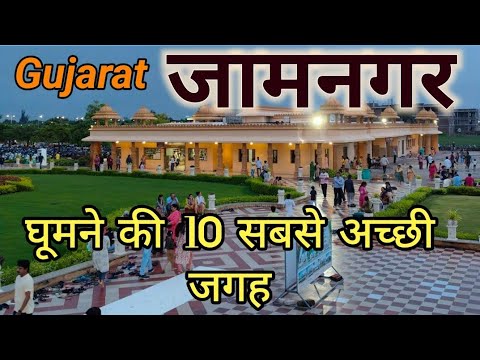
The best time to visit Jamnagar District is generally from October to March, when cooler and comparatively dry weather makes birdwatching, heritage sightseeing, temple visits, coastal exploration and outdoor photography more comfortable. Summer can still work for short city breaks if sightseeing is limited to mornings and evenings, while the monsoon gives Jamnagar a moodier, greener character suited to lakes, temples, food trails and relaxed road trips.
Jamnagar does not offer the same experience in every season. This is particularly important around the Gulf of Kutch. Marine excursions are influenced not only by the month but also by tides, weather, permissions and local access conditions. Travelers should therefore treat seasonal recommendations as planning guidance rather than a guarantee of marine access.
| Season | Typical Travel Experience | Best For | Main Challenge |
|---|---|---|---|
| ☀️ Summer | Hot, bright and relatively quiet | Museums, temples, shopping, sunrise and evening sightseeing | Heat and dehydration |
| 🌧️ Monsoon | Humid, cloudy and intermittently rainy | Lakes, architecture, food, devotional trips, moody photography | Rain, slippery roads and uncertain coastal conditions |
| ❄️ Winter | Mild to pleasantly warm | Wildlife, marine ecology, heritage, picnics, long sightseeing days | Popular places can be busier |
Temperature ranges below are practical climatological approximations rather than day-specific forecasts. Travelers should check the latest forecast before departure.
☀️ Summer in Jamnagar District – Quiet Mornings and Slow Evenings
Summer broadly extends from March through June, with May and early June usually among the hottest periods. Afternoon temperatures can move into the high 30s °C and occasionally around or beyond 40°C during hotter spells.
Summer is therefore not the season for an exhausting noon-to-evening sightseeing marathon.
The better rhythm is simple: start early, rest through the hottest hours and return outdoors after the sun weakens.
For travelers who dislike crowds, however, summer has advantages. Hotels may offer better value outside holiday peaks, popular city attractions can feel quieter, and sunsets over Jamnagar’s lakes can be beautiful after a hot day.
🏰 Lakhota Palace and Museum – A Heritage Escape from the Summer Heat
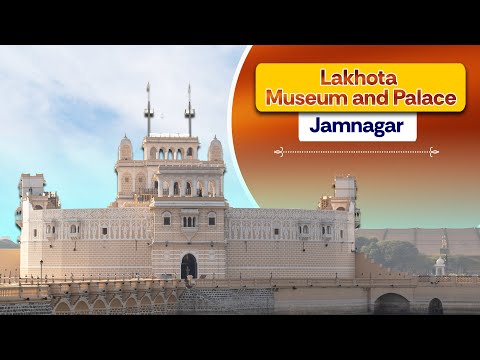
Lakhota Palace, standing dramatically within Ranmal Lake, is one of the defining images of Jamnagar. Summer is a surprisingly practical season for exploring this historic landmark because travelers can combine an indoor museum visit with a cooler evening walk around the lake.
Expect daytime conditions commonly around 33–41°C during the hotter part of summer, although actual temperatures vary by month and weather system.
Aim for the morning or later afternoon, allowing roughly two to three hours for the museum area, architecture and surrounding lake.
The attraction here is more than a photograph. Lakhota connects visitors with Jamnagar’s former princely identity, while its museum provides historical and archaeological context that makes the rest of an old-city journey more meaningful.
Photography improves toward evening. Warm light on the structure and reflections across the water can transform an otherwise harsh summer day into a memorable scene.
A modest local outing can cost roughly ₹100–₹700 per person, depending on transport, refreshments and applicable entry charges. Travelers staying overnight will find everything from budget hotels to more comfortable business properties within Jamnagar city.
For food, keep lunch relatively light during extreme heat. Gujarati snacks, simple thalis, buttermilk and properly prepared local meals work better than overeating before afternoon sightseeing.
Autos, taxis and private vehicles make access straightforward.
Families, students, couples, solo travelers and senior citizens can all enjoy the site, although seniors and young children should avoid prolonged exposure to midday sun.
Carry water, sunglasses, sunscreen, a breathable hat and light cotton clothing. Never leave children or elderly passengers waiting inside parked vehicles.
For couples and spouses, the surrounding lake becomes more romantic after sunset than during the afternoon. Families can also enjoy an easy evening outing here without committing to a long road journey.
🙏 Bala Hanuman Temple – Spiritual Jamnagar After Sunset

Beside Ranmal Lake stands one of Jamnagar’s most recognizable devotional landmarks, Bala Hanuman Temple.
The temple is famous for the continuous chanting of the Ram Dhun—“Sri Ram, Jai Ram, Jai Jai Ram”—a tradition for which the temple has received international recognition.
Summer suits this attraction because a meaningful visit does not require hours beneath the open sun.
Temperatures outside may remain high during the day, but early morning and evening visits are considerably more comfortable. Allow approximately one hour for darshan and additional time if combining the temple with Ranmal Lake.
What makes the experience memorable is the atmosphere. The rhythm of chanting, bells, devotees and the lakeside setting creates a completely different mood from Jamnagar’s markets and traffic.
Budget travelers can visit very economically. ₹50–₹400 per person is generally sufficient for local transport, refreshments and incidental expenses, excluding accommodation.
The temple is particularly suitable for families, senior citizens, children, solo pilgrims and multigenerational groups. Couples interested in cultural rather than conventional romantic tourism can combine the visit with a lakeside evening.
Students exploring Gujarat’s living religious traditions may also find it valuable.
Dress modestly, follow temple rules and avoid intrusive photography during worship.
Summer packing is simple: water, breathable clothing and easy-to-remove footwear. Evening mosquito protection can also be useful near water.
Nearby city restaurants make dinner easy afterward. This combination—temple, lake and Gujarati dinner—is one of the most practical safe evening sightseeing plans in central Jamnagar, though normal urban precautions should still be followed.
🛕 BAPS Swaminarayan Mandir – Architecture, Peace and an Easy Family Visit

Travel does not always need adventure to be rewarding. On a hot Jamnagar afternoon turning into evening, a peaceful temple visit can be exactly what a family needs.
The BAPS Swaminarayan Mandir offers a combination of religious devotion, architecture and an orderly environment.
Summer temperatures outside can remain around the mid-30s to low-40s °C during hotter spells, so plan the visit toward late afternoon or evening rather than noon.
Allow approximately one to two hours.
Families with children, senior citizens and travelers who prefer less physically demanding attractions will find this considerably easier than long outdoor excursions.
The principal activities are darshan, observing the architecture, quiet contemplation and respectful photography where permitted.
A local visit can remain within roughly ₹100–₹500 per person, excluding hotel costs.
Jamnagar city provides plenty of accommodation choices, and local taxis, autos and private cars make the temple accessible without complicated planning.
For couples and spouses, this is not a conventional romantic destination, but it can be part of a calm cultural evening followed by dinner.
Corporate visitors with a few spare hours, students studying religion or architecture, and solo travelers looking for a peaceful break can also include it.
Wear modest clothing and check current temple timings and photography regulations. Carry drinking water for the journey but respect restrictions concerning food or beverages inside religious areas.
🧵 Bandhani Markets and Old Jamnagar Shopping Streets – A Colourful Summer Evening

If the afternoon sun makes outdoor sightseeing exhausting, use summer evenings to discover another side of Jamnagar: Bandhani and traditional shopping.
Jamnagar has long been associated with Bandhani, the intricate tie-dye textile tradition deeply connected with Gujarat’s clothing culture.
Rather than treating shopping as a ten-minute souvenir stop, spend two or three hours understanding patterns, fabrics, workmanship and price differences.
The best summer window is generally late afternoon into evening, when temperatures begin to fall and markets become livelier.
Budget anywhere from ₹300 for snacks and small purchases to several thousand rupees for higher-quality garments or handcrafted products.
This experience works particularly well for families, couples, spouses, Gen Z travelers, international visitors and solo travelers comfortable exploring urban markets.
Students interested in textiles, traditional crafts or small-business ecosystems gain another perspective here.
Street photography can be rewarding, but always ask before taking close portraits of shopkeepers or craftspeople.
Summer precautions remain important. Markets can feel hot and crowded. Carry water, keep valuables secure and choose hygienic food outlets.
For food lovers, this is an excellent opportunity to combine shopping with Jamnagar’s local snacks.
A shopping-and-food evening also makes a practical alternative when extreme summer temperatures force you to cancel an outdoor day trip.
🍽️ Jamnagar Gujarati and Kathiawadi Food Trail – Travel Through Taste

Sometimes the best summer destination is a dining table.
Jamnagar’s food scene allows travelers to explore Gujarat without spending hours in direct sunlight. Local farsan, gathiya, fafda, chutneys, Gujarati meals and robust Kathiawadi flavors can become a journey of their own.
Plan a food trail around breakfast and evening, rather than eating heavily during the hottest afternoon hours.
Allow three to four hours spread across several stops rather than ordering everything at one restaurant.
A practical food budget is approximately ₹300–₹1,200 per person, depending on whether you choose street snacks, casual dining or more comfortable restaurants.
This experience suits nearly everyone: solo travelers, couples, friends, families, students and corporate groups.
Children can participate easily if spice levels are controlled, while senior citizens may prefer established restaurants with comfortable seating.
For photography, focus on food preparation, colourful plates and wider market scenes rather than blocking working vendors for staged photographs.
Food safety matters more than social-media popularity. Choose busy establishments with visible turnover, drink safe water and avoid food that has remained exposed to extreme heat for long periods.
A food trail is also among the easiest evening experiences for travelers who have only one night in Jamnagar.
🌧️ Monsoon in Jamnagar District – Clouds, Reflections and Cultural Journeys
The southwest monsoon generally influences Jamnagar from June/July into September, although rainfall varies substantially from year to year.
Temperatures are often around the mid-20s to low-30s °C, but high humidity can make conditions feel warmer.
Monsoon travel requires flexibility. A bright morning can turn wet quickly, roads may develop standing water, and coastal conditions can change.
Instead of forcing a rigid itinerary, use the rain to experience Jamnagar more slowly.
🌅 Ranmal Lake – Jamnagar’s Monsoon Mood

Ranmal Lake takes on a different personality beneath monsoon clouds.
The hard summer glare disappears. Reflections become deeper, the sky turns dramatic and the historic structures around the water gain an atmospheric backdrop.
Temperatures are generally more moderate than peak summer, often roughly 26–33°C, although humidity remains high.
Visit during a dry morning window or late afternoon, and allow one to two hours.
Walking, people-watching, casual photography and enjoying the city atmosphere are the main pleasures.
A simple visit can cost ₹50–₹400 per person, depending on transport and food.
Because the lake lies within the city, accommodation and restaurants are easy to find. Autos, taxis and private vehicles provide straightforward access.
This is particularly good for couples, families, solo travelers and photographers. Senior citizens can enjoy it when surfaces are dry, while families with children should avoid slippery edges after rain.
Carry a compact umbrella, light rain jacket, water-resistant footwear and protection for your phone or camera.
Do not approach flooded or slippery lake edges for photographs.
When conditions are comfortable, an early-evening walk followed by dinner creates a relaxed monsoon outing for couples and spouses.
🏛️ Darbargadh and Jamnagar’s Old-City Heritage

Rain makes old buildings look different.
Colours deepen, stonework becomes more pronounced and the streets surrounding Jamnagar’s historic royal precinct acquire an atmosphere that bright summer light often hides.
Darbargadh represents an important chapter in the city’s princely history and works well as part of a broader old-city heritage walk.
Monsoon temperatures generally remain in the mid-20s to low-30s °C. Choose a relatively dry morning and keep two to three hours available.
Nearby heritage structures, gates, market streets and traditional architecture can be woven into the same route.
A self-guided experience can cost under ₹500 per person, while taxis or a knowledgeable local guide increase the budget.
Solo travelers, couples, history enthusiasts, photographers and students are particularly well suited to this outing.
Families can participate, but a long walking route immediately after heavy rain may be tiring for children and seniors.
Pack waterproof footwear with good grip, an umbrella and a small waterproof pouch for electronics.
Photography becomes especially interesting when rain clouds create soft light over old façades.
Respect private property and do not enter unsafe or restricted heritage structures simply to obtain a photograph.
🚪 Khambhalia Gate and Historic Street Circuit

Khambhalia Gate provides a compact way to experience Jamnagar’s historic urban character during the monsoon.
Rather than treating the gate as a stand-alone destination, use it as an anchor for exploring nearby streets and architecture.
The best time is a rain-free morning or late afternoon. Two hours is usually enough for a relaxed circuit.
Temperatures may hover around 27–33°C, with humidity often being more noticeable than heat itself.
Costs are minimal—approximately ₹100–₹600 per person for transport, refreshments and optional local guidance.
This experience is particularly suitable for students, photographers, solo travelers, couples and friends. Corporate groups interested in local heritage can arrange a short guided walk rather than a conventional entertainment outing.
The monsoon creates excellent opportunities for street photography: wet roads, textured walls, cloudy skies and market life.
However, busy traffic and slippery streets require attention. Do not stand in roadways for photographs, and avoid walking through water when its depth or surface is unclear.
Comfortable waterproof shoes are far more useful here than fashionable footwear.
Finish with tea and Gujarati snacks, and an ordinary heritage walk suddenly feels like a small monsoon adventure.
🔱 Jamnagar’s Shiva Temple Circuit – Devotional Monsoon Travel

Jamnagar has long-standing associations with Shiva temples, contributing to its religious identity.
A monsoon temple circuit can include established shrines such as Kashi Vishwanath Mahadev, Nagnath Mahadev and other important local Shiva temples, subject to current opening schedules.
Rain makes this kind of travel practical because individual visits are relatively short and can be connected by vehicle.
Allow half a day for an unhurried circuit.
A reasonable local budget is approximately ₹300–₹1,200 per person, depending largely on private transport and meals.
This is particularly suitable for senior citizens, families, solo pilgrims and devotional groups. Students interested in religious geography and living traditions can also gain more from these places than from merely photographing architecture.
Couples and spouses seeking a spiritual journey can combine the circuit with a vegetarian lunch and lakeside evening.
Wear modest clothing and footwear that can be removed easily. Carry an umbrella, but avoid bringing dripping rain gear into crowded worship spaces where it may inconvenience others.
During festivals or important religious dates, expect larger crowds.
☪️ Jamnagar Multi-Faith Heritage Trail

One of Jamnagar’s less discussed travel experiences is its diverse religious landscape.
Historic mosques, Jain religious sites, Sikh places of worship and other community landmarks demonstrate that the city’s story cannot be told through royal buildings alone.
Monsoon suits this type of cultural exploration because travel occurs in short stages rather than prolonged exposure outdoors.
Plan three to five hours and use a taxi or auto if rain is persistent.
Costs can remain around ₹300–₹1,000 per person, excluding meals.
The experience is best for culturally curious solo travelers, students, mature couples, heritage groups and responsible photographers.
It requires greater etiquette than ordinary sightseeing. Places of worship are living religious spaces, not sets for travel photography. Dress appropriately, ask before photographing interiors or people and respect areas where visitors are not permitted.
For international visitors and students, a locally knowledgeable guide can make the experience significantly richer by explaining community history rather than relying on assumptions.
❄️ Winter in Jamnagar District – The Prime Season for Wildlife and Outdoor Exploration
For most first-time visitors, winter is the strongest overall season for Jamnagar District.
From roughly October/November through February, mornings can feel pleasantly cool and afternoons are generally comfortable enough for longer outdoor trips.
This is when Jamnagar’s greatest natural assets become especially rewarding.
🦩 Khijadiya Bird Sanctuary – Jamnagar’s Essential Winter Wildlife Experience

If I had to choose one nature destination that explains why winter matters in Jamnagar, it would be Khijadiya Bird Sanctuary.
The sanctuary is internationally recognized as a Ramsar wetland and is remarkable because freshwater and saline ecosystems occur close together, creating varied habitat for resident and migratory birds.
Winter mornings can be pleasantly cool, with temperatures often broadly within the low-teens to upper-20s °C range depending on the month and weather.
Arrive around sunrise and allow three to five hours.
Birdwatching is the obvious activity, but Khijadiya is equally valuable for nature photography, environmental education and slow travel.
Binoculars completely change the experience. A telephoto lens is useful for photographers, while students can treat the sanctuary as an outdoor lesson in wetland ecology.
A realistic local budget is around ₹300–₹1,500 per person, depending on transport, applicable entry charges and guiding.
Stay in Jamnagar city and make Khijadiya an early-morning excursion.
Families with nature-loving children, solo travelers, friends, senior citizens capable of moderate walking, students and corporate eco-groups can all enjoy it.
Couples looking for something more meaningful than a café date may find a quiet winter morning here surprisingly memorable.
Wear muted clothing, comfortable shoes and layers for the early morning. Carry water and binoculars but avoid loud music, feeding wildlife or chasing birds for photographs.
🪸 Narara Marine Area – Walk Into Jamnagar’s Intertidal World

Narara offers one of the most unusual outdoor experiences associated with the Gulf of Kutch.
At suitable low tide, the retreating water can reveal portions of the intertidal ecosystem, allowing visitors to appreciate marine life and coastal ecology from an entirely different perspective.
Winter provides more comfortable conditions for this exposed environment, often with temperatures roughly around 15–29°C, depending on the month and time of day.
But here the clock matters less than the tide.
A successful trip must be planned around appropriate tidal conditions and current access rules. Allow four to six hours including travel.
The experience suits students, wildlife enthusiasts, photographers, adventurous couples, friends and families with older children.
Budget approximately ₹500–₹2,500 per person, depending on transport, guidance and applicable fees.
Stay in Jamnagar and travel by private vehicle or arranged taxi.
Wear footwear appropriate to current local guidance, sun protection and clothing that can tolerate splashes and mud.
Never collect shells, corals or marine organisms. Avoid touching wildlife merely for photographs.
The experience is educational rather than thrill-based, but for travelers accustomed to ordinary beaches it can feel genuinely adventurous.
🌊 Marine National Park, Gulf of Kutch – Jamnagar’s Extraordinary Natural Identity

The Marine National Park in the Gulf of Kutch is central to Jamnagar’s environmental importance and is recognized as India’s first Marine National Park.
Its wider ecosystem includes reefs, mangroves, tidal flats, creeks, islands and marine wildlife.
Winter is generally the most practical season for considering marine-oriented exploration because temperatures are comfortable and official Jamnagar tourism information identifies October to March as the fair visiting period for the Marine National Park–Pirotan experience.
However, this is not a destination where travelers should simply arrive and expect a boat to be waiting.
Permissions, tides, weather, boat arrangements and protected-area regulations can determine what is actually accessible.
Depending on the authorized activity, keep half a day or a full day available.
Costs can vary enormously. A group marine excursion involving boats and permissions can run substantially higher than ordinary sightseeing, potentially from ₹1,500 to several thousand rupees per person.
The experience is best suited to wildlife travelers, students, photographers, friends and organized educational or corporate environmental groups.
Families should research the exact excursion before bringing very young children or mobility-limited seniors.
Carry sun protection even in winter. Water reflection can intensify exposure. Pack drinking water, a hat, binoculars and waterproof protection for cameras.
Responsible tourism is non-negotiable here. Marine organisms should be observed, not handled or removed.
🏝️ Pirotan Island – A Journey That Must Be Planned, Not Assumed

Pirotan Island is among the names that create the most curiosity around Jamnagar’s marine landscape.
The island lies within the protected Gulf of Kutch environment and is associated with mangroves, birdlife and intertidal biodiversity.
Winter is the logical season to investigate a visit, but travelers need to understand a crucial distinction: knowing that Pirotan exists does not mean unrestricted tourist access is available on your chosen date.
Permissions, boat availability, tides, protected-area rules and current administrative conditions can affect access.
If a legitimate trip is possible, reserve a full day.
A realistic excursion may cost roughly ₹2,000–₹6,000+ per person, depending heavily on group size, boat arrangements and permissions. Treat this only as a planning estimate rather than a published tariff.
The destination is most suitable for serious nature travelers, photographers, students, small groups and adventurous couples comfortable with a longer outing.
It is less appropriate as a spontaneous trip with toddlers or mobility-limited seniors.
Bring sun protection, sufficient water, basic food where permitted, binoculars and waterproof bags.
Never rely solely on an old blog or social-media post for access information. Verify current arrangements locally and through the relevant authorities.
🏖️ Balachadi Coast – A Relaxed Winter Picnic and Sunset Drive

After several wildlife-heavy days, Balachadi offers something simpler: open coastal scenery and room to slow down.
Winter temperatures are generally comfortable enough for a late-afternoon coastal outing, and sunset is the natural highlight.
Allow three to five hours including travel from Jamnagar.
A private vehicle is the easiest option, particularly for families and groups carrying picnic supplies.
The outing can cost approximately ₹300–₹1,500 per person, depending on transport and food.
Couples, spouses and friends can turn the drive into a relaxed weekend escape. Families can enjoy a picnic, while photographers should stay until the changing evening light begins to soften the coast.
Children require close supervision near water.
Do not interpret the presence of a beach as proof that swimming is safe. Currents, tides, water depth and the absence of lifeguards can make an unfamiliar coastline unsuitable for swimming.
Carry drinking water, snacks, sun protection and a light winter layer for the return journey.
Avoid isolated sections after dark. A sunset visit followed by departure toward the city is more sensible than treating an unfamiliar coastline as a late-night hangout.
🌾 Rural Jamnagar and Agricultural Countryside – A Different Kind of Winter Journey

Not every worthwhile Jamnagar experience has a ticket counter.
Winter is an excellent time to observe the district’s rural landscape because the cooler weather makes countryside drives and properly arranged agricultural visits far more comfortable.
This should be approached as responsible rural tourism, not as permission to enter farms or photograph villagers without consent.
Arrange a visit through a legitimate local host, agricultural contact or organized rural-tourism provider where available.
Temperatures can range from cool mornings to pleasantly warm afternoons. Allow half a day.
Activities might include understanding local crops, observing village landscapes, learning about water management and sharing a traditional meal when genuinely hosted.
Budget approximately ₹500–₹2,500 per person, depending on transport, hosting and food arrangements.
This experience suits families with older children, students, solo cultural travelers, friends and corporate educational groups particularly well.
Photographers should ask before photographing people, homes, livestock or private property.
Carry comfortable walking shoes, water, sun protection and a light jacket.
The greatest value here is not a famous landmark. It is the opportunity to understand the landscape beyond Jamnagar city and see how ordinary life connects with the wider geography of Saurashtra.
🧭 Which Season Should You Choose for Jamnagar?
| Travel Goal | Recommended Season | Best Experience |
|---|---|---|
| 🦩 Birdwatching | Winter | Khijadiya Bird Sanctuary |
| 🪸 Marine ecology | Winter | Narara and permitted Marine National Park experiences |
| 🏛️ Heritage | Winter / Monsoon | Lakhota and old-city circuit |
| 💑 Couple trip | Winter | Lake sunsets, coast, heritage and food |
| 👨👩👧 Family vacation | Winter | Wildlife + heritage + temples |
| 👴 Senior-citizen trip | Winter | Comfortable city sightseeing and temples |
| 🎓 Educational tour | Winter | Wetlands, marine ecology, museum and heritage |
| 🧑💼 Corporate outing | Winter | Eco-tourism and heritage circuits |
| 📷 Photography | Winter / Monsoon | Birds, lake reflections, coast and architecture |
| 💰 Lower-cost city break | Summer / Monsoon | Heritage, temples, markets and food |
| 🍽️ Food trip | Any season | Jamnagar and Kathiawadi food experiences |
| 🙏 Devotional journey | Any season | Major temples and religious heritage |
| 🌅 Safe evening plan | Winter / Summer | Central Lakhota–Ranmal Lake area |
| 🚗 Weekend getaway | Winter | Wildlife + heritage + coastal circuit |
🎒 Seasonal Packing Guide for Jamnagar District
| Season | What to Pack |
|---|---|
| ☀️ Summer | Cotton clothing, reusable water bottle, ORS, sunscreen, hat, sunglasses, comfortable footwear |
| 🌧️ Monsoon | Quick-dry clothes, umbrella, rain jacket, waterproof shoes, camera protection, mosquito repellent |
| ❄️ Winter | Light jacket, layered clothing, walking shoes, binoculars, sunscreen, hat |
| 🪸 Marine Trip | Sun protection, water, waterproof bag, appropriate footwear, binoculars, permitted essentials |
| 🦩 Birdwatching | Muted clothing, binoculars, telephoto lens, water, notebook, light winter layer |
🌟 Final Seasonal Recommendation
For a first journey, plan Jamnagar District between November and February if possible. This period provides the strongest combination of comfortable sightseeing weather, migratory bird activity, outdoor photography and opportunities to explore the district’s coastal and marine character.
Allow three to five days if you want more than a hurried city tour. Keep one day flexible when planning nature excursions because tides, weather and permissions can change coastal itineraries.
Summer travelers should build their day around sunrise and evening. Monsoon visitors should maintain a flexible schedule and avoid forcing coastal excursions during poor weather. Winter visitors should reserve their earliest mornings for wildlife.
Most importantly, do not judge Jamnagar by temperature alone.
The best time to visit Jamnagar District depends on what you have come to experience. If you want birds and marine landscapes, choose winter. If you enjoy rain-washed architecture and slower city travel, monsoon has its own charm. If budget, food, temples and quiet urban sightseeing matter more than outdoor exploration, even summer can produce a rewarding journey when planned intelligently.
Jamnagar becomes memorable when you travel according to its seasons rather than fighting them.
🍽️ Best Dhabas, Restaurants, Food Streets & Dining in Jamnagar District
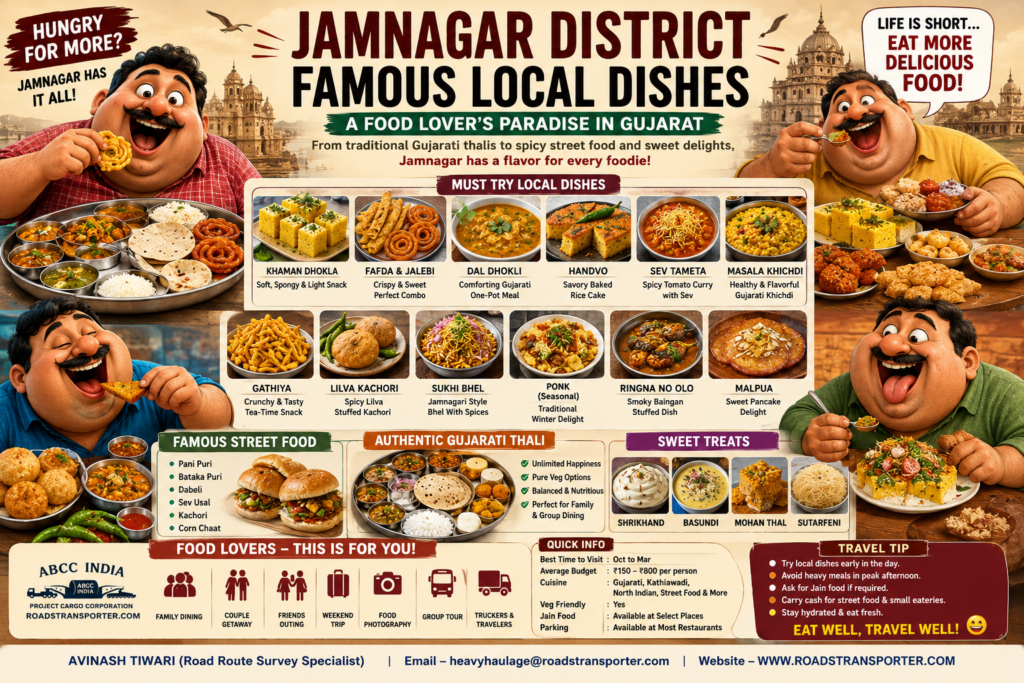
Jamnagar’s strongest food identity is Gujarati and Kathiawadi, supported by farsan, traditional sweets, vegetarian thalis, Punjabi food, South Indian dishes, cafés and increasingly diverse multi-cuisine restaurants. Jamnagar should not be described as having “Marathi local cuisine”—Marathi food may occasionally appear on individual menus, but Gujarati/Kathiawadi cuisine is the locally relevant regional food tradition.
Current restaurant listings also show genuine Jain preparations at some establishments and vegan-friendly choices at several larger restaurants, but a restaurant being vegetarian does not automatically mean every dish is Jain or vegan. Travelers with strict dietary requirements should confirm ingredients, separate preparation and availability directly before ordering.
Rating note: ratings below reflect current online/local listing data found during this 2026 check and can change. Phone numbers are intentionally privacy-masked according to your publishing format.

| Name | Category | Address | Nearby Highway / Location | Famous Dishes / Best For | Meal Type | Cuisine | Veg / Non-Veg / Jain / Vegan | Approx Budget | Family Friendly | Parking | Contact Number | Google/Listing Rating* | Why Visit | Travel Tip |
|---|---|---|---|---|---|---|---|---|---|---|---|---|---|---|
| Hotel Aram, Jamnagar | Heritage hotel restaurant | Nand Niwas, Pandit Nehru Marg, Jamnagar | Central Jamnagar | Indian meals, North Indian, business dining | Breakfast, Lunch, Dinner | Indian, North Indian | Veg; ask for Jain/Vegan | ₹400–1,200 | Yes | Verify onsite | 9…..2 | 4.4 | Established city dining option suitable for travelers, families and business guests | Good choice when comfort and central location matter |
| Spicy Bite Multi-cuisine Restaurant | Luxury multi-cuisine | Vinayak Plaza, Digjam Circle, Aerodrome Road | Airport Road / Digjam Circle | Indian, Chinese, Italian, Mexican; live-kitchen-style dining | Lunch, Dinner | Indian, Asian, Chinese, Italian, Mexican | Veg + Non-Veg; vegan-friendly options reported | ₹800–1,800+ | Yes | Verify | 9…..4 | 4.9 | Suitable for special occasions, corporate dinners and groups | Reserve ahead for larger groups |
| The Saffron | Premium restaurant | Digjam Circle, Airport Road | Airport corridor | Indian and international dishes | Lunch, Dinner | Indian, Asian, International | Veg + other options; ask about Jain/Vegan | ₹600–1,500 | Yes | Verify | 9…..7 | 4.6 | Popular with families, groups and business diners | Useful dining stop before/after airport-side travel |
| Prasadam Restaurant & Banquet, Jamnagar | Pure vegetarian / Gujarati dining | The Sky Imperial Hotel Kailash, near Samarpan Hospital, Ajanta Society | City area | Gujarati meals, Punjabi-style dishes, vegetarian dining | Breakfast, Lunch, Dinner | Gujarati, North Indian | Vegetarian; confirm Jain/Vegan | ₹200–600 | Yes | Verify | 8…..9 | 4.2 | Strong choice for vegetarian families and group meals | Ask specifically about thali availability before arriving |
| Brahmaniya Dining Hall | Gujarati dining hall | Badri Complex, Teen Batti Road, opposite Anupam Cinema | Teen Batti | Gujarati home-style dining / thali-style meals | Lunch, Dinner | Gujarati | Primarily vegetarian; confirm Jain | ₹100–300 | Yes | Limited/street; verify | 9…..0 | 4.1 | Budget-friendly local Gujarati meal with a large review base | Arrive near opening time during lunch rush |
| Ras Ghar Simply Delicious | Gujarati & modern Indian | Ranjit Sagar Road, Green City | Ranjit Sagar Road | Gujarati, Kathiawadi, North Indian, mixed vegetarian meals | Lunch, Dinner | Gujarati, Kathiawadi, Modern Indian | Primarily veg-oriented; confirm Jain/Vegan | ₹200–500 | Yes | Verify | Not listed | 4.4 | Useful for travelers wanting regional flavors with a broader menu | Ask what Gujarati/Kathiawadi specialties are available that day |
| Rajwadu The Village Hotel | Highway / village-theme dining | Dwarka Highway, opposite Airport | Jamnagar–Dwarka corridor | Punjabi meals, family dining, village-style ambience | Breakfast/Lunch/Dinner; listed 24×7 | Punjabi, Indian | Vegetarian listing; confirm Jain/Vegan | ₹300–800 | Yes | Onsite expected; verify | Not listed | 4.2 | Convenient for families, highway travelers and larger groups | Useful stop when traveling toward Dwarka; confirm current 24-hour kitchen service |
| Highway 10 Food Court Jamnagar Family Hangout Destination | Highway food court | SH-25, Lalpur–Rajkot Bypass, Khimliya | SH-25 / Rajkot Bypass | Multiple food options, snacks, group dining | Lunch, Dinner, Evening | Multi-cuisine / Indian | Depends on individual counter | ₹200–600 | Yes | Better highway-style parking; verify | 7…..8 | 4.3 | One-stop food option for road trips, families and groups | Particularly practical when different group members want different foods |
| Kano Maldhari Hotel&Restaurant | Highway restaurant / dhaba-style stop | Jamnagar–Rajkot Highway, Hapa Industrial Area | Jamnagar–Rajkot Highway | Low-cost Indian and North Indian food | Lunch, Dinner | Indian, North Indian | Veg options; verify Jain/Vegan | ₹100–300 | Generally | Highway-side; verify truck space | 9…..2 | 4.1 | Practical budget stop for highway travelers and commercial-route users | Truckers should confirm heavy-vehicle parking before entering |
| Dhaba – E – Jamnagari | Dhaba / casual Indian restaurant | Theba Cross Road, near JCR Entertainment World | Outer Jamnagar road | Punjabi/North Indian-style casual meals | Lunch, Dinner, Late Evening | Indian | Veg options; verify other dietary requirements | ₹200–500 | Yes | Verify | 9…..8 | 4.0 | Relaxed dhaba-style option outside the densest city core | Useful for friends and driving groups; check late-night kitchen hours |
| Keshav Restaurant | Bypass restaurant | Dwarka Bypass Road, opposite Mega Mall, near Kansumra Patiya | Dwarka Bypass | Family meals, North Indian-style dining | Lunch, Dinner | Indian / Multi-cuisine | Ask restaurant | ₹200–500 | Yes | Verify | 9…..2 | 4.7 | Strong current rating and convenient bypass location | Good meal stop for travelers entering or leaving Jamnagar |
| Kitchen Age | Large multi-cuisine restaurant | Near Sanidhya Party Plot, Khambhalia Bypass, Gokul Nagar | Khambhalia Bypass | Group dining, Indian and fast-food choices | Lunch, Dinner, Late Evening | Multi-cuisine | Veg options; ask about Jain/Vegan | ₹200–600 | Yes | Verify | 6…..0 | 4.1 | Useful for families and groups on the bypass side | Its long operating window is convenient for road-trip schedules |
| The Bethak Restaurant & Parcel Point | 24×7 restaurant / parcel point | Ranjit Sagar Road, opposite Sangam Baug | Ranjit Sagar Road | Indian, snacks and parcel meals | Breakfast, Lunch, Dinner, Late Night | Multi-cuisine | Veg choices; confirm Jain/Vegan | ₹200–500 | Generally | Verify | 8…..4 | 4.3 | Current listing shows 24-hour operation, useful for late arrivals | Confirm actual kitchen/menu availability at unusual hours |
| King Of Spice Restaurant & Parcel Point | 24×7 Punjabi restaurant | Opp. Raju Bhai Dhosa, Mahavir Park | City / Amusement Park area | Punjabi vegetables, paneer, roti, rice | All-day / Late Night | Punjabi, North Indian, Chinese | Vegetarian menu with some Jain preparation listed | ₹200–500 | Generally | Verify | Not listed | 4.9 | One of the useful current late-night/24-hour food listings | Ask whether all menu sections operate overnight |
| Sankalp Restaurant | South Indian restaurant | Dhiraj Building, Patel Colony Corner, Pandit Nehru Marg | Patel Colony | Dosa, idli, South Indian meals | Lunch, Dinner | South Indian | Vegetarian; ask for Jain/Vegan preparation | ₹200–600 | Yes | Verify | 9…..9 | 4.3 | Reliable category choice for travelers wanting South Indian food | For breakfast, confirm opening time because current listing begins later in the morning |
| Mr and Mrs Idly | South Indian eatery | P.N. Marg, Shreeji Sanmukh | P.N. Marg | Idli, dosa and South Indian food | Breakfast/Lunch/Dinner depending on hours | South Indian | Vegetarian-focused; ask about Jain/Vegan | ₹150–400 | Yes | Verify | 9…..3 | 4.3 | Budget-friendly South Indian alternative praised by family travelers | Check current morning timings before planning breakfast |
| Dosa House | South Indian restaurant | Shiv Complex, Dhinchada Road, near Nayara Petrol Pump | Dhinchada Road | Dosa and South Indian meals | Lunch, Dinner | South Indian | Ask restaurant | ₹200–400 | Yes | Verify | 7…..5 | 4.5 | Good current rating for a focused South Indian meal | Evening service is useful after city sightseeing |
| Tavaa Restaurant | Non-vegetarian local restaurant | Opp. Hajipir Dargah, Khoja Gate | Khoja Gate | Non-veg Indian meals | Lunch, Dinner, Late Evening | Indian, Non-Veg | Non-Veg + some veg may be available; not Jain-specialist | ₹200–500 | Generally | Verify | 8…..1 | 4.2 | Popular high-volume option for travelers specifically seeking non-vegetarian food | Vegetarians with strict cross-contamination concerns should choose a dedicated veg restaurant |
| Varso – The Premium Restaurant | Premium family restaurant | Orbit Seven, Ranjit Sagar Road, Green City | Green City | Breakfast and multi-cuisine dining | Breakfast, Lunch, Dinner | Multi-cuisine | Ask about Jain/Vegan | ₹200–500 | Yes | Verify | 9…..8 | 4.5 | Early opening makes it one of the more practical restaurant options for travelers | Useful before a morning road journey |
| 360 The Rooftop Restaurant | Rooftop vegetarian dining | Nand Nivas, Pandit Nehru Marg | Central Jamnagar | Vegetarian dinner, rooftop experience | Dinner, Late Evening | Multi-cuisine Vegetarian | Veg; request Jain/Vegan | ₹300–800 | Yes | Hotel/nearby; verify | Not listed | 4.2 | Attractive evening option for couples, spouses and family dinners | Current listing is evening-focused and runs late |
| Jam Sham Rooftop Cafe | Rooftop café | Zaver Chambers, Pandit Nehru Marg, opposite NEO Square | Park Colony / P.N. Marg | Café snacks, beverages, evening hangout | Evening, Late Night | Café / Fast Food | Veg options; verify Vegan/Jain | ₹200–500 | Groups/couples | Verify | 9…..5 | 4.2 | One of the city’s later-opening café choices | Better for friends/couples than travelers seeking traditional Gujarati meals |
| Cafe Tea | Budget café | Radhekrishna Avenue, near G.G. Hospital | G.G. Hospital area | Tea, quick snacks, casual meals | Breakfast, Snacks, Evening | Café / Indian snacks | Veg options | ₹100–300 | Yes | Street/nearby; verify | 9…..0 | 4.2 | Affordable café with long daily hours | Convenient for hospital-side or central-city travelers |
| Kesar Fast Food | Fast-food restaurant | Monalisa Complex, Pandit Nehru Marg | Ambar Cinema Road | Fast food and quick snacks | Lunch, Evening Snacks, Dinner | Fast Food | Veg-focused; verify Jain | ₹200–400 | Yes | Verify | 7…..0 | 4.2 | Useful when a group wants quick casual food rather than a full thali | Best treated as a snack/quick-meal stop |
| Jain Vijay Farsan Mart | Farsan & sweets | Oshwal Colony, Summair Club Road | Oshwal Colony | Farsan, Gujarati snacks, sweets | Breakfast, Snacks | Gujarati Farsan / Sweets | Vegetarian; ask which products meet strict Jain rules | ₹100–400 | Yes | Street/nearby; verify | 9…..6 | 4.5 | Extremely popular local snack shop with a large review base | Ask about freshness and same-day specialties |
| Shikhand samrat Mithaiwala (Indraprasthwala (since 1955) | Traditional sweets | Indraprasth Complex, Pancheshwar Tower | Pancheshwar Tower | Shrikhand and sweets | Dessert / Snacks | Gujarati sweets | Vegetarian; vegan usually limited | ₹100–500 | Yes | Limited city parking | 9…..1 | 4.8 | Strong choice for traditional sweets in the old-city area | Buy dairy sweets near the end of sightseeing if traveling in hot weather |
| Atul Bakery | Jamnagar | Bakery / cake shop | Shakti Krupa, Pancheshwar Tower Chowk | Pancheshwar Tower | Cakes, bakery products, quick snacks | Snacks, Dessert | Bakery | Vegetarian items available; ask about eggless/Vegan | ₹100–400 | Yes | Limited city parking | 9…..2 | 4.7 | Easy bakery stop during old-city shopping | Confirm eggless status item-by-item rather than assuming |
| Special’s Restro & Cafe | Modern family restaurant & café | Airport Road, near Padam Party Plot | Airport Road | North Indian, café dining and group meals | Lunch, Dinner, Late Evening | North Indian / Multi-cuisine | Ask about Jain/Vegan | ₹300–700 | Yes | Verify | Not listed | 4.6 | High review count and useful location for airport-side dining | Suitable for corporate dinners and family groups |
Restaurant ratings, hours, menus and operational status can change without notice. Current directory results range from traditional low-cost Gujarati dining to premium restaurants and 24-hour establishments.
🥗 Jain, Vegan, Upvas and Healthy Food in Jamnagar

For Jain food in Jamnagar, one of the clearest verified options I found is Shree Maruti Restaurant, whose current menu explicitly lists numerous Jain preparations including Jain paneer dishes, vegetables, dal and other mains. This is stronger evidence than simply labeling an ordinary vegetarian restaurant “Jain.”
Fire Food Fiesta and Giriraj Fast Food also currently list selected Jain sandwiches, pizza or snack preparations.
For vegan travelers, Jamnagar has vegan-friendly menu possibilities rather than a large clearly verified network of dedicated vegan-only restaurants. Current traveler listings identify establishments including Spicy Bite, The Saffron and Hotel Aram among vegan-friendly options. Always ask about ghee, butter, milk, paneer and cream because otherwise vegetarian Gujarati or Punjabi food may still contain dairy.
For Upvas or fasting food, I would not publish a permanent claim that a specific Jamnagar restaurant serves a full fasting menu every day unless the restaurant itself confirms it. Sabudana, potato-based fasting foods, fruit, dairy and vrat dishes may appear particularly around religious festivals, but menus can be seasonal. Call ahead and ask specifically for “farali/upvas food.”
🥘 Gujarati, Kathiawadi and Rajasthani Food to Look For

| Food Type | What Travelers Should Look For | Best Meal |
|---|---|---|
| Gujarati Thali | Dal, kadhi, vegetables, rotli, rice/khichdi, farsan, pickle, buttermilk, sweet depending on restaurant | Lunch |
| Kathiawadi Meal | Bajra rotla, ringna no olo, sev tameta, lasaniya bataka, khichdi-kadhi | Lunch / Dinner |
| Fafda–Jalebi | Crispy fafda with jalebi and accompaniments | Breakfast |
| Gathiya | Fresh fried gram-flour snack | Breakfast / Evening |
| Khaman / Dhokla | Steamed gram-flour snacks | Breakfast / Snacks |
| Dal Baati | Rajasthan-associated wheat baati with dal | Lunch / Dinner where specifically offered |
| Jain Meal | No onion/root vegetables according to the diner’s observance | Lunch / Dinner |
| Farali / Upvas Food | Sabudana, potato, peanuts, dairy/fruit depending on fasting rules | Festival/fasting days |
| South Indian | Idli, dosa, uttapam, sambhar | Breakfast / Dinner |
| Punjabi | Paneer, dal, roti, kulcha and North Indian curries | Dinner |
Jamnagar’s documented street-food culture includes dal puri, khaman dhokla and fafda-jalebi, among other snacks.
🌮 Popular Food Streets and Roadside Food Hubs

| Food Area | Best For | Recommended Time | Budget | Parking | Travel Tip |
|---|---|---|---|---|---|
| Pancheshwar Tower area | Farsan, sweets, bakery items, fast food | Morning–evening | ₹100–500 | Limited | Explore on foot and combine with heritage sightseeing |
| Teen Batti / Central Jamnagar | Gujarati meals, snacks, local dining | Lunch–evening | ₹100–600 | Limited | Use an auto/taxi if city traffic is heavy |
| Pandit Nehru Marg | Restaurants, rooftop dining, cafés, South Indian | Evening–late night | ₹200–1,000 | Varies | Good choice for couples and family dinner outings |
| Patel Colony | South Indian, casual dining, cafés | Morning/evening | ₹150–600 | Varies | Useful for breakfast and lighter meals |
| Ranjit Sagar Road | Family restaurants, cafés and modern dining | Evening | ₹200–800 | Generally easier than old city; verify | Strong choice for families and groups |
| Airport Road / Digjam Circle | Premium restaurants and corporate dining | Lunch/dinner | ₹400–1,500+ | Usually easier; verify | Convenient for business travelers and airport transfers |
| Jamnagar–Rajkot Highway / Hapa | Highway restaurants and budget meal stops | Lunch/dinner | ₹100–600 | Better highway access | Truckers should confirm dedicated heavy-vehicle parking |
| Dwarka Highway / Airport belt | Family highway dining | All-day depending on restaurant | ₹200–800 | Generally road-trip friendly | Practical stop when traveling between Jamnagar and Dwarka |
| Lalpur–Rajkot Bypass / SH-25 | Food court and roadside meals | Afternoon–late night | ₹200–600 | Generally better | Useful for group road trips |
| Khambhalia / Dwarka Bypass | Family restaurants and outbound highway meals | Lunch/dinner | ₹200–600 | Generally easier | Refuel and eat before long onward journeys |

🚚 Highway Dhaba and Truck-Driver Dining Tip

Drivers traveling the Rajkot, Dwarka, Lalpur or Khambhalia corridors should distinguish between “roadside parking available” and legal/safe parking for a loaded heavy truck. Restaurant listings rarely confirm trailer length, turning radius, overnight parking security or ODC clearance. Call before entering a crowded compound with a multi-axle vehicle.
🦐 Seafood and Non-Vegetarian Food – Important Jamnagar Reality

Jamnagar District has a marine coastline and a fishing economy, but that does not mean every coastal tourism destination has a dependable tourist seafood restaurant. The strongest easily verifiable restaurant category in Jamnagar city remains vegetarian, Gujarati, Punjabi and multi-cuisine dining.
Non-vegetarian restaurants do exist—for example, current listings clearly categorize Tavaa Restaurant as non-vegetarian—but travelers specifically seeking fresh seafood should verify the day’s menu and source directly with the restaurant rather than relying on generic “coastal Gujarat means seafood everywhere” claims.
🏭 Industrial Evolution & Economic Landscape of Jamnagar District, Gujarat

Jamnagar is one of those rare Indian districts where a visitor can move between two dramatically different economic worlds in a single day. In the city, thousands of workshops manufacture tiny precision components that may eventually become part of an electrical system, automobile, plumbing installation or industrial machine somewhere across the world. Travel toward the industrial coast and the scale changes completely: giant energy complexes, pipelines, storage systems, marine terminals and export infrastructure dominate the landscape.
That contrast explains the economic importance of Jamnagar District.
The district administration identifies agriculture, animal husbandry, brass manufacturing, oil mills and oil refining among Jamnagar’s important industries. Groundnut, cotton, wheat, bajra and castor remain important crops, while bauxite and stone are listed among its mineral resources.
Yet modern Jamnagar is much more than an agricultural district with factories. It has evolved into a distinctive combination of MSME engineering cluster + petroleum and petrochemical centre + traditional craft economy + port-linked logistics ecosystem + emerging clean-energy manufacturing hub.
⚙️ From Craft Workshops to a Globally Connected Industrial District

Jamnagar’s industrial story did not begin with an oil refinery.
Long before large energy investments transformed the district’s skyline, local entrepreneurship, metalworking, trading and craft traditions were creating an industrial identity.
Brass became especially important.
Historical cluster studies describe an ecosystem built through specialization. One enterprise could cast material, another could machine it, another perform finishing or electroplating, while traders and exporters connected the finished component with customers elsewhere.
That decentralized structure became one of Jamnagar’s great advantages.
Government MSME documentation from the mid-2010s described a brass cluster roughly half a century old with about 3,550 units at that time, spanning micro, small and medium enterprises. Its products included automobile and cycle valves, battery terminals, hinges, handles, sockets, electrical components and industrial-control valves.
Bureau of Energy Efficiency material has likewise documented Jamnagar as one of India’s major brass clusters, with foundries, extrusion units, machining operations and electroplating businesses.
The important lesson is not the exact historical unit count—which varies considerably by source, year and definition—but the industrial model itself.
Jamnagar learned cluster manufacturing before “manufacturing ecosystem” became a fashionable business expression.
🔩 Why Jamnagar Became Famous for Brass Parts
A brass component can look insignificant in your hand.
But put millions of such components into electrical systems, plumbing products, automobiles, industrial machinery, sanitary fittings, hardware, electronics and engineering equipment, and suddenly a small metal part becomes part of a very large economy.
The Jamnagar cluster produces products ranging from building hardware and sanitary fittings to electrical accessories, valves and precision engineering components. Government energy-efficiency programmes continue to recognize the Jamnagar Brass Cluster as a distinct industrial ecosystem.
Modernization has gradually changed the factory floor.
CNC and VMC machining have helped export-oriented manufacturers improve tolerances and product consistency. Industry reporting in 2022 described more than 7,000 brass-parts manufacturing units in and around Jamnagar and noted expanding business with European, American and Australian markets. That report also highlighted the cluster’s dependence on imported brass scrap and exposure to volatile international raw-material prices.
Because estimates differ sharply across periods and industry definitions, a responsible economic guide should not claim one permanent number of Jamnagar brass factories or employees. The stronger conclusion is that this is a very large, deeply interconnected MSME manufacturing cluster with substantial domestic and export linkages.
🔧 Jamnagar Brass Manufacturing Value Chain
| Industrial Stage | Typical Activity | Business Opportunity |
|---|---|---|
| Scrap & Raw Material | Brass/copper scrap procurement, billets and ingots | Trading, warehousing, quality testing |
| Casting | Melting and casting | Energy-efficient furnaces, automation |
| Extrusion | Rods, bars, sections and profiles | Precision material production |
| Machining | Turning, drilling, threading, milling | CNC/VMC, tooling, automation |
| Finishing | Polishing and surface preparation | Automated finishing |
| Electroplating | Surface treatment | Cleaner technologies, effluent management |
| Quality Control | Dimensions, composition and tolerances | Testing labs, metrology |
| Packaging | Industrial/export packaging | Sustainable packaging |
| Domestic Distribution | Dealers, OEM supply | B2B distribution |
| Export | Overseas OEM and industrial buyers | Export compliance and logistics |
🥇 One District One Product – Brass Parts

Jamnagar’s brass identity is not merely a marketing slogan.
The Government of India’s One District One Product portal identifies Brass Parts for Jamnagar, describing the district’s metalworking tradition and the use of its precision components in fittings and industrial applications.
This creates useful opportunities beyond conventional manufacturing.
Entrepreneurs can explore precision machining, industrial design, testing, packaging, digital B2B marketing, export documentation, automation, recycled-metal traceability, energy-efficient furnaces and specialized logistics.
For younger entrepreneurs, the opportunity may not necessarily be opening another conventional brass workshop.
The smarter business could be solving a problem shared by thousands of existing workshops.
🧵 Jamnagari Bandhani – A GI-Protected Traditional Economy
Heavy industry should not be allowed to erase Jamnagar’s craft economy from its economic story.
Jamnagari Bandhani is a registered Geographical Indication.
The official GI Registry records Jamnagari Bandhani under handicrafts, with the Jamnagar Chamber of Commerce and Industry as the applicant. Its registration certificate dates to 2016, and the current registry record shows validity through September 2030.
Bandhani connects commerce with culture.
Behind a finished piece lies knowledge of tying, pattern creation, dyeing, colour combinations and finishing. Unlike petroleum refining or automated CNC production, its value comes partly from human skill and cultural identity.
That creates a different kind of investment opportunity: authenticated products, artisan branding, designer collaboration, e-commerce, premium packaging, craft tourism and direct-to-consumer exports.
🧵 Traditional and Modern Jamnagar Industries

| Sector | Economic Character | Future Potential |
|---|---|---|
| Brass components | Large MSME engineering cluster | Precision exports, automation |
| Bandhani | Traditional handicraft | Premium fashion, e-commerce, craft tourism |
| Agriculture | Groundnut, cotton, wheat, bajra, castor | Processing and value addition |
| Oil mills | Agriculture-linked processing | Branded food products |
| Animal husbandry | Rural livelihood | Dairy/feed/value chains |
| Refining | Large-scale industrial economy | O2C integration |
| Petrochemicals | Downstream manufacturing | Specialty materials |
| Logistics | Road, rail and marine movement | Warehousing and multimodal services |
| Renewable energy | Emerging mega-manufacturing | Solar, batteries, hydrogen, electronics |
🛢️ The Refinery Revolution That Changed Jamnagar
The biggest structural change in Jamnagar’s modern industrial history came with Reliance Industries.
Reliance’s original Jamnagar complex represented an investment of approximately ₹25,000 crore and was completed in less than 36 months. Company records from the period described a 27-million-tonne-per-year grassroots refinery integrated with petrochemicals, captive power and port infrastructure. (Reliance Industries Limited)
Expansion subsequently turned Jamnagar into one of the world’s most important refining locations.
Reliance currently describes Jamnagar as the world’s largest integrated single-site refinery complex, while company material has cited design crude-processing capacity of approximately 1.24 million barrels per day. (Reliance Industries Limited)
The significance extends well beyond refinery employment.
A project of this scale generates demand for:
- industrial construction and engineering;
- project cargo transportation;
- heavy lifting and cranes;
- pipelines and fabrication;
- electrical and instrumentation work;
- maintenance contractors;
- industrial gases;
- warehousing;
- safety equipment;
- hotels and employee accommodation;
- food and workforce services;
- road transport;
- marine logistics;
- technical training.
This is why a refinery changes an economic geography rather than simply occupying land within it.
⚠️ Vadinar Refinery Is Important to the Region—but It Is Not in Present-Day Jamnagar District
A geographical correction is essential for an authoritative Jamnagar business article.
Nayara Energy operates the major Vadinar refinery, but Vadinar is currently in Devbhumi Dwarka District, not Jamnagar District.
Nayara identifies Vadinar as India’s second-largest single-site refinery with 20 MMTPA capacity and marine, rail, road and pipeline dispatch infrastructure. (Nayara Energy)
It remains economically relevant to the wider Jamnagar–Dwarka industrial and logistics belt, particularly for suppliers and transporters, but attributing the refinery directly to present-day Jamnagar District would be geographically inaccurate.
This distinction matters for EEAT.
🌱 Jamnagar’s Next Industrial Revolution Is Green
Perhaps the most important change happening now is that Jamnagar is preparing for another industrial identity.
This time the keywords are not merely petroleum and petrochemicals.
They are solar PV, batteries, green hydrogen, fuel cells and power electronics.
Reliance is developing the Dhirubhai Ambani Green Energy Giga Complex across more than 5,000 acres in Jamnagar. Its planned manufacturing ecosystem covers photovoltaic products, energy storage, green hydrogen, fuel cells and power electronics.
By FY2025–26, Reliance reported that the project had moved from construction into commissioning, with solar PV cell and module lines operational and nearly 1 GW of HJT modules produced.
Reliance’s latest annual reporting describes a 5,000-acre complex with about 44 million square feet of manufacturing and operational built-up area and projects more than 200,000 green jobs from the platform. That employment figure is a company projection for the broader platform, not a current Jamnagar employment count, and should be presented accordingly.
This transition could be transformational for local suppliers.
⚡ Emerging Green-Economy Opportunities

| New-Energy Segment | Supporting Businesses Jamnagar Could Attract |
|---|---|
| Solar PV | Components, glass handling, packaging, testing, automation |
| Batteries | Material handling, controlled storage, recycling, safety |
| Green Hydrogen | Valves, fittings, instrumentation, pipelines |
| Electrolysers | Precision components, fabrication, electronics |
| Fuel Cells | Specialized engineering and testing |
| Power Electronics | Electrical components, cooling, enclosures |
| Wind | Engineering materials and component supply |
| Industrial Decarbonization | Energy audits, efficiency equipment, carbon management |
| Recycling | Metals, batteries and industrial material recovery |
| Green Logistics | EV fleets, alternative fuels, optimized freight |
One particularly interesting possibility is the connection between Jamnagar’s old industrial strength and its new one.
A city that already understands valves, fittings, machined components and precision engineering has skills that can potentially migrate into hydrogen, renewable-energy and advanced industrial supply chains.
🏗️ Industrial Estates, Manufacturing Clusters and SEZ Ecosystem
Gujarat uses GIDC—Gujarat Industrial Development Corporation, not Maharashtra’s MIDC system.
This distinction should be correct throughout the article.
GIDC estates provide industrial land and infrastructure and are designed to create cluster advantages involving raw materials, markets, common services and industrial linkages. GIDC specifically recognizes sector-focused estates including engineering and brass-related industries.
Jamnagar’s industrial geography includes the long-established Shankar Tekri and surrounding brass-manufacturing belt, other city/peripheral MSME areas, highway-oriented industrial activity and the large Reliance industrial ecosystem closer to the coast.
The district also contains the Reliance Jamnagar Special Economic Zone. India’s SEZ records identify it as a multi-product SEZ; the notified-SEZ list updated through June 2025 recorded approximately 1,377 hectares after additions and de-notifications reflected in the official record.
For investors, the practical lesson is to verify the latest plot availability, zoning, environmental category, utilities and allotment terms directly with GIDC or the relevant authority rather than relying on an old industrial-estate directory.
🚢 Ports, Highways and the Logistics Economy
Jamnagar’s location on the Gulf of Kutch gives its industrial economy an advantage that an inland engineering cluster cannot easily replicate.
The district’s industrial geography connects manufacturing with coastal infrastructure, including the broader Sikka–Bedi–Rozi maritime belt, while highways connect factories with Rajkot, Morbi, Kutch and the wider Gujarat industrial network.
For brass MSMEs, logistics operates at several scales.
Imported metal scrap may begin its journey overseas, enter through western Indian ports, move by container or truck to the manufacturing cluster, pass through casting and machining units and finally return to domestic or export markets as finished components.
At the refinery end of the economy, logistics becomes dramatically larger: crude, fuels, petrochemical feedstocks, project machinery, modules, pressure vessels and heavy engineering equipment require marine terminals, pipelines, road transport, rail connections and specialized project logistics.
🚚 Industries Supporting Jamnagar’s Supply Chain
| Service | Main Customers | Business Demand |
|---|---|---|
| FTL trucking | Manufacturers, distributors | High |
| LTL/part-load | MSMEs | High |
| Container transport | Exporters/importers | High |
| ODC/project cargo | Refinery, energy and engineering projects | Specialized |
| Warehousing | Brass, engineering, consumer goods | Growing |
| Customs/export services | Export manufacturers | Important |
| Packaging | Engineering exporters | High |
| Crane/Hydra/Forklift | Factories and project sites | Specialized |
| Employee transport | Large industries | Recurring |
| Cold chain | Food/agriculture | Opportunity |
| EV/green freight | Emerging industries | Future growth area |
👷 Employment – From Artisans to Engineers
Few districts demonstrate India’s employment spectrum as clearly as Jamnagar.
At one end is an artisan tying Bandhani by hand.
At another is a CNC operator working to precision tolerances.
Elsewhere are refinery engineers, electricians, safety professionals, welders, truck drivers, crane operators, logistics planners, warehouse workers, accountants, exporters, retailers and hospitality staff.
Historical estimates for brass employment differ substantially. A government cluster proposal from around a decade ago reported approximately 90,000 direct and 75,000 indirect jobs for the cluster at that time, while later industry reports have published higher figures.
These should not be presented as current official employment statistics.
What is well established is the cluster’s labor-intensive multiplier effect.
Small factories create jobs not only inside the workshop but across tooling, scrap trading, transport, packaging, maintenance, plating, inspection and commerce.
👩💼 Women in Jamnagar’s Economy
Women’s contribution is particularly visible in craft, textiles, retail, education, services, food businesses, family enterprises and self-help-group activity.
Bandhani is especially relevant because craft-based value chains can create home-based and flexible livelihood opportunities.
The GI Registry itself lists an authorized Jamnagar self-help group in connection with Jamnagari Bandhani. (Intellectual Property India)
For the future, women’s entrepreneurship has opportunities in fashion labels, artisan aggregation, e-commerce, food processing, tourism, professional services, digital marketing and manufacturing-support businesses.
🧑💼 Corporate Houses and Business Leadership

The most consequential corporate name in modern Jamnagar’s transformation is unquestionably Reliance Industries.
The industrial development of the Jamnagar complex is closely associated with the entrepreneurial legacy of Dhirubhai Ambani and the subsequent leadership of Mukesh Ambani.
The scale of refinery investment fundamentally altered Jamnagar’s industrial profile, while the current green-energy programme could trigger another generation of supplier, contractor and employment opportunities.
Reliance’s social-development activities are implemented through the wider Reliance Foundation platform, whose national programmes span health, education, rural transformation, women’s empowerment, sports, disaster response and culture. Reliance reports that the Foundation has reached more than 76 million people nationally since 2010; this should not be misrepresented as a Jamnagar-only figure.
Jamnagar’s second leadership story is less visible but equally instructive.
It is the story of thousands of family-owned MSMEs.
Many have evolved from conventional workshops toward CNC machining, precision manufacturing, ISO-oriented quality systems and direct export relationships. Industry reporting indicates that technological modernization helped Jamnagar suppliers expand toward demanding European and American customers.
That collective entrepreneurship may be one of Jamnagar’s most important business achievements.
🚀 Startups and the New Generation of Entrepreneurs

Jamnagar is not best understood as a Bengaluru-style venture-capital startup hub.
Its entrepreneurial strength is more industrial.
A new business here may begin as a CNC machining company, engineering exporter, industrial automation provider, logistics operation, solar-services business, packaging company or specialized B2B platform rather than a consumer app.
That distinction is important.
The next generation of Jamnagar entrepreneurship could emerge at the intersection of manufacturing + software + clean energy + exports.
Promising startup areas include factory IoT, machine monitoring, computer vision for quality inspection, predictive maintenance, industrial marketplaces, scrap traceability, energy optimization, CAD/CAM services, robotics integration and export-tech platforms.
🌍 Export Economy – Small Components, Global Destinations
Jamnagar’s brass cluster demonstrates how an MSME ecosystem can participate in international trade without every company becoming a giant corporation.
Industry reporting has documented exports to markets across Europe, America, Australia, Africa and Asia, while Jamnagar-made components serve automobile, electrical, hardware and other engineering applications.
The cluster’s competitive strengths include specialization, supplier density, machining capability and the ability to fulfill highly varied orders.
Its vulnerabilities are equally real:
raw-material price volatility, imported scrap dependence, energy costs, environmental compliance, quality consistency and international competition.
Energy efficiency is therefore not simply an environmental issue. The Bureau of Energy Efficiency has specifically targeted the Jamnagar brass cluster for energy-efficiency and renewable-energy interventions because processes such as melting and machining can be energy intensive.
🌾 Agriculture Still Matters
Jamnagar’s industrial transformation should not make travelers assume that the rural economy has disappeared.
Official district information lists groundnut, cotton, wheat, bajra and castor among important crops.
These support opportunities in oil extraction, cleaning and grading, warehousing, agricultural machinery, packaging, commodity transport and food processing.
Future growth does not have to mean converting every agricultural activity into heavy industry.
Value addition closer to the farm can generate rural income while reducing unnecessary movement of unprocessed products.
🛍️ Wholesale and Offline Purchasing in Jamnagar
Travelers interested in Jamnagar’s economy can learn as much from a market as from a factory.
| Buying Interest | Area/Market Type | What to Look For | Buyer Advice |
|---|---|---|---|
| Bandhani | Traditional textile markets / city bazaars | Sarees, dupattas, dress materials | Ask about origin and workmanship |
| Brass components | Industrial supplier/manufacturer areas | Fittings, hardware, engineering parts | B2B buyers should request specifications |
| Machinery & tools | Industrial markets | Cutting tools, workshop supplies | Compare after-sales support |
| Gujarati food products | Local markets | Farsan, spices, snacks | Check packing date |
| Agricultural goods | APMC/commodity ecosystem | Groundnut and other crops | Commercial buyers should verify grading |
| Traditional jewellery | Established city markets | Local designs | Request bill and purity details |
| General wholesale | Central commercial areas | Textiles and household goods | Compare multiple sellers |
Chandi Bazaar, the Pancheshwar/old-city commercial belt and other central markets are useful for travelers seeking the city’s retail character, while industrial buyers should deal directly with established manufacturers, authorized dealers or recognized B2B suppliers.
🏛️ Government Initiatives and Industrial Support
Jamnagar businesses operate within several overlapping policy ecosystems.
| Initiative | Relevance to Jamnagar |
|---|---|
| ODOP | Promotes Jamnagar brass parts |
| GI Protection | Protects Jamnagari Bandhani identity |
| GIDC | Industrial land and estate infrastructure |
| MSME Schemes | Credit, technology, cluster and market support |
| Cluster Development | Common infrastructure and competitiveness |
| BEE Energy Efficiency | Cleaner, more efficient brass manufacturing |
| SEZ Framework | Export-oriented industrial development |
| Make in India | Domestic manufacturing |
| Atmanirbhar Bharat | Localized industrial supply chains |
| Renewable Energy Policies | Solar, hydrogen, storage and clean manufacturing |
| Digital Commerce | Market access for MSMEs and crafts |
♻️ Challenges Jamnagar Must Solve

Industrial success creates its own problems.
For the brass cluster, raw-material volatility remains a major risk. Imported scrap dependence exposes manufacturers to global commodity prices, currency movements and shipping disruptions.
Energy consumption is another challenge.
Environmental management in casting, surface treatment and electroplating requires investment in cleaner technology and responsible waste handling.
Large energy projects face different pressures: decarbonization, water use, coastal ecology, industrial safety and the need to balance development with the environmentally sensitive Gulf of Kutch.
Other challenges include:
- shortage of advanced technical skills;
- succession planning in family businesses;
- digital adoption among micro enterprises;
- global quality certification;
- access to affordable working capital;
- industrial traffic congestion;
- safer heavy-vehicle parking;
- recycling and circular-economy infrastructure;
- climate resilience;
- protecting traditional crafts from low-quality imitation.
Solving these problems represents an economic opportunity in itself.
💡 Future Business Opportunities in Jamnagar District

| Opportunity | Potential | Suitable For |
|---|---|---|
| Precision CNC components | Very High | Manufacturing MSMEs |
| Hydrogen valves/fittings | Emerging | Brass & engineering firms |
| Solar supply chain | Very High | Manufacturers & investors |
| Battery ecosystem | Emerging | Technology companies |
| Industrial automation | High | Startups & engineers |
| Machine vision/AI QC | High | Technology startups |
| Brass recycling | High | Circular-economy businesses |
| Energy-efficient furnaces | High | Industrial technology firms |
| Export packaging | High | MSMEs |
| Industrial warehousing | High | Logistics investors |
| ODC/project logistics | Specialized High | Heavy-haul operators |
| Industrial safety | High | Service companies |
| Skill training | High | Institutions |
| Bandhani e-commerce | High | Women/youth entrepreneurs |
| Craft tourism | Emerging | Tourism businesses |
| Food processing | Moderate–High | Rural entrepreneurs |
| Agricultural warehousing | High | Investors/cooperatives |
| EV logistics | Emerging | Fleet operators |
| Rooftop solar services | High | Energy entrepreneurs |
| Industrial waste recovery | High | Environmental businesses |
🧭 Practical Advice for Entrepreneurs and Investors

Do not enter Jamnagar simply because a sector is famous.
Study its supply chain.
A brass entrepreneur should understand metal pricing, machining tolerances, customer specifications, rejection rates, power consumption and export compliance before buying machines.
A warehouse investor should first identify the commodity, truck movement, highway connectivity, fire requirements and actual customer catchment.
A green-energy supplier should understand qualification standards before assuming that proximity to a mega-project guarantees orders.
A logistics company should study axle loads, factory approach roads, port procedures, industrial security and the difference between ordinary cargo and ODC/project cargo.
And anyone buying industrial land should verify title, zoning, environmental category, utility availability and current GIDC/local authority requirements independently.
🌍 Why Jamnagar Matters to Gujarat and India

Jamnagar demonstrates three different stages of Indian economic development occupying the same geography.
The first is traditional skill—represented by Bandhani and long-established commerce.
The second is cluster manufacturing—represented by thousands of brass and engineering MSMEs.
The third is mega-scale industrialization—represented by refining, petrochemicals and now renewable-energy manufacturing.
That combination gives Jamnagar unusual economic depth.
The district is not dependent on a single story.
A Bandhani artisan, brass exporter and solar manufacturing engineer may work in completely different worlds, yet each contributes to Jamnagar’s economic identity.
🌅 Future Outlook – From Brass City and Refinery Hub to Clean-Energy Manufacturing Centre
Jamnagar’s next chapter may be its most consequential.
The skills developed by its brass industry—precision machining, valves, fittings, metalworking, subcontracting and export manufacturing—could increasingly connect with renewable-energy and advanced-engineering supply chains.
At the same time, Reliance’s new-energy investment is creating the possibility of a new industrial ecosystem around solar manufacturing, batteries, hydrogen, fuel cells and power electronics. Reliance states that its Jamnagar new-energy complex spans more than 5,000 acres and is designed as an integrated manufacturing platform.
The opportunity for Jamnagar is therefore not simply to become bigger.
It is to become cleaner, more technologically advanced, more export competitive and more inclusive.
For manufacturers, that means automation and quality.
For MSMEs, it means moving up the value chain.
For startups, it means solving real industrial problems.
For women entrepreneurs and artisans, it means turning traditional knowledge into stronger brands and wider markets.
For logistics companies, it means preparing for increasingly complex project, container and green-energy cargo.
For investors, it means looking beyond land prices toward supply-chain fundamentals.
And for travelers, Jamnagar offers something unusual: the chance to understand how an Indian district can preserve centuries-old craft traditions while simultaneously manufacturing microscopic engineering components, processing energy at global scale and preparing for a renewable-energy future.

That is the real economic story of Jamnagar—a district where heritage, entrepreneurship, engineering and energy continue to reinvent one another.

🛍️ Economic Shopping & Business Growth Guide for Jamnagar District, Gujarat
Jamnagar is not a destination where shopping and industry exist as separate worlds. The city’s bazaars, brass workshops, agricultural markets, industrial estates, refinery-linked supply chains and new-energy investments are deeply connected.
A traveler may begin the morning buying Bandhani near the old-city markets, visit a wholesale food market later in the day, and then drive toward industrial areas where precision brass components, engineering products and energy-related materials move through a completely different commercial ecosystem.
For entrepreneurs and investors, this makes Jamnagar especially interesting. Its economy combines traditional retail, agricultural trade, MSME manufacturing, heavy industry, export-oriented businesses, logistics, warehousing and emerging renewable-energy opportunities.
For first-time investors, one geographical correction is essential: Gujarat uses GIDC—Gujarat Industrial Development Corporation—not MIDC. GIDC is the state’s industrial-development agency and currently reports 239 industrial estates across Gujarat. It also promotes sector-specific estates and cluster development, including engineering and brass-related industries.
🛒 What Should Travelers Buy in Jamnagar?
If you have limited time, focus on products genuinely connected with Jamnagar rather than generic souvenirs.
| Product | Why Jamnagar Is Relevant | Best Buyer | Where to Look | Buying Tip |
|---|---|---|---|---|
| Bandhani textiles | Traditional Jamnagar craft identity | Travelers, couples, wedding shoppers | Old-city textile markets, established Bandhani shops | Compare workmanship, fabric and tying detail |
| Brass fittings | Major manufacturing specialization | B2B buyers, contractors, exporters | Industrial suppliers and manufacturers | Buy against technical specifications |
| Brass decorative items | Connected to local metalworking | Travelers, gift buyers | Established retailers | Ask whether product is locally manufactured |
| Gujarati farsan | Popular regional food | Families, tourists | Central markets and reputed farsan shops | Buy fresh products close to departure |
| Traditional sweets | Strong local gifting culture | Travelers, families | Old-city sweet shops | Check shelf life in summer |
| Spices and dry foods | Part of regional grocery trade | Household buyers | Traditional markets | Prefer sealed packs for long-distance travel |
| Jewellery | Established city retail activity | Wedding and family shoppers | Chandi Bazaar and recognized jewellers | Always request invoice and purity certification |
| Engineering components | Jamnagar is a major brass/engineering cluster | Industrial buyers | Shankar Tekri and industrial suppliers | Conduct vendor and quality audits |
| Agricultural produce | Groundnut, cotton, garlic, spices and grains move through market yards | Traders, processors | APMC system | Check live mandi prices and quality grades |
| Industrial scrap/raw metal | Important brass supply-chain input | Licensed B2B buyers | Authorized industrial traders | Verify documentation, composition and compliance |
🏙️ Chandi Bazaar – Old Jamnagar’s Traditional Shopping Experience
Chandi Bazaar is one of the commercial names closely associated with central Jamnagar. Government area records identify Chandi Bazar and Pancheshwar Tower within the historic city fabric, confirming their role as established urban localities rather than invented tourist-shopping labels.
This is the kind of area I recommend when travelers want something more interesting than a standardized mall.
The surrounding old-city streets can offer jewellery, textiles, household products, religious goods, snacks and traditional retail experiences. Inventory changes shop by shop, so the value lies in exploring rather than expecting one fixed shopping list.
Morning is generally easier for serious purchasing. Evening brings more atmosphere but also more congestion.
For expensive jewellery or precious-metal purchases, compare recognized sellers, check hallmarking requirements and always request a proper bill.
Photography should be discreet. These markets are working commercial areas, not staged tourist attractions.
🧵 Bandhani Shopping – Jamnagar’s Most Meaningful Cultural Purchase
Among all Jamnagar purchases, Bandhani has the strongest cultural connection.
Buyers should not select Bandhani only by colour.
Examine the fabric, complexity and density of tying, dye consistency, pattern, finishing and whether the piece is handmade or mass-produced.
A genuine artisan-intensive piece can naturally cost more than a simpler commercial product.
Wedding shoppers and textile traders may find Jamnagar especially interesting because Bandhani functions both as cultural heritage and a commercial product.
For tourism businesses, this also creates an opportunity for craft tours, artisan storytelling, verified local-product stores, premium packaging and online sales.
The best economic model is one in which the customer receives authenticity and the craftsperson receives fair value.
🏬 Crystal Mall – Modern Retail in Jamnagar
Travelers who prefer branded shopping can use Crystal Mall on Khambhaliya Main Road near Khodiyar Colony.
Reliance’s current store locator confirms branded operations at Crystal Mall, including Trends and Footprint, while Reliance Digital also operates there.
| Shopping Need | Crystal Mall Use |
|---|---|
| Fashion | Branded apparel |
| Footwear | Multi-brand footwear |
| Electronics | Consumer electronics |
| Family shopping | Convenient consolidated retail |
| Business traveler | Quick organized shopping |
| Rainy/summer day | Indoor alternative to street markets |
For travelers, the mall is useful when heat, rain or limited time makes traditional market shopping inconvenient.
But if your purpose is to understand Jamnagar itself, I would still combine a mall visit with one traditional market.
🛒 Modern Hypermarket Shopping

Current official listings also confirm Reliance SMART Bazaar on Gurudwara Road opposite Gujarat Ayurvedic University, selling groceries, vegetables, staples, dairy, packaged foods, personal-care products and homeware.
Another Reliance SMART Superstore operates at Motikhavdi opposite the Reliance refinery, making it relevant to the industrial-residential belt as well as local workers and families.
These stores matter economically because Jamnagar’s retail geography is no longer centered only on historic bazaars.
Industrial expansion creates new residential demand, and that supports supermarkets, restaurants, education, healthcare, transport and housing.
🌾 Jamnagar APMC and Hapa Market Yard
For anyone studying the district economy, Hapa Market Yard is far more important than an ordinary tourist shopping location.
Recent agricultural-market sources identify Jamnagar APMC at Hapa and report active trading in products such as groundnut, cotton, garlic, cumin/seed crops, pulses, bajra, mustard and other commodities.
Academic documentation on Gujarat’s agricultural markets also identifies the Jamnagar APMC Market Yard at Hapa.
| APMC / Market | Main Economic Role | Typical Buyers | Logistics Relevance |
|---|---|---|---|
| Jamnagar–Hapa Market Yard | Major agricultural trading | Farmers, commission agents, processors, wholesalers | Trucks, loading, storage, onward distribution |
| Dhrol APMC | Taluka agricultural marketing | Farmers and traders | Jamnagar–Rajkot corridor movement |
| Kalavad market system | Agricultural procurement and trade | Farmers, commodity buyers | Rural-to-urban logistics |
| Jamjodhpur market system | Farm commodity trade | Farmers and wholesalers | Regional distribution |
| Lalpur market system | Agricultural marketing | Farmers/traders | Rural and highway freight |
The Jamnagar district today includes Jamnagar, Kalavad, Jamjodhpur, Lalpur, Jodiya and Dhrol talukas; current market information reflects these district boundaries.
For investors, APMC activity creates opportunities beyond commodity trading.
Warehousing, grading, packaging, moisture testing, weighbridges, transport brokerage, agricultural equipment, working-capital services and food processing can all grow around agricultural movement.
⚠️ Wholesale Buyers Should Never Treat a Mandi Price as a Permanent Price
Agricultural commodity rates can change daily according to arrivals, quality, grade, demand and broader market conditions.
Current Jamnagar APMC listings publish different daily values for commodities such as cotton, groundnut, garlic and pulses.
Therefore, an evergreen travel-business article should never say:
“Groundnut costs ₹X in Jamnagar.”
The responsible wording is:
Check the latest official or recognized mandi rate before purchasing commercial quantities.
🔩 Shankar Tekri – The Commercial Heart of Jamnagar’s Brass Economy
For an ordinary traveler, Shankar Tekri may not look like a sightseeing destination.
For an industrial buyer, it can be far more valuable than a tourist attraction.
The area is strongly associated with Jamnagar’s brass and engineering manufacturing ecosystem. GIDC’s current allotment tables specifically list Jamnagar-I (Shanker Tekri) among Jamnagar industrial estates.
This is where the concept of “shopping” changes completely.
A buyer may be sourcing:
- brass electrical components;
- sanitary fittings;
- precision turned parts;
- hardware;
- valves;
- inserts;
- fasteners;
- automotive components;
- customized CNC parts;
- industrial raw materials.
B2B purchases require a different discipline from retail shopping.
Never select a supplier solely from photographs or the lowest quotation.
Ask for samples, material grade, dimensional tolerances, plating specification, testing capability, production capacity, delivery schedule, GST documentation and export certification where necessary.
For repeat purchasing, visit the factory.
🏭 Jamnagar’s Industrial-Estate Network

Because administrative boundaries have changed over time, investors should be careful with older documents that still group present-day Devbhumi Dwarka locations under historical Jamnagar structures.
For current Jamnagar District, the most relevant GIDC names visible in the latest allotment data include Jamnagar estates, Shankar Tekri, Jamnagar expansion areas, Kalavad and Shekhpat-related developments. GIDC’s latest published FY 2026–27 allotment table lists Jamnagar-I, Shanker Tekri, Jamnagar-II, Jamnagar-III Expansion, Kalavad and Shekhpat categories.
| Industrial Area | General Economic Character | Suitable Businesses |
|---|---|---|
| Jamnagar-I / Shankar Tekri | Brass and engineering-intensive | Precision manufacturing, tooling, metal trading |
| Jamnagar-II | Mixed industrial activities | Manufacturing and support services |
| Jamnagar-III Expansion | Expansion-stage industrial development | New MSMEs, ancillary businesses |
| Kalavad industrial development | Rural-industrial linkage | Agro-industry, MSMEs, engineering |
| Shekhpat | New/expanding industrial opportunity | Manufacturing, warehousing, ancillary supply |
| Hapa industrial belt | Trade, transport and manufacturing activity | Logistics, warehouses, agri-linked commerce |
GIDC is currently publishing allotment prices and estate information online, so investors should check the latest portal rather than copying an old land-rate chart.
📍 GIDC Land Is Not the Same as Ordinary Private Industrial Land
GIDC highlights several structural advantages of its estates: industrial viability assessment, non-agricultural land status, infrastructure, standardized allotment procedures and cluster benefits.
That does not mean every GIDC plot is suitable for every industry.
Before investing, confirm:
| Due Diligence | Why It Matters |
|---|---|
| Industrial category | Some processes require specific zoning |
| Environmental clearance | Casting/plating/chemical processes need compliance |
| Power availability | Critical for manufacturing |
| Water | Important for process industries |
| Road width | Determines truck/trailer access |
| Plot shape | Affects factory design |
| Fire requirements | Essential for approvals and insurance |
| Effluent treatment | Critical for certain industries |
| Labour access | Influences operating cost |
| Expansion space | Important for long-term planning |
🌐 Reliance Jamnagar SEZ – A Different Scale of Business
Jamnagar’s commercial geography changes dramatically around the Reliance industrial ecosystem.
The Government of India’s SEZ list identifies Reliance Jamnagar Infrastructure Limited’s Jamnagar facility as a multi-product SEZ, with the official June 2025 notified list recording about 1,377 hectares after successive additions and de-notifications.
This is not a public wholesale market where a visitor walks in to buy products.
It is an industrial-export ecosystem.
Business opportunities arise around:
- engineering supply;
- maintenance;
- industrial services;
- safety;
- specialized transport;
- project cargo;
- warehousing;
- fabrication;
- inspection;
- hospitality;
- workforce services;
- automation;
- renewable-energy supply chains.
SEZ and refinery-related sites operate under strict security and regulatory controls. Travelers and prospective suppliers should never assume unrestricted entry.
⚡ The New-Energy Supply Chain Is Creating a New Jamnagar
Official SEZ documents have recorded new-energy investments adjacent to the existing Jamnagar industrial complex, including planned utility connectivity for renewable-energy factories.
This is especially significant for smaller manufacturers.
The future demand may not be limited to giant solar modules or battery cells.
Every mega-factory needs supporting products and services:
| New-Energy Requirement | Local MSME Opportunity |
|---|---|
| Precision fittings | Brass and engineering companies |
| Electrical enclosures | Fabricators |
| Industrial fasteners | Machine shops |
| Automation | Engineering startups |
| Packaging | Local converters |
| Pallets and crates | Packaging suppliers |
| Safety equipment | Industrial distributors |
| Warehousing | Logistics companies |
| Material handling | Forklift/crane operators |
| Employee movement | Fleet operators |
| Recycling | Circular-economy businesses |
| Quality testing | Labs and inspection firms |
This is where Jamnagar’s old strength in engineering may connect with its new green-energy economy.
🚚 Logistics and Warehousing – Where Jamnagar’s Businesses Connect
Jamnagar’s logistics strength comes from the combination of manufacturing, agriculture, coastal industry and highway connectivity.
Different industries generate very different freight.
A Bandhani seller may dispatch a five-kilogram parcel.
A brass exporter may require palletized cartons or a container.
An agricultural trader may dispatch a full truck of groundnut.
A refinery or green-energy project may require a multi-axle hydraulic trailer carrying oversized equipment.
🚛 Major Freight Categories in Jamnagar
| Cargo | Common Logistics Need |
|---|---|
| Brass components | LTL, FTL, containers |
| Metal scrap | Bulk road transport |
| Agricultural produce | Trucks, warehouses |
| Packaged food | Dry cargo |
| Bandhani/textiles | Courier and parcel |
| Machinery | Flatbed/open trucks |
| Heavy equipment | ODC/project cargo |
| Petroleum industry supplies | Specialized compliant logistics |
| Solar/new-energy components | High-value project logistics |
| Retail products | Distribution vehicles |
For warehouse investors, Hapa and highway-connected peripheral zones deserve attention, but property should be evaluated based on actual customer demand rather than merely proximity to a road.
🛣️ Transport Infrastructure and Business Connectivity

Jamnagar is connected by road, rail and air, while the district’s Gulf of Kutch coast supports industrial maritime activity.
For manufacturers, highway connectivity toward Rajkot is particularly important because Rajkot acts as another major engineering and distribution center.
The wider western Gujarat network connects Jamnagar commercially with Morbi, Kutch, Ahmedabad and major ports.
Rail can support both passenger and freight movement, while Jamnagar Airport improves business-travel accessibility.
Large industrial operations also use specialized marine and pipeline infrastructure that is separate from ordinary public transport.
For investors, “good connectivity” should never remain a vague phrase.
Measure:
- distance to customer;
- freight cost;
- toll impact;
- truck turnaround time;
- highway congestion;
- rail siding availability;
- container availability;
- port options;
- last-mile road quality.
📦 Where Warehousing Opportunities Are Growing
The strongest warehouse opportunity is usually created where goods change hands.
In Jamnagar, those points include:
- Hapa/APMC and agri-trading movement;
- brass-manufacturing clusters;
- city wholesale distribution;
- highway approaches;
- refinery and project-support areas;
- future renewable-energy supply chains.
Potential formats include:
| Warehouse Type | Likely Customers |
|---|---|
| General dry warehouse | FMCG, distributors |
| Brass/engineering warehouse | Manufacturers, exporters |
| Agricultural godown | Traders, processors |
| Container stuffing facility | Exporters |
| Industrial spare warehouse | Refineries/contractors |
| Project-cargo yard | Heavy equipment operators |
| E-commerce distribution | Retail/logistics companies |
| Cold storage | Food/agriculture where demand supports it |
| Secure high-value storage | Electronics/new-energy components |
A warehouse without clients is simply an expensive building.
Secure anchor customers before committing to large land and construction costs.
🏢 MSMEs – Jamnagar’s Economic Backbone
Government MSME material identifies brass parts as Jamnagar’s major exportable industrial product and documents a wide range of engineering and manufacturing enterprises.
Jamnagar’s MSME advantage lies in density.
A manufacturer can often find nearby suppliers for:
- raw material;
- casting;
- extrusion;
- machining;
- tooling;
- electroplating;
- polishing;
- packaging;
- transport;
- export services.
This reduces the need for every company to perform every process internally.
The model also creates opportunities for specialist businesses.
A small company with excellent quality control or high-precision CNC capability may succeed without becoming a large integrated factory.
🤝 Business Associations and Industrial Networking

Jamnagar’s business ecosystem is supported by organizations representing factories, traders and industry.
One visible institution is the Jamnagar Factory Owners Association, established in 1948 according to its own industrial-exhibition material. The association has been involved in organizing the Jamnagar Industrial International Expo.
For a new entrepreneur, a genuine association can provide more value than dozens of social-media groups.
Benefits may include:
- supplier introductions;
- industry updates;
- exhibitions;
- representation before authorities;
- technical awareness;
- networking;
- buyer contacts;
- training.
Investors should nevertheless verify membership rules and current office details directly.
🏗️ Jamnagar Industrial International Expo

Industrial exhibitions are particularly useful in a cluster economy because suppliers and buyers can compare machinery and technologies in one place.
The Jamnagar Industrial International Expo held in February 2025 was jointly organized with the Jamnagar Factory Owners Association and featured support from organizations including iNDEXTb, MSME, NSIC, GIDC and business associations.
Future dates should never be assumed from a previous edition.
Before planning travel around an industrial exhibition, verify:
- current event dates;
- venue;
- exhibitor list;
- visitor registration;
- B2B meeting opportunities.
For manufacturers, attending such events can be useful for CNC machines, tooling, automation, recycling, energy efficiency and industrial services.
🚀 Startup Opportunities – Jamnagar Needs Industrial Problem Solvers
Jamnagar is better suited to some startup models than others.
A generic consumer application must compete nationally.
An industrial startup solving a local factory problem can begin with customers on its doorstep.
Promising areas include:
| Startup Idea | Local Problem It Solves |
|---|---|
| Digital brass marketplace | Fragmented B2B procurement |
| Factory ERP for micro units | Manual production records |
| AI quality inspection | Rejection reduction |
| Scrap traceability | Material verification |
| Machine monitoring | Downtime |
| Energy analytics | High industrial power costs |
| Export documentation platform | SME export complexity |
| Shared testing lab | Capital-intensive quality equipment |
| Industrial hiring platform | Skill matching |
| Truck-load marketplace | Freight coordination |
| Warehouse management | Inventory visibility |
| Artisan marketplace | Bandhani market access |
| Farm-to-processor platform | Agricultural aggregation |
A successful Jamnagar startup does not need to imitate a metropolitan startup ecosystem.
It can build technology around real factories, real farms, real freight and real buyers.
🏛️ Government Schemes Useful for Jamnagar Businesses

Entrepreneurs should investigate schemes according to eligibility rather than assuming every programme offers a direct subsidy.
| Support Area | Relevant Programme/Agency Type |
|---|---|
| Industrial plots | GIDC |
| MSME registration | Udyam |
| Credit guarantees | CGTMSE-type support |
| Micro-enterprise finance | PMEGP / MUDRA depending on eligibility |
| Export support | DGFT / export promotion systems |
| Quality improvement | MSME quality programmes |
| Technology upgrading | MSME and state programmes |
| Energy efficiency | BEE-related cluster initiatives |
| Startup support | Startup India / Gujarat ecosystem |
| Craft promotion | Handicraft/textile schemes |
| Agricultural marketing | APMC/e-NAM systems |
| Food processing | Central/state food-processing programmes |
| Solar/renewable projects | Applicable renewable-energy policies |
Do not build a business plan around a subsidy before receiving written eligibility confirmation.
Policies, ceilings and application windows change.
🌾 Agriculture + Processing – An Underestimated Business Opportunity
Visitors frequently think of Jamnagar only as brass and petroleum.
The agricultural economy deserves equal commercial attention.
Groundnut, cotton, garlic, pulses, grains and spices moving through the district create opportunities for:
- cleaning;
- grading;
- sorting;
- oil extraction;
- packaging;
- private labels;
- warehouses;
- testing;
- transport;
- food processing.
Recent APMC data shows active trade across a diverse commodity basket rather than a single crop.
The biggest value opportunity is often not producing more raw commodity.
It is processing the commodity more intelligently.
🛍️ Retail vs Wholesale vs Industrial Buying
| Buyer Type | Best Jamnagar Shopping Environment | Main Rule |
|---|---|---|
| Tourist | Old-city markets, Bandhani stores | Buy authentic local products |
| Family shopper | Traditional markets + modern retail | Compare quality and convenience |
| Wedding shopper | Textiles and jewellery | Allow time for comparison |
| Food shopper | Farsan/sweets markets | Check freshness |
| Agricultural trader | APMC | Check current market rates |
| Retailer | Wholesale distributors | Negotiate volume terms |
| Engineering buyer | Industrial cluster | Audit supplier |
| Exporter | Manufacturer network | Verify compliance |
| Project company | Industrial suppliers | Prequalify vendors |
| Investor | GIDC/private industrial areas | Complete due diligence |
💎 Hidden Economic Gems of Jamnagar
Jamnagar’s biggest opportunities are not always the largest factories.
🔧 Small Precision Workshops
A workshop occupying a modest building may manufacture parts with micron-level tolerances for international customers.
Never judge an industrial supplier by building size alone.
Judge it by machines, process control, quality records and delivery history.
🧵 Artisan Networks
Some of the district’s most culturally valuable products emerge from decentralized home-based craft work rather than formal factories.
This is especially relevant to Bandhani.
🌾 Commodity Support Services
Testing laboratories, bag suppliers, weighbridges and transport contractors around agricultural markets may generate consistent business without owning farmland.
📦 Industrial Packaging
Exporting thousands of precision parts safely requires boxes, pallets, corrosion protection, labeling and documentation.
Packaging can therefore be a surprisingly important B2B opportunity.
🔄 Metal Recycling
Because brass manufacturing depends heavily on metal inputs, better sorting, recycling and traceability have long-term commercial relevance.
♻️ Sustainability Will Become a Business Requirement
Future industrial competitiveness will increasingly depend on more than price.
Buyers may demand information about:
- recycled content;
- energy consumption;
- waste management;
- wastewater;
- carbon footprint;
- worker safety;
- material traceability.
GIDC itself emphasizes environmental-management infrastructure in relevant estates, while energy-efficiency programmes have targeted industrial clusters including brass manufacturing.
Companies that invest early in cleaner production may find it easier to serve demanding export customers.
💰 Where Could Investors Find Future Growth?
| Opportunity | Investment Level | Risk | Outlook |
|---|---|---|---|
| Precision machining | Medium–High | Medium | Strong |
| Brass recycling | Medium | Medium | Strong |
| Industrial automation | Low–Medium | Medium | Strong |
| Warehousing | High | Medium | Strong if pre-leased |
| Agricultural processing | Medium | Commodity-linked | Good |
| Export packaging | Medium | Low–Medium | Good |
| Industrial testing | Medium–High | Medium | Good |
| Green-energy ancillaries | Medium–High | Qualification risk | High potential |
| Hydrogen components | High-tech | High | Emerging |
| Logistics aggregation | Low–Medium | Competitive | Good |
| ODC project logistics | High expertise | High | Specialized |
| Bandhani e-commerce | Low–Medium | Branding risk | Good |
| Food branding | Medium | Competitive | Good |
| Industrial skill training | Medium | Demand-linked | Strong |
| Recycling technology | Medium–High | Regulatory | Strong |
⚠️ Common Investment Mistakes in Jamnagar
Buying Industrial Land Before Understanding the Business
Cheap land is not automatically a good investment.
A distant plot can become expensive if every truck spends hours reaching it.
Assuming Refinery Proximity Guarantees Contracts
Large corporations use vendor qualification and procurement standards.
Being nearby is not enough.
Starting Brass Manufacturing Without Raw-Material Strategy
Metal price volatility can destroy margins faster than weak sales.
Ignoring Environmental Compliance
Plating, casting and waste-intensive activities require proper regulatory planning.
Treating Agricultural Trading Like Retail Shopping
Commodity prices change constantly.
Working capital and quality risk matter.
Copying a Competitor
Clusters reward specialization more than imitation.
🧭 Practical Shopping Tips for Travelers
| Situation | Expert Recommendation |
|---|---|
| Buying Bandhani | Ask whether it is handmade and where it was produced |
| Buying jewellery | Insist on proper invoice and hallmarking |
| Buying sweets | Check freshness and travel time |
| Shopping old city | Carry limited valuables and use smaller bags |
| Driving to markets | Expect congestion and limited parking |
| Buying expensive goods | Compare at least two or three sellers |
| Photographing shops | Ask permission first |
| Shopping with seniors | Choose cooler morning/evening hours |
| Monsoon shopping | Protect textile/electronic purchases from rain |
| B2B purchase | Never pay large advances without verification |
🧑💼 Practical Investment Checklist
Before committing money in Jamnagar, verify:
- Current district and local authority jurisdiction
- GIDC/private land status
- Land title and permitted industrial use
- Pollution category and required approvals
- Electricity load availability
- Water availability
- Labour availability
- Truck approach road
- Customer distance
- Supplier distance
- Freight cost
- Fire and safety requirements
- GST and corporate compliance
- Export documentation where applicable
- Raw-material price sensitivity
- Working-capital requirement
- Waste-disposal plan
- Future expansion space
- Government-scheme eligibility in writing
- Exit strategy
🌟 Expert Recommendations for Entrepreneurs

If I were evaluating Jamnagar as a first-time entrepreneur, I would look first for problems already being experienced by thousands of existing businesses.
That is often safer than creating demand from nothing.
Brass manufacturers need better quality, automation, energy efficiency and export support.
Large industrial projects need logistics, safety, fabrication and maintenance.
Agricultural traders need storage, grading and efficient movement.
Bandhani artisans need branding and wider market access.
Retail consumers need modern convenience without losing traditional-market identity.
These are actual economic pain points.
Build around them.

🌅 Future of Shopping and Business in Jamnagar

The most interesting thing about Jamnagar’s future is that several economies are expanding at once.
Traditional markets remain relevant.
Bandhani remains culturally valuable.
Brass manufacturing continues to connect MSMEs with national and international customers.
Agriculture supports large commodity flows.
Refinery-linked industries create enormous service demand.
And new-energy manufacturing is introducing an entirely new supply chain.
The smartest investment strategy is therefore not to ask:
“What is the biggest industry in Jamnagar?”
Ask instead:
“Where can my business become a necessary part of Jamnagar’s existing supply chain?”
That could mean manufacturing a precision fitting.
It could mean operating a warehouse.
It could mean creating software for factories.
It could mean exporting Bandhani.
It could mean grading groundnuts.
Or it could mean safely moving a massive renewable-energy component from one industrial site to another.
For travelers, Jamnagar’s markets reveal its culture.
For entrepreneurs, they reveal demand.
For investors, its industrial estates reveal scale.
And for anyone willing to study the district carefully, Jamnagar offers a rare combination of heritage commerce, manufacturing depth, agricultural trade, logistics and next-generation energy investment—making it one of western Gujarat’s most interesting places to watch for long-term business growth.

💼 Best Business Ideas & Corporate Team Outing Places in Jamnagar District
Jamnagar offers an unusual combination of brass and precision engineering, refinery-linked industry, agriculture, Bandhani craftsmanship, coastal ecology, tourism, logistics and emerging renewable-energy manufacturing. This makes the district suitable for both traditional MSMEs and newer technology-led businesses.
For corporate outings, Jamnagar is strongest in wetland eco-tourism, marine experiences, lakeside heritage, resorts, water recreation and business hotels rather than hill stations or mountain trekking. The district’s official tourism portal highlights Khijadiya Bird Sanctuary, Marine National Park–Pirotan and Ranmal/Lakhota Lake among its principal attractions.
💡 Best Business Ideas in Jamnagar District

Investment ranges below are planning estimates, not quotations. Land, machinery, working capital, licenses and production scale can change actual investment substantially. Government schemes are also eligibility-based; listing a scheme does not mean every applicant will receive a subsidy.
| Business Idea | Why Suitable for Jamnagar | Target Customers | Estimated Investment | Profit Potential | Skills Required | Possible Schemes / Support* | Main Risks | Success Tips | Future Growth |
|---|---|---|---|---|---|---|---|---|---|
| 🔩 Precision Brass Components | Established brass-engineering ecosystem | OEMs, exporters, electrical & plumbing firms | ₹15 lakh–₹2 crore+ | High | CNC, metallurgy, QC | MSME/Udyam, CGTMSE, applicable state support | Metal-price volatility | Specialize instead of competing only on price | Very High |
| ⚙️ CNC/VMC Job Work | Thousands of engineering suppliers need machining | Brass & engineering MSMEs | ₹20 lakh–₹1.5 crore+ | High | CNC programming, CAD/CAM | MSME credit/technology programmes | Machine utilization | Secure anchor customers before expansion | Very High |
| 🔬 Industrial Testing & Metrology Lab | Export suppliers need dimensional/material verification | Manufacturers, exporters | ₹25 lakh–₹2 crore+ | High | Metrology, certification | MSME quality/technology support where eligible | Accreditation cost | Build credible testing systems | High |
| 🤖 Factory Automation | Older MSMEs increasingly need productivity improvements | Brass factories, engineering units | ₹10–75 lakh | High | PLC, robotics, IoT | Startup India, MSME programmes | Long sales cycle | Demonstrate measurable ROI | Very High |
| 👁️ AI Quality Inspection | Precision components generate repetitive QC work | Export manufacturers | ₹10–60 lakh | High | AI, machine vision, manufacturing | Startup India, eligible innovation programmes | Customer adoption | Start with one high-rejection process | Very High |
| ♻️ Brass Scrap Sorting & Recycling | Metal recycling is integral to brass production | Foundries, manufacturers | ₹25 lakh–₹3 crore+ | High | Metallurgy, procurement | MSME/environment-linked support where eligible | Commodity prices/compliance | Invest in material traceability | Very High |
| 🔥 Energy-Efficient Furnace Services | Metal melting consumes significant energy | Foundries | ₹15 lakh–₹1 crore+ | High | Thermal engineering | BEE/MSME-linked programmes where applicable | Technology adoption | Sell savings, not equipment alone | High |
| 🔧 Industrial Tooling Business | Dense machining cluster consumes tools continuously | CNC shops, factories | ₹10–50 lakh | Medium–High | Tooling, sales | MUDRA/PMEGP for eligible scale | Competition | Provide technical support and inventory | High |
| ⚡ Renewable-Energy Ancillaries | Jamnagar is developing a major new-energy ecosystem | Solar, battery, industrial companies | ₹25 lakh–₹5 crore+ | Very High | Engineering, compliance | Startup/MSME/state renewable programmes | Vendor qualification | Target components matching existing expertise | Very High |
| 🟢 Hydrogen Valves & Fittings | Existing brass skills may transfer to hydrogen supply chains | Energy & engineering companies | ₹50 lakh–₹5 crore+ | High | Precision engineering, metallurgy | R&D/MSME/startup support where eligible | Technical certification | Develop standards-compliant products | Very High |
| ☀️ Industrial Rooftop Solar | Large factory base creates energy demand | MSMEs, warehouses, hotels | ₹10 lakh–₹1 crore+ | High | Solar engineering, EPC | Applicable renewable-energy finance/support | Payment cycles | Target energy-intensive customers | High |
| 🔋 Battery Logistics & Storage | New-energy manufacturing can increase specialized logistics | Energy manufacturers | ₹50 lakh–₹5 crore+ | High | Hazmat safety, warehousing | MSME/logistics schemes where eligible | Fire/safety risk | Design compliance before construction | Very High |
| 🚛 FTL/LTL Transport | Manufacturing and agriculture create recurring freight | MSMEs, traders, distributors | ₹15 lakh–₹1 crore+ | Medium–High | Fleet management | MUDRA/MSME finance where eligible | Fuel, utilization | Secure return loads | High |
| 🚚 ODC & Project Cargo Logistics | Refinery/new-energy projects generate specialized movements | EPCs, energy projects | ₹1 crore–₹20 crore+ | Very High | Route survey, heavy haulage, engineering | Institutional/MSME finance depending on eligibility | High capital & operational risk | Expertise and safety must precede fleet expansion | Very High |
| 🏗️ Crane/Hydra/Forklift Rental | Factories and projects require material handling | Industries, warehouses, contractors | ₹20 lakh–₹5 crore+ | High | Equipment operations | MSME equipment finance | Idle equipment | Use trained operators and preventive maintenance | High |
| 📦 Industrial Packaging | Engineering exports require protective packaging | Brass exporters, machinery firms | ₹10–75 lakh | High | Packaging engineering | MSME/PMEGP where eligible | Price competition | Offer export-grade custom packaging | High |
| 🏭 Industrial Warehouse | Manufacturing and distribution create storage demand | Manufacturers, distributors | ₹1–10 crore+ | High | Warehousing, property management | Logistics/infrastructure finance | Vacancy | Pre-lease before building | High |
| 🌾 Agricultural Warehouse | APMC and farm trade create seasonal storage needs | Farmers, traders, processors | ₹50 lakh–₹5 crore+ | Medium–High | Commodity storage | NABARD-linked finance/support where eligible | Seasonality | Add grading/testing services | High |
| 🥜 Groundnut Processing | Groundnut is important in the regional farm economy | Retailers, exporters, food companies | ₹25 lakh–₹3 crore+ | High | Food processing | PMFME/food-processing/NABARD support where eligible | Commodity prices | Move toward branded value-added products | High |
| 🌾 Grain/Pulse Cleaning & Grading | Agricultural trade needs quality preparation | Traders, wholesalers | ₹15 lakh–₹1 crore | Medium–High | Agri-processing | NABARD/PMFME depending on activity | Seasonal utilization | Connect directly with APMC traders | High |
| 🧵 Bandhani Brand | Jamnagari Bandhani has strong cultural identity | Tourists, wedding buyers, online shoppers | ₹5–25 lakh | High | Design, sourcing, branding | Handicraft/MSME/MUDRA support | Imitations | Build artisan traceability | High |
| 🛒 Bandhani E-commerce Export | Traditional craft can reach global buyers digitally | NRIs, fashion buyers | ₹5–30 lakh | High | E-commerce, export marketing | Startup India/MSME/export support | Returns/quality consistency | Professional photography and provenance | Very High |
| 👩💼 Women-led Artisan Collective | Decentralized craft supports flexible employment | Fashion brands, tourists | ₹2–20 lakh | Medium–High | Community management | SHG/MUDRA/NRLM-type support as applicable | Market access | Focus on fair pricing and quality | High |
| 🍱 Gujarati/Kathiawadi Food Brand | Strong local food identity | Tourists, residents, online buyers | ₹10–75 lakh | High | Food operations, branding | PMFME, MUDRA, PMEGP if eligible | Food safety | Standardize recipes and packaging | High |
| 🚛 Highway Dhaba & Truck Stop | Heavy industrial and highway movement creates demand | Drivers, families, logistics crews | ₹25 lakh–₹2 crore+ | High at right location | Hospitality, parking management | MSME/MUDRA depending on scale | Location risk | Prioritize toilets, hygiene and safe truck parking | High |
| 🏨 Business Hotel | Industrial travel generates recurring corporate stays | Engineers, vendors, executives | ₹2–25 crore+ | High | Hospitality | Tourism/MSME/state support where eligible | Occupancy | Locate near genuine business demand | High |
| 🧑🏫 Industrial Skill Centre | CNC, welding, safety and automation skills are needed | Youth, factories | ₹15 lakh–₹1 crore+ | Medium–High | Technical training | Skill-development programmes | Placement performance | Train against employer requirements | Very High |
| 🌿 Eco-Tourism Operator | Wetlands and marine ecology distinguish Jamnagar | Families, schools, corporates | ₹5–30 lakh | Medium–High | Natural history, tourism | Tourism/startup programmes where eligible | Permissions/seasonality | Never disturb protected habitats | High |
| 🦩 Birding Guide & Photography Tours | Khijadiya creates specialist tourism demand | Birders, photographers | ₹2–10 lakh | Medium | Ornithology, guiding | Self-employment/MUDRA where eligible | Seasonal demand | Build expertise, not just transport packages | Medium–High |
| 💻 B2B Export Marketplace | Fragmented MSME cluster needs buyer discovery | Manufacturers, international buyers | ₹10–75 lakh | Very High if scaled | Software, exports | Startup India | Trust and supplier verification | Solve RFQ/QC/documentation problems | Very High |
| 🔄 Industrial Waste Recovery | Manufacturing creates recyclable streams | Factories | ₹25 lakh–₹3 crore+ | High | Environmental compliance | MSME/circular-economy support where eligible | Regulation | Obtain approvals before operations | Very High |

Eligibility, subsidy percentage, collateral requirements and application windows change. Verify the current scheme with the relevant government agency or bank before making an investment decision.
📈 Which Jamnagar Businesses Have the Strongest Long-Term Potential?

For a new entrepreneur, I would prioritize precision manufacturing, industrial automation, recycling, renewable-energy ancillaries, logistics, agricultural value addition and Bandhani commercialization rather than simply copying an existing business.
Jamnagar’s advantage is its existing customer base. A startup can sell to factories already operating rather than trying to manufacture demand from nothing.
The most exciting long-term bridge may be between the old brass-engineering economy and emerging clean-energy supply chains. Valves, fittings, precision parts, industrial packaging, automation, testing and specialized logistics can potentially serve both.
🧑💼 Best Corporate Team Outing, Offsite & Get-Together Places in Jamnagar

A Jamnagar corporate offsite does not need to mean putting employees in a conference hall for eight hours.
The district can support three very different formats:
business hotel offsites, where meetings and accommodation are priorities;
resort/recreation outings, designed for informal bonding;
and nature/heritage outings, where teams explore wetlands, marine ecology or Jamnagar’s historic landscape.
The following options are genuine current places rather than invented “corporate resorts.”

| Place | Category | Best Season | Ideal Duration | Team Activities | Capacity | Approx Budget | Facilities | Why Choose | Travel Tip |
|---|---|---|---|---|---|---|---|---|---|
| Sayaji Jamnagar | Luxury Business Hotel / Conference | Year-round | Half day–2 days | Conference, presentations, workshops, gala dinner | Mahal Hall up to 400; smaller rooms available | ₹1,500–₹5,000+ pp depending package | Rooms, restaurant, banquet, Wi-Fi, gym, parking | One of the strongest formal corporate-offsite choices | Ask for a corporate residential package rather than booking components separately |
| The Fern Residency Jamnagar, Series by Marriott | Business Hotel / Conference | Year-round | Half day–2 days | Meetings, seminars, workshops, receptions | Largest space up to 500 | ₹1,500–₹5,000+ pp | 5,280 sq ft event space, boardroom, business facilities | Excellent for structured conferences and larger corporate events | Reserve AV, meals and seating configuration together |
| Hotel Celebration | City Hotel / Corporate Gathering | Year-round | Half/full day | Team lunch, business meeting, get-together | Confirm with venue | ₹800–₹3,000+ pp | Hotel, dining; event facilities subject to booking | Central-city convenience | Request written event inclusions before paying deposit |
| Lords Eco Inn Jamnagar | Business Hotel | Year-round | Half day–overnight | Meetings, team dinner, industrial-visit base | Confirm with property | ₹1,000–₹3,500+ pp | Rooms, dining, GIDC-area location | Particularly practical for industrial teams | Useful when the offsite is combined with factory visits |
| Hotel Aram, Jamnagar | Heritage-style City Hotel / Dining | Oct–Mar | Meal–overnight | Executive dinner, small gathering | Confirm | ₹700–₹3,000+ pp | Accommodation, dining | Established central Jamnagar option | Better for intimate management gatherings than outdoor adventure |
| The Forest Resort | Resort / Nature-style Outing | Oct–Mar | Full day–overnight | Informal games, relaxation, group meals | Confirm | ₹1,000–₹3,500+ pp | Resort accommodation and leisure facilities; confirm package | Moves teams away from office atmosphere | Inspect facilities before a large corporate booking |
| Nulife – A Poem By Nature | Resort / Nature Retreat | Oct–Mar | Full day–overnight | Team bonding, relaxation, informal sessions | Confirm | ₹1,000–₹3,500+ pp | Resort stay and recreation; confirm current package | Good for a quieter offsite format | Request group menu and activity details in advance |
| Ashirwad Club Resort | Club Resort | Oct–Mar | Half/full day | Games, leisure, group gathering | Confirm | ₹800–₹2,500+ pp | Resort/club facilities | Convenient for casual corporate outings | Confirm which recreational facilities are included |
| Parkland Club | Club / Recreation | Oct–Mar | Half day | Informal team gathering, recreation | Confirm | ₹500–₹2,000+ pp | Club facilities; booking conditions vary | Suitable for a lighter non-residential outing | Group access may require advance permission |
| Royal Resort | Resort / Picnic Outing | Oct–Mar | Half/full day | Group meals, informal games, relaxation | Confirm | ₹800–₹2,500+ pp | Resort facilities | Convenient option around the Khijadiya/bypass side | Check current group package before arrival |
| Gokulam Resort | Resort | Oct–Mar | Half/full day | Team recreation, meals, relaxation | Confirm | ₹800–₹2,500+ pp | Resort facilities; confirm directly | Suitable for small-to-medium informal groups | Visit or request recent facility details before a major booking |
| The Holiday Water Resort | Waterpark / Recreation | Mar–Jun; pleasant days in other seasons | Full day | Water recreation, group games, informal bonding | Confirm | ₹700–₹2,000+ pp | Waterpark/recreation facilities | Stronger choice for young teams wanting fun rather than meetings | Confirm swimming attire, lockers, safety and group rates |
| Khijadiya Bird Sanctuary | Eco-Tourism / Nature Retreat | Nov–Feb | Half day | Birdwatching, photography challenge, nature interpretation | Best for small/medium managed groups | ₹300–₹1,500 pp | Sanctuary infrastructure; limited compared with resort | Excellent low-noise sustainability/CSR-style team experience | No loud team-building games; wildlife comes first |
| Lakhota Lake | Heritage / Picnic / City Outing | Oct–Mar | 2–4 hours | Heritage walk, photography, informal team walk | Flexible | ₹100–₹700 pp | Promenade, central-city amenities | Very affordable short team outing | Combine with dinner rather than treating it as a full-day offsite |
| Lakhota Palace and Museum | Museum / Heritage | Oct–Mar | 2–3 hours | Heritage learning, photography, cultural team outing | Small/medium groups preferable | ₹100–₹700 pp | Museum and surrounding lake | Good educational component for visiting corporate teams | Verify museum timings before scheduling |
| Marine National Park–Pirotan* | Marine Eco-Tourism | Oct–Mar | Full day | Marine ecology, birding, environmental learning | Controlled group size | ₹1,500–₹6,000+ pp | Natural/protected environment; not resort infrastructure | Jamnagar’s most distinctive nature-led offsite concept | *Access depends on permissions, tides, boats and current rules |
Sayaji’s current official information is unusually useful for corporate planners: its Mahal Hall is listed for up to 400 people, while smaller Neel meeting rooms accommodate intimate groups. The hotel also provides accommodation, restaurant and event facilities.
The Fern is even more explicitly positioned for meetings: its official venue page lists 5,280 sq ft of total event space, a largest-space capacity of 500, a 400 sq ft boardroom and facilities for meetings, conferences and seminars.

🦩 Best Eco-Friendly Corporate Outing – Khijadiya
For teams tired of artificial “trust exercises,” Khijadiya offers a more memorable alternative.
A winter sunrise outing can include guided bird identification, nature photography, wetland interpretation and a team breakfast afterward. It is particularly suitable for environmental teams, educational institutions, CSR groups, photographers and companies seeking a quieter wellness-oriented day.
The important rule is that the sanctuary is not an adventure park. Corporate activities must remain quiet and wildlife-sensitive.
Jamnagar’s official tourism portal categorizes Khijadiya as a natural/scenic attraction and places it roughly 10 km northeast of Jamnagar near the Gulf of Kutch coast.
🪸 Most Unusual Corporate Experience – Marine Ecology

For a small group, a properly authorized Gulf of Kutch marine experience can be more memorable than another resort lunch.
The Marine National Park–Pirotan landscape contains mangroves, reefs, intertidal mudflats, creeks, marshes and rocky islands. Jamnagar district tourism identifies October to March as the fair visiting period and notes that Pirotan lies 18 nautical miles from Bedi Port.
However, this should never be sold to employees as a guaranteed excursion before checking current permissions, boat arrangements, tides and protected-area regulations.
🏨 Best Choice for a Formal Corporate Offsite

For a management conference, dealer meeting, training programme or residential strategy session, a hotel is usually more efficient than a resort.
My strongest verified options are Sayaji Jamnagar for a city-based event and The Fern Residency Jamnagar, Series by Marriott for meetings requiring flexible conference infrastructure.
The Jamnagar district administration itself currently lists Sayaji and Lords Inn among local commercial accommodation options, which adds another useful verification layer for business travelers.
🎯 Which Corporate Outing Should a Company Choose?

| Corporate Goal | Best Format |
|---|---|
| Annual strategy meeting | Sayaji / The Fern |
| Dealer conference | Large business hotel |
| Executive retreat | Resort + private meeting arrangement |
| Young employee fun day | Water resort/recreation venue |
| Environmental awareness | Khijadiya |
| Photography team outing | Khijadiya + Lakhota |
| Heritage experience | Lakhota Palace + old Jamnagar |
| CSR/environment theme | Wetland/marine interpretation |
| Informal employee picnic | Resort/club |
| Overnight team bonding | Resort or business hotel |
| Client entertainment | Premium hotel dinner + heritage outing |
| Educational corporate visit | Wetland/marine/industrial learning circuit |
💰 Corporate Outing Budget Planning
A simple city heritage + restaurant outing can often be planned for roughly ₹500–₹1,500 per employee. A resort day may move toward ₹1,000–₹3,000+, while a residential corporate offsite with rooms, conference space and meals can readily reach ₹3,000–₹7,000+ per person depending on room category, season and inclusions.
Marine excursions can be less predictable because transport, permissions, guides and boat arrangements may materially affect the final cost.
These are budgeting ranges—not published venue tariffs. Request a current written group quotation before publishing or approving a corporate package.
✅ Expert Planning Checklist

Before paying a corporate-outing deposit, verify the actual group capacity, parking, bus access, meal plan, Jain/vegan requirements, conference equipment, accommodation inventory, swimming supervision, first aid, cancellation policy, GST invoice, employee accessibility and rain backup plan.
For nature outings, add permissions, guide requirements, tide/weather conditions and wildlife rules.
For resorts, confirm whether advertised amenities are included in the corporate package or charged separately.
And for business investment, follow the same principle that works for travel: do not buy because something looks attractive online. Visit the location, understand the supply chain, calculate the risk and verify every government incentive before committing capital.

🎉 Famous Festivals & Cultural Events in Jamnagar District, Gujarat

Jamnagar’s festival calendar combines Gujarati folk culture, Krishna devotion, temple traditions, Jain observances, Garba, kite flying, fairs, food, Bandhani dress and community celebrations. The Ministry of Tourism specifically documents Jamnagar’s annual Shravani Lok Mela, while its Utsav portal also records Jamnagar’s distinctive old-city Navratri traditions.

| Festival / Cultural Event | Usual Time | Major Location / Area | Main Attraction | Cultural Experience | Best For | Photography | Typical Budget | Travel Tip |
|---|---|---|---|---|---|---|---|---|
| 🎡 Jamnagar Lok Mela / Shravani Lok Mela | Janmashtami–end of Shravan | Jamnagar city | Giant fair, rides, stalls, food and performances | One of Jamnagar’s biggest public cultural gatherings | Families, children, friends, tourists | ⭐⭐⭐⭐⭐ | ₹200–₹1,500 | Visit early evening before peak crowds |
| 🦚 Janmashtami | Aug–Sep | Temples across Jamnagar | Krishna worship, bhajans, decorated temples | Strong devotional atmosphere influenced by Saurashtra’s Krishna traditions | Families, devotees, seniors | ⭐⭐⭐⭐⭐ | ₹100–₹1,000 | Expect large crowds around temples and mela areas |
| 💃 Navratri & Garba | Sep–Oct | Across Jamnagar city | Garba, dandiya, traditional dress, music | One of the best periods to experience living Gujarati culture | Gen Z, couples, families, groups | ⭐⭐⭐⭐⭐ | ₹200–₹3,000+ | Carry traditional dress but check individual event entry rules |
| 🪔 Jala Ni Jar Sheri Garba | Navratri | Jala Ni Jar Street, Old Jamnagar | Centuries-old traditional Garba | Distinctive heritage Garba with traditional singing | Culture travelers, photographers | ⭐⭐⭐⭐⭐ | Usually low-cost/free where public access applies | Treat it as a living religious tradition, not merely entertainment |
| 🪁 Uttarayan / Makar Sankranti | Around 14 January | Rooftops and neighborhoods across Jamnagar | Kite flying and festive food | Colorful winter community celebration | Families, friends, children | ⭐⭐⭐⭐⭐ | ₹200–₹1,000 | Watch for kite strings when walking or riding two-wheelers |
| 🔥 Holi & Dhuleti | Feb–Mar | Communities throughout district | Holika Dahan, colors and celebrations | Social spring festival | Friends, youth, families | ⭐⭐⭐⭐ | ₹100–₹700 | Protect camera/phone and ask before photographing people |
| 🕉️ Maha Shivratri | Feb–Mar | Shiva temples including Nagnath, Siddhnath and other shrines | Puja, fasting and devotional gatherings | Strong Shaivite tradition | Devotees, seniors, cultural travelers | ⭐⭐⭐⭐ | ₹100–₹500 | Temple queues can increase considerably |
| 🚩 Ram Navami | Mar–Apr | Hindu temples | Ram worship, bhajans and religious programs | Devotional community celebration | Families, devotees | ⭐⭐⭐ | ₹100–₹500 | Check local temple schedules |
| 🙏 Bala Hanuman Ram Dhun | Year-round | Bala Hanuman Temple, Lakhota Lake | Continuous Ram Dhun tradition | One of Jamnagar’s most recognizable spiritual experiences | All ages, spiritual travelers | ⭐⭐⭐⭐ | Free–₹300 | Combine with an evening Lakhota Lake walk |
| 🌺 Diwali | Oct–Nov | Jamnagar city & district towns | Diyas, rangoli, sweets, shopping and family celebrations | Major Gujarati festive season | Everyone | ⭐⭐⭐⭐⭐ | ₹500–₹5,000+ | Markets become busy before Diwali |
| 🪔 Gujarati New Year / Bestu Varas | After Diwali | Homes, temples and business areas | New-year greetings, worship and commercial traditions | Excellent insight into Gujarati family and business culture | Families, business travelers | ⭐⭐⭐⭐ | ₹200–₹1,000 | Many businesses follow special festive schedules |
| 👧 Bhai Bij | After Gujarati New Year | Throughout district | Brother-sister family rituals | Intimate family tradition | Families | ⭐⭐⭐ | ₹100–₹500 | More family-oriented than tourist-oriented |
| 🕊️ Mahavir Janma Kalyanak | Mar–Apr | Jain temples, including old-city Jain areas | Prayers and religious programs | Important Jain cultural celebration | Jain pilgrims, families, heritage travelers | ⭐⭐⭐⭐ | ₹100–₹500 | Dress conservatively inside religious places |
| 🙏 Paryushan & Samvatsari | Aug–Sep | Jain temples and community centers | Fasting, prayer, forgiveness | Deeply spiritual Jain observance | Spiritual and cultural travelers | Limited/respectful | ₹100–₹500 | Avoid intrusive photography |
| 🌙 Eid-ul-Fitr | Lunar calendar | Muslim neighborhoods and mosques | Prayer, family gatherings and festive meals | Shows Jamnagar’s multicultural character | Cultural travelers, community visitors | ⭐⭐⭐ | Varies | Respect prayer times and private gatherings |
| 🕌 Eid-ul-Adha | Lunar calendar | Muslim communities | Prayer and family observance | Religious and community celebration | Cultural travelers | Limited | Varies | Ask before photographing religious activity |
| ☪️ Muharram | Islamic calendar | Muslim communities | Religious observances and processions where locally held | Solemn community tradition | Cultural observers | Limited | Free | This is an observance, not a celebratory festival; behave respectfully |
| 🎄 Christmas | 25 December | Churches and Christian communities | Prayer, decorations and community celebrations | Adds to Jamnagar’s religious diversity | Families, cultural travelers | ⭐⭐⭐ | ₹100–₹1,000 | Check church visitor arrangements before services |
| 🪯 Guru Nanak Gurpurab | Oct–Nov | Gurudwara, Jamnagar | Kirtan, prayer and community service | Sikh devotional culture and hospitality | Families, spiritual travelers | ⭐⭐⭐ | Free–₹500 | Cover your head and follow gurdwara etiquette |
| 🌾 Rural Fairs & Temple Melas | Dates vary | Villages and taluka areas | Local food, devotional rituals, rural commerce | Less-commercialized side of Jamnagar culture | Offbeat travelers, photographers | ⭐⭐⭐⭐⭐ | ₹100–₹800 | Confirm dates locally because small fairs can follow lunar calendars |
| 🧵 Bandhani Cultural & Craft Experiences | Year-round; strongest around festive/wedding shopping | Old Jamnagar / textile markets | Bandhani textiles and artisan traditions | Connects shopping with Jamnagar’s craft heritage | Shoppers, women travelers, designers | ⭐⭐⭐⭐⭐ | ₹500–₹10,000+ shopping dependent | Ask about workmanship and provenance rather than buying only by price |
| 🏏 Cricket Heritage Experiences | Event-dependent | Jamnagar | City’s historic connection with cricket | Unusual sports-cultural dimension | Students, sports lovers | ⭐⭐⭐ | Event-dependent | Treat as a heritage theme unless a verified event is scheduled |

Jamnagar Municipal Corporation’s 20.. calendar confirms locally observed dates including Makar Sankranti, Dhuleti, Ram Navami, Mahavir Janma Kalyanak, Eid observances, Janmashtami, Samvatsari, Dussehra, Gujarati New Year, Guru Nanak’s birthday and Christmas. Because many religious dates vary annually, an evergreen travel guide should give the usual month/season and advise readers to verify that year’s exact date.
🎡 Jamnagar Lok Mela – The Festival Experience Travelers Should Not Miss

If a first-time visitor can experience only one large public fair in Jamnagar, Jamnagar Lok Mela, also called Shravani Lok Mela, deserves priority.
The Government of India’s Utsav portal describes it as an annual Jamnagar fair beginning around Janmashtami and continuing toward the end of Shravan. It brings together villagers, traders, artists and visitors through shopping stalls, food, amusement rides and cultural programs. A Ministry of Tourism listing estimates attendance at roughly four to five lakh visitors, although attendance naturally varies from year to year.
For families, it is entertainment. For food lovers, it is a street-snacking expedition. For photographers, it offers lights, crowds, rides and human expressions. For a travel writer, it provides something even more valuable—a concentrated glimpse of how Jamnagar celebrates.
💃 Jala Ni Jar – Jamnagar’s Remarkable Heritage Garba

One cultural experience deserves separate attention from commercial Navratri grounds: Jala Ni Jar Sheri Garba in Old Jamnagar.
The Ministry of Tourism’s festival portal documents it as one of Jamnagar’s oldest Garba traditions and records distinctive customs, including the performance of Ishwar Vivah and a tradition of singing without electronic musical instruments.
This is exactly the kind of local cultural experience that gives a Jamnagar travel guide depth beyond ordinary sightseeing.
Visitors should observe respectfully, avoid blocking participants for photographs and remember that traditional Garba has religious and community meaning beyond its spectacular visual appeal.
📅 Best Festival Seasons for Jamnagar Travel

| Travel Period | Best Experiences | Why Visit |
|---|---|---|
| January | Uttarayan / Makar Sankranti | Kites, winter weather, rooftop atmosphere |
| February–March | Maha Shivratri, Holi/Dhuleti | Temple culture + colorful spring celebrations |
| March–April | Ram Navami, Mahavir Janma Kalyanak | Hindu and Jain devotional heritage |
| August–September | Janmashtami, Lok Mela, Jain observances | One of the richest religious-cultural periods |
| September–October | Navratri / Garba | Best period for Gujarati dance, dress and nightlife |
| October–November | Dussehra, Diwali, Gujarati New Year | Markets, lights, sweets and family traditions |
| November–February | Cultural sightseeing + seasonal events | Comfortable weather for combining festivals with tourism |
| December | Christmas + winter sightseeing | Pleasant weather and multicultural experiences |
Jamnagar’s religious diversity is visible in its official heritage inventory: the district administration lists Hindu temples, Jain Derasar, Jama Masjid, Parsi Agiyari and a Gurudwara among the city’s religious landmarks.

For a traveler, Navratri is best for dance and nightlife, Janmashtami and Shravani Lok Mela for devotion plus fairground energy, Uttarayan for photography and family fun, and Diwali for markets, food and festive city atmosphere. Together, these celebrations reveal a side of Jamnagar that monuments alone cannot—the living culture of the people who call the district home.

💍 Complete Wedding, Pre-Wedding & Honeymoon Guide for Jamnagar District, Gujarat
Jamnagar can create a surprisingly varied wedding journey. A couple can photograph royal architecture and lake reflections in the city, exchange quiet blessings at historic temples, celebrate with hundreds of guests at a lawn or banquet venue, spend the first night in a premium hotel, and escape the next morning toward wetlands, coastal landscapes or a resort.

For wedding photography, Ranmal–Lakhota Lake, Jamnagar’s heritage architecture, gardens, Khijadiya’s wider landscape and selected private resorts provide the most practical visual variety. Jamnagar district’s official tourism inventory confirms Lakhota Lake, Khijadiya Bird Sanctuary, historic monuments and numerous religious landmarks as major attractions.
All photography, hotel, makeup, decoration, transport and wedding-package figures below are approximate planning ranges, not vendor quotations. Wedding prices can change dramatically according to date, crew size, deliverables, guest count, décor complexity, drone permissions, travel, albums and editing requirements.
For privacy and safer online publishing, telephone numbers are intentionally masked.

📸 Best Pre-Wedding Photoshoot Places in Jamnagar

| Place | Category | Best Time | Why Choose | Nearest Photographer / Vendor Base | Approx Shoot Budget* | Ideal For | Travel Tip |
|---|---|---|---|---|---|---|---|
| 🏰 Lakhota Palace & Ranmal Lake | Royal Heritage + Lake | Nov–Feb, sunrise or golden hour | Water reflections, heritage architecture, romantic city backdrop | Central Jamnagar photographers | ₹8,000–₹40,000 + permissions | Traditional, cinematic, royal themes | Obtain photography permission before professional shooting |
| 🌅 Ranmal Lake Promenade | Lake / Urban Romance | Oct–Mar, sunrise/sunset | Pavilions, lake reflections, evening ambience | Central city | ₹7,000–₹30,000 | Casual, ethnic, engagement portraits | Weekday mornings offer fewer crowds |
| 🏛️ Old Jamnagar Heritage Streets | Heritage / Street | Oct–Mar, early morning | Gates, façades, bazaars and old-city atmosphere | Pancheshwar/central studios | ₹8,000–₹35,000 | Bandhani, Gujarati, vintage themes | Avoid blocking traffic and private shops |
| 🚪 Khambhalia Gate Precinct | Historic Architecture | Oct–Mar, morning | Heritage gateway and traditional surroundings | Central Jamnagar | ₹7,000–₹30,000 | Gujarati ethnic shoots | Scout traffic and light one day earlier |
| 🏯 Darbargadh Exterior Precinct | Royal Heritage | Oct–Mar | Historic royal character | Central Jamnagar | ₹10,000–₹40,000 | Royal, Bandhani, wedding invitation imagery | Confirm public-access boundaries before equipment setup |
| 🏛️ Bhujiyo Kotho Exterior | Monument | Oct–Mar | Distinctive historic profile | City studios | ₹8,000–₹35,000 | Dramatic heritage portraits | Verify current access/restoration restrictions |
| 🌳 Jamnagar City Gardens | Garden | Oct–Mar, morning | Greenery, softer backgrounds and child/family-friendly environment | Jamnagar city | ₹6,000–₹25,000 | Casual couple shoots | Avoid weekends when gardens are crowded |
| 🦩 Khijadiya Landscape | Wetland / Nature | Nov–Feb, sunrise | Grassland, wetlands and extraordinary winter atmosphere | Jamnagar city | ₹10,000–₹40,000 | Nature-loving couples | Wildlife sanctuary rules override photography plans |
| 🌊 Gulf of Kutch Coastal Landscape | Coast | Oct–Mar | Open horizons and dramatic sunset skies | Jamnagar-based crew + vehicle | ₹12,000–₹50,000 | Cinematic romantic portraits | Use only legal/public access and avoid restricted industrial coast |
| 🏖️ Balachadi-side Coastal Outing | Coast / Picnic Style | Oct–Mar, sunset | Relaxed seaside aesthetic | Jamnagar city | ₹12,000–₹45,000 | Casual, boho, vacation-style shoot | Scout tides and safe access before shoot day |
| 🌾 Rural Jamnagar Countryside | Agriculture / Rustic | Nov–Feb | Fields, country roads and authentic Saurashtra feel | Jamnagar/Kalavad-side photographers | ₹10,000–₹40,000 | Rustic, Gujarati, storytelling shoots | Obtain landowner permission |
| 🧵 Bandhani Market Concept Shoot | Cultural / Lifestyle | Oct–Mar | Jamnagar’s distinctive textile identity | Old-city studios | ₹10,000–₹35,000 | Gujarati wedding storytelling | Ask shopkeepers before photographing interiors |
| 🏨 Private Resort Property | Resort / Luxury | Year-round | Landscaped grounds, rooms and controlled privacy | Resort-approved crew | ₹15,000–₹75,000+ | Luxury cinematic shoots | Get written location fee and shoot policy |
| 🌃 Premium Hotel Interior | Luxury / Editorial | Year-round | Air-conditioned interiors and polished décor | Hotel-approved crew | ₹20,000–₹1 lakh+ | Editorial, reception and engagement shoots | Book photography separately from room reservation |
Shoot budget usually includes photographer/videographer and basic editing but may exclude outfits, makeup, transport, permits, drone, accommodation and venue charges.

📷 Important Lakhota Photography Permission
Lakhota Kotho is a protected heritage attraction and professional couples should not assume an ordinary entry ticket permits a commercial wedding shoot. The Archaeological Museum currently publishes a ₹5,000 occasional-event photography charge around Lakhota Kotho with prior permission. Current rates and conditions should be reconfirmed before the shoot.
🎥 Professional Wedding Photographers & Videographers in Jamnagar

| Vendor | Category | Area / Address | Contact | Current Rating* | Approx Wedding Budget** | Best For | Booking Tip |
|---|---|---|---|---|---|---|---|
| Bajrang Studio | Wedding Photographer | Gokulnagar Main Road, Jamnagar | +91 9…..2 | 4.9 | ₹35,000–₹2.5 lakh+ | Wedding, pre-wedding, cinematic coverage | Compare full galleries, not only Instagram highlights |
| Asha Digital Studio | Photography Studio | Pancheshwar Tower Road, Jamnagar | +91 9…..4 | 4.8 | ₹25,000–₹2 lakh+ | Traditional + wedding photography | Ask exactly how many edited images and albums are included |
*Ratings are dynamic and may change.
**Budget ranges are market-planning estimates, not quoted prices from these businesses.
💰 Jamnagar Pre-Wedding & Wedding Photography Budget
| Photography Requirement | Practical Planning Range | Usually Includes | Often Costs Extra |
|---|---|---|---|
| Simple Couple Portrait Session | ₹5,000–₹15,000 | One photographer, short session | Makeup, location charges |
| Half-Day Pre-Wedding | ₹10,000–₹30,000 | Photos + edited selections | Drone, outfits, props |
| Full-Day Pre-Wedding | ₹20,000–₹60,000 | Multiple looks/locations | Travel, premium venue |
| Cinematic Pre-Wedding Film | ₹25,000–₹1 lakh+ | Video crew, edited film | Drone, concept production |
| Basic Wedding Photography | ₹25,000–₹60,000 | Traditional photos | Cinematic video |
| Photo + Traditional Video | ₹40,000–₹90,000 | Ceremony coverage | Albums, reels |
| Candid + Cinematic Wedding | ₹75,000–₹2 lakh+ | Multiple specialists | Travel/stay |
| Multi-Day Premium Wedding | ₹1.5–₹5 lakh+ | Engagement, wedding, reception, cinema team | Celebrity crew, destination travel |
| Drone Coverage | ₹8,000–₹25,000+ | Aerial filming where legal | Permissions |
| Premium Wedding Album | ₹10,000–₹40,000+ | Designed printed album | Extra copies |
Always obtain a written contract covering crew count, working hours, deliverables, teaser/reel, full video, raw footage policy, editing turnaround, drone legality, cancellation, overtime and data backup.

💄 Bridal Makeup Artists in Jamnagar

| Vendor | Category | Address | Contact | Current Rating | Planning Budget | Why Choose | Travel Tip |
|---|---|---|---|---|---|---|---|
| Divine Touch Bridal Makeup – Neha Makeup Artist | Bridal Makeup | Kamdar Colony, Jamnagar | +91 9…..1 | 4.9 | ₹8,000–₹35,000+ | Bridal-specialist local option | Book trial before wedding whenever possible |
| Heer Makeup Studio & Salon – Ripam Patel Makeup Artist | Jamnagar | Makeup Artist | Near Amusement Park, Mahavir Park | +91 9…..5 | 4.9 | ₹8,000–₹35,000+ | Bridal and occasion makeup | Share outfit/jewellery photographs in advance |
Actual bridal pricing depends on artist, products, hairstyle, lashes, draping, travel and whether the artist provides HD or airbrush-style makeup.

🎊 Wedding Planners, Event Managers & Decorators

| Vendor | Category | Location | Contact | Current Rating | Approx Planning Budget | Suitable For | Booking Tip |
|---|---|---|---|---|---|---|---|
| Hemz Events private limited | Event Management | Neo Square, P.N. Marg | +91 9…..7 | 4.8 | ₹50,000–₹5 lakh+ management/decor scope | Weddings, receptions, corporate-scale events | Demand itemized scope and vendor responsibility |
| Anjan Enterprise | Event Management | Patel Colony | +91 9…..9 | 4.8 | ₹30,000–₹3 lakh+ | Family weddings and events | Separate décor, sound and management costs |
| Chamunda Mandap | Mandap / Event Services | Pancheshwar Tower area | +91 8…..9 | 4.8 | ₹25,000–₹2 lakh+ | Mandap and traditional wedding setup | Inspect material quality before confirming |
| ASHISH MANDAP SERVICE | DJ / Wedding Event Service | Narayan Nagar | +91 8…..5 | 5.0 | ₹15,000–₹1 lakh+ | Music, entertainment and ceremony support | Confirm sound-time restrictions with venue |
Large décor budgets can rise from a few lakhs to many lakhs for designer stages, floral installations, LEDs, trussing, premium furniture and multi-function themes.
🏛️ Wedding Venues, Banquets & Celebration Spaces

| Venue | Category | Location | Capacity | Approx Venue/Food Budget* | Best For | Why Choose | Travel Tip |
|---|---|---|---|---|---|---|---|
| Padam Banquets & Lawn | Banquet + Lawn | Airport Road, near RTO | Confirm by layout | ₹800–₹2,500+ pp / package based | Wedding, reception, sangeet | Outdoor + banquet-style possibility | Ask separately about lawn, banquet, catering and décor |
| HERITAGE PARTY LAWNS | Wedding Lawn | Kansumra Patiya | Confirm | ₹700–₹2,000+ pp / package based | Larger outdoor functions | Open celebration format | Check parking and weather backup |
| Sayaji Jamnagar | Premium Hotel / Banquet | Indira Gandhi Road | Up to ~400 in its larger published event space | ₹1,200–₹3,500+ pp | Premium wedding, reception, residential guests | Rooms + food + banquet in one property | Negotiate room block with event package |
| The Sky Imperial Hotel Kailash | Hotel / Function Stay | Ajanta Society | Confirm | ₹800–₹2,000+ pp | Smaller weddings, guest accommodation | Convenient city hotel | Check banquet dimensions before final guest count |
| 7 seasons Resort & Spa | Resort / Destination-Style Wedding | Dwarka Highway side | Confirm | ₹1,200–₹4,000+ pp | Resort wedding, staycation reception | Resort environment + accommodation | Inspect rooms, lawn and rain backup before booking |
| Ashirwad Club Resort | Club Resort / Event Stay | Naghedi / Bypass Road | Confirm | ₹900–₹3,000+ pp | Family wedding, get-together | Large resort-style environment | Ask whether outside vendors are permitted |
*These figures are planning estimates rather than current venue quotations.
🌙 Best First Honeymoon Destinations in Jamnagar District

| Destination | Category | Best Time | Recommended Stay | Why Visit | Couple Budget | Ideal For | Romantic Tip |
|---|---|---|---|---|---|---|---|
| 🌅 Ranmal–Lakhota Lake | Heritage Romance | Oct–Mar | Evening / 1 night in city | Sunset, heritage and relaxed walking | ₹500–₹3,000 + hotel | Newlyweds | Walk after golden hour and book dinner nearby |
| 🦩 Khijadiya Bird Sanctuary | Nature / Eco-Romance | Nov–Feb | Half day | Quiet wetland sunrise and birdwatching | ₹500–₹2,500 | Nature-loving couples | Bring binoculars rather than loud music |
| 🌊 Gulf Coast Drive | Coastal Escape | Oct–Mar | Half/full day | Long horizons and sunset atmosphere | ₹1,000–₹4,000 | Road-trip couples | Finish before isolated coastal areas become dark |
| 🏖️ Balachadi-side Coast | Picnic / Coast | Oct–Mar | Half day | Sea breeze and informal couple picnic | ₹1,000–₹3,500 | Budget honeymooners | Do not assume swimming conditions are safe |
| 🏨 Resort Staycation | Resort Honeymoon | Oct–Mar | 1–2 nights | Privacy, pool/spa depending property | ₹3,000–₹12,000+ couple/night | Newlyweds wanting relaxation | Request honeymoon setup in advance |
| 🏙️ Jamnagar Luxury Hotel Stay | Urban Honeymoon | Year-round | 1–2 nights | Dining, spa, comfortable rooms | ₹4,000–₹15,000+ couple/night | Couples with limited time | Combine with heritage + food itinerary |
The district’s official tourism material confirms both Ranmal–Lakhota Lake and Khijadiya as important visitor attractions; Khijadiya sits roughly 10 km northeast of Jamnagar and combines freshwater, mudflat, creek, saline and mangrove habitats.
💕 Romantic Second Honeymoon & Anniversary Ideas

| Experience | Best For | Recommended Duration | Approx Couple Budget | Why It Works |
|---|---|---|---|---|
| Luxury resort weekend | Anniversary couples | 2 nights | ₹8,000–₹30,000+ | Less sightseeing, more private time |
| Lakhota heritage + rooftop dinner | Short anniversary | Evening | ₹2,000–₹7,000 | Easy romantic plan within city |
| Birding sunrise + breakfast | Nature couples | Half day | ₹1,000–₹4,000 | Peaceful shared experience |
| Coastal sunset road trip | Road-trip couples | Half/full day | ₹2,000–₹6,000 | Simple and photogenic |
| Spa + hotel stay | Wellness couple | Overnight | ₹6,000–₹20,000+ | Rest rather than rushed sightseeing |
| Bandhani shopping + fine dining | Shopping couple | Half day | ₹3,000–₹20,000+ | Local cultural keepsake + celebration meal |
| Anniversary photoshoot | Long-married couples | 2–4 hours | ₹8,000–₹30,000 | Recreates wedding memories without full wedding expense |
🏨 Couple Staycations, Luxury Hotels & Nature Retreats

| Property | Category | Best For | Notable Couple Appeal | Approx Room Range* | Contact | Tip |
|---|---|---|---|---|---|---|
| 7 seasons Resort & Spa | Luxury Resort & Spa | Honeymoon, staycation | Resort atmosphere, spa/leisure positioning | ₹3,000–₹10,000+ | +91 7…..4 | Ask about honeymoon decoration and spa packages |
| The Fern Residency Jamnagar, Series by Marriott | Premium Business Hotel | Romantic city stay | Spa, rooftop dining, contemporary rooms | ₹3,000–₹8,000+ | +91 2…..0 | Best when combining honeymoon with city sightseeing |
| Sayaji Jamnagar | Premium Hotel | Couples, wedding guests | Central comfort, dining and event facilities | ₹3,000–₹8,000+ | +91 2…..9 | Convenient for wedding + overnight stay |
| Lemon Tree Hotel, Jamnagar | Premium Hotel / Wellness | Couples | Spa/wellness, restaurant and modern stay | ₹3,000–₹8,000+ | Verify current | Good for couples seeking hotel-based relaxation |
| Ashirwad Club Resort | Resort | Weekend staycation | Leisure/resort setting | ₹2,000–₹7,000+ | +91 9…..9 | Verify pool/recreation access with room package |
| The Sky Imperial Hotel Kailash | City Hotel | Budget-premium couple stay | Comfortable city base | ₹2,000–₹5,000+ | +91 9…..6 | Useful for shorter honeymoon stays |
*Prices fluctuate by weekend, festival, wedding season and room category. Current traveler listings rank several Jamnagar properties as popular romantic choices, including The Fern Residency, Hotel Aram, Lemon Tree and other premium hotels.
🕯️ Candle-Light Dinner & Romantic Dining
| Venue | Category | Best Time | Approx Couple Budget | Why Choose | Reservation Tip |
|---|---|---|---|---|---|
| Galaxy at The Fern Residency Jamnagar | Rooftop / Candle-Light Dining | 7–11 pm | ₹1,500–₹4,000+ | Rooftop city views and explicitly promoted candlelit dining | Request a romantic table/setup in advance |
| Special’s Restro & Cafe | Restaurant / Café | Evening | ₹600–₹1,500 | Popular Airport Road casual date option | Weekend reservation helps |
| Size Zero Roof Top Lounge – Jamnagar | Rooftop Café | Sunset–late evening | ₹500–₹1,200 | Rooftop ambience suited to younger couples | Prefer sunset arrival |
| Premium Hotel Private Dinner | Hotel Dining | Evening | ₹2,000–₹7,500+ | Privacy and personalized setup may be possible | Ask about décor/cake restrictions |
The Fern’s official dining information specifically describes Galaxy as a rooftop setting suitable for romantic sundowners and candlelit dinners, while White Sand serves all-day vegetarian dining.
💆 Spa, Wellness & Couple Relaxation

| Wellness Provider | Category | Address | Contact | Rating | Approx Budget | Best For | Safety Tip |
|---|---|---|---|---|---|---|---|
| Dreams Wellness Family Spa – Massage Centre/Thai Spa/Body Massage Family/Best Spa in Jamnagar | Spa / Massage | P.N. Marg, opposite Manek Center | +91 9…..0 | 4.2 | ₹1,000–₹4,000+ pp | Pre-wedding relaxation, couples | Ask about therapist qualification and exact treatment |
| Relax Spa | Spa | Patel Colony | +91 8…..8 | 4.0 | ₹1,000–₹4,000+ pp | Relaxation | Verify treatment menu and hygiene before booking |
| The Fern Residency Spa | Hotel Wellness | Dwarka Bypass Road | +91 2…..0 | Hotel amenity | ₹1,500–₹5,000+ pp | Honeymoon/staycation guests | Reserve treatments before check-in |
| Lemon Tree Hotel Wellness | Hotel Spa / Wellness | Jamnagar | Verify current | Hotel facility | ₹1,500–₹5,000+ pp | Premium couples | Confirm couples’ treatment availability |
Do not automatically describe a commercial massage service as an Ayurvedic treatment centre. Authentic Ayurveda should involve appropriately qualified practitioners and clearly identified Ayurvedic therapies. The Fern currently lists a spa among its hotel facilities.
🚘 Wedding Cars, Rental Cars & Couple Transport
| Vendor | Service | Location | Contact | Rating | Approx Budget | Suitable For | Tip |
|---|---|---|---|---|---|---|---|
| PT car rental | Car Rental | Aerodrome Road | +91 9…..4 | 4.9 | ₹1,500–₹5,000+/day depending vehicle | Airport transfer, pre-wedding shoot | Ask whether fuel, driver and km are included |
| Shailesh Car & Bike Private Limited | Car Leasing / Rental | Samarpan Over Bridge area | +91 9…..7 | 4.6 | ₹1,500–₹8,000+/day | Couple road trips and wedding transport | Verify commercial permit and insurance |
Luxury wedding cars—Mercedes, BMW, Audi, premium SUVs or decorated bridal vehicles—should be booked only after confirming the exact model, manufacturing year, decoration policy, driver dress, duty hours, kilometre allowance and replacement guarantee. Generic “luxury vehicle available” advertisements should not be trusted without photographs and registration details.

🙏 Religious Blessing Places for Newly Married Couples

| Religious Place | Faith / Category | Best Time | Why Visit | Approx Budget | Couple Tip |
|---|---|---|---|---|---|
| Bala Hanuman Temple | Hindu / Ram-Hanuman devotion | Morning/evening | Famous lakeside devotional atmosphere | Free–₹300 | Combine blessing with Lakhota evening |
| Kashi Vishwanath Mahadev Temple | Hindu / Shiva | Morning | Important Jamnagar Shiva shrine | Free–₹300 | Dress conservatively |
| Nagnath Mahadev Temple | Hindu / Shiva | Morning | Ancient local religious importance | Free–₹300 | Avoid peak festival queues |
| Siddhnath Mahadev Temple | Hindu / Shiva | Morning/evening | Spiritual couple blessing | Free–₹300 | Keep ceremony unobtrusive |
| BAPS Swaminarayan Mandir | Hindu / Swaminarayan | Evening | Architecture and peaceful atmosphere | Free–₹300 | Check darshan timings |
| Jain Derasar, Chandi Bazaar | Jain | Morning | Blessings within historic city | Free–₹300 | Follow Jain temple etiquette |
| Gurudwara, Jamnagar | Sikh | Morning/evening | Prayer and community atmosphere | Free | Cover head before entering |
| Local Christian Church | Christian | Service/appointment | Wedding prayer or blessing where permitted | Donation/appointment based | Contact the congregation before planning photography or a blessing |
Jamnagar district officially lists Bala Hanuman, Siddhnath, Nagnath, Kashi Vishwanath, Bhidbhanjan Mahadev, Khijda Mandir, Gurudwara, Jain Derasar and Swaminarayan Mandir among the city’s major religious places.
For churches, confirm the specific parish, denomination, service schedule and permission rather than publishing an unverified church as a general wedding venue.
🛍️ Wedding & Honeymoon Shopping in Jamnagar

| Shopping Need | Best Area / Product | Typical Budget | Why Jamnagar Is Useful | Shopping Tip |
|---|---|---|---|---|
| Bridal Bandhani | Jamnagar Bandhani stores / old markets | ₹2,000–₹50,000+ | Strong local textile identity | Ask about hand tying, fabric and origin |
| Sarees & Dupattas | Chandi Bazaar / central textile markets | ₹1,000–₹30,000+ | Traditional wedding shopping | Compare several shops |
| Wedding Jewellery | Established jewellers in central Jamnagar | ₹5,000 to luxury budgets | Strong wedding retail demand | Check hallmark and invoice |
| Groom Ethnic Wear | City apparel stores | ₹2,000–₹30,000+ | Sherwani, kurta, jackets | Complete alterations early |
| Wedding Gifts | Markets + modern retail | ₹300–₹10,000+ | Wide budget range | Buy fragile gifts after sightseeing |
| Gujarati Sweets | Established sweet shops | ₹300–₹2,000+/box | Wedding gifting | Ask shelf life |
| Honeymoon Clothing | Crystal Mall / city retail | ₹1,000–₹20,000+ | Convenient branded shopping | Shop before peak wedding week |
| Couple Souvenirs | Bandhani / handicrafts | ₹500–₹10,000 | Strong Jamnagar identity | Prefer products with local provenance |
🎡 Couple Entertainment & Adventure Activities

| Activity | Best Season | Approx Couple Budget | Romance / Adventure Level | Safety Advice |
|---|---|---|---|---|
| Khijadiya Birdwatching Sunrise | Nov–Feb | ₹500–₹2,500 | Peaceful / Nature | Keep noise low and follow sanctuary rules |
| Coastal Sunset Drive | Oct–Mar | ₹1,000–₹4,000 | Romantic | Avoid isolated areas late at night |
| Heritage Photography Walk | Oct–Mar | ₹500–₹3,000 | Cultural | Watch traffic while shooting |
| Resort Pool & Recreation | Warm weather | ₹1,500–₹8,000 | Relaxing / Fun | Confirm lifeguard and pool rules |
| Couple Spa | Year-round | ₹2,000–₹10,000 | Wellness | Use reputable providers |
| Food Trail | Year-round | ₹500–₹2,000 | Casual Romance | Pick hygienic, busy establishments |
| Bird/Nature Photography | Winter | ₹500–₹3,000 | Creative | Never disturb wildlife |
| Private Anniversary Photoshoot | Oct–Mar | ₹8,000–₹30,000 | Romantic | Obtain location permission |
| Marine Ecology Excursion | Oct–Mar, subject to access | ₹2,000–₹10,000+ | Adventure / Nature | Tide, weather and permissions are essential |
❤️ Recommended Jamnagar Wedding-to-Honeymoon Plan

| Stage | Suggested Experience | Time Needed | Approx Couple Budget |
|---|---|---|---|
| Engagement | Lakhota/heritage portraits | Half day | ₹10,000–₹40,000 |
| Pre-Wedding | Heritage + countryside/coast | Full day | ₹20,000–₹75,000+ |
| Mehendi | Home/resort/lawn setup | Half day | ₹20,000–₹2 lakh+ |
| Sangeet | Banquet/lawn + DJ | Evening | ₹75,000–₹5 lakh+ |
| Wedding | Banquet/resort/lawn | Full day | Highly guest-count dependent |
| Wedding Night | Premium hotel/resort | Overnight | ₹4,000–₹15,000+ |
| Blessings | Bala Hanuman / chosen faith place | 1–2 hours | Minimal |
| First Romantic Evening | Lakhota + candle-light dinner | Evening | ₹2,000–₹6,000 |
| Mini Honeymoon | Resort + Khijadiya/coastal outing | 2 nights | ₹10,000–₹35,000+ |
| Anniversary / Second Honeymoon | Luxury stay + spa + photoshoot | 2 nights | ₹15,000–₹50,000+ |
✅ Before Wedding Activities Checklist

- Finalize realistic wedding budget and maintain contingency money.
- Lock wedding and reception dates before paying major vendor advances.
- Prepare guest count separately for every ceremony.
- Inspect wedding venue physically.
- Confirm venue parking, power backup, washrooms and accessibility.
- Sign written contracts with photographer, planner, decorator and caterer.
- Confirm photographer deliverables and editing timeline.
- Secure professional-shoot permissions for heritage/public locations.
- Schedule pre-wedding shoot according to weather and sunrise/sunset.
- Complete bridal makeup trial.
- Finalize hairstyles, jewellery and outfit draping.
- Arrange groom styling and fittings.
- Purchase bridal Bandhani or other local wedding textiles early.
- Verify jewellery hallmarking and invoices.
- Prepare digital and printed invitations.
- Confirm accommodation blocks for outstation guests.
- Arrange airport, railway and bus-station pickups.
- Reserve bridal/groom vehicle and backup transport.
- Confirm menu tasting, Jain meals, vegan meals and allergy requirements.
- Confirm décor drawings rather than relying only on reference photographs.
- Verify DJ/music/noise restrictions.
- Arrange generator/power backup where necessary.
- Create emergency medical and first-aid plan.
- Prepare rain/heat backup for outdoor weddings.
- Assign one family contact to each major vendor.
- Backup all important wedding documents digitally.
- Keep valuables and cash under assigned family supervision.
- Confirm honeymoon tickets, hotel and identity documents.
- Check weather before the honeymoon.
- Keep one free day after the wedding before demanding travel where possible.
💕 After Wedding Activities Checklist

- Complete family and religious blessing visits according to personal tradition.
- Return hired jewellery, clothing, furniture and décor items on schedule.
- Verify all final vendor invoices before closing payments.
- Collect photographer backups and confirm data has been safely archived.
- Select photographs for album design.
- Review wedding-film music and editing requirements.
- Send thank-you messages to guests.
- Store wedding outfits properly after cleaning.
- Save jewellery invoices and certificates securely.
- Update legal documents where required.
- Confirm honeymoon transfers before leaving Jamnagar.
- Keep medical essentials and emergency contacts during the honeymoon.
- Avoid overpacking the honeymoon itinerary immediately after a tiring wedding.
- Plan at least one quiet couple-only experience.
- Respect protected wildlife and coastal environments during romantic trips.
- Consider an anniversary photoshoot instead of trying to complete every photo concept during the wedding.
- Create multiple digital backups of photographs and films.
- Leave verified reviews for professional vendors after receiving the complete service.
⚠️ Wedding Vendor Safety & Booking Rules

Never pay the entire wedding amount simply because a vendor has impressive social-media photographs.
Before paying a significant advance, verify the business identity, written quotation, cancellation terms, GST treatment where applicable, exact deliverables, payment schedule, replacement policy and real recent work.
For photographers, examine at least two or three complete weddings, not merely twenty highly edited portfolio images.
For planners and decorators, determine who owns responsibility for flowers, furniture, electrical work, stage structure, sound, permissions and dismantling.
For rental cars, obtain the exact vehicle details.
For bridal makeup, confirm the named artist rather than assuming the person shown on the business page will personally attend.
For hotels and resorts, ask whether an advertised room rate includes breakfast, taxes, spa, pool access, decoration or late checkout.
And for any pre-wedding shoot inside a sanctuary, heritage monument, temple, resort or private property, permission must come before photography.

💖 Final Couple Recommendation
Jamnagar works best as a wedding destination when couples use what is genuinely local rather than trying to imitate Goa, Udaipur or a hill station.

Let Bandhani become part of the bridal story. Use Lakhota’s royal architecture rather than an artificial palace backdrop. Take blessings at a temple meaningful to your family. Spend a winter morning watching birds together. Finish your evening with a rooftop dinner. Choose the Gulf’s sunset horizons when legal access and weather permit.
A memorable wedding is not created by using the largest possible budget.

It is created when the photographs, rituals, food, clothes, location and honeymoon begin to tell the same story—and in Jamnagar, that story can combine royal Nawanagar heritage, Gujarati traditions, lakes, coastal landscapes, craftsmanship and modern hospitality in a way that feels distinctly local rather than copied from somewhere else.

🌊 I Am Jamnagar
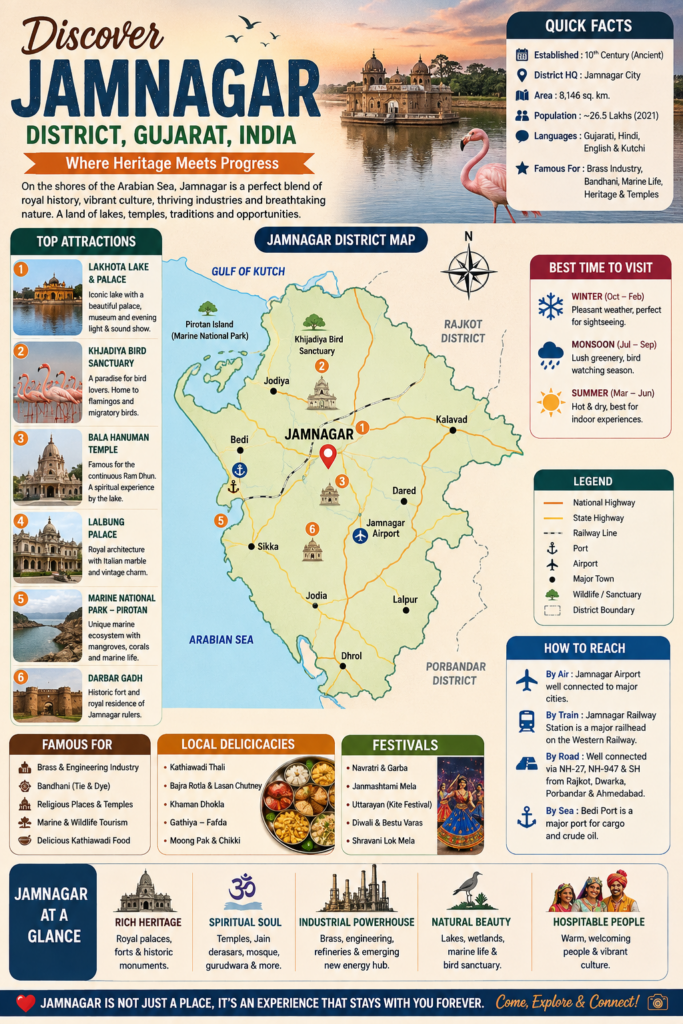
I am Jamnagar.
I was born where the winds of Saurashtra meet the waters of the Gulf of Kutch, where salt hangs softly in the air, where flamingos paint the wetlands pink, and where temple bells still rise above the noise of traffic and industry.
People often arrive expecting only a city.
I wish they would stay long enough to discover that I am much more than that.
I am a district of stories, coastlines, workshops, palaces, birds, faith, food, craft and restless ambition. I have watched rulers build walls, artisans tie Bandhani knots, traders open bazaars, fishermen read the tides, engineers build refineries, and young people imagine businesses their grandparents could never have dreamed of.
My story did not begin with highways or factories.
Long before my industrial skyline appeared, I grew around the princely state of Nawanagar. My old streets still carry that memory. Darbargadh, gateways, towers and the architecture around Lakhota remind me of the days when royal processions, administrators, craftsmen and merchants moved through a much smaller city.
Lakhota Palace still sits in the lake like an old storyteller.
When the evening light falls across Ranmal Lake, I sometimes feel that my past is looking back at me through the water.
I have changed, but I have not forgotten.
My temples remember generations of footsteps. At Bala Hanuman Temple, the rhythm of the Ram Dhun became part of my spiritual identity. Shiva temples, Jain derasars, mosques, a gurudwara and other sacred places have taught me that devotion can speak in many voices and still belong to the same landscape.
During Navratri, I become almost impossible to recognize.
The streets glow. Garba circles spin late into the night. Bandhani fabrics move like waves of colour. Young people dance beside grandparents who still remember older forms of celebration.
Janmashtami brings another mood.
Devotion grows stronger, fairs become crowded, children pull their parents toward rides and food stalls, and the atmosphere carries both religion and celebration.
Then comes Uttarayan, when rooftops turn into little kingdoms of competition and laughter.
Kites rise above me.
For one day, almost everyone seems to look upward.
Food is another language through which I tell my story.
I know the smell of freshly fried gathiya in the morning.
I know fafda beside jalebi, Gujarati thalis served with quiet generosity, and Kathiawadi meals strong enough to make a traveler forget the distance he has driven.
My markets have always understood hunger.
There are snacks for hurried workers, sweets for festivals, meals for families, and roadside food for drivers who have been on the highway for hours.
You should not visit me only with a camera.
Come hungry.
Sit where local families sit. Ask what is fresh. Taste slowly.
My Bandhani is one of my proudest traditions.
Those tiny knots are not merely decorative.
They contain patience.
A piece of Bandhani may pass through many hands before it reaches a bride, a traveler or a shop window. Every dot has been created through human skill. Every pattern is evidence that craftsmanship can survive even while the world around it becomes automated.
And automation certainly came to me.
The brass industry changed my economic character long before many outsiders understood how important it had become.
In workshops across Jamnagar, metal was cast, machined, polished, plated and transformed into tiny components that travelled far beyond Gujarat.
Some were used in electrical systems.
Others became fittings, valves, hardware or engineering parts.
People began calling me a brass city, and I accepted the name with pride.
My factories were not always enormous.
That was part of their strength.
Small family enterprises learned to specialize. One workshop made one component, another performed another stage, and a network of suppliers, traders and transporters connected them.
Generations grew up around machines.
Children learned the sound of lathes before they understood what export orders were.
Then my industrial story grew much larger.
The arrival and expansion of major refining and petrochemical activity transformed my coastal economy.
Suddenly, enormous projects stood where older generations had known a very different landscape.
Engineers arrived.
Contractors arrived.
Heavy machinery moved along roads.
Warehouses appeared.
Hotels grew.
Transport companies found new work.
The scale of industry changed my identity not only in Gujarat but across India.
Some people feared that I would lose myself.
I understand why.
Growth can erase memory when it moves carelessly.
But I am still trying to carry both worlds.
A Bandhani artisan may work within the same district where advanced energy technology is being developed.
A brass worker may live within driving distance of giant industrial complexes.
A farmer may pass heavy transport vehicles while carrying produce toward a market yard.
This contrast is not a weakness.
It is my character.
And now I am changing again.
The language of my future includes solar manufacturing, batteries, green hydrogen, clean energy, industrial automation and new logistics systems.
I have lived through royal history, craft-based commerce, industrial clustering and refinery-driven transformation.
Perhaps my next chapter will be written in renewable energy.
But whenever I begin to feel too modern, nature reminds me where I really live.
Khijadiya does that to me.
At sunrise, the wetlands become quiet enough to make even a busy traveler slow down.
Migratory birds arrive from faraway places and rest here as though borders mean nothing to them.
Flamingos, waders and countless other birds make my winter mornings unforgettable.
The Gulf of Kutch tells an even older story.
Tides retreat and return.
Mangroves breathe between land and sea.
Marine life survives in spaces that many visitors would never notice unless someone teaches them where to look.
My Marine National Park and intertidal landscapes are among the reasons I wish travelers would see me as more than an industrial district.
My coast is not simply a background for factories.
It is alive.
It deserves protection.
I ask visitors to remember that.
Do not collect what belongs to the sea.
Do not disturb birds for photographs.
Do not treat protected places like amusement parks.
Travel gently.
I will show you more when you do.
Tourism came to me gradually.
I was never a destination that shouted for attention like some of India’s more famous cities.
Perhaps that has protected part of my charm.
Many people still arrive because they are passing through.
Some are traveling toward Dwarka.
Some come for business.
Some visit relatives.
Some arrive because of work in industry.
And then, unexpectedly, they find a lake at sunset.
They discover old architecture.
They hear continuous chanting at Bala Hanuman Temple.
They visit Khijadiya early in the morning.
They buy Bandhani.
They taste local food.
And suddenly, I become more than a stopover.
That is the moment I enjoy most.
I like surprising people.
Couples discover that they can find romantic evenings without luxury resorts.
Families find easy outings around lakes, temples and wildlife.
Students find lessons in ecology, engineering and history.
Photographers find birds, markets, architecture and extraordinary coastal light.
Business travelers sometimes extend their stay because they realize the city has more character than the industrial meeting that brought them here.
Solo travelers often understand me particularly well.
They move slowly.
They sit by the lake.
They watch people.
They notice details.
I am not a destination that must always be consumed quickly.
Sometimes my best experiences are ordinary.
A tea stall at the end of a long road.
An old man feeding stories to grandchildren beside a temple.
A shopkeeper unfolding Bandhani while explaining the difference between two patterns.
Workers leaving an industrial area at sunset.
Birds returning to water as the city begins lighting its evening streets.
These are not always found in travel brochures.
But they are where I live.
I have challenges too.
Growth brings traffic.
Industry brings environmental responsibilities.
Wetlands and coastal ecosystems need protection.
Traditional artisans need fair markets.
Small businesses need technology without losing independence.
Young people need skills that match the industries arriving around them.
Farmers need stronger value chains.
Urban expansion must learn to coexist with the natural geography that existed long before my roads.
I do not want progress to mean forgetting.
I want progress to mean becoming wiser.
When you visit me, I hope you do not ask only, “What are the best places to see?”
Ask me different questions.
Ask how I became a princely city.
Ask why brass shaped thousands of livelihoods.
Ask why Bandhani survived.
Ask why migratory birds choose my wetlands.
Ask how a coastal district became one of India’s most important industrial landscapes.
Ask what local people eat after work.
Ask where they go in the evening.
Ask what they fear losing.
Ask what they hope I will become.
Then you will begin to know me.
I am Jamnagar.
I am old stone and new machinery.
I am temple chants and factory shifts.
I am Bandhani knots and precision brass.
I am refinery lights and winter flamingos.
I am market noise, coastal silence, wedding colours, roadside food and business ambition.
I have been a royal capital, a manufacturing town, an industrial powerhouse and a gateway to some of Gujarat’s most delicate natural habitats.
And I am still becoming something new.
So when you come, do not rush through me.
Walk beside my lake.
Listen inside my temples.
Wake before sunrise for my birds.
Talk to my shopkeepers.
Taste my food.
Understand my industries.
Follow my coast responsibly.
And carry something home that cannot be bought in a market:
the feeling that you discovered a place whose story was much larger than you expected.
Because that is who I am.
I am Jamnagar—and my story is still being written.
📍 Where Is Jamnagar District?
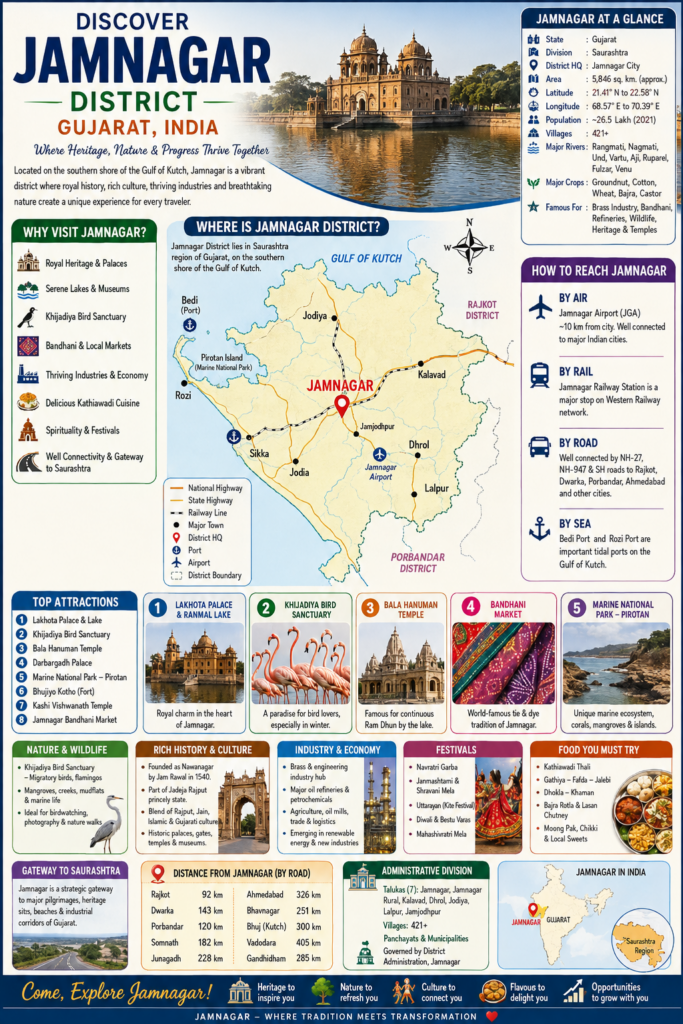
Jamnagar District lies in the Saurashtra region of western Gujarat, India, on the southern side of the Gulf of Kutch. Its landscape stretches from the tidal coast and marine ecosystems to agricultural plains, historic towns, wetlands and one of India’s most important industrial belts. The district administration places it between approximately 21.41°–22.58° N latitude and 68.57°–70.39° E longitude, with a present area of about 5,846 sq km.
If you look at Jamnagar on a Gujarat map, one thing immediately explains much of its personality: the sea is never far from its story. The Gulf shaped its ecology, trade and ports; the hinterland supported agriculture and settlements; royal Nawanagar shaped its architecture and identity; and modern industry transformed Jamnagar into an internationally significant manufacturing and energy centre.
For a traveler, this creates a destination where a morning can begin among migratory birds, continue through an old royal city and end beside a lake illuminated after sunset.
🗺️ Jamnagar District at a Glance
| Geographic Feature | Jamnagar District |
|---|---|
| State | Gujarat |
| Region | Saurashtra |
| District Headquarters | Jamnagar city |
| Approximate Area | 5,846 sq km |
| Northern / Northwestern Natural Boundary | Gulf of Kutch |
| Neighbouring Districts | Devbhumi Dwarka, Rajkot and Porbandar |
| Important Rivers | Rangmati, Nagmati, Und, Vartu, Aji, Ruparel, Fulzar and Venu |
| Important Urban Centre | Jamnagar |
| Major Coastal Points | Bedi, Rozi and Sikka region |
| Landscape | Coast, tidal flats, wetlands, agricultural plains and semi-arid Saurashtra terrain |
| Major Crops Listed by District Administration | Groundnut, cotton, wheat, bajra and castor |
| Major Economic Activities | Brass engineering, refinery-related industry, agriculture, oil mills, trade and logistics |
| Major Nature Attraction | Khijadiya Bird Sanctuary and Gulf of Kutch marine ecosystem |
| Major Heritage Landmark | Lakhota Kotho / Archaeological Museum |
| Nearest Major Regional City | Rajkot |
The district administration currently identifies 421 villages and lists Jamnagar City, Jamnagar Rural, Kalavad, Dhrol, Jodiya, Lalpur and Jamjodhpur in its taluka information. Because administrative structures can be reorganized, travelers and businesses should use current government records rather than older maps—especially maps produced before the creation of Devbhumi Dwarka District.
🌊 Geography – Where Saurashtra Meets the Gulf of Kutch
Jamnagar’s geography is one of the reasons it feels different from inland Gujarat.
Drive away from the city and the landscape can change quickly. Urban neighborhoods give way to industrial belts, farms, scrubland, villages and eventually tidal environments connected with the Gulf of Kutch.
This is not a mountain district, and travelers should not describe Jamnagar as a hill-station destination merely for Clickbate purposes. Its natural strength comes instead from coast, wetlands, creeks, islands, mudflats, mangroves and open Saurashtra countryside.
The district’s official geographic record lists the Rangmati, Nagmati, Und, Vartu, Aji, Ruparel, Fulzar and Venu among its rivers.
Rangmati and Nagmati are particularly important to Jamnagar’s historical identity because the new capital of Nawanagar was established beside them.
Water is also woven into the city’s visual identity through Ranmal Lake and Lakhota Kotho.
For photographers, this combination creates very different frames: royal architecture reflected in lake water, winter birds over wetlands, colorful Bandhani in crowded markets, salt-influenced coastal landscapes and the industrial silhouettes of modern Jamnagar.
🌦️ Climate – When Does Jamnagar Feel Best?
Jamnagar generally experiences a hot, relatively dry Saurashtra climate, moderated to some extent around coastal areas.
Summer can become intensely hot, particularly during the middle of the day. The southwest monsoon transforms agricultural and natural landscapes, although heavy rainfall can occasionally disrupt local roads. Winter is normally the most comfortable period for broad sightseeing and is particularly rewarding for birdwatching.
| Season | General Experience | Best Activities |
|---|---|---|
| Winter | Pleasant and comparatively comfortable | Heritage, birdwatching, markets, photography, outdoor sightseeing |
| Summer | Hot, especially afternoons | Museums, temples, early-morning and evening outings |
| Monsoon | Greener countryside with variable rain | Scenic drives, culture, food, photography |
| Post-Monsoon | Fresh landscapes and improving outdoor weather | Road trips and nature tourism |
The district’s statistical page reports 1,100 mm average rainfall for the 2012–2016 reference period; that figure should not be treated as a permanent annual forecast because rainfall naturally varies from year to year.
🏰 How Nawanagar Became Jamnagar
To understand Jamnagar, I would begin not at a modern factory but in 1540.
The official district history records Jamnagar as the former Nawanagar, an important Jadeja princely state of Saurashtra. Jam Rawal established his new capital in August 1540 on the banks of the Rangmati and Nagmati rivers. Over time, Nawanagar became known as Jamnagar—essentially the city of the Jams.
One traditional story recorded by the district administration gives the city’s founding an almost cinematic character.
During a hunting expedition, Jam Rawal reportedly saw a hare turn against the hunting dogs and drive them away. He interpreted the animal’s courage as a sign of the strength of the land and decided that such a place was worthy of becoming his capital.
Whether a modern traveler approaches that episode as historical tradition or legend, it remains an evocative part of Jamnagar’s cultural memory.
🦚 Mythology, Krishna and the Yadava Connection
Jamnagar’s wider cultural landscape cannot be separated from the Krishna traditions of western Saurashtra.
The district’s official historical account says that Pauranic literature associates Lord Krishna with the establishment of his kingdom at Dwarka after leaving Mathura, and records the Nawanagar Jams’ traditional claim of Yadava ancestry.
An important modern geographical distinction is necessary here.
Dwarka is now in Devbhumi Dwarka District, not present-day Jamnagar District.
Older histories and documents can refer to Dwarka as part of Jamnagar because the administrative geography was different. For an evergreen travel guide, mythology and historical jurisdiction should therefore be distinguished from today’s district boundaries.
This distinction makes the article more trustworthy without diminishing the cultural relationship between Jamnagar and the Krishna landscape of western Saurashtra.
🏛️ Archaeology and the Memory Inside Lakhota
If Jamnagar’s history feels abstract, walk into Lakhota.
The Archaeological Museum occupies Lakhota Kotho, a water fort constructed in 1846 under Jam Ranmalji. The government describes its architecture as predominantly Rajput with Iranian influence and notes that it originally served defensive and royal-leisure purposes.
Its museum collections take visitors much deeper into the regional past.
The reorganized museum contains 321 exhibits across 11 sections, representing regional heritage from roughly the ninth through nineteenth centuries. Objects include sculptures, miniature paintings, coins, copper plates, textiles, beadwork, natural-history specimens and royal arms.
This makes Lakhota more than a photography stop.
It is one of the best places for a first-time traveler to understand how royal, artistic and everyday histories overlap in Jamnagar.
👑 Princely Nawanagar, Colonial India and Cultural Change
Under British paramountcy, Nawanagar remained a princely state rather than becoming an ordinary British-administered city.
Its rulers influenced civic development, architecture, institutions and cultural life. The princely legacy remains visible in Jamnagar’s palaces, gateways, old streets and museum collections.
Perhaps the best-known Nawanagar royal internationally was K. S. Ranjitsinhji, whose cricketing legacy extended far beyond the princely state; India’s Ranji Trophy carries his name.
Later royal patronage also supported heritage preservation. The district’s museum history credits Jam Shri Digvijaysinhji’s interest in archaeology and records the establishment of the Archaeological Museum at Lakhota in 1946.
After independence and political integration, the old princely landscape became part of modern Gujarat, but its cultural imprint survived.
That is why Jamnagar can feel both royal and intensely industrial today.
🔩 From Royal Capital to Industrial Powerhouse
Few Indian travel destinations demonstrate economic transformation as dramatically as Jamnagar.
The district administration identifies brass industry, oil refinery, agriculture and oil mills among its major economic activities.
The brass engineering cluster became especially important.
Across workshops and factories, manufacturers developed capabilities in precision components, fittings, electrical parts, hardware and related engineering products. Around this manufacturing base grew tool suppliers, packaging companies, metal traders, transporters, warehouses and other ancillary businesses.
Then large-scale petroleum refining fundamentally changed the industrial geography.
Today, the wider Jamnagar industrial landscape is associated internationally with massive refining and energy operations, while a new generation of renewable-energy manufacturing is adding another layer to the district’s economic story.
The fascinating part is that the older economy has not disappeared.
You can still encounter traditional Bandhani craftsmanship and small engineering workshops in the same district that accommodates industrial projects of extraordinary scale.
🚛 Why Jamnagar Matters to Transport and Logistics
Jamnagar is not merely a place where products are manufactured; it is a place from which enormous volumes and many different types of cargo must move.
Agriculture generates farm-to-market transport.
Brass manufacturers require raw materials, LTL/FTL distribution and export logistics.
Retail markets depend on daily distribution.
Industrial plants require machinery, spares and project materials.
Large energy developments can require specialized heavy-haul and ODC transportation.
The coast adds another dimension.
The district administration identifies Bedi Port as an important tidal lighterage port on the Gulf of Kutch and also lists Rozi as a maritime access point.
For a logistics professional, Jamnagar therefore represents an intersection of road freight, railway movement, coastal infrastructure, manufacturing supply chains, agriculture and project cargo.
✈️ How Is Jamnagar Connected?
Jamnagar is accessible by road, railway and air, while its coast supports maritime industrial activity.
The district administration places Jamnagar Airport approximately 10 km from the city and confirms that Jamnagar lies on the Western Railway network. Road connections link it with major Gujarat cities through state transport and private buses.
| Transport Mode | Practical Role |
|---|---|
| ✈️ Air | Business and leisure access through Jamnagar Airport |
| 🚆 Rail | Long-distance passenger connectivity via Western Railway |
| 🚌 Bus | Gujarat ST and private services |
| 🚗 Road | Best flexibility for district attractions and onward Saurashtra travel |
| 🚚 Freight Road | Crucial for agriculture, brass, industrial and project cargo |
| ⚓ Maritime | Bedi, Rozi and specialized coastal industrial infrastructure |
The official district travel page identifies Rajkot at about 92 km from Jamnagar, making Rajkot an important regional road gateway.
Flight and train schedules change, so travelers should check live timetables rather than relying on an evergreen article for a specific daily service.
🦩 Why Jamnagar Is Important for Tourism
Jamnagar is unusual because its strongest attractions belong to completely different tourism categories.
You can explore royal heritage, religious traditions, birdwatching, marine ecology, Bandhani craftsmanship, food, old markets and industrial history within one district.
| Travel Interest | Jamnagar Experience |
|---|---|
| Heritage | Lakhota Kotho, old-city architecture and Nawanagar legacy |
| Museum | Archaeological Museum at Lakhota |
| Birdwatching | Khijadiya Bird Sanctuary |
| Spiritual Tourism | Bala Hanuman and historic temples |
| Marine Nature | Gulf of Kutch ecosystem |
| Photography | Wetlands, lake, heritage streets and markets |
| Shopping | Bandhani, traditional markets and local products |
| Food Tourism | Gujarati and Kathiawadi flavors |
| Industrial Tourism Context | Brass and energy-driven economic landscape |
| Family Travel | Lake, temples, museum and nature outings |
🌿 Hidden Jamnagar Beyond the Famous Attractions
First-time visitors often make the mistake of collecting only landmark names.
Jamnagar becomes more rewarding when you explore its transitions.
Walk around older neighborhoods early in the morning before commercial traffic becomes intense. Watch craftsmen and shopkeepers prepare for the day. Drive through the countryside after the monsoon. Explore traditional markets without turning every encounter into a photograph.
Spend enough time at Khijadiya to stop counting birds and simply listen.
And notice the transition from historic Jamnagar to the industrial outskirts.
That changing landscape tells the economic history of the district more clearly than a textbook.
For responsible travelers, wetlands and coastal habitats deserve particular care. Avoid loud music, wildlife disturbance, littering and unauthorized access to protected or industrial coastal zones.
🧵 Culture – Bandhani, Garba and Living Traditions
Jamnagar’s culture is not locked inside its museum.
You see it in Bandhani textiles, wedding clothing, religious rituals, Gujarati hospitality, market conversations and festival nights.
Navratri brings Garba and traditional clothing into public spaces. Janmashtami carries particular resonance across western Saurashtra’s Krishna-influenced cultural landscape. Uttarayan fills the sky with kites, while Diwali and the Gujarati New Year transform markets and family homes.
Jain, Hindu, Muslim, Sikh and other communities have also contributed to the district’s cultural fabric.
For travelers, festivals are excellent opportunities for photography—but religious observance should never be treated as a staged performance. Ask before photographing people closely and respect temple, mosque, derasar and gurudwara rules.
🍽️ What Should You Eat in Jamnagar?
Come hungry.
A Jamnagar trip becomes much more personal when sightseeing pauses for local food.
Look for gathiya, fafda, jalebi, khaman, Gujarati snacks, Kathiawadi-style meals, rotla, vegetable preparations, chutneys, buttermilk and regional sweets. What is available varies by restaurant, season and time of day.
Morning food outings can be particularly enjoyable because local snack shops are active before the sightseeing heat intensifies.
For a first visit, I would choose one polished restaurant for comfort and at least one busy local establishment for character.
Follow local customers.
A crowded, clean food counter often tells you more than a large advertising board.
🚪 Jamnagar as a Gateway to Western Saurashtra
Jamnagar’s location makes it useful not only as a destination but also as a base or gateway for a broader western Gujarat journey.
Rajkot lies inland to the east and functions as a major commercial and transport connection. Devbhumi Dwarka lies toward the west, opening the route toward one of India’s most celebrated Krishna pilgrimage landscapes. Porbandar provides another important coastal and historical direction.
This allows travelers to design circuits rather than isolated trips.
| Travel Direction | Wider Opportunity |
|---|---|
| Toward Rajkot | Urban tourism, business and onward Gujarat connectivity |
| Toward Devbhumi Dwarka | Dwarka pilgrimage and western Saurashtra coast |
| Toward Porbandar | Coastal travel and Gandhi heritage |
| Gulf of Kutch side | Marine ecology and coastal landscapes |
| Jamnagar hinterland | Villages, agriculture and offbeat Saurashtra |
| Industrial corridors | Manufacturing, logistics and business travel |
🧭 Practical Advice for First-Time Visitors
For a short visit, keep two days for Jamnagar city and a carefully selected nature outing; add more time if birdwatching, photography, business visits or regional road trips are important.
Winter is generally the easiest season for long outdoor days. In summer, move heritage walks and nature activities toward early morning or evening. During the monsoon, check road and weather conditions before rural travel.
Keep separate expectations for tourist and industrial areas. Refinery, port, defense-sensitive and other controlled locations may have strict access or photography restrictions.
For nature tourism, verify sanctuary timings and permissions before departure.
And don’t measure Jamnagar against Ahmedabad, Dwarka or Kutch.
It tells a different story.
🌅 Why Jamnagar Deserves More Than a Stopover

Jamnagar is one of those places that becomes more interesting after you understand why everything is here.
The lake makes more sense after you learn about Nawanagar.
The old gates mean more after hearing Jam Rawal’s story.
The market becomes richer after understanding Bandhani.
A small brass workshop looks different once you recognize the district’s manufacturing influence.
Khijadiya becomes more precious when you understand the ecological importance of the Gulf landscape.
And the enormous industrial horizon becomes another chapter—not the whole identity—of a district whose story began centuries before modern factories appeared.
So don’t simply pass through Jamnagar on the way somewhere more famous.
Come for the royal history. Wake early for the birds. Walk beside Lakhota Lake. Taste Saurashtra. Explore the old markets. Understand the industries. Follow the coast responsibly. Then use Jamnagar as your doorway into the wider landscapes of western Gujarat.
That is when Jamnagar stops being a point on the Gujarat map and becomes a destination you genuinely remember.
✈️ How to Reach Jamnagar District, Gujarat – Complete Transport & Stay Guide

Reaching Jamnagar is easier than its far-western position on the Gujarat map might suggest. The district is connected by air, long-distance rail, GSRTC buses, private coaches, highways, city buses, auto-rickshaws, taxis, app-based rides and rental vehicles, making it practical for tourists, pilgrims, families, solo travelers and people arriving for refinery, brass-industry or other business work.
For a first-time outstation traveler, the simplest rule is this: use Jamnagar Airport for the fastest arrival, Jamnagar Railway Station for convenient long-distance travel, GSRTC/private buses for lower-cost Gujarat connections, and a taxi or rental car when you plan to explore Khijadiya, coastal areas or destinations outside central Jamnagar.
Jamnagar District’s official tourism information places Jamnagar Airport roughly 10 km from the city, confirms that Jamnagar lies on the Western Railway network, and states that state transport buses and private luxury coaches connect the city with major places across Gujarat. Rajkot, an important alternative transport gateway, is approximately 92 km away by road.
🚦 Jamnagar Transport at a Glance
| Transport Mode | Main Arrival Point | Best For | Approx Travel Cost | Last-Mile Option | Advance Booking | Main Advantage |
|---|---|---|---|---|---|---|
| ✈️ Flight | Jamnagar Airport | Long-distance travelers, business visitors | Route/date dependent | Taxi, app cab, auto where available | Strongly recommended | Fastest |
| 🚆 Train | Jamnagar Railway Station – JAM | Families, budget travelers, long-distance trips | ₹150–₹3,000+ | Auto, taxi, app cab, city bus | Recommended | Excellent value |
| 🚉 Hapa Railway Station | HAPA | Selected trains and local connectivity | Train dependent | Auto/taxi/city bus | Recommended | Useful secondary railhead |
| 🚌 GSRTC Bus | Jamnagar Bus Station | Gujarat intercity travel | ₹100–₹1,000+ | Auto/city bus/taxi | Available online | Low-cost statewide connectivity |
| 🚍 Private Bus | Different boarding points | Sleeper/AC road travel | ₹300–₹2,000+ | Auto/cab | Recommended | Multiple comfort levels |
| 🚗 Self-Drive Car | Jamnagar highways | Families, couples, road trips | Fuel + toll + rental | Direct | Rental booking advised | Maximum flexibility |
| 🚕 Taxi | Door-to-door | Families, seniors, business travelers | ₹15–₹25+/km broadly | Direct | Optional | Convenient |
| 🛺 Auto-Rickshaw | City/local | Short journeys | ₹50–₹300 typical | Direct | Usually no | Cheap local travel |
| 📱 App Cab | Uber and available platforms | New visitors | Dynamic | Direct | In-app | Upfront fare estimate |
| 🏍️ App Bike Taxi | Uber Bike / current operators | Solo travelers | Dynamic | Direct | In-app | Low-cost quick rides |
| 🚌 Jamnagar City Bus | City routes | Budget travelers | Very low | Walk/auto | Some digital support | Cheapest city transport |
| 🚢 Waterway | Bedi/Rozi industrial-maritime zone | Maritime/authorized use | Not regular tourist fare | Road transfer | Special arrangements | Industrial/coastal significance |
| 🚇 Metro | Not available | — | — | — | — | Jamnagar currently has no metro network |
Costs throughout this guide are travel-planning estimates, not fixed tariffs. Airfare, train class, bus category, taxi prices, fuel and hotel rates vary according to season and availability.
✈️ Reaching Jamnagar by Air
🛫 Nearest Airport – Jamnagar Airport
The nearest commercial airport is Jamnagar Airport, also associated with the Govardhanpur civil enclave.
The district administration places it approximately 10 km from Jamnagar town, while Gujarat Tourism describes it as around 9 km from the city centre. Both figures should be understood as approximate because distance varies according to your exact hotel or destination.
| Airport Information | Details |
|---|---|
| Airport | Jamnagar Airport |
| Approx Distance from Central Jamnagar | 9–10 km |
| Typical Road Time | Roughly 20–35 minutes |
| Best For | Business travelers, families, elderly travelers, short trips |
| Local Transfer | Taxi, app ride, auto where available, hotel pickup |
| Booking | Airline website/app or reputable flight portal |
| Recommended Buffer | Arrive well before scheduled departure according to airline advice |
The district’s current travel page specifically notes an Air India connection with Mumbai, but airline networks and frequencies are inherently changeable. Travelers should therefore search the actual travel date rather than using an evergreen blog as a flight timetable.
📱 Online Flight Booking
Use:
- airline official websites and mobile apps;
- reputable travel portals;
- corporate travel systems where applicable.
For baggage changes, cancellations and schedule disruptions, booking directly with the airline can sometimes simplify support.
🚕 Airport to Jamnagar City
A taxi or app-based car is usually the simplest option for someone visiting Jamnagar for the first time.
Plan approximately ₹250–₹700 for an ordinary airport-city ride depending on destination, vehicle type, surge pricing and waiting. Premium cars can cost more.
Some hotels provide chargeable or complimentary airport transfer packages. Hotel Aram, for example, currently advertises an airport pickup/drop benefit on qualifying direct-booking offers, although travelers should reconfirm the active offer for their dates. (hotelaram.in)
♿ Air Travel for Senior Citizens and Differently Abled Travelers
Travelers needing wheelchair or mobility assistance should request it directly from the airline before travel, ideally while booking.
Also consider:
- requesting wheelchair assistance from terminal entry to aircraft;
- booking an aisle or easy-access seat where available;
- pre-arranging a taxi rather than negotiating after arrival;
- choosing a hotel with lift access;
- allowing extra boarding time;
- carrying medicines in hand baggage.
🚆 How to Reach Jamnagar by Train
🚉 Jamnagar Railway Station
Jamnagar Railway Station is one of the most practical ways to reach Jamnagar District.
Jamnagar is part of the Western Railway network, and the district administration states that the city is connected with the rest of India by multiple daily and weekly trains.
The primary station code is:
JAM – Jamnagar
Another useful station in the wider city area is:
HAPA – Hapa
Gujarat Tourism also identifies Jamnagar, Hapa and Modpur among railway points in the area. (Gujarat Tourism)
| Rail Option | Best Use |
|---|---|
| Jamnagar – JAM | Primary arrival station for tourists |
| Hapa – HAPA | Useful for trains stopping outside central Jamnagar |
| Other regional stations | Only when train routing makes them more convenient |
🎟️ Online Train Ticket Booking
The safest booking route is the official IRCTC reservation platform for reserved Indian Railways tickets.
Indian Railways’ passenger enquiry systems can also be used for train information and status. (Indian Railway)
Book early during:
- Navratri;
- Diwali;
- Janmashtami;
- school holidays;
- long weekends;
- wedding season;
- major religious travel periods.
🚕 Railway Station Last-Mile Connectivity
From Jamnagar Railway Station, travelers can generally continue by:
- auto-rickshaw;
- city bus;
- taxi;
- app-based ride;
- hotel transfer;
- rental vehicle.
Central attractions such as Lakhota Lake and the old-city area are relatively accessible from the railway station. Hotel Aram is officially listed by Gujarat Tourism as approximately 2 km from the nearest railway station, while Sayaji’s current factsheet lists Jamnagar Station approximately 2.6 km from the hotel.
🚌 Reaching Jamnagar by GSRTC State Transport Bus
For budget travelers coming from elsewhere in Gujarat, GSRTC is one of the most useful transport options.
The district administration confirms that Jamnagar is well connected with Gujarat cities through state transport services.
GSRTC’s current directory lists Jamnagar Bus Station as the city’s principal state transport terminal and also identifies bus control points within the wider division.
Common road directions include services toward or via:
- Rajkot;
- Ahmedabad;
- Dwarka;
- Porbandar;
- Junagadh;
- Bhavnagar;
- other Gujarat towns according to current schedules.
🎟️ GSRTC Online Ticket Booking
GSRTC supports electronic booking and mobile booking. Its published booking system also describes a current-booking facility for eligible last-minute trips after trip sheets are generated.
For important journeys, reserve in advance rather than relying on last-minute availability.
| GSRTC Passenger Type | Recommended Service |
|---|---|
| Student / backpacker | Standard bus |
| Budget family | Express |
| Senior traveler | Reserved seat service |
| Longer overnight trip | Sleeper/AC service where scheduled |
| Last-minute passenger | Check current/e-booking availability |
🚍 Private Buses and Luxury Coaches
Private operators supplement GSRTC with various combinations of:
- AC seating;
- non-AC seating;
- sleeper coaches;
- semi-sleeper buses;
- overnight services.
These are useful for routes where departure time or comfort matters more than the lowest fare.
Private bus boarding points may not always be at the main GSRTC terminal, so check the exact pickup address before leaving your hotel.
A bus advertised as “Jamnagar” may depart from a roadside office, bypass or private boarding point.
For a first-time visitor arriving late at night, I recommend booking a cab or auto from the confirmed drop point rather than walking with luggage through an unfamiliar area.
🚌 Public Transport in Jamnagar District – City Bus Service
Jamnagar has an operating municipal city-bus network.
The Jamnagar Municipal Corporation currently publishes routes including services linking Darbargadh, Hapa Railway Station, Jamnagar Railway Station, Town Hall, Bedi Port, Dared and other areas. Current published schedules generally operate from around morning through evening, with frequencies varying substantially by route.
This makes the city bus useful for:
- budget tourists;
- students;
- workers;
- solo travelers;
- passengers connecting to railway areas;
- travelers without heavy luggage.
💰 Jamnagar City Bus Fare
JMC’s currently published route page shows a very low stage-based tariff, beginning from ₹5 for the first 2 km on the listed routes and increasing progressively.
Because fares and route structures may be revised, check the latest city-bus information before publishing fixed prices permanently.
📱 Jamnagar City Bus Digital Information
The JJMF mobile application currently advertises city-bus ticket booking, real-time vehicle location and route timetable functionality.
This is particularly helpful for someone unfamiliar with Jamnagar.
🚇 Does Jamnagar Have a Metro?
No. Jamnagar currently does not have a metro rail system.
Therefore, travelers should not search for a “nearest Jamnagar Metro Station.”
Urban movement depends mainly on:
- city buses;
- auto-rickshaws;
- taxis;
- app rides;
- private cars;
- two-wheelers.
If a future metro or rapid-transit system is announced, this section should be updated only after an official project confirmation.
🛺 Auto-Rickshaws in Jamnagar
Autos remain one of the simplest ways to travel short distances inside Jamnagar.
They are useful for:
- railway station to hotel;
- bus stand to market;
- Lakhota Lake;
- temples;
- shopping streets;
- restaurants.
Approximate short urban trips may cost ₹50–₹200+, while longer movements can cost more.
Always agree on a fare when a meter is not being used.
For elderly travelers, confirm that the vehicle can stop close to the hotel or attraction entrance.
📱 App-Based Cabs in Jamnagar
Uber currently lists Jamnagar as an active service area, with on-demand Uber Go trips available through its app. Uber’s present Jamnagar page reports an illustrative average of ₹243 for a 20-minute Uber Go trip, although real fares depend on distance, time and demand.
This is particularly helpful for outstation visitors because the fare estimate is displayed before travel.
Use app-based rides for:
- airport pickups;
- railway transfers;
- hotel-to-attraction journeys;
- restaurant trips;
- short business travel.
Always verify the vehicle and driver details displayed in your application before boarding.
🏍️ Bike Taxi in Jamnagar
Bike-taxi availability has recently expanded in Jamnagar.
Uber currently advertises Uber Bike in Jamnagar, and August 2026 reporting specifically included Jamnagar among the Indian cities added during Uber Bike’s latest expansion.
This can be useful for:
- solo travelers;
- students;
- people with little luggage;
- short city trips.
It is not ideal for:
- senior citizens;
- families with children;
- passengers with large suitcases;
- travelers during heavy rain;
- passengers uncomfortable with two-wheelers.
Always wear the provided helmet and follow local safety rules.
🚕 Traditional Taxi and Outstation Cab
A private taxi becomes much more useful once your itinerary goes beyond central Jamnagar.
Consider booking a car for:
- Khijadiya Bird Sanctuary;
- rural areas;
- coastal drives;
- Narara direction subject to access;
- Rajkot transfer;
- Dwarka onward journey;
- Porbandar journey;
- business visits to industrial areas.
A broad planning range for local/outstation taxis may be roughly:
| Vehicle | Typical Planning Rate |
|---|---|
| Hatchback / small sedan | ₹12–₹18/km |
| Sedan | ₹14–₹22/km |
| SUV | ₹18–₹30/km |
| Full-day city use | ₹2,000–₹4,500+ |
| Outstation day trip | Distance + allowance based |
These are not government tariffs. Ask for a written quote covering:
- kilometers included;
- driver allowance;
- tolls;
- parking;
- night charge;
- interstate tax if applicable;
- waiting time.
🚗 Rental Cars, Self-Drive Vehicles and Two-Wheelers
Rental vehicles are useful for travelers wanting an independent district road trip.
Before accepting any rental vehicle, inspect:
- insurance;
- tyres;
- spare tyre;
- brakes;
- lights;
- FASTag;
- fuel level;
- RC and permit documents where applicable.
For scooters or motorcycles, photograph the vehicle’s existing scratches before leaving the rental location.
A self-drive vehicle is particularly valuable if your itinerary includes multiple places outside Jamnagar city.
🛣️ Reaching Jamnagar by Road
Road travel is one of Jamnagar’s major strengths.
The district is connected toward Rajkot and the wider Gujarat highway system, while westbound roads continue toward Devbhumi Dwarka and the coast.
The official district page identifies Rajkot as approximately 92 km from Jamnagar.
Approximate road-trip planning:
| Origin | Approx Travel Character | Typical Road Time* |
|---|---|---|
| Rajkot | Closest major regional gateway | 2–3 hours |
| Dwarka | Western Saurashtra pilgrimage circuit | 2.5–3.5 hours |
| Porbandar | Coastal circuit | 2.5–3.5 hours |
| Ahmedabad | Long intercity highway journey | 6–8 hours |
| Bhuj | Longer western Gujarat connection | 6–8 hours depending route |
Road time varies with traffic, stops, roadworks and route.
For long journeys, avoid planning by distance alone. Gujarat highways may be fast for long stretches, but urban approaches, construction, toll plazas and village traffic affect actual time.
⚓ Reaching Jamnagar by Water
Jamnagar has genuine maritime importance, but there is no ordinary public tourist ferry that should be treated as the normal way to reach Jamnagar city.
The district administration identifies Bedi Port and Rozi Port as maritime access points on the Gulf of Kutch.
These facilities are more relevant to:
- cargo;
- port activity;
- industrial supply chains;
- authorized marine access;
- specialized local maritime movements.
For Pirotan or Marine National Park-related travel, visitors must not simply hire an unverified boat. Access can depend on permissions, tide, protected-area regulations and current boat arrangements. The district identifies Bedi Port as a principal access reference for Marine National Park–Pirotan.
🚆 What About Local Trains?
Jamnagar is not a suburban railway city like Mumbai.
Rail should primarily be treated as intercity and regional transport, with Jamnagar and Hapa serving as useful stations.
For movement inside the city, buses, autos and cabs are normally more practical than waiting for a train.
🚕 Last-Mile Connectivity from Major Arrival Points
| Arrival Point | City Centre | Lakhota Lake | Khijadiya | Recommended Transfer |
|---|---|---|---|---|
| Jamnagar Airport | ~9–10 km | Similar urban range | Approx 20 km to sanctuary | Cab / hotel transfer |
| Jamnagar Railway Station | A few km | Short city ride | Approx 15 km to sanctuary | Auto / cab |
| Jamnagar Bus Station | Central access | Short urban journey | Approx 15 km to sanctuary | Auto / cab |
| Hapa Railway Station | Outer-city side | Longer than JAM station | Route dependent | Cab / city bus |
The district’s Khijadiya page gives approximate distances of 20 km from Jamnagar Airport and 15 km from Jamnagar Railway Station and the State Transport bus stand.
🅿️ Parking in Jamnagar
Drivers should expect three types of parking:
- hotel/private parking;
- roadside or market-area parking where legally permitted;
- designated pay-and-park facilities.
Old Jamnagar streets around traditional markets can be congested, so parking farther away and walking can be easier.
Jamnagar Municipal Corporation has an established pay-and-park framework. Its published parking policy includes a designated paid facility near Digjam Circle under the railway overbridge, although the specific rate table in that policy is historical and should not be treated as a guaranteed current 2026 tariff.
For evergreen content, the best advice is:
use marked parking, obtain a receipt where applicable and confirm the current rate displayed at the facility.
🚘 Parking Tips by Traveler Type
| Traveler | Best Parking Strategy |
|---|---|
| Family | Hotel with onsite parking |
| Senior citizens | Drop passenger near entrance before parking |
| Heritage visitor | Park outside congested core and walk |
| Market shopper | Use legal paid parking where available |
| Large SUV | Avoid narrow old-city lanes |
| Tourist bus | Confirm bus parking before arrival |
| Rental vehicle | Never leave documents or valuables visible |
⚡ EV Charging in Jamnagar
EV charging infrastructure is expanding quickly across Gujarat, but individual charger availability, connector status and operating hours change too frequently for an evergreen travel article to rely on a fixed list.
EV travelers should check live charging-network applications or map services immediately before departure.
Before a long trip:
- locate at least two possible chargers;
- confirm CCS2/appropriate connector compatibility;
- charge before visiting rural or coastal areas;
- ask hotels whether overnight charging is permitted;
- avoid reaching an isolated charger with less than a comfortable reserve.
This is particularly important when driving toward coastal nature destinations where public charging can be less predictable than inside the city.
♿ Accessible Travel in Jamnagar
Jamnagar can be manageable for senior citizens and travelers with limited mobility if the itinerary is designed realistically.
Prefer:
- air or AC train for long-distance arrival;
- pre-booked taxi transfers;
- hotels with elevators;
- ground-floor rooms if required;
- attractions with shorter walking circuits;
- morning/evening sightseeing in summer.
At airports and railway stations, request official mobility assistance in advance where available.
Avoid trying to cover:
- wet intertidal terrain;
- long rural walks;
- crowded old markets;
- uneven heritage areas
without checking suitability first.
Wheelchair accessibility at individual temples, restaurants and older monuments can vary substantially.
🌙 Arriving in Jamnagar Late at Night
For someone who has never visited Jamnagar, late-night arrival deserves planning.
Before leaving home:
- save the hotel address offline;
- tell the hotel your expected arrival;
- arrange an airport/station pickup if arriving very late;
- keep your phone charged;
- avoid accepting unsolicited rides from unknown intermediaries;
- confirm the vehicle number before entering an app cab;
- keep cash plus digital payment available.
Do not choose a cheaper hotel far outside the city merely to save a few hundred rupees if you arrive after midnight without reliable transport.
🎟️ Online Ticket Booking for Jamnagar District
| Travel Requirement | Best Booking Method |
|---|---|
| Flight | Airline app/website or trusted OTA |
| Train | IRCTC |
| GSRTC Bus | GSRTC online/mobile booking |
| Private Bus | Operator website or established bus-ticket portal |
| Uber Car | Uber app |
| Uber Bike | Uber app where shown |
| City Bus | JJMF app/current JMC information |
| Rental Car | Established local/national rental company |
| Hotel | Hotel’s official website or reputable hotel-booking portal |
| Wildlife Attraction | Check official forest/tourism instructions where applicable |
Never transfer large amounts to an unknown number sent through an unofficial social-media page claiming to offer “special tourist tickets.”
🏨 Where to Stay in Jamnagar – Accommodation by Location and Budget
Jamnagar offers budget lodges, independent hotels, heritage accommodation, business hotels and premium branded stays.
The district administration currently lists properties including Sayaji Jamnagar and Lords Inn Jamnagar, while Gujarat Tourism officially profiles Hotel Aram.
Room rates below are estimated booking ranges and can rise during festivals, weddings, industrial events and holidays.
💰 Budget Hotels in Jamnagar District
| Hotel / Stay Type | Location Advantage | Approx Room Price | Approx Distance/Access | Typical Amenities | Best For | Booking Tip |
|---|---|---|---|---|---|---|
| Hotel President / similar central hotel | Teen Batti / central Jamnagar | ₹1,200–₹2,500 | Convenient to city attractions | AC, Wi-Fi, basic dining varies | Budget families, solo travelers | Check recent room photos |
| KD Comfort / similar | P.N. Marg / Dwarka Road side | ₹1,200–₹2,500 | Central-to-west city access | Basic business stay | Short visits | Confirm parking before booking |
| Local station-area hotels | Railway side | ₹800–₹2,000 | Near rail arrival | Basic rooms | Overnight train passengers | Avoid choosing solely by lowest price |
| Dharamshala / community stays | Location varies | ₹300–₹1,500 | Often near religious areas | Basic | Pilgrims | Eligibility/rules may apply |
Gujarat Tourism’s trip planner currently includes Hotel President and KD Comfort among Jamnagar lodging options.
🏨 Mid-Range Hotels in Jamnagar
| Property | Location | Approx Range | Nearby Convenience | Amenities | Best For | Booking Tip |
|---|---|---|---|---|---|---|
| Hotel Aram | P.N. Marg / central Jamnagar | ₹2,500–₹5,500+ | Approx 2 km from rail station; central heritage access | Heritage atmosphere, restaurant, gym, conference facilities | Couples, heritage travelers, families | Direct booking may include useful transfer benefits |
| Hotel Keshwara’s Residency | Jamnagar | ₹2,000–₹4,500+ | City access | Typical hotel facilities | Families/business | Gujarat Tourism lists it as a registered Jamnagar hotel |
| Lords Inn Jamnagar | Motikhavdi, Jamnagar–Khambhalia Highway | ₹2,500–₹5,500+ | Industrial/highway side | Hotel dining, business facilities | Refinery/business travelers | Not ideal if all sightseeing is central city |
| Express Residency | Jamnagar–Dwarka / industrial side | ₹2,500–₹6,000+ | Good for industrial belt | Hotel, restaurant, leisure facilities | Business couples, industrial visitors | Compare distance with your actual worksite |
Hotel Aram’s official Gujarat Tourism listing places it approximately 7 km from the airport and 2 km from the nearest railway station and identifies amenities such as conference facilities, restaurant, AC/non-AC rooms and a gym. (Gujarat Tourism)
⭐ Premium & Luxury Hotels in Jamnagar
| Hotel | Area | Approx Range | Transport Advantage | Notable Amenities | Ideal For | Booking Tip |
|---|---|---|---|---|---|---|
| Sayaji Jamnagar | Indira Gandhi Road | ₹3,500–₹8,000+ | Approx 2.6 km station, 7.8 km airport | Restaurant, 24/7 café, banquet, premium rooms | Families, couples, corporate guests | Strong option for central business + tourism |
| The Fern Residency Jamnagar, Series by Marriott | Dwarka Bypass / airport-connected area | ₹3,500–₹8,000+ | Positioned near airport and station | 49 rooms/suites, dining, rooftop venue, gym | Couples, business travelers | Good for modern branded stay |
| Premium resort/business properties | Outer Jamnagar | ₹4,000–₹12,000+ | Better for self-drive users | Pool/spa/recreation varies | Staycations, couples | Verify distance before booking |
Sayaji’s current factsheet lists 60 rooms, a restaurant, café and banquet spaces and places the property 7.8 km from the airport and 2.6 km from the railway station.
The Fern Residency, now operating as The Fern Residency Jamnagar, Series by Marriott, describes itself as close to both Jamnagar Airport and Jamnagar Station and offers 49 rooms/suites, dining, a rooftop venue and business/event facilities.
🦩 Best Accommodation for Khijadiya Bird Sanctuary
Khijadiya is close enough to Jamnagar that most visitors do not need to relocate to a separate remote hotel.
Stay in Jamnagar city and leave before sunrise.
The district places the sanctuary approximately 15 km from Jamnagar Railway Station and bus stand and about 20 km from the airport.
For birdwatchers:
- choose a hotel with 24-hour reception;
- request packed breakfast;
- arrange a car the evening before;
- leave early;
- carry binoculars and water.
🏭 Best Hotels for Industrial & Business Travelers
Travelers working around the refinery, Motikhavdi, industrial highways or western industrial belt should choose hotels based on factory distance rather than tourist-attraction distance.
| Work Purpose | Better Location Strategy |
|---|---|
| Central brass business | Central Jamnagar |
| Shankar Tekri/GIDC | City/eastern industrial-access location |
| Motikhavdi industrial visits | Motikhavdi/highway hotel |
| Refinery-related visit | Highway/industrial-side accommodation |
| Multiple city meetings | Central branded hotel |
| Airport-heavy schedule | Airport/bypass side |
Sayaji’s published distance sheet, for example, lists the hotel approximately 22 km from Reliance and 12 km from GIDC, useful figures for deciding whether a central hotel fits an industrial itinerary.
🧳 Best Transport Choice for Different Travelers
| Traveler Type | Best Arrival | Best Local Transport |
|---|---|---|
| Solo backpacker | Train / GSRTC | City bus + auto + bike taxi |
| Couple | Flight / train | App cab / rental car |
| Family with children | Train / flight | Cab |
| Senior citizens | Flight / AC train | Pre-booked taxi |
| Students | Train / GSRTC | City bus |
| Corporate traveler | Flight | Hotel cab / app cab |
| Photographer | Train / flight | Rental car with early departures |
| Birdwatcher | Train / flight | Private taxi |
| Pilgrim | Train / bus | Auto/cab |
| Industrial visitor | Flight / train | Chauffeur-driven car |
| International traveler | Major gateway airport + domestic connection/road | Pre-booked transfer |
🚗 Best Alternative Gateway – Rajkot
If a direct flight or train to Jamnagar does not suit your schedule, Rajkot is the most useful major regional alternative gateway.
The Jamnagar administration places Rajkot approximately 92 km away.
A taxi trip commonly takes around two to three hours depending on traffic and route.
This can be especially useful when:
- flights to Jamnagar are inconvenient;
- you find a better train to Rajkot;
- your Gujarat itinerary already includes Rajkot;
- you are traveling by private car.
Compare the total journey time and transfer cost, not merely the airline fare.
🌍 Practical Arrival Plan for a First-Time Outstation Traveler
If this is your first visit to Jamnagar, I would plan the journey like this:
By flight: pre-book a hotel or app cab, go directly to your accommodation and keep the first evening relaxed.
By train: use Jamnagar station when possible, then take an auto or cab to your hotel.
By GSRTC: save the hotel location and confirm how far it is from Jamnagar Bus Station before arrival.
By private sleeper: check the exact drop point—do not assume it is the government bus terminal.
By self-drive: choose a hotel with confirmed parking.
After check-in, use autos or app rides for the central city. Hire a car only on the days you travel to Khijadiya, coastal destinations or onward places such as Dwarka.
⚠️ Essential Jamnagar Transport Safety Tips
Avoid unlicensed drivers offering aggressively discounted outstation trips.
For app rides, match the vehicle registration and driver details before boarding.
Do not photograph sensitive military, airport, refinery, port or restricted industrial infrastructure.
Never enter an operational port assuming it is a tourist attraction.
During monsoon, ask about road conditions before heading to isolated coastal or rural areas.
Do not depend on an EV charger without confirming live status.
When traveling with children or elderly family members, avoid unnecessarily complex transfers simply to save a small amount.
Keep digital and offline copies of:
- hotel address;
- train/flight ticket;
- identification;
- emergency contacts.
Jamnagar district’s official emergency resources currently list 108 for ambulance services and 1077 for the disaster control room.
🌟 Best Way to Reach Jamnagar – Final Recommendation

There is no single best transport mode for everyone.
Choose air travel when time matters most.
Choose rail when you want the best balance of cost and comfort.
Choose GSRTC when your priority is economical travel within Gujarat.
Choose a private AC/sleeper bus when its route and timing are more convenient.
Use city buses and autos for economical movement within Jamnagar.
Use an app cab or private taxi if you are new to the city, carrying luggage or traveling with your family.
And choose a rental or chauffeur-driven car when Khijadiya, coastal attractions or a wider Saurashtra road trip are part of the plan.
The biggest mistake a first-time traveler can make is treating Jamnagar merely as a point to reach.
The journey is also the beginning of the experience.
Arrive with enough time to settle in, choose accommodation according to the places you genuinely plan to visit, and give Jamnagar at least a little room to surprise you—from Lakhota Lake and old-city markets to bird-filled wetlands, temples, industrial landscapes and the open roads leading deeper into western Gujarat.
🌟 What Is Jamnagar District Famous For?
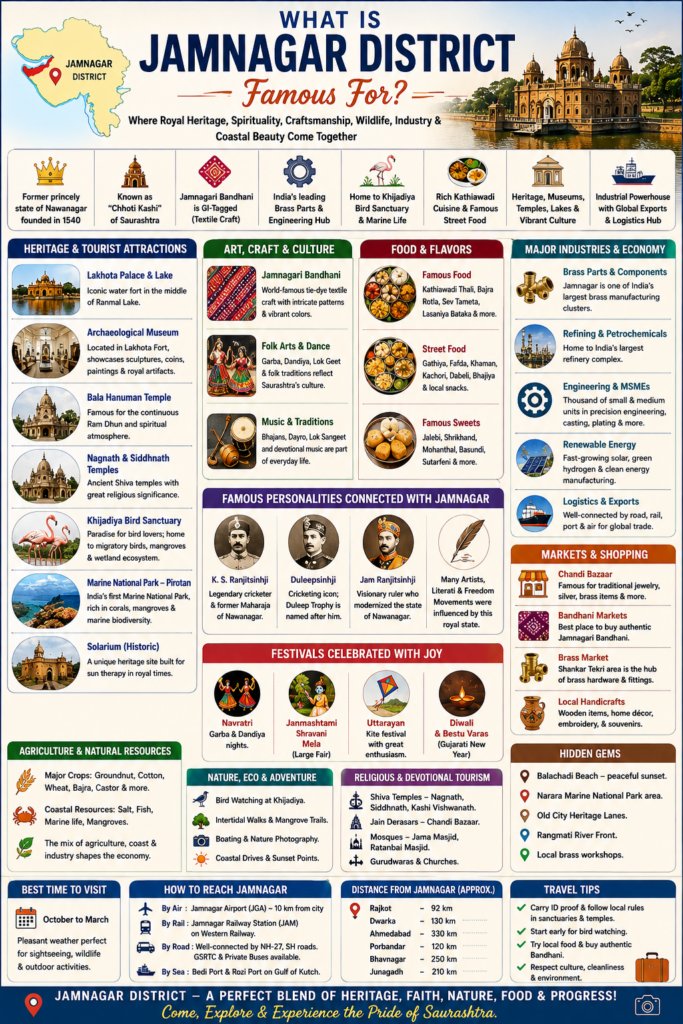
Jamnagar District is famous for a rare combination of royal Nawanagar heritage, Jamnagari Bandhani, brass engineering, temples, wetlands, marine biodiversity, lakes, Gujarati food, festivals, industry and coastal landscapes. Official district tourism highlights Lakhota, Khijadiya Bird Sanctuary, Marine National Park–Pirotan and religious heritage, while the GI Registry confirms Jamnagari Bandhani as a registered geographical indication.
| Category | Famous Attraction / Thing | Why It Is Famous | Historical / Cultural Significance | Best Time to Experience | Interesting Facts | Travel Tip |
|---|---|---|---|---|---|---|
| 🏰 Royal Heritage | Nawanagar legacy | Jamnagar was historically the capital of the princely state of Nawanagar | Founded in 1540 and associated with the Jadeja rulers | Oct–Mar | Jamnagar literally developed from the identity of the Jams of Nawanagar | Begin with Lakhota and the old city to understand the district |
| 🏛️ Heritage Monument | Lakhota Kotho | Iconic water fort and museum in Ranmal Lake | Built in 1846 under Jam Ranmalji and now a protected monument | Oct–Mar | Combines Rajput architecture with Iranian influence | Visit near sunset after the museum |
| 🏺 Museum | Archaeological Museum, Lakhota | Regional sculpture, coins, paintings, textiles and royal objects | Preserves Nawanagar and wider regional heritage | Year-round | Located inside historic Lakhota Kotho | Check current museum timings |
| 🌅 Lake | Ranmal / Lakhota Lake | Jamnagar’s signature urban landscape | Closely tied to the city’s royal and civic history | Oct–Mar | One of the easiest places for sunset photography | Combine with Bala Hanuman Temple |
| 🙏 Devotional Tourism | Bala Hanuman Temple | Famous for its continuous Ram Dhun tradition | One of Jamnagar’s best-known religious landmarks | Year-round | Located on the bank of Lakhota Lake | Visit in the evening for temple + lake ambience |
| 🕉️ Temple Culture | “Chhoti Kashi” identity | Jamnagar has a dense concentration of important temples | Reflects the city’s long Shaivite and devotional tradition | Year-round | District tourism explicitly describes Jamnagar as Chhoti Kashi | Plan a temple circuit rather than rushing individual shrines |
| 🔱 Shiva Heritage | Nagnath, Siddhnath, Kashi Vishwanath, Bhidbhanjan | Important local Shiva temples | Part of Jamnagar’s historic religious geography | Maha Shivratri / winter | Several major shrines lie within the city | Dress modestly and avoid peak queues |
| 🕍 Jain Heritage | Jain Derasar, Chandi Bazaar | Important Jain religious presence | Reflects the city’s mercantile and multicultural history | Year-round | Located in the old commercial core | Respect photography rules |
| ☪️ Islamic Heritage | Jama Masjid, Ratanbai Masjid, Vohra-no-Hajiro | Historic Muslim religious architecture | Demonstrates Jamnagar’s diverse urban culture | Oct–Mar | These sites coexist with Hindu, Jain, Sikh and Parsi landmarks | Avoid visiting during prayer rush unless attending respectfully |
| 🪯 Sikh Heritage | Gurudwara, Jamnagar | Community worship and hospitality | Part of Jamnagar’s multi-faith identity | Year-round | Listed among official religious attractions | Cover your head before entering |
| ⛪ Christian Heritage | Local churches | Part of Jamnagar’s modern religious diversity | Smaller but meaningful Christian community presence | Christmas / year-round | Not a dominant tourism category | Verify church access before visiting |
| 🧵 GI-Tagged Handicraft | Jamnagari Bandhani | Intricate tie-dye textile tradition | Registered GI handicraft connected to Jamnagar’s identity | Year-round | GI registration is valid through 2030 | Ask about handwork, fabric and provenance before buying |
| 👗 Textile Culture | Bandhani sarees and dupattas | Bright colors and traditional patterns | Strongly associated with weddings and Gujarati dress | Wedding/festival season | Often bought for bridal and festive use | Compare workmanship instead of judging only by color |
| 🔩 Major Industry | Brass parts | Jamnagar is one of India’s best-known brass-component clusters | Family-run workshops evolved into precision engineering units | Year-round | Components serve electrical, plumbing, automotive and industrial markets | Industrial buyers should audit suppliers and specifications |
| ⚙️ MSME Cluster | Precision engineering | Dense ecosystem of machining, casting, plating and tooling | Built through generations of specialized small enterprises | Year-round | Strong B2B and export orientation | Visit factories only with prior appointment |
| 🛢️ Heavy Industry | Refining and petrochemicals | Jamnagar has global industrial significance | Large-scale refinery investment transformed the regional economy | Year-round | The industrial landscape is vastly different from the old city | Do not photograph restricted industrial infrastructure |
| ⚡ Emerging Industry | Renewable-energy manufacturing | New solar, battery and hydrogen-linked investment | Represents Jamnagar’s next phase of industrial transformation | Year-round | Connects old engineering skills with new energy technology | Best understood through business research, not casual tourism |
| 🚚 Logistics | Project and industrial freight | Manufacturing, refinery and energy activity generate major cargo flows | Important to western Gujarat’s supply chains | Year-round | Includes FTL, containers and specialized heavy haulage | Industrial visitors should plan routes and security access in advance |
| ⚓ Maritime Economy | Bedi and Rozi coastal belt | Port-linked trade and industrial marine activity | Gulf of Kutch location gave Jamnagar strategic commercial importance | Oct–Mar for sightseeing context | Operational port areas may be restricted | Never enter port zones without permission |
| 🦩 Wildlife | Khijadiya Bird Sanctuary | Wetland bird diversity and migratory species | Important conservation landscape close to the Gulf of Kutch | Nov–Feb | Combines freshwater and saline habitats | Reach around sunrise with binoculars |
| 🪸 Marine Wildlife | Marine National Park–Pirotan | Coral, mangroves, intertidal habitats and marine biodiversity | One of India’s pioneering marine protected landscapes | Oct–Mar | Access depends on tide, permissions and current rules | Never promise Pirotan access without checking |
| 🌿 Eco-Tourism | Mangroves and tidal wetlands | Distinct coastal ecology | Critical wildlife habitat | Winter | Jamnagar’s nature is coastal rather than mountainous | Avoid disturbing intertidal life |
| 🏖️ Coast | Balachadi-side coastal landscape | Relaxed sunset and picnic atmosphere | Part of Jamnagar’s Gulf-side geography | Oct–Mar | Better for scenery than classic resort-beach tourism | Do not assume swimming is safe |
| 🌳 Gardens & Leisure | Lakhota lakefront / city gardens | Easy family outings | Part of Jamnagar’s urban recreation landscape | Oct–Mar evenings | Suitable for all ages | Best paired with nearby food |
| ⛰️ Hill Stations | None as a defining Jamnagar attraction | Jamnagar is not a genuine hill-station district | Its identity is coastal and semi-arid | — | Inventing hills for SEO would be misleading | Choose other Gujarat destinations for hill travel |
| 💦 Waterfalls | No major signature waterfall | Waterfalls are not a defining Jamnagar tourism feature | Geography is better known for coast, wetlands and lakes | Monsoon for countryside | Seasonal water features should not be mislabeled as major attractions | Do not market Jamnagar as a waterfall destination |
| 🧗 Adventure | Intertidal exploration and nature trips | Adventure comes through ecology rather than mountain sports | Connected to Gulf of Kutch landscapes | Winter | Tide timing can matter more than clock time | Use authorized/local guidance where required |
| 🍽️ Local Cuisine | Gujarati & Kathiawadi food | Strong regional flavor and simple hearty meals | Reflects Saurashtra’s food culture | Year-round | Bajra rotla, sev tameta and regional thalis are common favorites | Ask about spice level |
| 🥨 Street Food | Gathiya, fafda, khaman, snacks | Popular breakfast and evening eating culture | Everyday urban food tradition | Year-round | Morning snack culture is especially lively | Choose busy, hygienic stalls |
| 🍬 Sweets | Jalebi, shrikhand, local mithai | Popular at festivals and family functions | Strong connection with Gujarati celebration culture | Festivals / year-round | Sweet shops are integral to local gifting | Buy dairy sweets close to departure in summer |
| 🥘 Kathiawadi Meals | Rotla, lasaniya preparations, sev tameta | Robust Saurashtra flavors | Linked with regional rural food traditions | Winter | Often spicier than standard Gujarati food | Order buttermilk and specify spice preference |
| 🛍️ Traditional Market | Chandi Bazaar | Jewellery, textiles and old-city shopping | Longstanding commercial area | Oct–Mar | Also near religious heritage | Explore on foot |
| 🧵 Shopping | Bandhani markets | Best cultural souvenir category | Directly connected to Jamnagar’s textile heritage | Year-round | Quality varies significantly | Ask whether work is handmade |
| 🏭 Industrial Market | Shankar Tekri | Brass and engineering cluster | Symbol of Jamnagar’s MSME economy | Business hours | More valuable to buyers than ordinary tourists | Arrange B2B visits beforehand |
| 🌾 Agriculture | Groundnut | Important local crop | Supports oil mills, trade and rural livelihoods | Harvest/market season | District administration lists groundnut among major crops | Check live mandi rates for commercial buying |
| 🌱 Agriculture | Cotton, wheat, bajra, castor | Important rural production base | Supports agriculture and commodity trade | Seasonal | Jamnagar’s economy is not purely industrial | Rural visits should respect private farmland |
| 🎡 Festival | Shravani / Jamnagar Lok Mela | Large fair atmosphere | Combines devotion, commerce and entertainment | Around Janmashtami/Shravan | One of the district’s major public cultural gatherings | Expect heavy crowds |
| 💃 Festival | Navratri Garba | Dance, music and traditional attire | One of Gujarat’s most visible cultural traditions | Sep–Oct | Old Jamnagar retains traditional Garba forms | Ask before close-up photography |
| 🪁 Festival | Uttarayan | Kite flying | Major Gujarati winter celebration | Around mid-January | Rooftops become highly animated | Watch for kite strings on roads |
| 🪔 Festival | Diwali & Gujarati New Year | Lights, sweets, markets and family traditions | Important cultural and commercial season | Oct–Nov | Business schedules may change during Bestu Varas | Book accommodation early |
| 🦚 Festival | Janmashtami | Krishna devotion and fairs | Saurashtra has deep Krishna cultural connections | Aug–Sep | Often overlaps with major local fair activity | Expect temple crowds |
| 🏏 Sports Heritage | K. S. Ranjitsinhji | One of India’s most celebrated historical cricket figures | Nawanagar ruler whose name lives on in the Ranji Trophy | Year-round | Jamnagar has an unusual royal-cricket legacy | Sports-history readers should explore Nawanagar history |
| 🏏 Sports Heritage | Duleepsinhji | Important cricket personality connected with Nawanagar | Part of the region’s princely sporting tradition | Year-round | Duleep Trophy carries his name | Include in sports-history storytelling |
| 👑 Famous Royal Figure | Jam Ranjitsinhji | Royal ruler and cricketer | Internationally important in cricket history | Year-round | Helped shape Jamnagar’s modern royal identity | Do not confuse royal history with current administration |
| 📚 Literature & Culture | Gujarati/Saurashtra literary traditions | Regional language and storytelling | Reflects the cultural evolution of western Gujarat | Festivals / cultural events | Gujarati remains dominant in everyday cultural life | Local-language interaction enriches travel |
| 🗣️ Languages | Gujarati, Hindi and local Saurashtra speech forms | Everyday communication and identity | Reflects migration, commerce and regional culture | Year-round | English is understood in many tourism/business settings | Learning simple Gujarati greetings helps |
| 🎶 Folk Music | Garba, devotional bhajans, folk traditions | Integral to religious and festival life | Passed through community celebrations | Navratri / religious events | Traditional music may coexist with modern amplified events | Seek smaller community events for authenticity |
| 💃 Folk Dance | Garba & Dandiya | Jamnagar participates deeply in Gujarat’s dance culture | Ritual, festive and social importance | Navratri | Traditional street Garba can differ from commercial events | Respect devotional context |
| 🏫 Education | Gujarat Ayurved University / ITRA legacy | Jamnagar is nationally important for Ayurveda education and research | Helped establish the city as a centre for Ayurvedic learning | Year-round | Ayurveda is one of Jamnagar’s strongest educational identities | Academic visitors should verify campus-access rules |
| ☀️ Unique Heritage | Historic Solarium | Unusual medical-history structure | Established in the princely era | Oct–Mar | District tourism describes it as a rare attraction | Verify current visitor access |
| 🌍 Eco-Photography | Khijadiya & Gulf landscapes | Birds, wetlands and coastal light | Combines conservation with tourism | Winter | Excellent sunrise photography | Use long lenses instead of approaching wildlife |
| 📸 Urban Photography | Lakhota and old Jamnagar | Reflections, gates, bazaars, temples | Historic city layers remain visible | Oct–Mar | Early morning offers softer light and lighter traffic | Avoid obstructing commercial streets |
| 🚗 Weekend Travel | Heritage + wildlife combination | Compact mix of city and nature | Good for short Saurashtra breaks | Nov–Feb | A two-day trip can combine lake, museum and birding | Add another day for coast |
| 🧭 Hidden Gem | Old-city heritage lanes | Less commercialized travel experience | Architectural and social history survives in everyday streets | Winter mornings | Best discoveries are often between major landmarks | Walk slowly and ask before photographing people |
| 🌅 Unique Experience | Temple + lake + local dinner evening | Combines spirituality, scenery and food | Reflects contemporary Jamnagar lifestyle | Oct–Mar | One of the easiest first-time itineraries | Start at Bala Hanuman and end with dinner |
| 🧑💼 Business Travel | Brass + energy ecosystem | Strong industrial demand | Generates hotels, logistics and professional services | Year-round | Jamnagar attracts visitors who arrive primarily for work | Add half a day for heritage sightseeing |
| 🌐 Export Identity | Brass components | Precision parts travel to domestic and global markets | Demonstrates the power of clustered MSMEs | Year-round | Small components can serve large international industries | B2B buyers should verify certifications |
| 🚀 Startup Opportunity | Industrial technology | Automation, QC, logistics, recycling and energy services have demand | Built around existing manufacturing problems | Year-round | Jamnagar’s startup opportunity is more B2B than consumer-app driven | Solve existing supply-chain pain points |
| 🧭 Gateway Role | Western Saurashtra | Useful base toward Rajkot, Dwarka and Porbandar | Strategic position within western Gujarat | Oct–Mar | Jamnagar links industry, pilgrimage and coastal travel | Combine districts rather than rushing through |
Jamnagar’s tourism authority confirms the importance of Khijadiya Bird Sanctuary, Marine National Park–Pirotan, Ranmal Lakhota Lake, Archaeological Museum and the city’s religious sites. (Jamnagar District) The district also records its origin as Nawanagar, founded in 1540 as a major Jadeja princely state in Saurashtra.
✨ Why Jamnagar Is Special in One Sentence

Jamnagar is famous because royal Nawanagar history, Chhoti Kashi temples, GI-tagged Bandhani, brass engineering, Gulf of Kutch marine life and Khijadiya’s birds all coexist within one remarkably diverse district.
🌟 Interesting Things Jamnagar Is Especially Known For

- Jamnagari Bandhani is officially GI registered, making it one of the district’s strongest authentic shopping and cultural identities.
- Jamnagar was historically Nawanagar, founded in 1540 and shaped by the Jadeja rulers.
- Lakhota Kotho is a historic water fort, now functioning as an archaeological museum and protected monument.
- Jamnagar is known as Chhoti Kashi because of its concentration of important religious places.
- Khijadiya is one of Jamnagar’s strongest wildlife attractions, combining freshwater wetlands, tidal mudflats, creeks, saline land and mangrove habitat.
- The Gulf of Kutch marine ecosystem gives Jamnagar an ecological identity quite different from ordinary beach destinations.
- Brass manufacturing and precision engineering give Jamnagar a strong international industrial reputation.
- K. S. Ranjitsinhji’s legacy gives the former princely state an unusual place in Indian cricket history.
- The city’s tourism appeal works particularly well for heritage travelers, birdwatchers, photographers, devotees, food lovers, business travelers and short weekend visitors.
❤️ Why First-Time Travelers Should Visit Jamnagar

Come to Jamnagar if you want a destination that refuses to fit into one category.
Come for a winter morning among birds at Khijadiya. Come for the reflections of Lakhota at sunset. Listen to the Ram Dhun beside the lake. Buy Bandhani from people who understand the craft. Taste Gujarati and Kathiawadi food. Walk the old markets. Learn how tiny brass components built a global manufacturing reputation.
Then look toward the Gulf and realize that the same district also protects one of India’s most remarkable marine landscapes.
That combination—heritage, devotion, craftsmanship, wildlife, food and industrial ambition—is what Jamnagar District is truly famous for.
🛡️ Common Travel Myths, Tourist Scams, Safety Issues & Solutions in Jamnagar District

Jamnagar is a major tourism, pilgrimage, business and industrial destination, and visitors should approach safety practically rather than fearfully. There is no sound basis for portraying ordinary scams listed below as uniquely or unusually common in Jamnagar. They are general travel risks that can occur in many Indian destinations, alongside Jamnagar-specific concerns such as summer heat, monsoon disruption, protected coastal ecosystems and restricted industrial areas.
For emergencies, India’s unified emergency number is 112. Jamnagar District currently lists Police 100, Ambulance 108, Fire 101, Disaster Control Room 1077, Women Helpline 1091, and Child Helpline 1098. Gujarat also operates the Abhayam 181 Women Helpline statewide.
🚨 Jamnagar Travel Myths, Scams, Problems & Practical Solutions Chart

| Myth / Scam / Problem | Reality | Common Target | Warning Signs | Prevention Tips | Recommended Solution | Emergency Helpline / Authority |
|---|---|---|---|---|---|---|
| 🚕 Taxi fare overcharging | An unmetered/private ride can cost more if fare is not agreed beforehand | First-time visitors, airport/rail passengers | Driver avoids quoting fare or changes amount later | Use app fare estimate or agree total fare before departure | Pay agreed fare; keep vehicle details if disputing serious misconduct | Police 112 / 100 |
| 🛺 Auto-rickshaw fare dispute | Short trips may involve negotiated fares | Tourists unfamiliar with local distances | “Meter not working,” unclear fare | Ask hotel/local staff for approximate fare; agree before boarding | End ride at safe public location if disagreement escalates | Police 112 / 100 |
| 🚖 “Your hotel is closed” story | Never accept such a claim without checking yourself | New arrivals | Driver recommends a different hotel immediately | Call your booked hotel directly | Go only to the address on your confirmed reservation | Police if coercion occurs |
| 🏨 Fake accommodation listing | Fraudulent or misleading listings can occur online anywhere | Budget travelers, couples | Extremely low price, off-platform payment, no verifiable address | Cross-check hotel name, recent reviews and location | Contact booking platform/bank quickly after suspected fraud | Cyber fraud 1930 |
| 💳 Fake hotel payment request | A scammer may impersonate accommodation staff | Travelers with upcoming bookings | WhatsApp payment link or urgency threat | Contact hotel through independently verified details | Block payment/card where possible and report immediately | 1930 |
| 🎟️ Counterfeit attraction ticket | Not every person claiming to sell admission is authorized | First-time tourists | Cash-only “special ticket,” no receipt | Buy at official counter/authorized booking channel | Do not pay unofficial agents | Attraction management / Police |
| 🧑🏫 Fake or unofficial guide | A friendly stranger is not automatically an authorized guide | Heritage tourists | Aggressive approach, no identification, vague pricing | Confirm fee and credentials before starting | Decline politely and use recognized guides where required | Tourist/attraction authority |
| 💰 Guide changes price afterward | Usually caused by failing to establish terms | Foreign and family travelers | “Pay whatever you like” followed by demand | Fix total price, duration and inclusions beforehand | Pay only agreed amount | Police if threatened |
| 📱 UPI QR-code scam | You do not need to scan a QR code or enter a UPI PIN to receive ordinary UPI money | Almost anyone | “Scan this to receive refund/prize” | Read every UPI screen before approving | Contact bank immediately after unauthorized transfer | Cyber fraud 1930 |
| 🔐 OTP fraud | Legitimate payment support should not require handing an OTP to strangers | Senior citizens, less tech-confident travelers | Caller asks for OTP, PIN or CVV | Never share OTP, PIN, CVV or UPI PIN | Freeze affected account/card quickly | 1930 |
| 💸 Fake UPI payment screenshot | A screenshot does not prove that money reached your account | Vendors and travelers receiving refunds | Person shows “successful” screenshot | Check your own banking/UPI app | Trust actual account credit, not sender screenshot | Bank / 1930 |
| 🏧 ATM assistance scam | Strangers offering unsolicited ATM help may be risky | Seniors, distracted visitors | Person stands too close or asks for card/PIN | Cover keypad; refuse assistance | Block card immediately if compromised | Bank + 1930 |
| 🏧 ATM skimming/tampering | Tampered ATMs are a general banking risk | All travelers | Loose card slot, suspicious keypad/camera | Prefer bank-branch ATMs in visible locations | Stop transaction and inform bank | Bank / Police |
| 📞 “Digital arrest” scam | Police or government agencies do not legitimately demand money through threatening video calls to avoid arrest | Travelers and families | Threats, secrecy demands, urgent transfers | Disconnect and independently verify with authorities | Preserve evidence and report immediately | 1930 / 112 |
| 🎁 Prize/refund scam | Unexpected winnings/refunds requiring a fee are major warning signs | Tourists shopping online | “Pay processing charge first” | Do not transfer money | Save evidence and report | 1930 |
| 📶 Public Wi-Fi risk | Open networks can expose sensitive activity | Café/hotel users | Unsecured network with suspicious login | Avoid banking on unknown Wi-Fi | Use mobile data for payments | Cybercrime 1930 if fraud occurs |
| 👛 Pickpocketing | Crowded places require ordinary precautions | Festival visitors, market shoppers | Unnecessary crowding/contact | Keep phone/wallet in secure front/closed bag | Block cards and report theft | 112 / 100 |
| 🎒 Unattended luggage | Railway/bus areas require normal vigilance | Families and solo travelers | Stranger asks you to leave baggage | Keep luggage under your control | Inform security/police if stolen | Police/Railway authorities |
| 🛍️ Bandhani authenticity confusion | Not every colorful tie-dye item has identical workmanship or provenance | Souvenir buyers | Seller makes unverifiable “pure handmade” claims | Compare shops and ask about technique/fabric | Request invoice for expensive purchases | Consumer grievance route if warranted |
| 💎 Jewellery purity issue | Appearance alone cannot establish precious-metal purity | Wedding shoppers | Resistance to hallmark/invoice questions | Buy from established jeweller and check applicable hallmarking | Preserve bill and product | Consumer authority / Police for suspected fraud |
| 🔩 Brass souvenir overpricing | Price and quality vary | Business and souvenir buyers | No weight/specification or invoice | Compare multiple sellers | Obtain written specification for B2B purchase | Consumer/legal remedy as applicable |
| 🍽️ Food bill disagreement | Menu prices, taxes and extras should be checked | Families/groups | No menu or unclear pricing | Check price before ordering expensive items | Request itemized bill | Consumer grievance route |
| 🍴 “Famous local restaurant” claim | Popularity on social media does not guarantee quality | Food tourists | Paid-looking reviews, no recent evidence | Check several recent sources and local demand | Choose busy, hygienic establishments | Food-safety authority if serious issue |
| 🥤 Unsafe drinking water | Heat makes hydration essential, but unsafe water can cause illness | Everyone | Broken bottle seal, questionable water source | Use sealed/verified drinking water | Seek medical help for severe symptoms | Ambulance 108 |
| ☀️ Summer heat exhaustion | Jamnagar can become very hot | Children, seniors, outdoor tourists | Dizziness, headache, weakness | Avoid intense midday exposure; hydrate | Move to cool area and seek medical attention if severe | 108 |
| 🌧️ Monsoon road disruption | Heavy rain can temporarily affect roads and low-lying areas | Drivers, rural tourists | Waterlogging, official warnings | Check weather/road conditions before departure | Delay or reroute rather than crossing unsafe water | Disaster Control 1077 |
| 🌊 Unsafe sea swimming assumption | A coastline does not automatically mean safe swimming | Families, couples | Strong currents, tidal flats, no lifeguard | Swim only where explicitly considered safe | Leave water during worsening conditions | 112 / 108 |
| 🌊 Tide miscalculation | Gulf of Kutch intertidal travel can depend heavily on tides | Marine tourists, photographers | Water level changing rapidly | Use authorized guidance and current tide information | Return before conditions become unsafe | Forest/local authority / 112 |
| 🪸 Collecting coral/shells from protected areas | Protected marine ecosystems are not souvenir shops | Marine tourists | Guide/person encourages wildlife removal | Leave natural material where it belongs | Follow protected-area instructions | Forest Department |
| 🦩 Getting too close to birds | Khijadiya is a wildlife habitat, not a staged photo set | Photographers | Chasing/flushing birds | Use binoculars/telephoto lens | Move back immediately if wildlife reacts | Forest/sanctuary authority |
| 🛥️ Unauthorized Pirotan trip | Access to protected marine areas may involve current permissions and operational restrictions | Adventure tourists | Agent promises guaranteed unrestricted access | Verify current official access first | Do not board questionable boat trips | Forest/Marine authorities |
| 🏭 Industrial-area photography | Refineries, ports, airport/defence-sensitive and industrial sites can have restrictions | Photographers, vloggers | Security signage/barriers | Ask permission before photography | Delete/stop recording if lawfully instructed | Site security / Police |
| ⚓ “Bedi Port is an ordinary tourist attraction” | Operational port areas may have controlled access | Curious tourists | Gates/security restrictions | Observe only from legal public areas | Follow port instructions | Port authority |
| 🚧 Restricted-area shortcut | Google Maps can sometimes suggest roads unsuitable or inaccessible to tourists | Self-drive visitors | Security gate, industrial road, private property | Use established public roads | Turn back instead of arguing with security | Police if genuinely stranded |
| 🚗 Rental-car damage dispute | Existing damage should be documented | Road-trip travelers | Vehicle handed over without inspection | Photograph/video vehicle before accepting | Compare return condition with timestamped images | Rental company / consumer remedy |
| ⛽ Fuel-related disagreement | Verify pump display before fueling | Self-drive travelers | Meter not reset | Watch zero reading and retain receipt | Raise issue with station manager | Oil-company grievance channel |
| 🅿️ Fake parking collector | Not everyone demanding roadside cash represents an official facility | Drivers | No rate board, receipt or authorization | Use marked parking and ask for receipt | Move to verified parking | JMC/Police |
| 🚫 Illegal parking | Narrow markets and busy roads are not safe places to abandon a vehicle | Self-drive tourists | No-parking signage, obstruction | Use designated parking | Follow traffic authority directions | Traffic Police |
| 🚆 Train ticket “agent” fraud | Reserved tickets should come through legitimate channels | Outstation tourists | Stranger promises guaranteed berth | Use official/authorized reservation channel | Report suspicious transaction | Railway authority / 1930 if online fraud |
| 🚌 Wrong private-bus boarding point | Private coaches may use different pickup/drop points | First-time passengers | Ticket says vague landmark | Confirm exact map location and operator contact | Arrive early | Bus operator |
| ✈️ Fake flight cancellation/refund call | Fraudsters can exploit travel disruptions | Air passengers | Caller requests OTP/card/UPI PIN | Check airline app/site independently | Contact airline/bank directly | 1930 |
| 🚕 Late-night unsolicited ride | Convenience should not override verification | Solo/women travelers | Driver pressures you away from official pickup area | Use verified taxi/app/hotel transfer | Share trip details with trusted person | 112 / 100 |
| 👩 Women travelers’ safety concern | Normal precautions and reliable transport are more useful than fear-based claims | Solo women | Isolated area, unwanted following/contact | Prefer populated routes and verified rides after dark | Move to a staffed/public location and seek help | 181 / 1091 / 112 |
| 👵 Senior citizen mobility problem | Heat, long walks and uneven heritage surfaces may create more difficulty than crime | Seniors | Fatigue, inaccessible stairs | Arrange cab, rest breaks and suitable hotel | Shorten itinerary | 108 for medical emergency |
| ♿ Accessibility assumptions | Historic sites may not provide uniform step-free access | Travelers with disabilities | Stairs, uneven surfaces | Confirm accessibility before departure | Arrange assistance/alternative viewpoint | Attraction management |
| 👶 Lost child in festival crowd | Large fairs and festivals can separate families | Families | Dense crowd | Put guardian contact details with child | Alert police/event control immediately | Child Helpline 1098 / 112 |
| 🎆 Festival overcrowding | Navratri, Janmashtami and fairs can create traffic/crowd pressure | Everyone | Packed entrance/exit | Arrive early and establish family meeting point | Leave before congestion becomes unsafe | Police 112 / 100 |
| 🌙 Isolated night sightseeing | Some nature/coastal areas are unsuitable for casual late-night exploration | Couples, photographers | Poor lighting, few people, weak network | Finish remote sightseeing before dark | Return to populated area | 112 |
| 🐕 Stray animal/road hazard | Animals can appear on urban and rural roads | Drivers, bikers | Poor visibility at night | Slow down and avoid sudden swerving | Seek medical help after bite/injury | 108 |
| 🛵 Helmet neglect | Short tourist trips still carry road risk | Bike/scooter users | Rental provider minimizes safety | Wear proper helmet | Do not accept unsafe vehicle | Traffic Police |
| 📸 Photographing people without consent | A public place does not remove basic privacy and cultural courtesy | Photographers/vloggers | Visible discomfort or objection | Ask before close portraits | Stop if requested | Police only if dispute escalates |
| 🛕 Temple “mandatory donation” confusion | Genuine donations are generally distinct from officially priced services/tickets | Pilgrims | Stranger insists payment is compulsory without official basis | Use official counter/donation box | Ask temple management | Temple administration |
| 👟 Temple etiquette problem | Footwear, clothing and photography rules vary | First-time tourists | Posted restrictions | Read signs and follow local custom | Cooperate with temple staff | Temple management |
| 💵 Carrying excessive cash | Digital payments are common, but backup cash remains useful | All travelers | Large visible cash bundle | Split money and cards | Block lost cards immediately | Bank / Police |
| 📍 Blind reliance on map apps | Navigation apps can be wrong around rural/private/industrial roads | Self-drive travelers | Road becomes narrow, gated or unpaved | Cross-check with signage/local advice | Turn back safely | 112 if stranded/emergency |
| 🔋 Phone battery failure | Tickets, maps, UPI and cab apps often depend on the phone | Digital-first travelers | Low battery before remote trip | Carry power bank and offline hotel address | Ask verified establishment for assistance | — |
| ⚡ EV charging assumption | A charger shown online may be busy or temporarily unavailable | EV road trippers | Long rural stretch with low battery | Keep backup chargers/routes | Recharge before remote coastal trips | Charging operator |
| 🧳 “Everything can be seen in one day” | Jamnagar’s heritage, wetlands and coastal experiences need sensible pacing | First-time visitors | Overloaded itinerary | Prioritize 2–4 experiences per day | Drop lower-priority stops | — |
Cyber-financial fraud deserves especially fast action: the Government of India’s National Cyber Crime Reporting Portal directs victims of financial cyber fraud to call 1930 immediately, and complaints can also be filed through the national portal.
| Emergency / Problem | Contact | When to Use |
|---|---|---|
| 🚨 Unified Emergency Response | 112 | Immediate emergency requiring police/emergency response |
| 👮 Jamnagar Police | 100 | Crime, theft, threat or police assistance |
| 🚑 Ambulance | 108 | Medical emergency |
| 🔥 Fire | 101 | Fire emergency |
| 🌧️ District Disaster Control Room | 1077 | Flood, cyclone, severe weather or district disaster |
| 👩 Jamnagar-listed Women Helpline | 1091 | Women’s emergency assistance |
| 👩 Gujarat Abhayam Women Helpline | 181 | Women’s guidance, support, distress and rescue services |
| 👶 Child Helpline | 1098 | Child protection/emergency |
| 🕵️ Crime Stopper | 1090 | Crime-related assistance as listed by district administration |
| 💻 Cyber Financial Fraud | 1930 | UPI, card, banking and other cyber-financial fraud |
| ☎️ Citizen Call Centre | 155300 | Citizen-service assistance |
| 👮 Jamnagar District Police Control Room | 0288-2550200 | District police control room |
Jamnagar District’s official helpline page confirms its local emergency numbers, while its police directory currently provides station and control-room contacts throughout the district. (Jamnagar District) Gujarat’s Women & Child Development Department confirms that Abhayam 181 operates across all districts and can provide guidance, assistance and rescue services to women in distress.
🛡️ Essential Safety Rules for First-Time Jamnagar Visitors

- Keep 112, 108, 181 and 1930 saved before traveling.
- Never share an OTP, CVV, ATM PIN or UPI PIN with a caller, hotel, taxi driver or supposed bank employee.
- If money disappears through a suspected cyber scam, contact 1930 immediately rather than waiting until the next day.
- Confirm taxi/auto fares or use an app estimate before beginning an unfamiliar journey.
- Book hotels, buses, trains and flights through established official or reputable channels.
- Keep receipts for expensive Bandhani, jewellery and other major purchases.
- Carry sealed drinking water and reduce strenuous afternoon sightseeing during extreme summer heat.
- Check weather before monsoon road trips and use 1077 for district disaster assistance when necessary.
- Treat Khijadiya, mangroves and marine habitats as protected ecosystems—not picnic grounds.
- Never enter refineries, operational ports, defence-sensitive zones or other restricted industrial property merely because a map shows a road.
- Women arriving late should favor verified app cabs, hotel transfers or known taxi services; Gujarat’s 181 Abhayam service is available statewide when assistance is needed.
- Seniors should prioritize comfortable transport, shade, hydration, elevators and shorter walking circuits rather than trying to match a younger group’s itinerary.
⚠️ Important Reality Check for Travelers

A responsible Jamnagar safety guide should not claim that taxi scams, pickpocketing, fake guides, food fraud or crimes against tourists are especially prevalent in Jamnagar unless reliable evidence demonstrates that.
The more useful approach is preparation.
Verify before paying. Keep control of your phone and banking credentials. Use authorized booking channels. Respect wildlife and restricted industrial areas. Check weather and tides before coastal outings. Use well-lit, populated places for late-evening travel, and contact official authorities when something genuinely feels unsafe.
With those ordinary precautions, visitors can focus on what brought them to Jamnagar in the first place: Lakhota’s heritage, Bala Hanuman’s spiritual atmosphere, Jamnagari Bandhani, Gujarati and Kathiawadi flavors, Khijadiya’s birdlife and the extraordinary coastal ecology of the Gulf of Kutch.

🛣️ National Highways, Road Connectivity & Travel Advisory for Jamnagar District, Gujarat
Jamnagar District has strong road connectivity with Rajkot, Kalavad, Dhrol, Lalpur, Jamjodhpur, Devbhumi Dwarka, Porbandar and the wider Saurashtra highway network. For tourists, industrial travelers and goods-transport operators, the most important routes are the national-highway corridors feeding Jamnagar from the east and northeast, together with major state highways, bypasses and city arterial roads.
The most important practical point is that road classifications and local traffic restrictions can change. A road that appeared as a State Highway in an older map may later be upgraded, renumbered or absorbed into a National Highway. Likewise, city no-entry timings for trucks may be changed through temporary police notifications. For that reason, this guide separates verified highway facts from travel-risk guidance and avoids inventing permanent truck timings, crime zones or accident black spots where no current official location-wise notification is available.
🚗 Major National Highways Connecting Jamnagar District

| Highway / Corridor | Important Jamnagar Connection | Main Direction / Places Served | Importance for Travelers & Freight | Typical Road Character | Travel Advice |
|---|---|---|---|---|---|
| NH-927D | Jamnagar – Kalavad corridor | Jamnagar → Kalavad → Jamkandorna → Dhoraji → NH-27 | Major eastern/southeastern connection toward central Saurashtra and NH-27 | Intercity highway | Useful toward Dhoraji/Junagadh-side routes; check roadworks and local traffic |
| NH-151A | Dhrol / northern district corridor | Connects the Jamnagar-side region through Dhrol toward Morbi and wider northern Gujarat routes | Important passenger, industrial and freight corridor | Sections under widening/improvement | Construction caution around Dhrol/Amran-side works |
| NH-27 connection via regional network | Access through Dhoraji/Rajkot-side network | Major national east-west highway connectivity beyond Jamnagar | Links Jamnagar traffic with wider Gujarat and India | High-capacity national corridor outside much of Jamnagar district | FASTag and toll planning needed on onward journeys |
| Jamnagar–Dwarka highway corridor | Westbound from Jamnagar | Jamnagar → Khambhalia → Dwarka region | Major pilgrimage, tourism and industrial route | Busy intercity route | Watch mixed tourist, bus and heavy-vehicle traffic |
| Jamnagar–Rajkot corridor | Eastbound regional gateway | Jamnagar → Dhrol/Rajkot direction depending selected route | Most important connection to Rajkot | Heavy passenger and commercial traffic | Allow extra time near towns and junctions |
The Ministry of Road Transport and Highways officially defines NH-927D as a 108 km highway beginning at NH-27 near Dhoraji, passing Jamkandorna and Kalavad, and terminating at Jamnagar.
NHAI’s current infrastructure records also show active four-laning work on NH-151A around the Dhrol bypass and Amran missing-link section, with the project covering roughly 12.25 km and a target completion timeframe extending into 2027. Travelers should therefore expect construction zones, lane shifts and temporary speed restrictions on affected stretches.
🛤️ Important State Highways & Regional Roads
Several older Gujarat road classifications identify key corridors serving Jamnagar, though travelers should use these more as route identities than permanent numbering guarantees, because road upgrades and renumbering can occur.
| Important Road / Traditional SH Corridor | Key Places | Main Use | Traveler Relevance |
|---|---|---|---|
| Jamnagar–Kalavad road | Jamnagar, Kalavad | Passenger + agricultural + industrial | Important southeastern district connection |
| Jamnagar–Lalpur road | Jamnagar, Lalpur | Rural, industrial and regional | Useful for western/southern district travel |
| Jamnagar–Dhrol road | Jamnagar, Dhrol | Rajkot/northern regional movement | Heavy mixed traffic |
| Jamnagar–Jamjodhpur road | Jamnagar, Jamjodhpur | Rural and inter-district travel | Scenic rural drive in good weather |
| Jamnagar–Bedi road | City to Bedi maritime belt | Port/industrial traffic | Expect trucks and restricted operational zones |
| Jamnagar–Sikka road | City toward Sikka industrial/coastal belt | Industry, refinery-linked movement | Heavy commercial traffic and security-sensitive areas |
| Jamnagar–Khambhalia road | Toward Devbhumi Dwarka | Pilgrimage, industry, freight | One of the busiest westbound corridors |
| Hapa / bypass approaches | Hapa, industrial/rail areas | Freight, APMC, industrial movement | Truck traffic and market congestion can be significant |
Older Gujarat highway listings identify corridors such as SH-22 through Dhrol, SH-23 through Kalavad/Lalpur, SH-26 through Jamnagar–Kalavad and SH-27 through Jamnagar–Lalpur, but these should not be treated as immutable current road numbers without checking the latest state road notification.
🚦 Does Jamnagar Have an Expressway?
Jamnagar District does not currently have a major operational controlled-access expressway comparable with the Ahmedabad–Vadodara Expressway running through the district.
For road-trip planning, Jamnagar should therefore be considered a highway-based destination rather than an expressway destination.
That matters because travelers should expect:
- at-grade junctions;
- village access;
- two-wheelers;
- tractors;
- pedestrians;
- commercial vehicles;
- occasional livestock;
- local buses entering and leaving traffic.
Even on improved four-lane sections, do not drive as if the road were a closed expressway.
🚧 Jamnagar Road Safety & Traveler Awareness Chart
| Road Issue / Location Type | Current Reality | Main Risk | Who Should Be Extra Careful | Prevention | Alternate / Solution |
|---|---|---|---|---|---|
| NH-151A Dhrol–Amran works | Major highway improvement project is under implementation | Construction machinery, diversions, lane changes | Night drivers, buses, trucks | Reduce speed and obey temporary signs | Allow extra time or use current navigation advice |
| Jamnagar–Rajkot travel | Important busy regional route | Mixed-speed traffic and junction congestion | Families, highway drivers | Avoid aggressive overtaking | Start early and keep buffer time |
| Jamnagar–Khambhalia/Dwarka corridor | Heavy pilgrimage + commercial traffic | Buses, trucks, tourist vehicles | First-time drivers | Maintain safe following distance | Travel during daylight when possible |
| Bedi road | Port-linked traffic | Heavy trucks and controlled areas | Tourists, cyclists | Stay on public roads | Do not enter operational port gates |
| Sikka industrial corridor | Major industrial movement | Heavy vehicles and restricted photography/security zones | Tourists, photographers | Follow industrial signage | Use only authorized public routes |
| Hapa / APMC approaches | Agriculture and freight activity | Trucks, loading vehicles and congestion | Small-car drivers, pedestrians | Avoid peak mandi activity if sightseeing | Use bypass/alternative urban approach |
| Old Jamnagar markets | Narrow, busy streets | Pedestrians, autos and limited parking | SUVs and tourist buses | Park outside dense market lanes | Walk or use auto-rickshaw |
| Lakhota / central city | Popular urban attraction | Evening traffic and parking demand | Families on weekends | Arrive before peak evening | Use legal paid/marked parking |
| Rural roads | Variable width/lighting | Animals, tractors, potholes after rain | Night drivers | Slow down after sunset | Prefer daytime travel |
| Monsoon low-lying sections | Temporary flooding can occur | Hidden potholes, water currents | Cars and bikes | Never enter unknown floodwater | Wait or reroute |
| Coastal access roads | Tidal/industrial geography | Remote stretches and weak night visibility | Couples/photographers | Return before late night | Use known public roads |
| Highway construction diversions | Temporary | Confusing lane alignment | Outstation drivers | Follow signs, not only phone navigation | Recheck route after each diversion |
| Night driving | Not inherently unsafe but visibility falls | Animals, unlit vehicles, fatigue | Solo and senior drivers | Take breaks and reduce speed | Stop at established towns |
| Fog/haze | Less common than north India but possible locally | Reduced visibility | Winter early-morning drivers | Use low beam, reduce speed | Delay departure if visibility is poor |
| Summer road travel | Extreme heat possible | Tyre overheating, dehydration | Long-distance travelers | Check tyres, coolant and water | Rest during peak afternoon |
| Cyclone/heavy weather | Gulf coast can face severe weather | Flooding, closures, high winds | All travelers | Follow district alerts | Suspend travel when authorities advise |
🚫 No-Entry Roads & Heavy-Vehicle Restrictions in Jamnagar
Local traffic authorities may impose time-based heavy-vehicle restrictions in congested commercial and city areas. However, I did not find a current official 2026 city-wide notification that safely confirms permanent hour-by-hour truck restrictions for every Jamnagar road.
For this reason, an evergreen guide should not publish unverified timings such as “9 AM–10 PM” as permanent law.
The most reliable approach is:
| Area Type | Likely Restriction Concern | Best Practice |
|---|---|---|
| Old-city commercial roads | Heavy-vehicle access can be restricted | Follow current Traffic Police signage |
| Chandi Bazaar / Pancheshwar side | Narrow commercial streets | Avoid trucks and large tourist buses |
| Market areas | Peak pedestrian congestion | Use peripheral parking |
| School/hospital areas | Temporary local restrictions | Obey posted signs |
| Festival routes | Temporary closures/diversions | Check police advisory on event day |
| Industrial-to-city freight movement | Truck timing controls may apply | Transporters should verify before dispatch |
| ODC movements | Special route/permission requirements | Obtain route survey and competent authority approvals |
A non-official online Jamnagar logistics page publishes specific no-entry claims for Pancheshwar Tower, Chandi Bazaar and Khambhalia Road, but because I could not corroborate those exact hours through a current police/government notification, they should not be treated as authoritative traffic law.
🚚 Truck & ODC Travel Advice
For ordinary truck drivers, always confirm:
- current city-entry timing;
- axle and gross-weight compliance;
- FASTag;
- parking availability;
- unloading slot;
- industrial gate timing;
- festival diversions.
For ODC/heavy-haul cargo, also verify:
- bridge load capacity;
- overhead electrical lines;
- railway crossings;
- sharp turns;
- median openings;
- height barriers;
- traffic permissions;
- police escort requirement;
- night-movement permission;
- industrial gate geometry.
Jamnagar’s refinery, brass, port and new-energy industries make this especially important.
🌧️ Flood-Prone & Monsoon Travel Awareness
Jamnagar’s monsoon risk is not comparable with a Himalayan landslide destination.
The main concern is temporary urban waterlogging, overflowing local drainage, low-lying rural roads and water over causeways/road depressions during intense rainfall.
| Monsoon Problem | Warning Sign | Safe Action |
|---|---|---|
| Water across road | Road edge no longer visible | Do not enter |
| Underpass flooding | Vehicles turning back | Use surface diversion |
| Strong flowing water | Debris moving across roadway | Stop well before water |
| Rural bridge/causeway overflow | Water crossing structure | Wait for official reopening |
| Potholes hidden by water | Unknown depth | Slow down or reroute |
| Lightning/heavy storm | Poor visibility | Park safely away from trees/power lines |
| Cyclonic weather | Official alert | Avoid unnecessary travel |
Jamnagar’s District Disaster Control Room currently lists 1077 and 0288-2553404 for disaster-related assistance.
⛰️ Landslide & Ghat Sections
Jamnagar is not a major ghat or landslide district.
Travelers should not expect the kind of mountain-road hazards found in the Western Ghats or Himalayas.
Its primary natural road risks are instead:
- heavy rain;
- waterlogging;
- coastal weather;
- heat;
- high winds;
- poor visibility;
- rural road conditions.
This is an important factual distinction for trustworthy travel content.
🚦 Major Congestion Hotspots
Traffic levels vary by time and event, but these locations/types commonly require extra travel time because of their function:
| Area | Why Congestion Can Build | Better Strategy |
|---|---|---|
| Pancheshwar / old city | Dense markets and narrow streets | Walk or use auto |
| Chandi Bazaar | Shopping and pedestrian activity | Visit outside busiest evening period |
| Lakhota / Ranmal Lake | Tourism and evening recreation | Arrive before sunset peak |
| Hapa | Railway, APMC and freight movement | Allow buffer time |
| Industrial approaches | Shift changes + heavy traffic | Avoid major shift-change windows if possible |
| GSRTC / railway approaches | Passenger pickups/drop-offs | Use designated pickup areas |
| Festival venues | Temporary crowd surges | Park away and walk |
| Airport Road / major junctions | Business and urban traffic | Allow additional city-transfer time |
💳 Toll Plazas & FASTag Awareness
Toll exposure depends heavily on your origin and route.
NHAI currently records toll plazas on major NH-27 corridors around wider Saurashtra, including Bharudi and Pithadiya on the Gondal–Rajkot section, while Dhumiyani serves the Porbandar–Jetpur corridor. These are not necessarily encountered on every Jamnagar journey.
| Travel Direction | Toll Expectation |
|---|---|
| Jamnagar city local travel | Usually none |
| Jamnagar–nearby district roads | Route-dependent |
| Long-distance NH travel | Expect tolls |
| Ahmedabad/central Gujarat road trip | Multiple tolls possible |
| Porbandar/Junagadh circuit | Toll depends on selected NH route |
| Kutch onward travel | Multiple NH tolls possible |
Travel with:
- active FASTag;
- sufficient FASTag balance;
- vehicle RC;
- driving licence;
- insurance;
- pollution certificate where applicable.
Toll rates change periodically, so avoid publishing a permanent fixed tariff inside an evergreen travel article.
🅿️ Parking Availability
| Area | Parking Situation | Recommendation |
|---|---|---|
| Lakhota Lake | Limited/managed urban parking nearby | Reach early |
| Old city / Chandi Bazaar | Limited | Park outside dense streets |
| Hotels | Many mid/premium hotels provide onsite parking | Confirm before booking |
| Railway Station | Passenger parking/drop zones | Follow station signage |
| Airport | Regulated airport parking | Follow current airport tariff |
| Khijadiya | Visitor arrangements subject to sanctuary setup | Do not block approach |
| Highway restaurants | Usually easier than city centre | Confirm bus/truck space |
| Industrial estates | Private/site-controlled | Obtain visitor permission |
| Bedi/Sikka operational zones | Restricted/private parking | Do not park at industrial gates |
Jamnagar Municipal Corporation has previously published a formal pay-and-park framework, but charges and individual facilities can change, so travelers should follow the current displayed parking rate and obtain a receipt.
⚡ EV Charging & Electric-Car Road Trips
EV infrastructure is growing in Gujarat, but charging-point status changes too quickly to make a static station list genuinely evergreen.
Before an EV trip to Jamnagar:
| EV Planning Step | Recommendation |
|---|---|
| City charging | Check live charging apps |
| Hotel charging | Confirm before booking |
| Highway charger | Keep at least one backup |
| Coastal trip | Start with high state of charge |
| Khijadiya/rural trip | Do not assume destination charging |
| Connector | Verify CCS2/other compatibility |
| Long queue | Keep enough range to reach alternate station |
| Faulty charger | Report to network operator |
Do not arrive at a remote coastal destination with minimal battery simply because a map displayed one charger.
🚨 Roadside Emergency Services
| Emergency | Number / Authority |
|---|---|
| Unified emergency | 112 |
| Police | 100 |
| Ambulance | 108 |
| Fire | 101 |
| Disaster Control Room | 1077 |
| Jamnagar Police Control Room | 0288-2550200 |
| Women Helpline | 1091 / Gujarat 181 |
| Child Helpline | 1098 |
Jamnagar District’s current helpline and police pages confirm these official contacts and list the District Police Control Room at 0288-2550200.
👮 Crime Zones & Personal-Safety Awareness
A responsible travel guide should not brand individual Jamnagar neighborhoods as “crime zones” without official crime-rate evidence.
I did not find a current government source identifying any tourist neighborhood as a formally designated “crime zone.”
Instead, apply risk based on situation, not stigma.
| Situation | Risk Level | Safer Choice |
|---|---|---|
| Busy market in daytime | Normal urban caution | Secure wallet/phone |
| Lakhota evening | Generally populated | Use normal city precautions |
| Railway/bus arrival late night | Moderate situational caution | Pre-book cab/auto |
| Isolated coastal road after dark | Higher situational risk | Return before late night |
| Industrial road at night | Not appropriate for casual tourism | Stay on public route |
| Empty rural shortcut | Avoid if unfamiliar | Use main signed road |
| Festival crowd | Pickpocket/separation risk | Set meeting point |
| ATM in isolated location | Avoid | Use bank/bright commercial area |
| Unverified roadside parking | Theft/damage risk | Use staffed/legal parking |
Recent Jamnagar traffic-police enforcement has included action around Lakhota lakefront and Nuri Chowkdi, demonstrating active policing of vehicle-rule violations; this should not be interpreted as evidence that those locations are crime zones.
🚗 Safe Driving Rules for Jamnagar District
| Situation | Best Practice |
|---|---|
| Highway overtaking | Overtake only with full visibility |
| Village junction | Reduce speed in advance |
| Heavy truck nearby | Stay out of blind spots |
| Multi-axle/ODC cargo | Give extra passing room |
| Night driving | Use low beam around approaching traffic |
| Two-wheelers | Wear certified helmet |
| Children | Use age-appropriate restraint |
| Rain | Increase following distance |
| Floodwater | Never test depth with vehicle |
| Fatigue | Stop every few hours |
| Tyres | Check pressure before summer highways |
| Phone navigation | Passenger should operate phone where possible |
| Railway crossing | Never bypass closed barrier |
| Port/industrial gate | Do not stop for photography |
| Wildlife/cattle | Brake progressively, avoid violent swerving |
🔄 Alternate Route Planning
A single “best alternate route” cannot be permanently recommended because accidents, construction and flooding are dynamic.
Use this decision process:
| If This Happens | Do This |
|---|---|
| NH construction causes delay | Follow signed diversion rather than unsurfaced shortcut |
| Jamnagar city congestion | Use official bypass/ring-road option where navigation confirms |
| Old city blocked | Park externally and continue by auto/walking |
| Monsoon road closure | Wait or take authority-approved alternate |
| Accident shuts highway | Follow Police/NHAI diversion |
| Festival procession | Avoid city core |
| Industrial gate congestion | Wait outside legally or use confirmed industrial approach |
| Map suggests private road | Turn back |
Never allow navigation software to override a police barricade, closed bridge, no-entry sign, private-property gate or flood warning.
🚚 Jamnagar Road Connectivity for Industrial & Logistics Travelers
Jamnagar’s roads serve much more than tourism.
They carry:
- brass components;
- machinery;
- petroleum-related cargo;
- agricultural produce;
- containerized goods;
- construction materials;
- oversized project equipment;
- renewable-energy machinery.
The district also has maritime access through Bedi and Rozi ports, while the official travel page confirms Jamnagar’s strong road connection with Gujarat cities and places Rajkot about 92 km away.
For transport companies, the core risk is not simply road condition.
It is the combination of vehicle dimensions + route geometry + traffic restrictions + bridge capacity + industrial gate access + permissions.
🧭 Best Road-Trip Advice for First-Time Visitors

For a first Jamnagar visit, daylight driving is preferable when leaving the city for wildlife or coastal locations.
If arriving from Rajkot, keep time in hand rather than treating map ETA as guaranteed.
If continuing toward Dwarka, expect pilgrimage buses and commercial traffic.
If driving in monsoon, check the weather before leaving the hotel.
If your destination is an industrial facility, obtain the correct gate and access instructions in advance—large refinery complexes can have multiple controlled approaches.
If you are visiting markets, use a smaller vehicle or park outside the old-city core.
And if a local road looks unsafe, flooded, heavily under construction or restricted, turning around is usually smarter than proving that your vehicle can get through it.
✅ Jamnagar Road Travel Checklist

Before a highway trip, confirm fuel/EV range, tyres, spare wheel, brakes, FASTag, insurance, licence, weather, accommodation parking and expected arrival time.
Keep 112, 108 and 1077 saved.
Use the latest navigation map, but prioritize road signs and police instructions over the app.
Avoid isolated coastal or industrial roads late at night unless travel is genuinely necessary.
And for heavy trucks or ODC cargo, never use an ordinary tourist-route recommendation as a substitute for a professional road-route survey.
Jamnagar has excellent strategic connectivity, but its mix of tourism traffic, agriculture, ports, industrial plants, villages and heavy freight means good driving requires patience rather than speed.
That is the most important road-safety rule for Jamnagar District.
🧳 Travel Planning, Booking, Safety & Tourist Assistance Guide for Jamnagar District, Gujarat
Planning a first trip to Jamnagar is straightforward once you separate the journey into four parts: how you will reach the city, who will handle bookings, how you will move around locally, and what safety backups you will keep ready.
Jamnagar has physical travel agencies handling domestic and international holidays, flights, hotels, visas, customized tours and corporate travel, while Gujarat Tourism also publishes registered tour operators and registered guides for the destination. Its current Jamnagar tourism information identifies Royal Travel, Sunrise Holidays and HIR International among registered operators, and the state tourism portal maintains searchable lists of approved operators and tourist guides.
For first-time visitors, the safest approach is not to choose an agency only because it appears first in an online search. Compare a physical office, written itinerary, cancellation rules, hotel names, vehicle type, taxes, payment schedule and emergency support before sending a significant advance.
✈️ Verified Physical Travel Agencies & Tour Operators in Jamnagar
Phone numbers are intentionally privacy-masked for public publishing: the first and last digits remain visible while middle digits appear as …... Google ratings below are dynamic snapshots and can change.
| Agency Name | Address | Contact | Services | Domestic / International | Road | Rail | Air | Cruise | Visa & Passport | Hotel Booking | Travel Insurance | Google Rating* | Best For | Why Choose | Travel Tip |
|---|---|---|---|---|---|---|---|---|---|---|---|---|---|---|---|
| UNIGLOBE Royal Travel | Shreeji Imperia, F-1 A & B, above City Union Bank, Park Colony, Jamnagar | 0…..3 | Flights, hotels, travel management, visa services, corporate travel | Both | Arrange/confirm | Ask | Yes | Ask | Yes | Yes | Ask | Not reliably published in retrieved source | Corporate, international, visa-focused trips | Gujarat Tourism lists Royal Travel as a registered tour operator; its own site promotes flight/hotel booking and visa services | Ask for written visa checklist and refund conditions before payment |
| SaveTime Holidays | Bedi Gate Road, near Town Hall, Jamnagar | 0…..7 / 0…..8 | Air tickets, railway tickets, passport, visa, hotels, tour packages, study abroad | Both | Ask | Yes | Yes | Ask | Yes | Yes | Ask | — | Air + rail + visa planning | Company states it began in 1994 and is IATA/UFTAA/TAAI affiliated | Verify whether railway booking is direct agency service or authorized reservation support |
| Travel Temptations – Just a Mile Apart | Lal Bunglow, Patrakar Colony, Jamnagar | 9…..1 | Travel-agency planning; confirm individual products | Ask | Ask | Ask | Ask | Ask | Ask | Ask | Ask | 4.9 | Customized trip consultation | Strong current local rating and physical office | Ask for an itemized itinerary rather than only package total |
| Fit2Fly Holidays Pvt Ltd | Near Amusement Park, Mahavir Park, Jamnagar | 9…..0 | Tours/holiday planning; confirm flights, hotels and visa support directly | Ask | Ask | Ask | Ask | Ask | Ask | Ask | Ask | 5.0 | Family and leisure holidays | Highly rated local tour agency | Confirm exactly which services are handled in-house |
| Bandhav Tours Pvt ltd | C-32, Road No. 1, opposite Vikas Gruh, Indradeep Society, Jamnagar | 9…..1 | Travel-agency services and tours | Ask | Ask | Ask | Ask | Ask | Ask | Ask | Ask | 4.7 | General holiday planning | Long-standing reviewed local travel agency presence | Request recent customer references for complex international trips |
| FLY2HIGH HOLIDAYS | Ashirwad Complex, Gurudwara Road, Patrakar Colony, Jamnagar | 6…..0 | Tour operator / holiday planning | Ask | Ask | Ask | Ask | Ask | Ask | Ask | Ask | 4.9 | Holiday packages and group travel | Strong current rating | Verify hotel names before paying package advance |
| Express Holiday Mart | 104-B, Madhav Square, opposite Avantika Complex, Lal Bunglow Circle, Jamnagar | 9…..8 | Travel-agency and holiday-planning services | Ask | Ask | Ask | Ask | Ask | Ask | Ask | Ask | 4.9 | Couples, families, customized trips | Large review base for a local office | Compare package inclusions against direct hotel/flight prices |
| Travelcations Holiday | Office 8, Sanidhya Complex, Patel Colony, Jamnagar | 7…..0 | Tour operator, itinerary planning | Ask | Ask | Ask | Ask | Ask | Ask | Ask | Ask | 4.9 | Customized leisure trips | Highly rated local tour operator | Ask who provides 24-hour emergency support during the trip |
| Shree varudi tours & travels | Indira Marg, opposite Harsiddhi Mataji Temple, near Janta Fatak, Jamnagar | 9…..1 | Travel-agency services; 24-hour listing | Ask | Yes/confirm | Ask | Ask | Ask | Ask | Ask | Ask | 4.9 | Road travel, late-hour assistance | Current listing shows 24-hour operation | Confirm whether office service itself operates overnight or only phone support |
| Infinite Adventure | Royal Heights, near Khodiyar Temple, Khodiyar Colony, Jamnagar | 9…..0 | Tour operator; adventure-oriented planning | Domestic / ask international | Yes | Ask | Ask | Ask | Ask | Ask | Ask | 4.9 | Adventure and activity-led itineraries | Useful specialist category for travelers wanting more than standard sightseeing | Verify insurance, operator credentials and activity safety standards |
SaveTime specifically states that it provides air tickets, railway tickets, passport, visa, hotel and tour-package services, while UNIGLOBE Royal Travel publishes visa, flight and hotel-booking support.
Gujarat Tourism separately lists Royal Travel, Sunrise Holidays and HIR International as registered tour operators for Jamnagar, which is a useful verification layer when choosing assistance for a Gujarat itinerary.
🌍 Specialized Booking & Visa Assistance
| Service Need | Verified / Suitable Option | What to Confirm Before Paying |
|---|---|---|
| International flight + visa | UNIGLOBE Royal Travel / SaveTime Holidays | Visa category, embassy fee, service fee, refund policy |
| Passport assistance | SaveTime advertises passport support | An agency can assist with forms; passport approval remains with government authority |
| Study abroad | SaveTime and specialist immigration consultants operate locally | University recognition, visa category, refund clauses |
| Holiday visa consultation | Dream Viza Services | Visa decision is made by embassy/consulate, never guaranteed by consultant |
| Immigration/student visa | Royal Immigration & Student Visa Services | Check documentation and written service agreement |
| Visa consultancy | VISA X CONSULTANCY | Never pay for a “guaranteed visa” promise |
No legitimate agent can guarantee that an embassy, consulate or immigration authority will approve a visa. An agency can prepare documents, arrange appointments and advise on process; the official authority makes the decision.
🚕 Car Rentals, Airport Transfers & Local Sightseeing
| Provider | Location | Contact | Main Service | Rating* | Best For | Safety / Booking Tip |
|---|---|---|---|---|---|---|
| PT car rental | Aerodrome Road, Khodiyar Colony | 9…..4 | Car rental | 4.9 | Airport transfers, local sightseeing | Confirm km allowance, toll, driver allowance and night charges |
| Shailesh Car & Bike Private Limited | Dwarkesh Complex, near Samarpan Over Bridge | 9…..7 | Car leasing / vehicle hire | 4.6 | Car/bike requirements and flexible travel | Check insurance, vehicle papers and damage policy |
| Aram Travels | Pandit Nehru Marg, Jamnagar | 9…..5 | Car rental | 4.9 | 24-hour transport and city/outstation travel | Obtain written outstation price |
| Dwarkadhish cab jamnagar | Jamnagar | Contact via current listing | Car rental | 4.9 | Dwarka and regional road trips | Confirm exact pickup point and vehicle registration |
For Jamnagar sightseeing, a cab is especially useful for Khijadiya, coastal areas, industrial business visits and onward trips toward Dwarka, Rajkot or Porbandar. Central attractions such as Lakhota Lake, Bala Hanuman Temple and markets are often easier by auto, cab or local bus.
🚌 Which Booking Method Is Best?
| Travel Requirement | Best Booking Channel | Why |
|---|---|---|
| Domestic flight | Airline website/app | Direct schedule and support |
| International flight | Airline or experienced IATA-type agent | Useful for complex routing |
| Indian Railways | IRCTC / authorized booking source | Official reservation system |
| GSRTC bus | GSRTC official booking | State-transport schedules |
| Private bus | Established operator / trusted booking portal | Multiple sleeper/AC options |
| Hotel | Hotel direct or major booking platform | Easier comparison |
| Visa | Official embassy/VFS-type process + verified consultant if needed | Avoid fake guarantees |
| Travel insurance | Insurer/authorized agent | Policy wording matters |
| Gujarat tour guide | Gujarat Tourism registered-guide list | Stronger credential verification |
| Package tour | Physical agency + written itinerary | Useful for families/groups |
| Cruise | Cruise line/experienced cruise agency | Visa and port requirements can be complex |
Gujarat Tourism’s registered-guide portal and toll-free assistance line are particularly useful when a visitor wants a recognized guide rather than an unsolicited person approaching outside an attraction. Gujarat Tourism currently publishes toll-free tourist assistance at 1800 203 1111.
🗓️ Essential Jamnagar Trip Planning Guide
| Planning Question | Practical Recommendation |
|---|---|
| Best overall season | October to March |
| Best birdwatching | November to February |
| Best city sightseeing time | Morning and late afternoon |
| Summer strategy | Sightsee early, rest midday, return in evening |
| Monsoon strategy | Maintain flexible road/coastal plans |
| Recommended first trip | 2–4 days |
| Wildlife-focused trip | Add early-morning Khijadiya visit |
| Marine trip | Verify tides, permits and access first |
| Business + tourism | Keep at least half a day for Lakhota/heritage |
| Family transport | Chauffeur-driven cab is easiest |
| Solo budget transport | Train/bus + city bus/auto |
| Senior citizen plan | Fewer attractions, cab transfers, elevator hotel |
| Corporate group | Pre-book coach, restaurant and hotel conference facilities |
💰 Practical Jamnagar Travel Budget
| Traveler Style | Approx Daily Budget per Person | Typical Experience |
|---|---|---|
| Backpacker | ₹1,000–₹2,000 | Budget stay, bus/auto, local food |
| Budget Couple | ₹2,000–₹4,000 | Basic hotel + city sightseeing |
| Comfortable Traveler | ₹3,500–₹7,000 | Mid-range hotel + cabs + restaurants |
| Premium Couple | ₹7,000–₹15,000+ | Premium hotel, private vehicle, upscale dining |
| Family | ₹3,000–₹8,000 pp | Hotel, cab, attractions and meals |
| Corporate | ₹4,000–₹12,000+ pp | Business hotel, transfers, meals |
| Wildlife/Photography | ₹3,000–₹8,000+ | Transport, guide and specialized timing |
Planning estimates excluding long-distance air/rail fares.
🎒 Jamnagar Packing Checklist
- Government-issued identification
- Flight/train/bus confirmations
- Hotel address saved offline
- Light cotton clothing
- Comfortable walking footwear
- Hat/cap and sunglasses
- Sunscreen
- Refillable drinking-water bottle
- Prescription medicines
- Small first-aid kit
- ORS/electrolytes for hot weather
- Power bank
- Phone charging cable
- Small amount of backup cash
- Bank cards
- Rain jacket/umbrella during monsoon
- Light winter layer for early winter mornings
- Binoculars for Khijadiya
- Waterproof camera pouch for coastal trips
- Mosquito repellent
- Travel-insurance details where applicable
🚌 Public Transport & Last-Mile Assistance
Jamnagar is connected by air, Western Railway and state/private buses; Gujarat Tourism currently places Jamnagar Airport about 9 km from the city centre and identifies Jamnagar, Hapa and Modpur among railway points serving the region.
| Transport | Best For | Limitation |
|---|---|---|
| City bus | Lowest-cost urban movement | Routes/frequencies require checking |
| Auto-rickshaw | Short city journeys | Agree fare when needed |
| App cab | Visitors unfamiliar with city | Availability/surge can vary |
| Taxi | Families, seniors, outer attractions | More expensive |
| Rental car | Flexible multi-day travel | Parking and driver responsibility |
| Bike | Solo traveler | Weather and road safety |
| GSRTC | Intercity Gujarat travel | Longer than private vehicle |
| Train | Long-distance travel | Last-mile transfer still needed |
| Flight | Fastest access | Limited schedules compared with metro cities |
🚨 Verified Emergency & Tourist Assistance Contacts
| Assistance | Number / Authority | Use |
|---|---|---|
| Unified national emergency | 112 | Immediate emergency |
| Jamnagar Police | 100 | Police assistance |
| Ambulance | 108 | Medical emergency |
| Fire | 101 | Fire emergency |
| District Disaster Control Room | 1077 | Flood, cyclone, disaster |
| Women Helpline | 1091 | Women’s emergency support |
| National Women Helpline | 181 | Women in distress/support |
| Child Helpline | 1098 | Child protection/emergency |
| Crime Stopper | 1090 | Crime-related assistance |
| Citizen Call Centre | 155300 | Citizen assistance |
| Cyber Financial Fraud | 1930 | UPI/card/banking fraud |
| Gujarat Tourism | 1800 203 1111 | Tourism information/support |
Jamnagar District’s official helpline page, updated in August 2026, confirms 101, 100, 108, 1077, 1098, 1091, 1090 and 155300. (Jamnagar) The National Cyber Crime Reporting Portal states that victims of financial cyber fraud should call 1930 immediately.
🏥 Medical & Health Planning
For ordinary illness, Jamnagar has government and private medical facilities, but travelers should keep 108 for genuine emergencies.
Before travel:
| Traveler | Medical Preparation |
|---|---|
| Senior citizen | Carry prescription + medicine list |
| Diabetic traveler | Keep medicines/snacks in hand baggage |
| Cardiac patient | Avoid peak heat and excessive walking |
| Child | Carry pediatric basics prescribed by doctor |
| Pregnant traveler | Discuss long-distance travel with physician |
| Disabled traveler | Confirm hotel and vehicle accessibility beforehand |
| International visitor | Keep insurance documentation and passport copy |
Do not rely on a travel guide to diagnose symptoms. Severe dehydration, chest pain, breathing difficulty, loss of consciousness, major injury or other serious symptoms warrant urgent medical help.
👩 Women, Solo, Senior & Child Traveler Safety
| Traveler | Main Concern | Practical Solution |
|---|---|---|
| Solo woman | Late-night transfers | Use verified app cab/hotel transfer and share trip details |
| Solo man/woman | Isolated coastal road | Finish remote sightseeing before late night |
| Senior citizen | Heat, stairs, long walks | Cab transfers + shorter itinerary |
| Child | Crowded festival separation | Keep guardian contact details with child |
| Couple | Remote sunset locations | Return toward populated areas before late night |
| Student group | Group coordination | Use attendance/meeting-point system |
| Disabled traveler | Uneven heritage access | Call attraction/hotel beforehand |
| Foreign visitor | Communication/payment confusion | Keep hotel card/address and verified local guide |
📱 UPI, ATM & Cashless Payment Safety
Digital payments are widely useful, but the most important rule is:
You do not enter a UPI PIN to receive ordinary money.
| Risk | Prevention |
|---|---|
| QR-code refund scam | Never scan an unknown QR merely to “receive money” |
| OTP fraud | Never disclose OTP |
| UPI collect request | Read amount and recipient before approval |
| Fake payment screenshot | Check your own account balance |
| ATM shoulder surfing | Cover PIN keypad |
| Card skimming | Prefer bank/brightly located ATMs |
| Fake customer care | Use bank/app official number |
| Remote-screen app scam | Never install screen-sharing software at stranger’s request |
If money has been fraudulently transferred, call 1930 immediately rather than waiting.
⚠️ Common Tourist Scams & Prevention
| Scam / Problem | Warning Sign | Prevention | What to Do |
|---|---|---|---|
| Fake travel agent | Only WhatsApp, no verifiable office | Verify office and written invoice | Stop payment and report fraud |
| Fake hotel listing | Unrealistically low price | Call hotel independently | Contact bank/platform |
| Taxi overcharging | Fare not agreed | Use app/agree fare | End trip safely and dispute appropriately |
| Fake guide | No credentials, aggressive approach | Use registered guide | Decline and report harassment |
| Counterfeit ticket | Cash-only street seller | Buy official ticket | Inform attraction staff |
| QR scam | “Scan to receive refund” | Never approve unknown request | Call 1930 after loss |
| Visa scam | “100% guaranteed visa” | Embassy makes decision | Avoid consultant |
| Shopping fraud | No invoice for expensive goods | Compare shops and demand bill | Use consumer remedy |
| Pickpocketing | Dense festival/market crowd | Closed bag/front pocket | Block cards and inform police |
| Fake charity request | Pressure or emotional coercion | Donate only to verified organization | Walk away |
| Restaurant overcharge | No menu / unclear price | Ask price before ordering | Request itemized bill |
| Fake car rental | Advance to unverified number | Check office/vehicle | Do not transfer large advance |
| Adventure-tour fraud | No permits/safety information | Verify operator credentials | Cancel unsafe activity |
| Pirotan “guaranteed boat” | No mention of tide/permissions | Verify current official access | Do not board unauthorized boat |
🌧️ Weather & Monsoon Safety
Jamnagar’s biggest weather-related visitor risks are summer heat, heavy monsoon rain, coastal wind and occasional severe weather rather than mountain landslides.
The district operates an Emergency Operation Centre and lists 1077 / 0…..4 for disaster assistance.
| Condition | Safe Practice |
|---|---|
| Extreme summer heat | Avoid heavy sightseeing around midday |
| Dehydration | Carry water and electrolytes |
| Heavy monsoon rain | Delay rural/coastal travel |
| Flooded road | Never drive through unknown water depth |
| Lightning | Move into substantial shelter |
| Cyclone warning | Follow district instructions |
| Strong coastal wind | Avoid exposed marine areas |
| Poor visibility | Reduce speed or postpone road trip |
🦩 Wildlife, Marine & Adventure Safety
Khijadiya and Jamnagar’s marine environments should be treated as protected ecosystems rather than amusement areas.
Pirotan-related travel is tide-sensitive; Gujarat Tourism specifically warns that tide timing changes and travelers should ask locally about the day’s boat timing.
| Activity | Safety Rule |
|---|---|
| Khijadiya birdwatching | Stay quiet and keep distance |
| Wildlife photography | Use zoom lens rather than approaching |
| Marine intertidal visit | Follow current tide and guide instructions |
| Pirotan | Verify permits/access before departure |
| Mangrove visit | Do not damage roots or vegetation |
| Coastal drive | Stay on public roads |
| Swimming | Do not assume an unmonitored coast is safe |
| Boating | Use authorized operator and safety equipment |
| Adventure activity | Confirm insurance and trained operator |
🍽️ Food & Drinking-Water Safety
Jamnagar’s food is one of the pleasures of the trip, but heat makes basic hygiene important.
Choose establishments with good turnover, prefer freshly cooked hot food, and drink sealed or reliably filtered water.
During summer:
- avoid food that has sat exposed for long periods;
- refrigerate dairy sweets during long travel;
- drink more water than usual;
- do not replace every meal with fried snacks;
- reduce excessive spicy food if you are not accustomed to it.
Travelers with Jain, vegan, allergy or medically restricted diets should describe the actual ingredient restriction, not merely assume restaurant staff interpret a dietary label exactly the same way.
♿ Accessibility for Differently Abled Travelers
Jamnagar is manageable with advance planning, but accessibility is not uniform.
| Location Type | Accessibility Reality |
|---|---|
| Modern hotel | Usually easiest; confirm lift and accessible bathroom |
| Airport | Request airline wheelchair assistance |
| Railway station | Request official passenger assistance where available |
| Old heritage building | Stairs/uneven surfaces possible |
| Old city | Narrow streets and congestion |
| Khijadiya | Outdoor terrain may limit mobility |
| Coastal/intertidal area | Generally unsuitable for many mobility limitations |
| Temple | Access differs by individual shrine |
Ask specific questions: “Is there a step-free entrance?” is more useful than “Is it accessible?”
🌱 Eco-Friendly & Responsible Travel
Travel responsibly by carrying a reusable bottle, refusing unnecessary single-use plastic, keeping wetlands quiet, avoiding wildlife feeding, supporting genuine Bandhani craftsmanship, choosing locally owned food businesses, using shared transport where practical and never removing shells, coral or natural material from protected coastal environments.
Tourism should leave income and respect, not litter and disturbance.
✅ Local Do’s & Don’ts
| Do | Don’t |
|---|---|
| Dress respectfully at religious sites | Photograph worshippers intrusively |
| Ask before photographing people | Treat markets as photo sets |
| Verify prices before purchasing | Assume every “handmade” claim is equal |
| Carry hydration in summer | Plan exhausting midday walks |
| Check tide/access before marine travel | Arrive at Pirotan expecting guaranteed entry |
| Use licensed/verified transport | Enter an unknown vehicle without checking |
| Follow industrial security signs | Photograph refinery/defence-sensitive infrastructure |
| Keep emergency contacts saved | Depend entirely on internet connectivity |
| Use legal parking | Block old-city roads |
| Support authentic local craft | Bargain aggressively with artisans for tiny amounts |
⚖️ Advantages & Disadvantages of Visiting Jamnagar
| Advantages | Possible Limitations |
|---|---|
| Heritage + wildlife + industry in one destination | Not a classic hill-station destination |
| Strong railway and road connectivity | Flight network smaller than major metros |
| Excellent winter birdwatching | Summer can be extremely hot |
| Unique marine ecology | Marine access can be permit/tide dependent |
| GI-tagged Bandhani shopping | Quality varies by seller |
| Strong vegetarian food culture | Strict vegan travelers need ingredient verification |
| Useful gateway toward Dwarka/Rajkot | Remote coastal areas need private transport |
| Business + leisure potential | Industrial/security zones require care |
| Generally affordable compared with major tourist metros | Luxury tourism inventory is smaller than Goa/Udaipur |
📝 Before Booking Any Jamnagar Travel Package
Ask the agency to provide in writing:
- Exact hotel name
- Room category
- Meal plan
- Check-in/check-out dates
- Flight/train/bus details
- Vehicle type
- AC/non-AC status
- Kilometres included
- Toll and parking policy
- Driver allowance
- Sightseeing list
- Entry fees included/excluded
- Marine/wildlife permissions included/excluded
- Guide status
- Travel-insurance details
- Visa fee vs agency service fee
- GST/tax treatment
- Cancellation charges
- Refund timeline
- Emergency contact during journey
🌟 Practical Recommendation for a First-Time Jamnagar Traveler

For a simple Jamnagar trip, you do not necessarily need a travel agency. A confident traveler can book the train/flight and hotel independently, then arrange a local cab for Khijadiya or coastal sightseeing.
A verified local travel consultant becomes particularly valuable when the trip involves multiple cities, elderly passengers, corporate groups, international flights, visa paperwork, complex hotel combinations, pilgrimage circuits, school tours, honeymoon planning or specialized marine/nature arrangements.
For guides, use Gujarat Tourism’s registered-tourist-guide resources rather than accepting the first person who approaches you outside an attraction. For financial fraud, act quickly through 1930. For genuine emergencies, use 112/100/108, and for district weather or disaster problems use 1077.
The goal is not to make Jamnagar travel complicated. It is to remove avoidable uncertainty before you arrive.
Book through verifiable channels, preserve receipts, keep a realistic itinerary, use responsible local transport, protect your banking credentials, respect wildlife and religious places, and leave enough free time to enjoy what often becomes the best part of Jamnagar—the unplanned cup of tea, the quiet lake at sunset, the morning birds at Khijadiya and the conversations that happen between the famous attractions.
📚 Jamnagar District Movies, Books, Media, Museums, Archives & Trusted Research Resources
For travelers, students, historians, business researchers and content creators, the most reliable way to study Jamnagar District and historic Nawanagar is to combine current government sources with museums, census archives, established newspapers, historical books and carefully verified audiovisual material. The official Jamnagar District portal was updated in August 2026 and provides tourism, administration, emergency, citizen-service and district-reference information, while Gujarat Tourism and Incredible India provide broader visitor context.

🎬 Movies, Documentaries, Television & Visual Media Related to Jamnagar

| Resource Name | Category | Description | Why It Is Important | Best For | Official Website / Source | Travel & Learning Tip |
|---|---|---|---|---|---|---|
| Jamnagar / Nawanagar film-location research | Movies / Film Research | There is no authoritative consolidated government database of feature films shot specifically in present-day Jamnagar District | Prevents false “movie shot here” claims | Content Creators, Film Researchers | Verify with film credits, production companies and local authorities | Never copy film-location lists from unreferenced blogs |
| Polish Children & Jam Saheb Digvijaysinhji story | Documentary / Historical Film Subject | The wartime humanitarian story of the Nawanagar ruler and Polish refugees at Balachadi has inspired books and documentary interest | Important international humanitarian chapter of Nawanagar history | Historians, Students, Documentary Makers | Historical archives and reputable documentary sources | Distinguish Balachadi history from dramatized retellings |
| Nawanagar Royal History | Documentary Subject | Royal Jadeja history, princely-state administration and Jamnagar’s transformation provide rich documentary material | Explains how Nawanagar became modern Jamnagar | Historians, Students, Creators | Jamnagar District history resources (jamnagar.nic.in) | Use official history as chronology, then add archival research |
| Marine National Park – Gulf of Kutch | Wildlife Documentary Subject | Coral, mangroves, tidal ecology and marine wildlife | One of India’s most distinctive marine-documentary subjects | Wildlife Creators, Students, Families | Jamnagar District tourism (jamnagar.nic.in) | Check current protected-area access before filming |
| Khijadiya Bird Sanctuary | Nature / Bird Documentary | Wetlands supporting resident and migratory birds | Strong birdwatching and conservation subject | Birders, Students, Photographers | District tourism portal (jamnagar.nic.in) | Winter dawn produces the strongest field-learning experience |
| Lakhota Museum & Nawanagar Heritage | Travel / Heritage Video | Museum, fort, lake and royal collections | Excellent visual introduction to Jamnagar history | Families, Students, Creators | JMC / Archaeological Museum (mcjamnagar.com) | Professional shoots require checking current photography permissions |
| Sandesh News – Jamnagar coverage | Television / YouTube News | Major Gujarati news outlet regularly covering Jamnagar road, weather, civic and breaking news | Useful for current events rather than evergreen history | Travelers, Residents, Business Travelers | Sandesh News verified YouTube channel (YouTube) | Cross-check breaking reports with government advisories |

📖 Best Books & Historical Reading About Jamnagar and Nawanagar

| Resource Name | Category | Description | Why It Is Important | Best For | Official Website / Source | Travel & Learning Tip |
|---|---|---|---|---|---|---|
| The Jubilee Book of Cricket – K. S. Ranjitsinhji | Classic Book / Cricket | Cricket writing by Jamnagar’s most internationally celebrated royal sportsman | Connects Nawanagar with global cricket history | Sports Fans, Students, Historians | Major library/archive catalogues | Read alongside a modern biography of Ranji |
| Batting for the Empire: A Political Biography of Ranjitsinhji – Mario Rodrigues | Biography | Examines Ranji as cricketer, prince and political figure | Useful beyond simplified sporting biographies | Historians, Sports Researchers | Published-book/library catalogues | Particularly useful for colonial-era context |
| Historical biography of Jam Ranjitsinhji | Rare Book / Biography | Older publications document Ranji, reconstruction of Jamnagar, industries, banking and public works | Valuable primary/near-primary historical perspective | Historians, Researchers | Rare-book catalogues (rarefinds.co.in) | Treat period language and praise critically |
| India and the War – Nawanagar section | Historical Reference | Contemporary material on Jam Ranjitsinhji and the princely state | Useful snapshot of Nawanagar during the imperial period | Historians, Students | Rare Book Society of India archive (Rare Book Society of India) | Compare historical population/boundaries with modern Jamnagar |
| Nawanagar: The Immortal Ranji | Historical Biography | Archival account focused on the celebrated Jam Saheb | Helpful for cricket and princely-state history | Sports Historians, Researchers | IGNCA digitized archive (IGNCA) | Excellent supplementary source, not a modern district guide |
| Nawanagar State Census Report | Government Historical Document | Historic census information compiled for the former princely state | Primary source for population and administration | Researchers, Historians | Census India digital archive (Census India) | Ideal for comparing princely and modern demographic structures |
| Jamnagar District Census Handbooks | Government Research | Historical census volumes covering settlements, occupations, population and infrastructure | Valuable long-term district research resource | Students, Researchers, Planners | Census India NADA (Census India) | Always note the census year before quoting figures |
| Jamnagar District Profile | Government Report | Concise government district profile | Useful for baseline administrative research | Students, Businesses, Content Creators | District Jamnagar portal (jamnagar.nic.in) | Check publication date because some statistics may be historical |

📰 Newspapers, Local News & Current-Affairs Sources

| Resource Name | Category | Description | Why It Is Important | Best For | Official Website / Source | Travel & Learning Tip |
|---|---|---|---|---|---|---|
| Gujarat Samachar | Gujarati Newspaper | Major Gujarati daily covering Jamnagar and Saurashtra news | Useful for local politics, accidents, festivals, civic developments and business | Travelers, Businesses, Researchers | Official Gujarat Samachar platforms | Confirm breaking reports with official authorities |
| Sandesh | Newspaper / News TV / Digital | Large Gujarati media network with Jamnagar coverage | Useful for weather, roads, public events and regional news | Travelers, Families, Business Travelers | Sandesh digital/verified channel (YouTube) | Particularly helpful during fast-moving local events |
| Divya Bhaskar – Jamnagar Edition | Gujarati Newspaper | Divya Bhaskar publishes a Jamnagar edition | Strong source for hyperlocal civic and community developments | Residents, Researchers, Visitors | Divya Bhaskar (Wikipedia) | Search the Jamnagar edition rather than only national headlines |
| Times of India / Indian Express Gujarat coverage | English News | Broader English-language reporting on Gujarat | Useful for major industrial, environmental and policy stories | Business Travelers, Researchers | Official publications | Less hyperlocal than Gujarati newspapers |
| Official district press releases | Government News | District notices, announcements and administrative information | Highest-value source for official local changes | All Travelers | District Jamnagar portal (jamnagar.nic.in) | Prefer this for closures, public notices and government decisions |
| JMC News / What’s New | Municipal Information | Civic notices, parking, health, roads, taxation and municipal announcements | Important for city-level practical information | Residents, Business Travelers, Researchers | Jamnagar Municipal Corporation (mcjamnagar.com) | Check before major city events or civic disruptions |
🏛️ Government Portals & Official Public Information Sources

| Resource Name | Category | Description | Why It Is Important | Best For | Official Website / Source | Travel & Learning Tip |
|---|---|---|---|---|---|---|
| District Jamnagar – Government of Gujarat | District Administration | Official district portal covering history, tourism, contacts, administration, public services and emergencies | Primary official Jamnagar reference | Everyone | District Jamnagar (jamnagar.nic.in) | Use this before relying on private travel blogs |
| Jamnagar District Tourism | Official Tourism | Places to visit, accommodation, handicrafts and access information | Best government starting point for local travel | Tourists, Families, Pilgrims | District tourism section (jamnagar.nic.in) | Check pages again shortly before travel |
| Gujarat Tourism | State Tourism Board | State-level attraction and travel information | Useful for Jamnagar plus wider Saurashtra itineraries | Tourists, Families, Content Creators | Gujarat Tourism (Gujarat Tourism) | Useful for extending Jamnagar trips toward nearby districts |
| Incredible India – Jamnagar | National Tourism | Ministry of Tourism destination overview | Adds national tourism context | Domestic & International Tourists | Incredible India (Incredible India) | Cross-check district boundaries because broad tourism pages can group nearby attractions loosely |
| Jamnagar Municipal Corporation | Municipal Government | Roads, city services, complaints, civic notices, health and citizen services | Essential for city-specific practical information | Residents, Travelers, Researchers | JMC (mcjamnagar.com) | Useful for parking, civic issues and city maps |
| JMC Virtual Civic Center | Public Service Platform | Taxes, complaints, certificates, permissions and municipal services | Important civic reference | Residents, Businesses, Researchers | JMC Online Services (mcjamnagar.com) | Travelers mostly need complaints/public notices rather than tax services |
| Gujarat Open Government Data | Data Portal | Census and state datasets available for analysis/download | Strong source for factual, structured research | Researchers, Students, SEO Writers | data.gov.in Gujarat datasets (Data.gov.in) | Cite dataset year, not just download date |
| Census of India / NADA | Digital Government Archive | Historical census reports and district handbooks | Essential demographic/historical research | Researchers, Students | Census India (Census India) | Valuable for long-term trend analysis |
| Gujarat Land Records / official map systems | Government Mapping | Land, settlement and administrative mapping resources | Useful for geographical and property research | Researchers, Businesses | Gujarat government land-record systems | Do not treat cadastral information as a tourist map |
| BISAG-prepared Jamnagar District Map | GIS / Map Resource | Official-use district map showing boundaries, settlements, roads and railways | Better geographic reference than handmade maps | Researchers, Students, Logistics Planners | Gujarat government map PDF (Gujarat Agri & Water Management Board) | Map itself warns it is not to scale |
| Jamnagar Police | Public Safety | Police station/control-room information and law-enforcement notices | Essential emergency reference | Travelers, Women, Families | Linked through District Jamnagar portal (jamnagar.nic.in) | Save emergency contacts offline |
| District Disaster Management / Control Room | Emergency Information | Flood, cyclone and disaster alerts/support | Particularly relevant in severe monsoon/coastal weather | All Travelers | District portal | Check during major weather alerts |

🏺 Museums, Cultural Institutions & On-Site Learning

| Resource Name | Category | Description | Why It Is Important | Best For | Official Website / Source | Travel & Learning Tip |
|---|---|---|---|---|---|---|
| Archaeological Museum, Lakhota Kotho | Museum | State archaeological museum inside historic Lakhota Fort | Jamnagar’s strongest physical heritage-learning resource | Tourists, Students, Historians, Families | JMC / District Museum information (mcjamnagar.com) | Allocate at least 1–2 hours rather than visiting only for photos |
| Lakhota Museum Collection | Archaeology / Art | Includes sculptures, miniature paintings, coins, copper plates, textiles, natural-history specimens and royal arms | Covers regional history from roughly 9th–19th centuries | Researchers, Historians, Creators | Official museum information (mcjamnagar.com) | Read object labels carefully for original provenance |
| Archaeological Museum Library | Museum Library | Ministry of Culture’s museum directory lists library facilities | Useful supplementary research facility | Researchers, Students | Ministry of Culture Museum Directory (Ministry of Culture) | Contact museum before assuming research access |
| Lakhota Light & Sound Show | Heritage Interpretation | Current museum schedule includes weekend evening show | Accessible introduction to local heritage | Families, Tourists | JMC museum notice (mcjamnagar.com) | Verify show status/timing before arrival |
| Khijadiya Bird Sanctuary | Outdoor Education | Living wetland classroom | Valuable for ecology, migration and environmental education | Students, Birders, Families | Official district tourism (jamnagar.nic.in) | Bring binoculars and a bird field guide |
| Marine National Park | Outdoor / Marine Education | Intertidal marine ecology, coral and mangrove environments | Major environmental-learning resource | Students, Researchers, Nature Travelers | District tourism (jamnagar.nic.in) | Protected-area rules come before tourism convenience |
🗄️ Digital Archives & Historical Research Platforms

| Resource Name | Category | Description | Why It Is Important | Best For | Official Website / Source | Travel & Learning Tip |
|---|---|---|---|---|---|---|
| Census India NADA | Digital Archive | Digitized historical census material | One of the strongest primary-data resources | Researchers, Historians | Census India (Census India) | Search both “Jamnagar” and “Nawanagar” |
| IGNCA Digital Resources | Cultural Archive | Digitized older books and historical references | Useful for royal, art and cultural history | Historians, Students | IGNCA (IGNCA) | Older texts need contextual interpretation |
| Rare Book Society of India | Digital Rare Books | Historic books, images and colonial-era material | Valuable for Nawanagar-period primary reading | Historians, Writers | Rare Book Society of India (Rare Book Society of India) | Verify dates and original publication context |
| Open Government Data Platform India | Government Data | Downloadable demographic/statistical datasets | Strong for charts and SEO fact-checking | Researchers, Content Creators | data.gov.in (Data.gov.in) | Useful for creating transparent data visualizations |
| Internet Archive | Digital Library | Scanned historical books, maps and period material | Useful secondary discovery platform | Researchers, Students | Internet Archive | Verify scans against original bibliographic details |
| Google Books | Book Discovery | Searchable historical book previews/catalogues | Useful for finding references to Nawanagar | Historians, Students | Google Books | Search alternate spellings such as Nawanagar/Navanagar |
| HathiTrust / WorldCat | Library Discovery | Bibliographic search for rare and academic books | Helps locate physical/academic copies | Researchers | Library catalogues | Excellent when online full text is unavailable |
🗺️ Maps, GIS & Geographic Research Resources

| Resource Name | Category | Description | Why It Is Important | Best For | Official Website / Source | Travel & Learning Tip |
|---|---|---|---|---|---|---|
| Official Jamnagar District Map | GIS / Administrative Map | District/taluka boundaries, major roads, railway and settlements | Reliable administrative orientation | Researchers, Students, Logistics | Gujarat government map (Gujarat Agri & Water Management Board) | Do not use “not to scale” map for precise route measurement |
| JMC City Map | Urban Map | Municipal portal includes city-map resources | Useful for city-level orientation | Tourists, Residents | JMC (mcjamnagar.com) | Combine with current navigation for real-time routes |
| Google Maps | Navigation / POI | Current road navigation, businesses and user reviews | Excellent for practical travel logistics | Travelers | Google Maps | Verify restricted industrial/coastal roads locally |
| OpenStreetMap | Open Mapping | Community-maintained geographic database | Useful supplementary map layer | Researchers, Cyclists, Creators | OpenStreetMap | Do not assume every mapped road is publicly accessible |
| Bhuvan / NRSC | Satellite & GIS | Indian government geospatial information | Useful for regional landscape study | Researchers, Geographers | ISRO/NRSC Bhuvan | Better for analysis than everyday tourist navigation |
🏫 Educational & Academic Research Resources

| Resource Name | Category | Description | Why It Is Important | Best For | Official Website / Source | Travel & Learning Tip |
|---|---|---|---|---|---|---|
| Institute of Teaching and Research in Ayurveda, Jamnagar | Higher Education / Research | Major Ayurveda teaching and research institution in Jamnagar | Gives Jamnagar national significance in Ayurvedic education | Students, Researchers, Wellness Historians | ITRA / Ministry of AYUSH official sources | Check visitor/library rules before arriving |
| Gujarat Ayurved heritage in Jamnagar | Educational History | Jamnagar has a long association with formal Ayurveda education | Important cultural and medical-history theme | Students, Wellness Travelers | Government/academic sources | Distinguish academic Ayurveda from commercial spa marketing |
| Census research collections | Demography | Long-run district statistics | Supports population, occupation and development studies | Researchers | Census India | Pay close attention to district boundary changes |
| MSME / industrial cluster reports | Economic Research | Government research on brass and industrial sectors | Helps explain Jamnagar beyond tourism | Business Travelers, Students | MSME/BEE government sources | Check report year because cluster counts evolve |
| BEE Jamnagar Brass Cluster resources | Industrial Education | Energy-efficiency information for Jamnagar brass manufacturing | Useful for engineering and sustainability research | Businesses, Students | Bureau of Energy Efficiency | Strong source for industry-focused educational content |
🏭 Business, Industry & Economic Reference Platforms

| Resource Name | Category | Description | Why It Is Important | Best For | Official Website / Source | Travel & Learning Tip |
|---|---|---|---|---|---|---|
| GIDC | Industrial Development | Industrial-estate and investment information | Essential for understanding Gujarat industrial infrastructure | Investors, Businesses | GIDC official portal | Use current estate data rather than old directories |
| MSME Development resources | Government Business Research | Cluster reports and SME programmes | Important for Jamnagar brass-industry research | Businesses, Students | Ministry of MSME | Historical cluster figures are not current counts |
| Bureau of Energy Efficiency | Industrial Sustainability | Research and programmes related to Jamnagar brass cluster | Useful for energy and cleaner-production analysis | Manufacturers, Researchers | BEE | Good EEAT source for industrial articles |
| Reliance Industries public reports | Corporate Research | Jamnagar refinery and new-energy information | Critical for studying modern industrial transformation | Business Travelers, Investors | Reliance corporate reports | Distinguish company projections from completed capacity |
| SEZ India | Government SEZ Data | Official records for Jamnagar SEZs | Reliable regulatory reference | Investors, Researchers | Ministry of Commerce SEZ portal | Use current notified-area documents |
| Jamnagar Factory Owners Association | Industry Association | Represents a significant part of the local manufacturing ecosystem | Useful for networking and industrial-event research | Businesses, Manufacturers | Association’s official material | Confirm membership/vendor data directly |
📰 Magazines, Travel Guides & Secondary Reading

| Resource Name | Category | Description | Why It Is Important | Best For | Official Website / Source | Travel & Learning Tip |
|---|---|---|---|---|---|---|
| Incredible India Jamnagar Guide | Government Travel Guide | National-level overview of Jamnagar tourism | Strong starting source for mainstream travelers | Tourists, Families | Incredible India (Incredible India) | Cross-check nearby-district attractions before publishing |
| Gujarat Tourism Jamnagar Guide | Official Travel Guide | Attraction, access and regional tourism material | Useful for itinerary building | Tourists, Creators | Gujarat Tourism (Gujarat Tourism) | Verify seasonal access to marine destinations |
| District Jamnagar tourism pages | Local Travel Guide | District-specific attraction information | More locally grounded than generic portals | All Travelers | District portal (jamnagar.nic.in) | Strong source for local factual verification |
| National Geographic / nature publications | Magazine / Nature | Wider marine, coastal and wildlife reading where Jamnagar is covered | Adds ecological context | Nature Travelers | Publication archives | Search by “Gulf of Kutch” as well as Jamnagar |
| Academic journals | Scholarly Research | Papers on marine ecology, wetlands, industry and history | Highest depth for specialized subjects | Researchers | Google Scholar / institutional journals | Search Khijadiya, Gulf of Kutch and Nawanagar separately |
📺 YouTube Channels & Video Sources Worth Using Carefully

| Resource Name | Category | Description | Why It Is Important | Best For | Official Website / Source | Travel & Learning Tip |
|---|---|---|---|---|---|---|
| Gujarat Tourism official video content | Official Tourism Video | Destination promotion and state tourism footage | Useful visual overview | Tourists, Families | Gujarat Tourism’s official channels | Use as inspiration, not as proof of current accessibility |
| Incredible India official media | Government Travel Video | National tourism campaigns | Adds destination context | Travelers, Creators | Ministry of Tourism channels | Check upload date |
| Sandesh News | Verified News YouTube | Gujarati breaking/local news coverage including Jamnagar | Helpful for fast-changing events | Travelers, Businesses | Verified Sandesh News channel (YouTube) | Cross-check emergency stories with government sources |
| Major Gujarati news channels | News Video | Jamnagar reports from ABP Asmita, TV9 Gujarati, Zee 24 Kalak and others | Useful for regional developments | Residents, Researchers | Verified channel pages | Avoid relying on thumbnails/headlines alone |
| Independent Jamnagar travel vloggers | User-Generated Travel Video | Street food, routes, markets and attractions | Useful for visual orientation | Tourists, Creators | YouTube search | Confirm prices, timings and permissions independently |
🏞️ Best Physical Resources for Travelers Already in Jamnagar
| Resource | What You Can Learn | Best For | Practical Tip |
|---|---|---|---|
| Lakhota Archaeological Museum | Royal history, archaeology, textiles, arms and art | First-time visitors | Start your heritage exploration here |
| Khijadiya Bird Sanctuary | Wetland ecology and migration | Families, students, photographers | Arrive at sunrise in winter |
| Old Jamnagar streets | Living urban history | Photographers, historians | Walk early before traffic builds |
| Bandhani markets | Textile craft and commercial culture | Shoppers, designers | Talk to established sellers about technique |
| Brass industrial areas | Modern MSME manufacturing | Business travelers, engineering students | Visit only by prior appointment |
| Bala Hanuman and temple circuit | Living religious culture | Pilgrims, families | Respect worship before photography |
| JMC / Collectorate information offices | Civic/public information | Researchers, travelers with administrative needs | Use official channels rather than brokers |
🔍 Best Research Sources by Topic
| Research Question | Best Starting Sources |
|---|---|
| Where is Jamnagar and how is it administered? | District Jamnagar + official district map |
| What is Jamnagar’s history? | District history + Census archives + Lakhota Museum |
| What was Nawanagar? | Historical census reports + rare books + biographies |
| What is Jamnagar famous for? | District tourism + Gujarat Tourism + museum |
| What wildlife occurs around Jamnagar? | Forest/tourism authorities + academic ecology literature |
| What is Jamnagar’s population/history of settlement? | Census India |
| What industries dominate Jamnagar? | MSME, BEE, GIDC, company/government reports |
| Where can I find current civic notices? | Jamnagar Municipal Corporation |
| Where can I find emergency information? | District administration |
| Where should I check road/weather disruptions? | District administration + police + established local news |
| Where can I research Jamnagar cricket heritage? | Ranjitsinhji biographies + archival sources |
| Where can I find historic photographs/maps? | IGNCA, Census archives, rare-book collections, museum |
🏺 Lakhota Museum – Jamnagar’s Most Valuable Heritage Research Stop
The Archaeological Museum at Lakhota Kotho deserves special attention because it is simultaneously a tourist attraction, historical archive, museum and educational institution. Current official museum information states that the reorganized collection contains 321 exhibits in 11 sections, representing roughly the ninth through nineteenth centuries, with particular emphasis on the former princely state of Nawanagar.
The Ministry of Culture’s national museum directory also records a library among the museum’s facilities. Its collections include sculpture, inscriptions, coins, manuscripts, paintings, prehistoric material and other regional heritage.
For a researcher writing about Jamnagar’s temples, rulers, archaeology, textiles or princely history, an hour spent reading museum labels carefully can be more valuable than several generic travel blogs.
🗂️ How to Research Historic Jamnagar Correctly
A major research trap is the changing geography of the word Jamnagar.
Historic Nawanagar, older Jamnagar State and older Jamnagar District did not share the exact boundaries of present-day Jamnagar District. The official district portal explains Jamnagar’s origin as Nawanagar in 1540, while older census records document the princely state’s significantly different territory and administrative structure.
Therefore, when researching an old temple, village, port or palace, first ask:
Was this location inside historical Nawanagar, the former larger Jamnagar District, or today’s Jamnagar District?
That one question prevents many geographical errors.
Jamnagar is unusually rewarding for home study because its story connects Jadeja royal history, Ranjitsinhji and cricket, archaeology, Bandhani craftsmanship, brass engineering, refining, renewable energy, Ayurveda, wetlands and marine ecology. The deeper you research it, the clearer it becomes that Jamnagar is not simply a tourist city—it is a destination where cultural history, natural science and modern industrial India overlap.

🌍 People Who Raised Jamnagar’s Fame, Government Projects Shaping Its Future & Investment/CSR Opportunities

Jamnagar’s global identity has been built by very different kinds of people and institutions. A sixteenth-century ruler established Nawanagar on the Rangmati and Nagmati rivers. Later rulers strengthened architecture, public institutions, cricket and cultural heritage. In the modern era, internationally known sports personalities carried Jamnagar’s name onto cricket grounds, while industrial investment turned the district into a major engineering, refining and emerging clean-energy centre.
Its future is equally diverse.
As of August 2026, important publicly verifiable development activity includes NH-151A capacity expansion around Dhrol and Amran, continuing development and terminal reconfiguration at Jamnagar Airport, municipal sewerage and wastewater planning, city-bus operations, industrial and SEZ activity, and large private new-energy investment. At the same time, Jamnagar has substantial needs in heritage conservation, wetland ecology, skills, healthcare, sanitation, rural livelihoods, women and youth empowerment and public-space improvement.
These opportunities must not be mixed together. A highway concession, industrial factory or commercial warehouse is an investment. Some infrastructure may be developed through PPP or government procurement. Restoration of heritage, environmental conservation, education, health, sanitation, vocational skills and rural development may potentially qualify for CSR when structured within Schedule VII of the Companies Act and applicable CSR Rules. Ordinary commercial expenditure or infrastructure built primarily for a company’s own business cannot simply be relabelled as CSR.

👑 Famous Personalities Who Raised the Name of Jamnagar

| Name | Field | Jamnagar Connection | Major Contribution | National / Global Recognition | Legacy | Cultural / Tourism / Economic Impact |
|---|---|---|---|---|---|---|
| Jam Rawal | Founder / Ruler | Founded Nawanagar, the predecessor of Jamnagar, in 1540 | Established the new capital on the Rangmati–Nagmati riverbanks | Central figure in the founding history of Jamnagar | Created the political and urban foundation from which modern Jamnagar developed | His story anchors heritage tourism, local identity and historical interpretation |
| Jam Ranmalji II | Royal Governance / Urban Development | Ruler of Nawanagar | Associated with Ranmal Lake and Lakhota Kotho in the nineteenth century | Important figure in Jamnagar’s built heritage | Left one of the city’s most recognizable architectural landscapes | Lakhota Lake/Kotho remains a major tourism, cultural and public-space asset |
| K. S. Ranjitsinhji Vibhaji Jadeja | Cricket / Royalty | Jam Saheb of Nawanagar | International cricketing fame and civic-development legacy | One of cricket’s most celebrated early batsmen; India’s Ranji Trophy bears his name | Connected Jamnagar permanently with world cricket | Sports heritage creates strong potential for museums, interpretation, events and sports tourism |
| K. S. Duleepsinhji | Cricket | Member of the Nawanagar royal family | Distinguished first-class and Test cricket career | India’s Duleep Trophy bears his name | Extended Nawanagar’s extraordinary cricketing legacy | Strengthens Jamnagar’s sports-history branding |
| Jam Shri Digvijaysinhji Ranjitsinhji Jadeja | Royalty / Humanitarianism / Heritage | Jam Saheb of Nawanagar | Supported heritage institutions; his encouragement contributed to the creation of the Archaeological Museum in Lakhota Kotho | Remembered beyond India for humanitarian leadership during the Second World War | His personal collection contributed to Jamnagar’s museum heritage | Creates international heritage, humanitarian-history and educational-tourism potential |
| Vinoo Mankad | Cricket | Born in Jamnagar | One of India’s outstanding early all-rounders and opening batsmen | International Test cricketer; associated with major records in Indian cricket history | An enduring part of Jamnagar’s cricket tradition | Adds depth to Jamnagar’s potential cricket-heritage circuit |
| Ravindra Jadeja | Cricket | Born in the Jamnagar area and strongly associated with the city | International all-rounder representing India across formats | Global cricket recognition through international competition and major tournaments | Contemporary continuation of Jamnagar’s exceptional cricket culture | Keeps Jamnagar visible to younger sports audiences and strengthens sports-tourism potential |
| Dhirubhai Ambani | Industry / Entrepreneurship | Reliance’s later mega-scale investment profoundly transformed Jamnagar’s industrial geography | Built the entrepreneurial foundation of Reliance Industries | Globally recognized Indian industrial legacy | His business legacy underpins one of Jamnagar’s most important modern economic transformations | Helped position the district as a global energy and industrial centre |
| Mukesh D. Ambani | Industry / Energy | Reliance’s Jamnagar refinery, petrochemicals and new-energy investments are central to the district’s modern economy | Expansion of integrated refining and the new-energy manufacturing ecosystem | Globally prominent business leader | Jamnagar is evolving from refining hub toward integrated clean-energy manufacturing | Drives supplier opportunities, construction, logistics, engineering, skills and employment demand |
The district’s official history records Jam Rawal’s establishment of Nawanagar in August 1540, while Jamnagar’s Archaeological Museum credits Jam Shri Digvijaysinhji’s support for archaeology and the museum’s establishment in 1946.

🏛️ Current Government Leadership & Key Development Authorities

Government officers change through transfers, so names should always be date-stamped. As verified on the Jamnagar District portal updated August 19, 2026, the Collector & District Magistrate is Shri P. B. Pandya, IAS; Ms Nisha, IAS is District Development Officer; Shri Deepesh Kedia, IAS is Municipal Commissioner; and Ravi Mohan Saini, IPS is Superintendent of Police.
| Department / Authority | Current Role / Lead | Major Public, Transport, Tourism, Industrial or Infrastructure Responsibility | Location / Coverage | Current Status / Latest Verifiable Update | Budget / Funding Source Where Officially Available | Challenges | Expected Completion | Traveller / Business / Community Impact | Official Source |
|---|---|---|---|---|---|---|---|---|---|
| District Collectorate | Collector & DM – Shri P. B. Pandya, IAS | District coordination, land/revenue, disaster response, regulatory and development coordination | Jamnagar District | Current officeholder verified Aug 2026 | Scheme/project dependent | Multi-agency coordination, land and disaster resilience | Ongoing administrative role | Central coordination point for major district-level development | District Administration |
| District Panchayat | DDO – Ms Nisha, IAS | Rural development, health, education, agriculture, social welfare and Panchayat programmes | Rural Jamnagar | Current DDO verified Aug 2026 | State/central rural and departmental schemes | Rural service delivery and geographical spread | Ongoing | Major impact on villages, farmers, women, children and rural livelihoods | District Panchayat |
| District Planning Office | District Planning Office | Grant allocation and utilisation under district, taluka, MLA, pilgrimage-tourism and development programmes | Jamnagar | Active; official functions updated Aug 2026 | Multiple district/state grants | Prioritisation and monitoring of many small development schemes | Scheme-specific | Key institutional entry point for district-level public-development proposals | District Planning Office |
| Jamnagar Municipal Corporation | Commissioner – Shri Deepesh Kedia, IAS | Urban roads, drainage, water, waste, planning, city buses, public spaces and municipal services | Jamnagar City | Commissioner verified on current JMC portal | Municipal budget + state/central schemes | Legacy infrastructure, newly merged areas, drainage, traffic and service expansion | Ongoing | Directly affects tourism quality, investment climate and urban liveability | JMC |
| JMC Underground Drainage Branch | Municipal engineering authority | PMC for STP, TTP, CETP, APS and multiple sewerage-system works | Jamnagar City | Fresh PMC tenders issued Aug 13, 2026 | Government grants / municipal project funding; final package values subject to tender documents | Old-city utilities, merged areas, treatment capacity | To be determined after procurement | Better sanitation, water quality, public health and urban environment | JMC Tender Portal |
| JMC Old Fort Sewerage – AMRUT | JMC / AMRUT | Sewer collection network in Old Fort Area | Old Jamnagar | Older project page still labels work in progress; page contains historical completion dates and therefore requires fresh field/status verification | Approved cost ₹24.58 crore under AMRUT on JMC project page | Dense existing utility network and heritage-city constraints | Historic completion date shown has passed; current status should be reverified | Significant for heritage-area sanitation if completed/fully commissioned | JMC UGD |
| JMC City Bus Network | JMC public transport | Municipal routes linking Darbargadh, railway stations, Hapa, Dared, Bedi Port and other areas | Jamnagar City | Current route information published July 2026 | Municipal public-transport funding | Frequency, coverage and first/last-mile integration | Operational | Supports low-cost commuting and tourist mobility | JMC Bus Routes |
| NHAI / MoRTH | National highway authority | 4-laning Dhrol bypass + Amran missing link on NH-151A | Dhrol–Amran corridor | Current MoSPI dashboard lists 12.25 km project with ₹455.54 crore original/project cost field and ₹126.13 crore expenditure field; target date shown Feb 2, 2027 | Central road-sector funding / EPC | Land, construction interfaces, traffic management | Feb 2, 2027 on current dashboard | Faster freight/passenger movement and safer bypassing of built-up areas | MoSPI PAIMANA / NHAI |
| NHAI – Dhrol/Bhadra/Pipaliya corridor | National highway authority | Four-laning of Dhrol–Bhadra–Pipaliya sections of NH-151A | Northern Jamnagar corridor | NHAI lists the 50.42 km project among completed projects | HAM road project | Maintenance, traffic safety and network integration | Completed | Improves northern road connectivity and freight efficiency | NHAI |
| Airports Authority of India – Jamnagar Airport | AAI | General airport development | Civil Enclave, Jamnagar | AAI FY2026–27 capital budget continues to classify Development of Jamnagar Airport as ongoing | AAI / government grant entries vary by work | Space, civil-enclave operational constraints, passenger growth | Scheme dependent | Supports business travel, tourism and regional connectivity | AAI Capital Budget |
| AAI – Terminal Reconfiguration | AAI | Reconfiguration of terminal, expansion of security-hold and arrival areas | Jamnagar Airport | Listed as ongoing in AAI FY2026–27 capital budget | AAI capital budget | Operating-airport construction and passenger handling | Official budget document does not provide a final completion date in retrieved excerpt | Better passenger experience and terminal capacity | AAI |
| Jamnagar Police | SP – Ravi Mohan Saini, IPS | Law and order, traffic, public/event security and emergency response | District-wide | Current officer and control-room details verified Aug 2026 | Government policing budget | Festival crowds, industrial traffic, highways and city enforcement | Continuous | Direct bearing on resident and visitor safety | District Police |
| GIDC | Gujarat Industrial Development Corporation | Industrial-estate planning, land and infrastructure | Jamnagar/Shankar Tekri and other estate areas | Existing industrial-estate system; current availability/pricing must be checked on GIDC portal | GIDC/state industrial-development model | Land availability, utilities, environmental compliance | Continuous | Critical for manufacturing, warehousing and MSME investment | GIDC official portal |
| Reliance Jamnagar SEZ / Development Commissioner | SEZ authorities + developer | Multi-product export-oriented SEZ | Jamnagar industrial belt | SEZ was operational; 2025–26 Board material records proposal to de-notify 155.254 ha from 1,377.4622 ha for renewable-energy use in DTA | Private investment under SEZ framework | Boundary changes, regulatory compliance and industrial transition | Ongoing regulatory process | Maintains Jamnagar’s export and industrial significance | SEZ India |

✈️ Jamnagar Airport – A Verifiable Near-Term Infrastructure Opportunity
The AAI FY2026–27 capital budget is especially useful because it confirms two distinct Jamnagar entries: continuing airport development and terminal reconfiguration including expansion of the security-hold and arrival areas, both shown as ongoing.
AAI is also tendering commercial services at the civil enclave. In 2026 it issued concessions relating to advertising and passenger-facing services, showing that airport development creates commercial tender opportunities in addition to publicly funded construction.
These airport concessions are commercial procurement—not CSR.
🛣️ NH-151A – One of the Most Important Current Public Infrastructure Projects
The Dhrol bypass and Amran missing-link four-laning package is the clearest current highway project directly relevant to Jamnagar.
The MoSPI PAIMANA infrastructure-monitoring dashboard currently records:
| Project Fact | Current Official Record |
|---|---|
| Highway | NH-151A |
| Dhrol bypass | Approx. 5.7 km |
| Amran missing link | Approx. 6.55 km |
| Combined length | Approx. 12.25 km |
| Configuration | Four lane |
| Contractor in NHAI award record | MKC Infrastructure Ltd. |
| Project-cost field | ₹455.54 crore |
| Expenditure field in current dashboard | ₹126.13 crore |
| Current target date shown | February 2, 2027 |
For logistics companies, the value is straightforward: bypass capacity can reduce built-up-area conflict, improve freight reliability and connect more efficiently with the wider NH-151A network.
⚡ Private Industrial Investment – Jamnagar’s Clean-Energy Transformation

Public infrastructure is only one part of Jamnagar’s investment story.
Reliance’s large-scale new-energy development is a private commercial investment, not a government project or CSR project. It is relevant because the industrial ecosystem can stimulate secondary demand for precision engineering, automation, packaging, logistics, safety, warehousing, skills and industrial services.
SEZ Board material explicitly records land being considered for de-notification from the operational Jamnagar multi-product SEZ because land is required in the Domestic Tariff Area for a renewable-energy plant.
This distinction matters:
Building solar/battery factories = commercial investment.
Training disadvantaged youth for employment in renewable-energy manufacturing may potentially qualify as CSR under vocational skills/livelihood enhancement if structured in compliance with CSR law.
🤝 Investor, Corporate Funding & CSR Opportunity Mapping

The following table separates confirmed public/commercial projects from development needs that could become investible, PPP or CSR programmes after government/implementing-agency approval.
| Project / Development Need | Sector | Location | Opportunity Type | Investment Potential | Suitable Investor / Corporate Profile | CSR Eligibility / Schedule VII Theme | CSR Funding Opportunity | PPP / Corporate Partnership Potential | Government / Institutional Funding Possibility | Potential Social / Economic / Tourism Impact | Beneficiary Group | Implementing Agency / Authority | Fund Utilisation & Management Framework | Governance / Due-Diligence / Monitoring Requirements | Main Risks | Investor / CSR Value Proposition | Official Contact / Source |
|---|---|---|---|---|---|---|---|---|---|---|---|---|---|---|---|---|---|
| NH-151A Dhrol–Amran four-laning | Highways | Dhrol/Amran | Confirmed government infrastructure | High, but procurement already governed by NHAI contract | Highway EPC/O&M firms | Generally not ordinary CSR | Do not market highway construction as CSR | Future roadside/commercial services may arise separately | Central highway programme | Freight efficiency, safety, reduced congestion | Residents, transporters, industries | NHAI/MoRTH | EPC contract and government monitoring | NHAI/MoSPI monitoring, quality and audit requirements | Delays, land, utilities, cost/time overruns | Better regional logistics | NHAI / MoSPI |
| Jamnagar Airport terminal reconfiguration | Aviation | Jamnagar Airport | Confirmed public infrastructure | High through AAI procurement/concessions | Aviation contractors, commercial concessionaires | Terminal civil works not normally CSR | Passenger assistance/accessibility programmes could require separate CSR analysis | Strong commercial concession potential | AAI capital programme | Business and tourist connectivity | Passengers, business travelers | AAI | Tender/concession agreements | AAI procurement, safety and security compliance | Aviation approvals, operating-site constraints | Growing passenger-facing commercial market | AAI |
| Airport retail / advertising / passenger services | Aviation Commerce | Jamnagar Airport | Confirmed tender-driven commercial opportunity | Moderate | Retail, hospitality, media, passenger-service firms | No—commercial concession | Not CSR | Yes—commercial concession | AAI tendering | Better passenger services and local business opportunity | Airport users | AAI | Concession revenue model | Tender compliance, service KPIs | Traffic volume, concession economics | Direct airport market access | AAI tender portal |
| STP/TTP/CETP/APS and sewerage-system development | Sanitation / Water | Jamnagar City | Current municipal procurement + future programme opportunities | High | Water-tech, EPC, O&M, environmental firms | Potentially eligible CSR only for qualifying sanitation/safe-water public-benefit components, not contractor’s commercial work | Strong for community sanitation, water conservation or awareness projects if structured separately | Strong public procurement / O&M potential | Government grants, AMRUT/state/municipal programmes | Public health, cleaner water, urban liveability | Residents, visitors, vulnerable communities | JMC | Ring-fenced project accounts / tender-based spending | Technical audits, water-quality KPIs, procurement compliance | O&M sustainability, utility conflicts | High visible social/environmental value | JMC |
| Old-city underground drainage improvement | Sanitation / Heritage City | Old Jamnagar | Public need; current/future works must be checked by tender | Moderate–High | Water infrastructure firms | Potential under sanitation theme for qualifying public-benefit additions | Possible for toilets, hygiene, community awareness, water-quality work—not commercial sewer EPC | Procurement/technical partnership | AMRUT/state grants | Improves heritage district visitor experience and public health | Old-city residents, tourists | JMC | Government project/tender accounts | GIS/utility survey, engineering audit, outcome monitoring | Dense utilities, heritage impacts | Strong urban-health and tourism co-benefit | JMC |
| Lakhota Kotho heritage conservation & interpretation | Heritage / Tourism | Ranmal Lake | Conservation need; any new project requires State Archaeology/JMC approval | Moderate | Heritage conservation firms, foundations, cultural corporations | Schedule VII: protection of national heritage, art and culture potentially relevant | High potential for approved conservation, interpretation, accessibility, library/education components | Possible sponsorship/technical partnership subject to monument rules | State archaeology, municipal grants, cultural schemes | Tourism, conservation, local pride, educational value | Tourists, students, residents | Gujarat State Archaeology + JMC | Conservation plan approved by competent heritage authority | Heritage-impact review, procurement, conservation standards, public reporting | Inappropriate restoration, commercialization | Strong place-based CSR with measurable visitor/heritage outcomes | District Museum/JMC; museum already underwent joint restoration |
| Khijadiya wetland conservation | Environment / Eco-tourism | Khijadiya | Conservation need, not open commercial-development invitation | Moderate philanthropic/technical | Environmental foundations, biodiversity companies, scientific institutions | Schedule VII environmental sustainability / flora & fauna | Strong potential where Forest Department approves research, habitat, interpretation, waste/water work | Limited commercial PPP; conservation-first | Forest/wetland programmes, grants | Biodiversity protection, eco-tourism quality, education | Wildlife, students, local communities | Gujarat Forest Department / sanctuary authority | Dedicated conservation project account with ecological workplan | Baseline biodiversity data, independent ecology review, output/outcome indicators | Habitat disturbance, greenwashing | High-impact biodiversity CSR | District tourism identifies 605 ha sanctuary |
| Marine ecosystem & mangrove conservation | Environment | Gulf of Kutch coast | Conservation/research need | High long-term social/environmental value | Energy, port, shipping, environmental foundations | Environmental sustainability, natural-resource conservation | Strong if additional, public-benefit and authority-approved | Research partnerships more appropriate than commercial tourism | Forest/coastal/environment grants | Coastal resilience, biodiversity and responsible tourism | Coastal communities, wildlife | Forest/Coastal authorities | Science-based conservation plan | CRZ/protected-area compliance, ecological baselines, third-party monitoring | Ecological sensitivity, industrial conflicts | Strong nature-positive CSR with measurable indicators | District tourism / competent environmental authority |
| Bandhani artisan livelihoods & GI-linked craft development | Handicrafts / Women / Livelihood | Jamnagar | Social-enterprise + CSR opportunity | Moderate | Fashion/textile companies, e-commerce, foundations | Heritage/traditional arts; livelihood enhancement; women empowerment where applicable | Strong potential | Strong commercial market-linkage plus separate CSR training components | Handicraft/MSME schemes | Artisan income, women’s livelihoods, tourism spending | Artisans, women, youth | Eligible implementing entity + relevant government/craft body | Beneficiary-linked project accounting; avoid subsidising corporate sourcing costs | Artisan consent, pricing transparency, provenance, impact metrics | Exploitative sourcing, tokenism | High cultural + livelihood impact | GI/craft authorities / District Planning Office |
| CNC, renewable-energy & industrial-skills academy | Skills / Employment | Industrial clusters | Commercial training + CSR programme potential | High | Engineering, energy, automotive, manufacturing companies | Employment-enhancing vocational skills / livelihood enhancement | Very strong for eligible beneficiary-focused programmes | Industry-academia partnership | Skill India, state skill programmes, industry contributions | Employability and productivity | Youth, women, economically weaker groups | ITI/skill institution/eligible implementing entity | Trainee-level expenditure and placement tracking | Employer curriculum validation, certification, placement and retention measurement | Training not matched to jobs | Direct talent-pipeline and community impact | District Panchayat / skill agencies |
| Women in advanced manufacturing programme | Women Empowerment / Skills | Jamnagar industrial belt | CSR / workforce-development opportunity | Moderate | Manufacturing, engineering, energy companies | Gender equality + vocational skills | Strong if beneficiaries/community purpose meet CSR requirements | Industry training and recruitment partnerships | Skill/women-development schemes | Higher female labour participation and income | Women/youth | Eligible CSR implementing entity + training institution | Ring-fenced training budget | Gender-disaggregated placement/pay/retention metrics | Safety, transport, placement quality | Strong DEI + local talent outcomes | DDO / Women & Child Development |
| Rural farm-value-chain training | Agriculture / Rural Development | District villages | Commercial agri-investment + CSR capacity building | Moderate–High | Food processors, agri-tech, warehousing companies | Rural development / livelihood themes | Strong for farmer training, water, productivity and livelihoods | Commercial procurement must remain separate from CSR | NABARD/agriculture/state schemes | Farm income, post-harvest efficiency | Farmers, FPOs, rural youth | District Agriculture Office/FPO/eligible entity | Farmer-level records and transparent procurement separation | Avoid captive sourcing disguised as CSR; measure income/productivity | Climate, prices, adoption | Rural-development impact + stronger local ecosystem | District Panchayat agriculture contacts |
| Public libraries & digital heritage learning | Education / Culture | City and rural centres | CSR/philanthropy | Low–Moderate | Banks, IT firms, industrial corporates, foundations | Education + public libraries + heritage | Strong potential | Public institution partnerships | Education/cultural grants | Literacy, digital access, heritage awareness | Students, families, researchers | Municipal/Panchayat/library/eligible entity | Asset register, utilisation monitoring | Open access, procurement audit, usage metrics | Low utilisation without programming | Highly measurable social infrastructure | District Planning Office |
| Government-school STEM & robotics labs | Education | Rural/urban Jamnagar | CSR | Moderate | Engineering, technology, energy firms | Education | Strong | School-industry partnerships | Education schemes | STEM exposure and employability pipeline | Students | Education Department / eligible partner | School-level asset and programme accounts | Teacher training, utilisation and learning assessment | Equipment without sustained teaching | Strong local future-skills alignment | District Panchayat education office |
| Healthcare screening & preventive-health programmes | Health | Rural/industrial communities | CSR | Moderate | Pharma, energy, manufacturing, hospitals | Preventive healthcare | Strong | Hospital/community partnerships | NHM/state health programmes | Earlier diagnosis, worker/community health | Women, elderly, rural residents | District Health Office / qualified NGO | Patient confidentiality + health programme accounting | Medical protocols, referral tracking, outcome monitoring | One-off camps without follow-up | High direct social value | CDHO via District Panchayat |
| Accessible tourism at major heritage sites | Tourism / Disability Inclusion | Lakhota and approved sites | CSR + public project | Low–Moderate | Hospitality, mobility, construction, technology companies | CSR eligibility depends on design: reducing inequalities / disability inclusion + heritage | Potentially strong if authority-approved | Technical sponsorship / procurement | Tourism/heritage/accessibility schemes | More inclusive tourism | Differently abled visitors, seniors | JMC / State Archaeology | Accessibility audit and approved works plan | Universal-design standards and user testing | Heritage constraints, poor design | Highly visible inclusion outcome | JMC / State Archaeology |
| City public-space shade, drinking water & heat resilience | Climate / Public Health | Jamnagar City | Municipal + potential CSR components | Moderate | Banks, energy, manufacturing, urban foundations | Healthcare/safe water/environment where properly structured | Potential | Sponsorship/municipal partnership | Municipal/state climate programmes | Heat-risk reduction and better visitor comfort | Pedestrians, workers, seniors, tourists | JMC | O&M responsibility must be clear | Heat-risk baseline, usage and maintenance audits | Neglected assets | Practical climate-adaptation value | JMC |
| City-bus shelters / passenger information | Public Transport | Jamnagar | Commercial advertising/PPP or municipal project; CSR only for clearly eligible inclusion components | Moderate | Transit-tech, advertising, infrastructure firms | Ordinary bus infrastructure is not automatically CSR | Limited; accessible passenger information may potentially fit inclusion if properly structured | Strong PPP/advertising potential | Municipal funding | Better mobility and tourist usability | Commuters, students, visitors | JMC | Concession or public procurement model | Service standards, ad rights, maintenance KPIs | Revenue shortfall, vandalism | Visible mobility improvement | JMC bus network |
| Marine/wetland interpretation centres | Tourism / Environment / Education | Approved conservation sites | CSR/philanthropy + public institution | Moderate | Environment-focused corporations, foundations | Environment + education | Strong if authority-approved | Limited eco-tourism partnership | Forest/tourism grants | Better responsible tourism and conservation literacy | Students, tourists | Forest Department | Interpretation plan + conservation safeguards | No habitat disturbance, visitor carrying-capacity metrics | Over-tourism | Education + biodiversity impact | Forest/official tourism authority |
| ODC/logistics training and road-safety centre | Logistics / Skill Development | Industrial corridor | Commercial training + CSR for eligible youth | Moderate | Logistics, EPC, heavy-haul, refinery contractors | Vocational skills; road-safety education may qualify under approved themes/program design | Good for public-benefit skills programmes | Strong industry partnership | Skill programmes / road-safety institutions | Skilled jobs and safer industrial transport | Drivers, youth, logistics workers | Training institution/eligible CSR entity | Training/certification accounts | Competency testing, safety outcomes, placement tracking | Poor certification quality | Industry-relevant social investment | R&B / Skill agencies / industry |
| Public sanitation at tourism nodes | Tourism / Sanitation | Heritage/visitor areas | CSR + municipal project | Low–Moderate | Hospitality, consumer brands, industrial CSR foundations | Sanitation | Strong subject to public access and authority approval | Possible O&M partnership | Municipal/tourism schemes | Visitor comfort, women/senior safety, cleaner public spaces | Tourists/residents | JMC | Construction + long-term O&M plan | Usage, hygiene inspections, uptime KPIs | O&M failure | Highly visible, measurable public benefit | JMC |
🧾 What Can Legally Fit CSR—and What Usually Cannot?

| Activity | CSR Potential | Important Qualification |
|---|---|---|
| Preventive healthcare | ✅ Strong | Must be a genuine public-benefit CSR programme |
| Drinking water & sanitation | ✅ Strong | Clearly included under Schedule VII themes |
| Education | ✅ Strong | Includes special education and relevant learning programmes |
| Vocational skills | ✅ Strong | Especially employment-enhancing skills and livelihood programmes |
| Women empowerment | ✅ Strong | Must create community/public benefit |
| Senior citizen support | ✅ Strong | Subject to CSR programme compliance |
| Environment / biodiversity | ✅ Strong | Includes flora/fauna, ecological balance and natural resources |
| Heritage restoration | ✅ Strong | Heritage/art/cultural conservation expressly recognized |
| Public libraries | ✅ Strong | Specifically within heritage/culture theme |
| Rural development | ✅ Strong | Express Schedule VII category |
| Sports training | ✅ Eligible in qualifying categories | Relevant recognized sports categories and programme design matter |
| Disaster relief / rehabilitation | ✅ Potential | Must comply with applicable CSR interpretation/rules |
| Ordinary highway construction | ❌ Generally not CSR | Core public infrastructure procurement should not be relabelled |
| Company’s own factory | ❌ No | Commercial capital expenditure |
| Warehouse built for corporate operations | ❌ No | Business asset |
| Routine employee benefits | ❌ Generally excluded | CSR should not principally benefit employees and families |
| Commercial sponsorship aimed mainly at marketing | ❌ Not automatically CSR | Advertising value cannot replace CSR purpose |
| Statutory compliance expenditure | ❌ Not CSR merely because socially useful | CSR must be additional to normal legal obligations |
| Political contribution | ❌ Not CSR | Separate legal treatment |
| Normal business procurement from local SMEs | ❌ Not CSR | Valuable economic activity but still ordinary business |
Schedule VII includes healthcare and sanitation, education and vocational skills, gender equality, environmental sustainability, heritage and traditional arts, and rural development. MCA guidance also emphasizes that CSR has its own statutory framework and should not be stretched to classify ordinary business expenditure as social responsibility.
💰 Commercial Investment vs PPP vs CSR vs Philanthropy

| Funding Model | Primary Purpose | Financial Return Expected? | Jamnagar Example |
|---|---|---|---|
| Commercial Investment | Build profitable business/assets | Yes | Warehouse, engineering plant, renewable-energy supplier |
| Government Procurement | Deliver publicly funded works/services | Contractual return | Highway EPC, municipal sewerage contract |
| PPP / Concession | Private participation in public/commercial service | Usually yes | Airport advertising concession, possible transit advertising |
| CSR | Statutory social-development spending under Companies Act | No commercial return as primary purpose | Vocational skills, wetlands, public health, heritage |
| Philanthropy / Grant | Public-good support outside/alongside CSR framework | No | Museum research, scholarships, cultural programmes |
| Impact Investment / Social Enterprise | Social impact plus sustainable financial return | Usually yes | Artisan marketplace or farmer value-chain enterprise |
This distinction is fundamental for investor credibility.
🔍 CSR Due-Diligence & Fund-Management Framework

Any serious Jamnagar CSR proposal should begin with a documented needs assessment, not with a predetermined publicity idea.
| Governance Area | Minimum Good-Practice Requirement |
|---|---|
| Legal eligibility | Confirm Schedule VII alignment and Companies Act/CSR Rules |
| Implementing partner | Verify legal registration and CSR-1 eligibility where required |
| Need assessment | Establish baseline beneficiary/environmental problem |
| Government approval | Obtain written approval where government land/assets are involved |
| Conflict of interest | Disclose related-party relationships |
| Budget | Activity-wise, beneficiary-wise and milestone-based |
| Bank account | Ring-fenced accounting appropriate to programme structure |
| Procurement | Competitive and documented for material spending |
| Asset ownership | Clearly define who owns and maintains CSR-created capital assets under applicable rules |
| Monitoring | Monthly/quarterly operational metrics |
| Outcomes | Measure outcomes, not only money spent |
| Impact assessment | Follow statutory requirements where applicable; use independent assessment for large programmes |
| Audit | Financial + programme audit |
| Geo-tagging | Useful for physical assets |
| Beneficiary verification | Prevent duplicate/ghost beneficiaries |
| Environmental programmes | Scientific baseline and technical review |
| Heritage projects | Competent conservation architect/authority approvals |
| Public disclosure | Annual report/project dashboard where appropriate |
| Grievance mechanism | Accessible complaints and resolution process |
| Exit plan | Define post-CSR O&M and sustainability |
📊 Example Impact Metrics for Jamnagar CSR Projects
| Programme | Inputs Are Not Enough—Measure These Outcomes |
|---|---|
| Skills | Certification, placement rate, 6/12-month retention, wage increase |
| Women’s livelihood | Income change, sustained orders, enterprise survival |
| Health | Screened → diagnosed → treated/referral completion |
| School STEM | Student participation, learning gains, teacher usage |
| Heritage | Conservation condition, visitor learning, accessibility |
| Wetland conservation | Habitat indicators, species trends, disturbance reduction |
| Water | Quality compliance, litres reliably supplied, downtime |
| Sanitation | Toilet uptime, cleanliness score, usage, pathogen/health indicators |
| Rural livelihood | Farm income, yield/productivity, post-harvest loss reduction |
| Public transport | Ridership, waiting time, passenger-information uptime |
| Road safety | Crash/severity trends and trained-driver compliance |
🏭 Best Commercial Investment Opportunities Around Jamnagar’s Growth
| Sector | Why Jamnagar Is Attractive | Investor Profile |
|---|---|---|
| Precision components | Existing brass/engineering ecosystem | Engineering MSMEs, global OEM suppliers |
| Automation & robotics | Dense manufacturing cluster | Industrial-tech companies |
| Renewable-energy ancillaries | Emerging solar/battery/hydrogen ecosystem | Clean-tech manufacturers |
| Hydrogen valves/fittings | Existing machining and metal skills | Advanced engineering companies |
| Industrial warehousing | Manufacturing and project freight | Logistics/real-estate investors |
| Export packaging | Brass and engineering exports | Packaging firms |
| Project logistics | Refinery/new-energy/industrial equipment | Heavy-haul specialists |
| Crane/material handling | Industrial construction and maintenance | Equipment-rental companies |
| Testing & certification | Export-quality requirements | Laboratories/technical investors |
| Industrial recycling | Brass and metals ecosystem | Circular-economy investors |
| Hospitality | Industrial/business travel | Hotel operators |
| Airport services | Ongoing airport commercial tendering | Retail/travel-service concessionaires |
| Food processing | Agriculture and mandi linkages | Agri-food investors |
| B2B industrial software | Fragmented MSME ecosystem | SaaS/industrial startups |
🌱 Highest-Potential CSR Themes for Jamnagar
If a corporate house asked me where CSR could create the strongest additional, measurable and locally relevant impact, I would prioritize:
industrial and green-energy skills for youth; women-led Bandhani livelihood programmes; wetlands and mangrove conservation; preventive healthcare; rural farm-value-chain capacity building; school STEM education; heritage conservation and public interpretation; disability-accessible tourism; safe drinking water and sanitation; and heat/climate resilience.
These themes align strongly with Jamnagar’s actual economy and social geography while fitting more naturally within Schedule VII than artificially labelling commercial infrastructure as CSR.
🧑💼 Who Should Investors and CSR Teams Contact First?

| Requirement | Starting Authority |
|---|---|
| District-level public-development proposal | Collectorate / District Planning Office |
| Rural programme | District Development Officer / District Panchayat |
| Urban project | Jamnagar Municipal Corporation |
| Urban water/drainage | JMC Engineering / UGD / Water Works |
| National highway | NHAI / MoRTH |
| Airport commercial opportunity | Airports Authority of India |
| Industrial land | GIDC |
| SEZ issue | Development Commissioner / SEZ India |
| Heritage monument | Gujarat State Archaeology + relevant local authority |
| Wildlife/wetland project | Gujarat Forest Department / sanctuary authority |
| Health programme | Chief District Health Officer |
| Government-school programme | District Primary Education Office / Education Department |
| Agriculture/rural livelihood | District Agriculture Office / District Panchayat |
| Law/order/event safety | Superintendent of Police |
The Jamnagar District portal provides current District Panchayat contact points for health, education, agriculture, irrigation, roads and social welfare, while the District Planning Office lists direct contact details for development-plan and grant functions.
📞 Key Official Institutional Contacts
| Authority | Contact |
|---|---|
| District Planning Office | 0288-2550248 • dpo-jam@gujarat.gov.in |
| District Development Officer | 0288-2550286 • ddo-jam@gujarat.gov.in |
| Jamnagar Municipal Corporation | 0288-2550231–235 • Toll-free 1800-233-0131 |
| JMC Commissioner | 0288-2552321 |
| Superintendent of Police | 0288-2554203 |
| District Police Control Room | 0288-2550200 / 100 |
| District Agriculture Officer | 0288-2556119 |
| District Primary Education Officer | 0288-2676532 |
| Chief District Health Officer | 0288-2671097 |
| Executive Engineer – R&B | 0288-2670286 / 2670287 |
Current district and municipal portals verify these contacts; institutional contact details should still be rechecked immediately before submitting an investment, CSR or public-development proposal.
🚀 Jamnagar’s Future – Where Heritage, Infrastructure and Clean Industry Can Meet

Jamnagar’s development story is unusually powerful because its future does not require abandoning its past.
The same city that carries the legacy of Jam Rawal, Ranjitsinhji and Digvijaysinhji now serves a manufacturing and energy economy of global scale. Its historical water fort remains a major public landmark; its wetlands support internationally important biodiversity; brass workshops participate in worldwide supply chains; and new-energy manufacturing is creating an entirely new industrial horizon.
Current public investment reinforces that transition. NH-151A capacity expansion is improving the road network. AAI continues developing Jamnagar Airport and reconfiguring its terminal. JMC is procuring new sewerage and wastewater-planning work. City buses continue providing basic public transport.
The next opportunity is to connect these investments intelligently.
Commercial capital can build factories, logistics networks, hotels, technology companies and industrial services.
Government investment and PPPs can improve transport and urban infrastructure.
CSR can build skills, protect wetlands, strengthen healthcare, improve education, conserve heritage and empower artisans, women and rural communities.
Philanthropy and research partnerships can document Jamnagar’s history and protect knowledge that commercial markets may never adequately value.
For investors, the district offers industrial depth.
For CSR leaders, it offers measurable social and environmental challenges.
For foundations, it offers heritage and ecological importance.
For young entrepreneurs, it offers existing supply chains waiting to be improved.
And for Jamnagar itself, the greatest opportunity is not simply attracting more money—it is attracting the right type of capital to the right type of project, governed transparently and measured by what genuinely changes after the money is spent.
That is how Jamnagar can protect the fame built by its past while financing a more inclusive, resilient and globally competitive future.
🚛🌊 Jamnagar and Me : The Night the Tide Changed Our Route — An ODC Road Survey Story from Jamnagar

At 4:42 in the morning, the road outside Jamnagar was almost colourless.
The headlights of our survey vehicle cut through a thin coastal haze as we moved toward the industrial belt. On my dashboard lay a notebook, a laser distance meter, measuring tape, bridge notes and a route drawing that already had too many corrections in red ink.
Our proposed cargo was not something a driver could simply load and take onto a highway.
It was an oversized industrial module whose final transport configuration would be substantially wider and taller than a conventional truck. Before any actual movement, the transport engineering team would have to validate the trailer configuration, axle loads, turning geometry, overhead clearances, bridge suitability, traffic-management requirements and every critical obstruction along the approved route.
That was why I was here.
Not to drive the cargo.
To discover where it could not go.
🌅 First Light Near the Industrial Belt
Jamnagar looks very different before factories and highways fully wake up.
The district sits beside the Gulf of Kutch, but its transport geography is shaped equally by industry. Refinery-linked movement, engineering workshops, brass manufacturing, ports, villages and agricultural traffic all meet on the same regional road network.
Our proposed survey began around the industrial side of Jamnagar and examined a potential connection toward the wider highway network.
The first kilometer looked easy.
Wide carriageway.
Reasonable shoulders.
No immediate overhead obstruction.
One of the younger members of my team looked through the windshield and said, “Sir, this section is clear.”
I stopped the vehicle.
“Clear for what?”
He understood immediately.
A route is never simply clear.
It can be clear for a car and impossible for a 45-metre transport combination.
It can be clear for an ordinary trailer and unacceptable for an ODC movement with a high centre of gravity.
It can look wide enough until the rear trailer sweeps across the opposite shoulder during a turn.
That morning, those distinctions would save our route.
📐 The Junction That Looked Bigger on the Map
Our first serious obstacle appeared at a junction connecting the industrial approach with the onward road.
Satellite imagery had made it look generous.
Standing there was different.
There was a raised median on one side, a utility pole near the outer turning envelope and a drainage edge that reduced the usable pavement.
I positioned one teammate at the estimated tractor line and another near the expected rear-trailer sweep.
We measured again.
Then again.
The problem was not simply road width.
It was swept-path geometry.
If the tractor turned too early, the trailer could climb the median.
If it turned late, the outer side of the transport combination moved dangerously close to the utility pole and drainage edge.
A tea seller nearby had been watching us place markers on the road.
Finally, he walked over.
“Bada saman aane wala hai?”
“Very big,” I replied.
He pointed toward another local approach.
“Trucks sometimes go from that side.”
We inspected it.
For ordinary trucks, his suggestion was excellent.
For our proposed ODC configuration, it introduced an even tighter reverse curve.
Still, his information mattered. Local people often know road behavior that no desktop survey reveals—where trucks queue, where water collects, which junction becomes blocked during market hours and which road looks public on a map but functions differently on the ground.
I marked the junction:
Critical turning point — swept-path simulation and temporary traffic/median intervention to be evaluated subject to authority approval.
That single sentence could eventually represent hours of engineering work.
🛣️ Toward the NH-151A Network
As daylight strengthened, we continued toward the highway system associated with the Dhrol side of Jamnagar District.
NH-151A is strategically important to this part of the region, and highway improvement around Dhrol and the Amran missing-link corridor has been part of ongoing national-highway development.
For a tourist, a wider highway usually means a faster journey.
For an ODC engineer, widening creates different questions.
Is the construction complete on the movement date?
Are temporary diversions operating?
What is the usable carriageway width?
Are unfinished structures present?
Have new sign gantries been erected?
What are the vertical and lateral clearances?
Can a modular trailer negotiate temporary traffic islands?
An ODC route survey is therefore a time-sensitive engineering exercise. A survey drawing can become obsolete after a new median, overhead sign, power line, culvert or construction diversion appears.
We stopped beside one transition where normal traffic passed comfortably.
Our proposed transport would not.
A temporary alignment narrowed the usable movement corridor.
I photographed the approach, recorded coordinates in our working documentation and noted that the location would require revalidation close to the actual movement date.
The road had taught us its second lesson:
A future highway cannot be surveyed only as it exists today.
🌉 The Bridge Where Everyone Became Quiet
By late morning we reached the structure that concerned me most.
A bridge.
Drivers often look at a bridge and ask:
“Is it wide enough?”
An ODC engineer has to ask something much more important:
Can the structure safely carry the proposed loading configuration?
We did not pretend that visual inspection could answer that.
I recorded the structure location, approach geometry, approximate available width, parapet constraints and observable condition for preliminary route-survey purposes.
But bridge acceptance would require appropriate structural information and competent engineering/authority review.
The cargo weight alone would not tell the full story.
The trailer configuration matters.
Number of axle lines matters.
Axle spacing matters.
Load distribution matters.
Bridge span and structural condition matter.
Dynamic effects matter.
I wrote across the survey sheet:
NO MOVEMENT ASSUMPTION — STRUCTURAL CAPACITY TO BE VERIFIED THROUGH COMPETENT AUTHORITY/ENGINEERING REVIEW.
Nobody in the team spoke for a moment.
That is the discipline heavy-haul transport demands.
Sometimes the most professional answer is not “yes” or “no.”
It is:
“We do not yet have enough engineering evidence to approve this.”
☀️ Heat, Tyres and Human Fatigue
By afternoon, Jamnagar’s heat had transformed the survey.
The road shimmered.
Truck tyres threw warm dust from the shoulder.
Our water bottles disappeared quickly.
ODC safety is often discussed in terms of bridges, electricity lines and turning radii, but human fatigue can destroy a technically perfect movement plan.
So I began marking potential controlled holding areas.
A heavy-haul convoy may need places where it can stop without obstructing normal traffic.
Those locations need sufficient width and ground stability.
A random shoulder is not necessarily a safe parking bay for a loaded hydraulic modular trailer.
We considered emergency stopping, escort-vehicle positioning and the ability of local traffic to pass.
Every few kilometres, the route became less like a line on a map and more like an operating system.
⚡ The Obstacle Above Our Heads

Later, one teammate called me back.
“Sir, check the line.”
An overhead electrical crossing passed above the proposed movement corridor.
That changed everything.
We took preliminary clearance observations without treating them as authorization.
The critical height would ultimately depend on the final loaded transport height, road level at the movement line, suspension configuration and legally required electrical safety clearance.
Nobody would simply “lift the wire” during movement.
Any required shutdown, raising, isolation or modification would need coordination and authorization from the responsible electricity utility and other competent authorities.
I photographed the crossing from both directions.
My note was short:
Electrical clearance critical — joint verification required before movement.
A beautiful road can become impossible because of one cable.
🏘️ Where the Highway Became a Village
Further ahead, the character of the route changed.
Shops appeared.
Motorcycles multiplied.
A tractor carrying agricultural produce moved slowly ahead of us.
Children were returning home.
For the first time that day, our biggest problem was neither concrete nor steel.
It was people.
An ODC convoy passing through an inhabited section changes the normal use of a road. Traffic may need temporary regulation. Parked vehicles can destroy turning clearance. Pedestrians can enter the movement envelope. Local businesses can be affected.
I spoke with a shopkeeper about the busiest period.
He described morning activity, school traffic and evening congestion.
That information went into the operational notes.
If movement through the section were ultimately permitted, the traffic-management plan would need to consider the community—not merely the convenience of the transporter.
Heavy hauling should never become a demonstration of who owns the biggest machine.
The road belongs to everyone.
🌧️ A Dry Culvert Told Me About the Monsoon
One location looked harmless.
A small drainage crossing.
Almost dry.
One of our local drivers said something that made me stop.
“In heavy rain, water comes here.”
That sentence changed the risk classification.
Jamnagar’s terrain does not present Himalayan-style ghat and landslide conditions, but monsoon drainage can still matter enormously for heavy transport.
Soft shoulders are particularly dangerous.
An empty survey vehicle can drive over ground that may not safely support a loaded trailer carrying concentrated loads.
We photographed the culvert and adjoining shoulders.
For any movement near severe monsoon conditions, drainage, pavement condition and ground bearing would need fresh inspection.
That was the third lesson the road gave us:
Never survey only the weather you are standing in.
🌊 The Gulf of Kutch Changed My Thinking
Near evening, we moved closer to the coastal-industrial landscape.
The air changed first.
Then the light.
Industrial silhouettes stood against the fading sky while the Gulf of Kutch gave the horizon a strange metallic glow.
Our route discussion had originally focused on the most direct road connection.
But coastal Jamnagar made me reconsider the problem.
Jamnagar’s logistics geography includes maritime infrastructure such as the Bedi/Sikka-side industrial-port environment alongside major road and industrial networks.
Could a different logistics concept reduce difficult inland ODC movement?
Not necessarily.
But it deserved engineering evaluation.
In project logistics, the shortest road is not always the best route.
Sometimes the safest solution comes from reconsidering the entire logistics chain—origin handling, port interface, road leg, trailer configuration, temporary works and final delivery sequence.
I drew a box around one sentence in my notebook:
Do not optimize kilometres. Optimize risk.
🛑 The Survey Was Not an Approval
We returned toward Jamnagar after sunset.
Our vehicle was dusty.
The camera contained hundreds of site photographs.
The survey sheets were covered with observations:
critical junctions;
bridge verification;
overhead electrical crossings;
temporary highway works;
drainage structures;
holding locations;
village movement;
industrial access;
traffic-management requirements.
But none of those notes constituted permission to move an ODC cargo.
Before an actual movement, the project could require coordination or approvals involving relevant road-owning authorities, police/traffic authorities, electricity utilities, bridge/structural authorities, industrial facilities and other agencies depending on the final route, vehicle and cargo.
The final transport configuration would also need engineering validation.
A route survey identifies problems.
It does not magically authorize solutions.
🚛 The Phone Call I Did Not Expect
Two days later, our team reviewed the route.
The easiest option on paper had accumulated too many unresolved interfaces.
Someone asked the question every project team eventually asks:
“Can we somehow make it work?”
I looked at the route drawings.
“Yes,” I said.
Then I added:
“But that doesn’t mean we should.”
We began comparing alternatives.
A slightly longer alignment reduced the number of severe turning conflicts and avoided one particularly difficult community interface.
It added kilometres.
It potentially reduced operational uncertainty.
The room became quiet.
Heavy-haul projects are full of pressure to save distance, hours and money.
But one avoided structural problem, one eliminated overhead obstruction or one safer village passage can be worth far more than several kilometres of additional travel.
We recommended that the alternative be developed further, subject to detailed engineering and authority verification.
🌅 What Jamnagar Taught Me
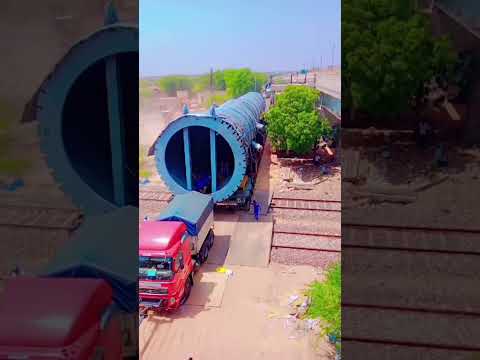
Weeks later, I returned to one of the survey locations shortly after sunrise.
There was no convoy.
No hydraulic trailer.
No police escort.
No giant cargo dominating the road.
Only ordinary Jamnagar life.
A milk vehicle passed.
Two motorcycles crossed the junction.
A tea stall opened.
A truck headed toward the industrial side.
Nobody there knew how many calculations, photographs, measurements and arguments had been generated by that ordinary piece of road.
And that is exactly how successful heavy-haul engineering should feel.
When people watch a giant ODC cargo move successfully, they often remember the machine.
I remember everything that allowed the machine to move:
the surveyor who noticed the cable;
the engineer who refused to assume bridge capacity;
the local driver who remembered monsoon water;
the shopkeeper who explained village traffic;
the safety team that demanded a proper holding location;
the authorities whose permissions would govern the movement;
and the teammate who measured the same difficult turn three times because being certain mattered more than being fast.
I closed my notebook beside the road.
The first page had begun with a proposed route.
The final page contained something different:
a route we were prepared to defend with engineering evidence.
That morning in Jamnagar, I understood again why I have never measured the success of an ODC road survey by the number of kilometres completed.
I measure it by the dangers we discover before the cargo ever reaches the road.

🌅 Blog Recap: Places to Visit in Jamnagar District, Gujarat
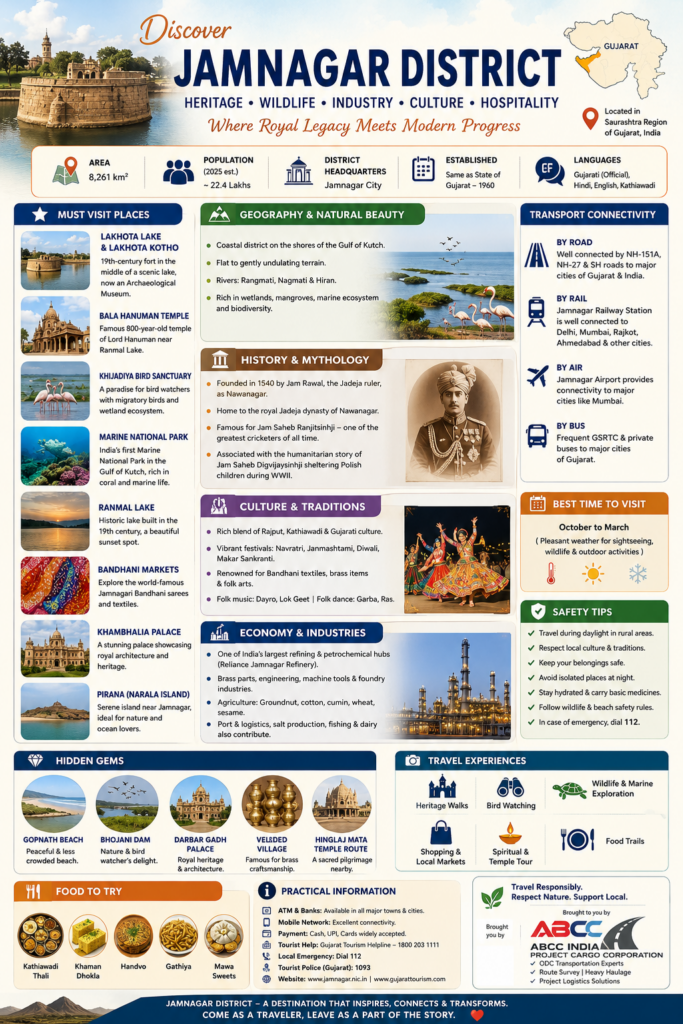
Jamnagar District is one of those corners of Gujarat that becomes more interesting the longer you stay. At first, a visitor may know it for Jamnagar city, Lakhota Lake, temples, Bandhani textiles or its enormous industrial presence. Travel deeper, however, and a much broader landscape appears—wetlands alive with birds, a biologically rich coastline along the Gulf of Kutch, old Nawanagar heritage, village traditions, bustling bazaars, brass workshops, pilgrimage places and roads carrying both travelers and some of India’s most important industrial freight.
Geographically, Jamnagar occupies a strategically important part of the Saurashtra peninsula. Its relationship with the Gulf of Kutch has influenced its ecology, maritime connections, industries and settlement patterns. This coastal character also explains why nature travelers should look beyond conventional city sightseeing. Khijadiya’s wetlands and the protected marine environments associated with the Gulf of Kutch reveal an entirely different side of the district—one where tides, migratory birds, mangroves and coastal ecosystems determine the rhythm of a journey.

Historically, understanding Jamnagar means remembering Nawanagar. The story of Jam Rawal and the Jadeja rulers gives the region a royal identity that remains visible through its architecture, urban heritage and cultural memory. Lakhota Kotho and Ranmal Lake are therefore more than attractive photography locations; they are gateways into the evolution of the former princely state.
Jamnagar’s heritage also reaches far beyond Gujarat. The legacy of Ranjitsinhji connects the region with international cricket, while the humanitarian story associated with Jam Saheb Digvijaysinhji and Polish children during the Second World War gives the wider Nawanagar story an extraordinary international dimension.
For spiritually inclined travelers, Jamnagar offers another layer. Temples, shrines and long-established devotional traditions continue to shape everyday life. Bala Hanuman Temple beside Ranmal Lake is among the city’s best-known spiritual landmarks, while smaller religious places encountered away from the principal tourist circuit often provide quieter experiences.
Culture is equally visible outside monuments.

It lives in Bandhani fabric being unfolded across a shop counter, Gujarati and Kathiawadi meals shared around a table, festival decorations appearing in neighborhood streets, conversations at tea stalls and generations of artisans continuing specialized skills. Travelers who slow down enough to experience these ordinary moments often understand Jamnagar better than those racing between attractions.
🦩 From Heritage Streets to Wetlands: Why Jamnagar Rewards Different Travelers

There is no single correct way to experience Jamnagar District.
Families can combine Lakhota Lake, museums, temples, local food and accessible city attractions. Couples can enjoy quieter mornings, sunset walks and carefully chosen coastal experiences. Solo travelers can explore markets, heritage areas and birdwatching destinations while maintaining ordinary safety precautions.
Students can turn the district into an open classroom covering history, marine ecology, ornithology, Ayurveda, manufacturing and urban development. Photographers can work with radically different subjects—from palace architecture and Bandhani patterns to migratory birds and coastal landscapes.
Business travelers encounter yet another Jamnagar.
The district is internationally important for refining and energy while Jamnagar city and its industrial areas are widely associated with brass components and engineering manufacturing. MSMEs, workshops, industrial suppliers, logistics businesses and emerging energy-related activity make the district economically significant far beyond tourism.
This coexistence of heritage, ecology and heavy industry is one of Jamnagar’s most unusual characteristics.
🏭 Economy, Industry & the Jamnagar Visitors Rarely See

Jamnagar should not be described merely as a heritage destination.
Modern industry has profoundly changed its economy.
Large-scale energy and refining activity, brass manufacturing, engineering enterprises, trading, agriculture, logistics and supporting service businesses generate employment and commercial movement across the region.
For entrepreneurs and investors, opportunities extend into manufacturing support, warehousing, industrial services, logistics, hospitality, skills, technology and supply-chain businesses. At the same time, socially useful initiatives in education, healthcare, artisan livelihoods, environmental conservation, skill development and heritage protection can create long-term community value when developed through legitimate government, institutional, philanthropic or CSR frameworks.
Travelers should remember that industrial importance also creates boundaries. Refineries, ports, sensitive installations and operational industrial premises are not sightseeing attractions merely because they look impressive from a road. Access controls, photography restrictions and security instructions must always be respected.
🚆 Road, Rail, Air & Local Transport

Jamnagar’s transport connectivity makes it practical for first-time visitors.
The city is connected by rail and road with major Gujarat destinations, while Jamnagar Airport provides air connectivity subject to current airline schedules. State transport buses, private coaches, taxis, auto-rickshaws and rental vehicles provide onward options.
A private cab becomes particularly convenient when combining city attractions with locations farther outside the urban centre.
Road travelers should plan more carefully during intense monsoon weather and on industrial corridors carrying heavy vehicles. Avoid treating map-app arrival times as guarantees.
For coastal or wildlife excursions, daylight travel is usually the more practical choice.
🌿 Hidden Jamnagar Is Often the Most Memorable Jamnagar

The most rewarding Jamnagar itinerary does not need to contain dozens of stops.
Instead of collecting locations, collect experiences.
Watch the city become active around Ranmal Lake in the morning. Spend time understanding the exhibits inside Lakhota rather than photographing only its exterior. Listen to the devotional atmosphere around Bala Hanuman. Speak respectfully with Bandhani sellers about craftsmanship. Taste regional food without rushing through the meal.
Then leave the dense city behind.
At Khijadiya, slow down enough to observe the wetlands rather than treating birdwatching as another checklist activity. Around protected coastal environments, understand the importance of tides and conservation before planning access.
These quieter experiences provide something Google Maps cannot calculate: a sense of place.
🛡️ Practical Safety Lessons Before Visiting Jamnagar

Jamnagar does not need sensational warnings to become a useful travel guide. Most visitors need the same sensible precautions required elsewhere.
Confirm hotel and transport bookings through reliable channels. Agree or understand taxi and auto fares before unfamiliar journeys. Never share OTPs, banking PINs, CVVs or UPI PINs. Treat unexpected QR-code refunds and urgent payment requests cautiously.
During summer, heat and dehydration may present more practical difficulty than crime. Carry drinking water, use sun protection and reduce strenuous afternoon sightseeing.
During heavy monsoon weather, never drive through floodwater of unknown depth.
Around wildlife, maintain distance and follow sanctuary rules.
Before marine excursions, verify current access, permission and tide conditions.
Women traveling alone should favor populated areas and verified transport after dark. Senior citizens benefit from shorter sightseeing schedules, comfortable vehicles and advance accessibility checks. Families visiting crowded festivals should establish a meeting point and keep guardian contact information with children.
For a genuine emergency anywhere in India, 112 should be remembered.
💰 Planning a Better Jamnagar Trip

A first visit becomes much more enjoyable when the itinerary has breathing room.
Rather than attempting every tourist place in a single day, use Jamnagar city as a base and divide the trip by experience:
| Travel Interest | What to Prioritize |
|---|---|
| Heritage | Lakhota, Ranmal Lake and historic city areas |
| Spirituality | Bala Hanuman and established religious sites |
| Wildlife | Khijadiya and authorized nature experiences |
| Marine ecology | Officially accessible Gulf of Kutch experiences |
| Food | Gujarati/Kathiawadi meals, snacks and sweets |
| Shopping | Jamnagari Bandhani and established local markets |
| Photography | Sunrise wetlands, heritage architecture and lake sunsets |
| Family trip | City heritage + food + comfortable nature outing |
| Couple trip | Relaxed sightseeing, sunset and quality stay |
| Solo travel | Heritage walks, food exploration and birdwatching |
| Students | Museum + ecology + history + industrial learning |
| Business | Industrial appointments combined with city heritage |
| Senior citizens | Temples, lakefront, museum and comfortable vehicle itinerary |
Two to four days can provide a rewarding introduction depending on interests, while wildlife photographers, researchers and travelers combining Jamnagar with the wider Saurashtra circuit may want longer.
🌍 A Destination Worth Understanding, Not Simply Visiting

The greatest mistake would be to judge Jamnagar by a single identity.
It is not only an industrial city.
It is not only the former Nawanagar.
It is not only a pilgrimage stop.
It is not only a wildlife destination.
And it is certainly not simply somewhere travelers pass through on the way to another famous Gujarat attraction.
Jamnagar is the combination.
Royal history meets modern engineering. Temple bells coexist with factory shifts. Bandhani artisans work within an economy known internationally for industrial production. Migratory birds arrive beside a district containing enormous energy infrastructure. Ancient cultural memory survives inside a city planning its next stage of growth.
That contrast gives Jamnagar its character.
🌱 Leave Jamnagar Better Than You Found It

The best Jamnagar journey is not measured by how many pins disappear from your sightseeing list.
Measure it by what you understood.
Did you learn why Nawanagar matters to the city’s identity?
Did you recognize the ecological value of its wetlands and coastline?
Did you buy from genuine local artisans?
Did you taste regional food rather than eating only familiar chain meals?
Did you respect worshippers before taking photographs?
Did you leave wildlife undisturbed?
Did you avoid littering the place you came to admire?
Responsible tourism is made from these small decisions.

For travelers arriving by road—including those who become curious about the enormous machinery and industrial cargo occasionally associated with this manufacturing region—professional route planning and road safety remain essential. ABCC India Project Cargo Corporation works in the specialized transport and heavy-haul ecosystem, including ODC road-route surveying and project-logistics support. That industrial identity, however, is only one small part of Jamnagar’s much larger story.
Come for the famous places, but leave time for what you did not expect.
Watch birds rise over a wetland before breakfast. Walk beside the lake when the evening light reaches Lakhota. Listen instead of speaking for a few minutes inside an old devotional space. Ask an artisan how Bandhani is actually made. Sit over a Gujarati meal longer than your itinerary planned.

Then, when it is time to leave Jamnagar District, take photographs, memories and knowledge with you—but leave its heritage intact, wildlife undisturbed, streets cleaner and local culture respected.
That is not merely a better way to visit Jamnagar.
It is the kind of travel that gives a destination a reason to welcome us back.
🌅 Conclusion:
Exploring the places to visit in Jamnagar District reveals a Gujarat destination where royal heritage, spiritual traditions, wetlands, marine landscapes, craftsmanship and modern industry exist surprisingly close to one another. Jamnagar is not simply a sightseeing stop—it is a district whose character becomes clearer when travelers give it enough time.
A meaningful journey can begin around Lakhota Lake and Lakhota Kotho, continue through the devotional atmosphere of Bala Hanuman Temple, move into traditional markets filled with Jamnagari Bandhani, and then leave the city for the remarkable birdlife and wetland environment of Khijadiya Bird Sanctuary. The wider Gulf of Kutch landscape adds another dimension through mangroves, tidal ecosystems and protected marine biodiversity.

History gives the journey greater depth. The legacy of Nawanagar, its Jadeja rulers, the extraordinary cricket heritage associated with Ranjitsinhji, and the humanitarian memory of Jam Saheb Digvijaysinhji connect this corner of Saurashtra with stories extending far beyond Gujarat.
Yet Jamnagar is equally a place of the present.
Its brass and engineering industries, refinery and energy ecosystem, ports and logistics activity have made the district economically important. This unusual meeting of heritage, wildlife, spirituality, manufacturing and coastal geography is precisely what separates Jamnagar from a conventional tourist destination.
First-time visitors should avoid trying to see everything in a hurry. Allow time for an early morning around the wetlands, an unhurried museum visit, authentic Gujarati or Kathiawadi food, conversations in traditional markets and an evening beside the lake. Check current weather, attraction timings, protected-area permissions and transport conditions before longer excursions, particularly during the monsoon or when visiting coastal environments.
Travel responsibly as well. Do not disturb birds or marine life, remove natural material from protected areas, litter beaches and wetlands, photograph people without permission or enter restricted industrial and port areas merely for photographs. Supporting genuine artisans, independent food businesses, local guides and responsible accommodation allows tourism expenditure to remain connected with the communities that give Jamnagar its identity.

The best places to visit in Jamnagar District are therefore not necessarily those producing the most photographs. They are the places that help you understand how this district developed—its water, coast, rulers, faith, wildlife, artisans, industries and people.
Come with curiosity rather than a checklist.
Watch Jamnagar wake beside the lake. Listen to birds before the roads become busy. Study an old museum object instead of simply photographing it. Taste something you have never ordered before. Speak with the people who work in its markets and workshops.
And when you leave, carry Jamnagar’s stories with you while leaving its heritage, wildlife and landscapes exactly where they belong.

🚛 ABCC India Project Cargo Corporation – Connecting Geography with Logistics

For journeys of a very different scale, ABCC India Project Cargo Corporation works across India’s road-route survey, transport, logistics and project-cargo consulting sector. Its expertise includes geographical route planning, industrial connectivity assessment, ODC and heavy-haul transportation support, road-route surveys and project-logistics planning.
In industrial districts such as Jamnagar, where highways, ports, manufacturing zones, settlements and sensitive infrastructure intersect, professional route assessment can be essential for complex cargo movement. ABCC India’s work focuses on understanding these real-world geographical and engineering conditions so that project logistics can be planned more systematically and safely.
Whether you arrive in Jamnagar as a traveler searching for heritage and nature or as a professional studying its industrial connectivity, one principle remains the same:
Understand the road, respect the place, and travel responsibly.

❓ FAQs

🌿 What are the best places to visit in Jamnagar District?
The best places to visit in Jamnagar District include Lakhota Lake and Lakhota Palace, Bala Hanuman Temple, Khijadia Bird Sanctuary, Pratap Vilas Palace, Bhujio Kotho and protected coastal and marine attractions around the Gulf of Kutch. Jamnagar is especially rewarding for travelers interested in heritage, birdwatching, temples, photography, local food and coastal ecology.
🚗 What are the best places to visit near Jamnagar within 100 km?
Within roughly 100 km of Jamnagar, travelers can plan day trips combining Khijadia Bird Sanctuary, coastal landscapes, religious sites, heritage locations and countryside destinations. Distances should be checked from your exact starting point because Jamnagar District is geographically large and road routes can differ from straight-line distances.
👨👩👧👦 Which are the best one-day picnic places near Jamnagar for families?
For families, Khijadia Bird Sanctuary, Lakhota Lake, city gardens, established religious destinations and suitable coastal locations can work well for one-day outings. Choose destinations according to children’s ages, weather, driving distance, food availability and accessibility for senior citizens.
❤️ Where can couples go for a one-day trip near Jamnagar?
Couples can consider Lakhota Lake around sunset, peaceful heritage locations, birdwatching at Khijadia and permitted coastal destinations. Early mornings and late afternoons generally provide more comfortable weather and better photography, especially outside winter.
🌴 Are there hidden and unexplored places near Jamnagar?
Yes. Beyond Jamnagar’s famous tourist attractions, the district contains lesser-known wetlands, rural landscapes, traditional villages, coastal environments and heritage pockets. However, “hidden” should not be confused with unrestricted access—protected wildlife areas, ports, defence installations and industrial zones may require permission or prohibit entry.
🐦 What is the best nature and wildlife destination near Jamnagar?
Khijadia Bird Sanctuary is one of the strongest choices for birdwatching and nature tourism. Jamnagar’s wider Gulf of Kutch region is also nationally important for marine biodiversity. Wildlife visits are most rewarding when travelers follow current Forest Department rules and avoid disturbing birds or marine habitats.
🌧️ What is the best season for a one-day picnic near Jamnagar?
Winter is generally the most comfortable season, particularly for outdoor sightseeing and birdwatching. Monsoon can make landscapes greener but requires checking rainfall, waterlogging and road conditions. Summer outings are better planned for early morning or evening, with adequate drinking water and sun protection.
💳 How much does a one-day Jamnagar picnic trip cost?
The cost depends heavily on transport and activities. A self-planned local outing using public transport can be inexpensive, while a private taxi, restaurant meals, attraction fees or organized group activities increase the budget. Families and corporate groups should compare transport, meals, entry fees, parking and activity charges rather than relying on a single fixed per-person estimate.
🚌 Which places near Jamnagar are suitable for corporate team outings?
Corporate groups can consider nature-oriented day trips, resorts or professionally managed recreational venues, heritage outings and approved eco-tourism experiences according to group size. Before booking, verify parking, washrooms, meal arrangements, indoor backup space, accessibility, group activities and whether the venue can legally accommodate the expected number of visitors.
⭐ Is Jamnagar District worth visiting for a weekend trip?
Yes. Jamnagar District is worth visiting, particularly for travelers who enjoy combining heritage, spirituality, wildlife, coastal ecology, Gujarati food and local culture. A short trip can cover Jamnagar city’s principal attractions, while a longer weekend allows time for Khijadia and carefully planned excursions outside the city. For first-time visitors, choosing fewer places and experiencing them properly usually creates a better trip than attempting an overcrowded sightseeing schedule.