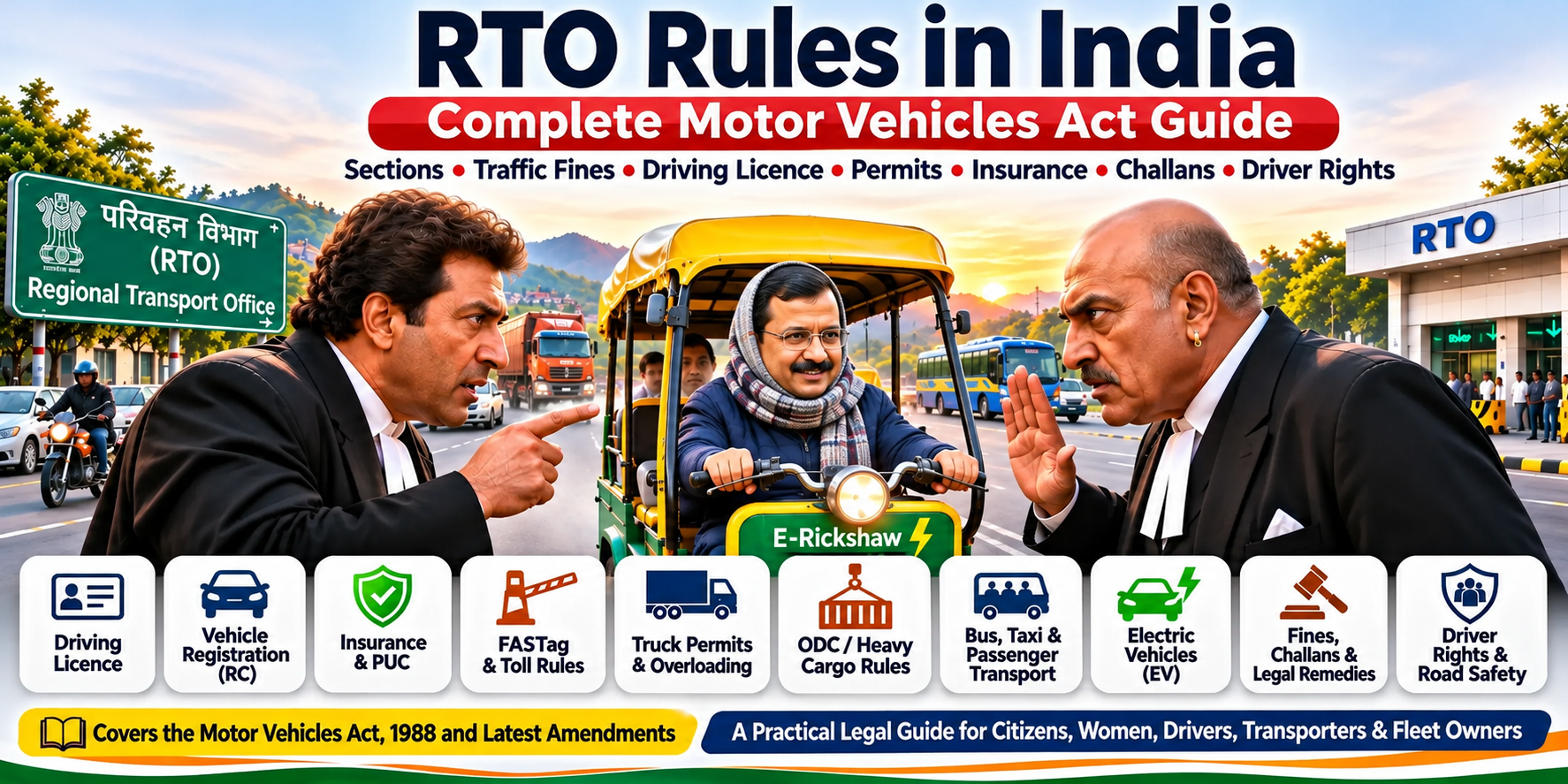
⚖️ RTO Rules in India 2026/2027: Complete Motor Vehicles Act, Traffic Fines, Driving Licence & Road Safety Guide
For Drivers, Women, Students, Senior Citizens, Vehicle Owners, Transporters, Truck Operators and Every Road User in India

This guide explains Indian road transport laws in practical language, with references to the Motor Vehicles Act, 1988, the Central Motor Vehicles Rules, 1989, and other applicable legal frameworks.
It is written for people who want to understand not only what the law says, but also what they must do, what can happen if they break a rule, and how they can protect their legal rights.
The complete guide is divided into four parts. This first part covers the legal foundations, driving licences, vehicle ownership basics and important protections for different categories of road users.
🚦 Introduction: Why Every Indian Should Understand RTO Rules

Road transport is an essential part of everyday life in India.
Millions of people use motorcycles, cars, buses, taxis, trucks and other vehicles for commuting, business, education, tourism and transportation of goods.
Road traffic laws exist to regulate these activities, protect road users and establish responsibilities for vehicle owners, drivers and transport operators.
However, many people are uncertain about the difference between a traffic offence, an RTO compliance requirement, a vehicle permit condition and a criminal offence arising from dangerous driving.
These are not always the same thing.

For example, a private car owner may need to understand driving licence validity, vehicle registration, insurance and traffic signals.
A commercial truck operator must also consider vehicle fitness, transport permits, authorised vehicle weights and other applicable conditions.
A person injured in a road accident may need information about medical assistance, police reporting, insurance and compensation.
A parent may need to understand the legal consequences of allowing an underage child to drive.
This guide addresses those different needs.
📊 Who needs to know which RTO rules?

| Road User | Important Legal Subjects | Why They Matter |
|---|---|---|
| Motorcycle rider | Driving licence, helmet, insurance, traffic rules | Personal safety and legal compliance |
| Car driver | Licence, seat belts, registration, insurance | Safe and lawful driving |
| Women drivers | Equal driving rights, safety, reporting and remedies | Protection and legal awareness |
| Students | Learner licences, age restrictions | Prevent illegal driving |
| Parents | Juvenile driving and vehicle-owner responsibilities | Avoid serious legal consequences |
| Senior citizens | Licence validity, renewal and fitness requirements | Continued lawful driving |
| Persons with disabilities | Licensing eligibility and adapted vehicles | Accessible and lawful mobility |
| Taxi drivers | Transport authorisation and passenger safety | Commercial compliance |
| Bus operators | Permits, fitness and passenger safety | Public transport obligations |
| Truck drivers | Commercial licensing, permits, loading and enforcement | Freight compliance |
| Transport companies | Vehicle records, permits, insurance and driver compliance | Fleet risk management |
| Pedestrians | Road safety and accident remedies | Protection of vulnerable road users |
| Accident victims | Reporting, medical assistance and compensation | Access to legal remedies |
🏛️ History of Motor Vehicle Laws in India

India’s road transport laws developed alongside the growth of motor vehicles and road infrastructure.
The Motor Vehicles Act, 1988 is the principal central legislation governing motor vehicle registration, driving licences, permits, insurance and numerous road transport obligations.
It replaced the Motor Vehicles Act, 1939 and has been amended over time.
The Motor Vehicles (Amendment) Act, 2019 introduced important changes concerning penalties, road safety, enforcement, accident-related provisions and other areas.
The Central Motor Vehicles Rules, 1989 provide detailed rules under the Act.
States also have powers to make rules and administer aspects of motor vehicle regulation within the legal framework.
📊 Evolution of Indian road transport law

| Period | Development | Significance |
|---|---|---|
| Early motor vehicle regulation | Initial rules for motor vehicles | Basic control of road transport |
| 1939 | Motor Vehicles Act, 1939 | Earlier comprehensive framework |
| 1988 | Motor Vehicles Act, 1988 | Modern central legislative framework |
| 1989 | Central Motor Vehicles Rules | Detailed regulatory requirements |
| 2019 | Motor Vehicles (Amendment) Act | Significant changes to safety and enforcement |
| 2020s | Digital services and continuing regulatory amendments | Online documentation and compliance processes |
Important: A legal provision’s original enactment date does not necessarily establish when a particular amendment became enforceable. Commencement notifications and later amendments must also be considered.
⚖️ Understanding the Motor Vehicles Act, 1988

The Motor Vehicles Act is the central statutory framework for many road transport activities.
It addresses the legal authority to drive, vehicle registration, transport permits, traffic control, insurance and penalties.
📊 Major chapters and subjects
| Legal Subject | Important Sections | Practical Meaning |
|---|---|---|
| Driving licence requirement | Section 3 | Appropriate licence required |
| Minimum driving age | Section 4 | Age eligibility |
| Owner’s responsibility for driving | Section 5 | Restriction on allowing unauthorised driving |
| Learner and driving licence framework | Sections 8–15 | Application, issue and renewal |
| Vehicle registration | Section 39 | Registration requirement |
| Transfer of ownership | Section 50 | Ownership record changes |
| Vehicle alteration | Section 52 | Regulation of alterations |
| Fitness certification | Section 56 | Applicable transport vehicle fitness |
| Transport permit requirement | Section 66 | General permit framework |
| Speed limits | Section 112 | Applicable speed regulation |
| Traffic signs | Section 119 | Obedience to traffic signs |
| Owner information duties | Section 133 | Information to authorities |
| Third-party insurance | Section 146 | Mandatory insurance framework |
| Driving without required licence | Section 181 | Penalty provision |
| Dangerous driving | Section 184 | Offence and punishment |
| Drunken driving | Section 185 | Offence and punishment |
| Overloading | Section 194 | Excess weight penalties |
| Juvenile offences | Section 199A | Special provisions concerning juveniles |
These are selected sections, not a complete reproduction of the Act.
🪪 Central RTO Rules vs State RTO Rules

India has a central legal framework, but vehicle administration and certain enforcement arrangements vary by state.
The Motor Vehicles Act, 1988 provides the primary statutory structure. The Central Motor Vehicles Rules, 1989 provide detailed requirements. States administer registration and licensing services and may make rules or issue notifications within their legal powers.
Example: A traffic offence may be defined by central legislation, while the amount accepted for compounding that offence may depend on an applicable state notification. A statutory maximum penalty and an on-the-spot compounding amount are not necessarily identical.
📊 Central law and state administration
| Subject | Main Legal Framework | What May Vary by State |
|---|---|---|
| Driving licence eligibility | Motor Vehicles Act and central rules | Administrative procedures |
| Vehicle registration | Central Act and rules | Local processing arrangements |
| Traffic enforcement | Central law and applicable regulations | Enforcement procedures and compounding |
| Transport permits | Central and state frameworks | Permit conditions and administration |
| Road tax | Applicable state taxation laws | Rates and payment procedures |
| Vehicle fitness | Central standards and applicable rules | Testing infrastructure and administration |
| Parking restrictions | Applicable traffic laws and orders | Local restrictions |
| Commercial vehicle operations | Central and state requirements | Route-specific and permit conditions |
Practical advice
Drivers should not assume that a fine shown on a social media poster applies uniformly throughout India.
Check the legal section, the relevant state notification, the date of the alleged offence and the actual challan.
🚗 Driving Licence Rules in India – Sections 3, 4 and 5

Section 3: Necessity for a Driving Licence
Section 3 generally prohibits driving a motor vehicle in a public place without an effective driving licence authorising that vehicle.
Transport vehicle driving may involve additional licensing requirements and applicable exceptions.
Simple explanation: Knowing how to drive is not the same as being legally authorised to drive. IndiaCode
Section 4: Minimum Driving Age
The general minimum age for driving a motor vehicle in a public place is 18 years.
Section 4 contains a limited provision for motorcycles with engine capacity not exceeding 50 cc after the age of 16, subject to the applicable licensing conditions.
The general minimum age for driving a transport vehicle is 20 years, subject to the statutory framework and exceptions. IndiaCode
📊 Driving age and licence requirements
| Vehicle / Situation | General Age Rule | Important Qualification |
|---|---|---|
| Private car | 18 years | Appropriate valid licence |
| Ordinary motorcycle | 18 years | Appropriate vehicle category |
| Motorcycle not exceeding 50 cc | 16 years under the statutory exception | Applicable licensing conditions |
| Transport vehicle | Generally 20 years | Additional legal requirements may apply |
| Learner driving | Relevant age eligibility | Learner licence conditions |
| Underage driving | Not permitted outside applicable exceptions | Owner and guardian consequences may arise |
Section 5: Responsibility of Vehicle Owners
A vehicle owner or person in charge must not cause or permit a person who fails to meet the requirements of Sections 3 or 4 to drive.
Example: A vehicle owner should not hand over a truck to a person who lacks the appropriate legal authorisation to drive it.
The driver and the person permitting unauthorised driving may face separate legal consequences.
🎓 Learner Licence and Permanent Driving Licence

A learner licence allows a person to learn driving under prescribed conditions.
It is not equivalent to unrestricted permission to drive independently.
The application, testing and licensing process is administered through the relevant licensing authority and the applicable government system.
📊 Important licence sections
| Section | Subject | Practical Relevance |
|---|---|---|
| 7 | Restrictions concerning learner licences for certain vehicles | Eligibility conditions |
| 8 | Grant of learner licence | Learner application |
| 9 | Grant of driving licence | Driving licence issue |
| 10 | Form and contents of licence | Vehicle categories |
| 11 | Addition to driving licence | Additional vehicle class |
| 12 | Driving instruction establishments | Driving schools |
| 13 | Extent of effectiveness | Territorial validity |
| 14 | Currency of driving licence | Licence validity |
| 15 | Renewal | Renewal procedures |
How to apply
- Visit the official Parivahan portal.
- Select the relevant driving licence service and state.
- Review the current eligibility, documents, fee and test requirements.
- Complete the applicable application process.
- Attend any required verification or driving test.
- Check the application status through the official service.
Avoid unofficial agents promising a licence without required eligibility checks or testing.
🔄 Driving Licence Validity, Renewal and Changes

A driving licence is not necessarily valid indefinitely.
Its validity depends on the applicable statutory provisions, licence category, holder’s age and relevant circumstances.
The Motor Vehicles (Amendment) Act, 2019 introduced changes to renewal arrangements. The government implementation material describes applications for renewal within a window extending from one year before expiry to one year after expiry, with a fresh competence test required in the specified circumstances when applying after that period. parivahan.gov.in
Important distinction: Being allowed to apply for renewal after expiry does not automatically mean the expired licence authorises driving throughout that period.
📊 Common licence problems
| Problem | Recommended Action |
|---|---|
| Licence approaching expiry | Apply for renewal within the permitted period |
| Licence already expired | Check renewal eligibility; do not assume driving is permitted |
| Wrong vehicle category | Apply for the required class or authorisation |
| Incorrect personal details | Use official correction procedure |
| Lost licence | Apply for the appropriate replacement service |
| Medical eligibility question | Follow applicable medical and licensing requirements |
| Licence suspension | Check the order and available remedies |
| Licence refusal | Review reasons and statutory appeal provisions |
👩💼 Women Drivers: Legal Rights, Road Safety and Protection

Indian motor vehicle licensing law does not impose a general gender-based prohibition on women driving.
Women who meet the applicable legal requirements may obtain driving licences and operate eligible vehicles, including commercial vehicles where the necessary conditions are satisfied.
Safety, harassment, accident reporting and access to official complaint mechanisms are important practical issues for all drivers.
📊 Practical legal and safety guidance
| Situation | Recommended Response |
|---|---|
| Applying for a licence | Use official licensing procedures |
| Traffic checking | Cooperate with lawful directions and request identification when appropriate |
| Harassment or threats | Seek safety and report through appropriate police channels |
| Disputed challan | Preserve details and use the official dispute mechanism |
| Road accident | Prioritise medical assistance and lawful reporting |
| Unsafe commercial workplace | Document concerns and use relevant workplace or labour remedies |
| Vehicle breakdown | Move to a safe location if possible and request assistance |
| Unauthorised payment demand | Request an official receipt and use complaint channels |
Important principle
A driver’s legal obligations do not disappear because the driver is a woman, and lawful enforcement should not involve discriminatory or abusive treatment.
Specific procedures for searches, detention and criminal complaints depend on the applicable law and circumstances. They should not be confused with ordinary traffic-document checking.
👴 Senior Citizens and Drivers with Disabilities

Age alone does not mean every older person is automatically prohibited from driving.
Licence validity, renewal and medical requirements must be assessed under the applicable legal framework.
Likewise, disability does not automatically disqualify a person from driving every category of motor vehicle.
Eligibility may depend on the nature of the disability, vehicle adaptations, medical assessment and the relevant licensing provisions.
📊 Key considerations
| Driver Category | Main Consideration | Practical Action |
|---|---|---|
| Older private vehicle driver | Licence validity and applicable medical requirements | Check renewal rules |
| Older commercial driver | Transport licence and fitness requirements | Verify applicable conditions |
| Driver with physical disability | Ability to operate suitable vehicle safely | Seek appropriate licensing assessment |
| Driver using an adapted vehicle | Vehicle suitability and authorisation | Verify modification and licence requirements |
| Driver with a medical condition | Safety and statutory eligibility | Obtain relevant professional assessment |
Avoid assuming that a single age threshold applies to every licence holder and every vehicle class.
👨👩👧 Children, School Vehicles and Juvenile Driving – Section 199A

Underage driving can create serious risks for the child, passengers, pedestrians and other road users.
Section 199A establishes special consequences where a juvenile commits an offence under the Motor Vehicles Act, subject to the section’s conditions and exceptions.
These may include proceedings against the guardian or vehicle owner, statutory punishment, cancellation of vehicle registration for twelve months and restrictions affecting the juvenile’s future licence eligibility. IndiaCode
📊 Juvenile driving – Legal consequences
| Legal Issue | Relevant Provision | Explanation |
|---|---|---|
| Minimum age | Section 4 | General age restrictions |
| Owner permitting unauthorised driving | Sections 5 and 180 | Separate owner responsibility |
| Driving contrary to age or licence requirements | Section 181 | Driver offence |
| Juvenile offence | Section 199A | Special guardian/owner and juvenile consequences |
| Registration cancellation | Section 199A | Twelve-month consequence under the provision |
| Future licence eligibility | Section 199A | Restriction until age 25 in covered cases |
| Statutory guardian/owner punishment | Section 199A | Up to three years’ imprisonment and ₹25,000 fine, subject to legal conditions and defences |
The law includes qualifications, including a defence concerning knowledge or due diligence and an exception for appropriately licensed juvenile driving within the legally permitted category.
For parents: Do not allow an underage child to drive a car, ordinary motorcycle or other vehicle outside the legally permitted framework, even for a short journey.
School transport
School transport involves additional obligations relating to vehicle safety, fitness, authorisation, driver suitability and applicable state requirements.
Schools, vehicle owners and contractors should verify the specific rules applicable in their state rather than relying on a generic nationwide checklist.
🏍️ Two-Wheeler Rules in India: Helmets, Pillion Riders and Motorcycle Safety

Motorcycles and scooters are among India’s most widely used forms of personal transportation.
Their convenience makes them particularly important for commuting, education, delivery services and small businesses.
However, riders and passengers are exposed to significant injury risks during collisions.
Indian motor vehicle law therefore establishes requirements concerning licensing, protective headgear, passenger numbers and road behaviour.
Section 129 – Protective Headgear
Section 129 of the Motor Vehicles Act deals with protective headgear for persons riding or being carried on motorcycles in public places.
The statutory framework generally requires protective headgear complying with prescribed standards, subject to applicable exceptions and qualifications.
The Act provides a specific exemption for a Sikh person wearing a turban. The legal position concerning other exemptions or modifications must be checked against applicable law.
Simple explanation: Both the rider and pillion passenger should use a legally compliant, properly secured helmet wherever required.
A construction helmet, decorative head covering or unapproved novelty helmet should not be assumed to satisfy motorcycle helmet requirements.
Section 128 – Safety Measures for Motorcycle Riders
Section 128 regulates the carrying of passengers on motorcycles.
The general rule does not permit more than one person in addition to the driver, and that passenger must be carried in the legally prescribed manner.
Additional requirements may apply to children, including relevant safety equipment.
📊 Two-wheeler rules and penalties
| Subject | Relevant Section | Legal Requirement | Potential Consequence |
|---|---|---|---|
| Driving licence | Sections 3 and 181 | Appropriate effective licence | Statutory penalty for unauthorised driving |
| Minimum age | Section 4 | Meet legal age conditions | Driver and potentially owner liability |
| Passenger limit | Section 128 | Follow passenger restrictions | Section 194C consequences |
| Helmet requirement | Section 129 | Compliant protective headgear | Section 194D consequences |
| Dangerous riding | Section 184 | Avoid dangerous driving | Fine, imprisonment or both |
| Drunken riding | Section 185 | Do not drive in violation of alcohol/drug provisions | Criminal consequences |
| Insurance | Sections 146 and 196 | Required third-party insurance | Statutory punishment |
| Traffic signs | Section 119 | Obey applicable signs | Relevant enforcement provisions |
Common motorcycle offences
Unsafe riding can involve several different legal provisions.
For example, travelling without a helmet is different from dangerous driving. A rider may commit multiple offences during one incident, but each allegation must have a valid legal basis.
Similarly, the absence of a rear-view mirror, defective lighting or an unauthorised vehicle alteration may raise questions under applicable vehicle construction and equipment rules.
Practical safety guidance
Riders should maintain suitable tyres, brakes, lights and mirrors. Protective equipment should fit properly and be used correctly.
Parents should not permit children to operate vehicles outside the legally authorised age and licence framework.
🚘 Car Rules in India: Seat Belts, Child Safety, Speed and Passenger Responsibilities

Car owners and drivers must comply with licensing, registration, insurance, vehicle condition and road traffic requirements.
Passengers also have responsibilities, particularly concerning seat belts and safe behaviour.
Section 194B – Seat Belts and Child Safety
Section 194B provides penalties concerning specified failures to use safety belts and certain child-passenger safety requirements.
The exact obligations must be read together with applicable rules governing vehicle construction, seat belts and child restraints.
Simple explanation: Seat belts should be worn by occupants for whom they are required. Children should be transported using legally compliant and age-appropriate safety arrangements.
Section 112 – Speed Limits
Section 112 addresses speed limits.
A driver must comply with the speed limits legally applicable to the vehicle and road.
There is no single nationwide speed limit that applies to every vehicle on every road.
Speed restrictions can differ according to vehicle class, road category and applicable notifications.
📊 Important car-related rules
| Legal Subject | Section | Practical Meaning |
|---|---|---|
| Valid driving licence | 3 | Appropriate licence required |
| Minimum driving age | 4 | Age eligibility |
| Registration | 39 | Vehicle must meet registration requirements |
| Vehicle alteration | 52 | Alterations are regulated |
| Speed limits | 112 | Follow applicable speed restrictions |
| Traffic signs | 119 | Obey traffic signs |
| Seat belts and child safety | 194B | Comply with applicable restraint rules |
| Dangerous driving | 184 | Avoid driving that meets the statutory offence |
| Drunken driving | 185 | Do not drive in violation of alcohol/drug limits |
| Insurance | 146 | Required third-party insurance |
| Insurance-related punishment | 196 | Penalty for relevant contraventions |
Mobile phones and distracted driving
Using a phone while driving can create serious risks.
Certain mobile-phone use is specifically relevant to dangerous driving provisions. The applicable legal classification depends on the conduct and circumstances.
Drivers should avoid messaging, video calls and other distractions while operating a vehicle.
📄 Vehicle Registration, RC, Ownership Transfer and Vehicle Alterations

Vehicle registration establishes the official registration identity of a motor vehicle.
Registration records may contain information concerning ownership, vehicle class, chassis number, engine number and other prescribed details.
Section 39 – Necessity for Registration
Section 39 generally prohibits driving a motor vehicle in a public place, or allowing it to be driven there, unless it is registered and displays the registration mark as prescribed, subject to applicable exceptions.
Section 50 – Transfer of Ownership
Section 50 deals with transfer of ownership.
When a registered vehicle is sold or otherwise transferred, the applicable statutory reporting and registration procedures should be followed.
A private sale agreement alone should not be assumed to complete every statutory registration obligation.
Section 52 – Alteration in Motor Vehicle
Section 52 governs alterations to motor vehicles.
Not every aftermarket accessory or modification is automatically lawful.
Changes affecting vehicle particulars, structure, equipment or compliance may require specific legal assessment or approval.
📊 Registration and ownership compliance

| Situation | Relevant Section | Required Action |
|---|---|---|
| New vehicle registration | 39 and related provisions | Complete registration |
| Registration certificate | 41 | Follow applicable registration procedure |
| Renewal of registration | 41 and applicable rules | Check validity and renewal requirements |
| Transfer of ownership | 50 | Complete prescribed transfer process |
| Change of residence or business address | 49 | Follow applicable address-change requirements |
| Vehicle alteration | 52 | Verify legal permissibility |
| Suspension of registration | 53 | Understand grounds and remedies |
| Cancellation of registration | 55 | Follow statutory procedure |
| Registration mark display | Act and applicable rules | Display prescribed registration mark |
Buying a used vehicle: Essential precautions
Before purchasing a used vehicle, check the registration details, seller’s authority, insurance, hypothecation status where relevant, and applicable transfer requirements.
For commercial vehicles, additional checks may include fitness, permit validity, tax status and outstanding compliance issues.
Use official vehicle information services where available.
🛡️ Vehicle Insurance, PUC and Fitness Certificates
Vehicle owners often confuse three separate requirements: insurance, pollution certification and vehicle fitness.
These documents serve different purposes and cannot automatically substitute for one another.
Section 146 – Compulsory Third-Party Insurance
Section 146 generally requires a motor vehicle used in a public place to have insurance complying with the Act’s third-party risk requirements, subject to statutory exceptions.
Third-party insurance primarily addresses legally covered liabilities arising from injury, death or property damage involving third parties.
It is different from own-damage insurance, which concerns damage to the insured vehicle under the policy terms. IndiaCode
Important 2026 change to Section 196
For an uninsured vehicle, do not rely on older internet charts showing a universal ₹2,000 first-offence fine.
A 2026 statutory amendment changed Section 196, with effect reported from 15 August 2026. The amended provision uses a penalty linked to the applicable base premium, subject to minimum amounts. legislations.in
📊 Insurance, pollution and fitness requirements
| Requirement | Legal Reference | Applies To | Important Point |
|---|---|---|---|
| Third-party insurance | Section 146 | Motor vehicles subject to the provision | Required insurance must remain in force |
| Uninsured vehicle penalty | Section 196 | Relevant contraventions | Check amended 2026 penalty |
| Pollution Under Control certificate | Central Motor Vehicles Rules, including Rule 115 | Applicable vehicles | Certificate and emission requirements |
| Transport vehicle fitness | Section 56 | Applicable transport vehicles | Valid fitness certification |
| Vehicle registration | Section 39 | Vehicles subject to registration | Registration compliance |
| Permit | Section 66 | Applicable transport operations | Permit conditions must be satisfied |
Section 196 – Illustrative statutory penalty framework
| Contravention | Amended Statutory Penalty |
|---|---|
| First contravention | Three times the applicable base premium or ₹5,000, whichever is higher |
| Subsequent contravention | Five times the applicable base premium or ₹10,000, whichever is higher |
The actual amount depends on the legally applicable base premium and the relevant statutory framework. This table should not be confused with an insurer’s quoted annual premium or a state compounding schedule.
What if the insurance has expired?
Do not assume that an expired policy provides continuing protection.
Arrange valid coverage before using the vehicle where compulsory insurance applies.
If an accident has already occurred, obtain legal and insurance advice regarding the applicable facts and liabilities.
🚦 Traffic Signals, Speed Limits, Parking and Road Discipline
Traffic regulations are intended to reduce collisions, maintain orderly movement and protect vulnerable road users.
Section 119 – Duty to Obey Traffic Signs
Section 119 concerns compliance with mandatory traffic signs and lawful traffic directions.
A driver should distinguish between traffic signals, regulatory signs, warning signs and road markings.
Section 112 – Speed Limits
Section 112 addresses speed regulation.
The permitted speed depends on the applicable legal limit, vehicle type and location.
Drivers must not assume that a road’s design speed or an expressway’s maximum permitted speed applies to every category of vehicle.
Parking and vehicle obstruction
Parking restrictions can arise under the Act, applicable regulations and local traffic orders.
Section 127 deals with the removal of certain abandoned, unattended or illegally parked vehicles, subject to statutory conditions. indiacode.nic.in
📊 Common traffic offences
| Offence | Relevant Legal Area | What Drivers Should Do |
|---|---|---|
| Speeding | Sections 112 and 183 | Follow applicable speed limits |
| Dangerous driving | Section 184 | Avoid conduct meeting the statutory offence |
| Drunken driving | Section 185 | Do not drive under prohibited influence |
| Disobeying traffic signs | Section 119 and penalty provisions | Obey lawful signs and directions |
| Driving without required licence | Sections 3 and 181 | Hold the correct licence |
| Riding without required helmet | Sections 129 and 194D | Use compliant headgear |
| Seat belt contravention | Section 194B | Use required restraints |
| Overloading passengers | Relevant passenger and permit provisions | Follow authorised capacity |
| Illegal parking | Applicable parking provisions | Park only where permitted |
| Driving without insurance | Sections 146 and 196 | Maintain required coverage |
Editorial caution: Avoid publishing a single nationwide fine amount beside every offence without checking amendments and the applicable state compounding notification.
💸 Traffic Challans and Penalties in India

A traffic challan is an enforcement record alleging a violation of an applicable law or regulation.
A challan is not, by itself, proof that every allegation is correct.
Drivers should understand the offence, evidence, payment process and available dispute mechanisms.
Difference between fine, penalty and compounding
| Term | Meaning | Practical Example |
|---|---|---|
| Statutory fine | Fine prescribed by legislation | Punishment under a Motor Vehicles Act section |
| Compounding amount | Amount accepted under an applicable compounding framework | Eligible offence resolved through prescribed process |
| Court-imposed punishment | Punishment ordered by a competent court | Fine or other lawful sentence |
| Administrative action | Regulatory action distinct from a fine | Suspension or cancellation where authorised |
| Challan | Formal enforcement record | Alleged traffic violation |
| Notice | Communication requiring response | Electronic enforcement notice |
Important 2026 e-challan procedure
A Ministry of Road Transport and Highways reply to the Rajya Sabha on 25 March 2026 describes amendments notified through G.S.R. 48(E), dated 20 January 2026, concerning Rule 167 of the Central Motor Vehicles Rules.
Under the procedure described by the government, a person issued a challan generally has 45 days from issuance to accept and pay or contest it through the designated portal, with additional time limits governing subsequent steps. sansad.in
📊 Challan response timeline under the notified framework
| Stage | Time Period Described by Government | Action |
|---|---|---|
| Challan issued | Day of issuance | Check allegation and evidence |
| Initial response | Within 45 days | Pay or contest through designated process |
| No contest within initial period | After 45 days | Challan deemed accepted under the described rule |
| Payment after deemed acceptance | Further 30 days | Pay as prescribed |
| Contested challan | Authority’s prescribed process | Review supporting evidence |
| Rejected contest | 30 days from receipt/uploading of rejection order | Pay or pursue the prescribed further remedy |
These are important 2026 procedural changes. The complete rule, exceptions, portal workflow and subsequent appeal provisions should be reviewed before giving case-specific advice.
Why challan amounts may differ
Two drivers committing apparently similar violations may encounter different amounts because of legally relevant circumstances.
These may include the applicable law, repeat-offence provisions, vehicle class, state compounding notification or court proceedings.
The correct approach is to identify the precise legal provision and enforcement basis rather than rely on a generic viral penalty chart.
📱 How to Check, Pay or Contest an e-Challan in India
The government’s official e-Challan service provides facilities to check challans, make payments, obtain receipts, raise grievances and check grievance status. NextGen eChallan
Step-by-step e-challan process
- Open the official e-Challan portal.
- Select the appropriate challan enquiry service.
- Enter the requested vehicle or challan details.
- Review the offence, location, date and available evidence.
- If the challan is correct, follow the authorised payment process.
- If the challan is incorrect, use the designated contest or grievance procedure within the applicable deadline.
- Save the payment receipt, complaint reference or order.
📊 Common e-challan disputes
| Situation | Useful Evidence | Recommended Action |
|---|---|---|
| Wrong vehicle number | RC and vehicle photographs | Submit a dispute |
| Vehicle sold before offence | Transfer records and sale documents | Explain ownership circumstances |
| Incorrect location | GPS or other reliable records | Submit supporting evidence |
| Duplicate challan | Both challan references | Request verification |
| Incorrect vehicle category | RC and vehicle classification | Seek correction |
| Payment made but still pending | Transaction reference and receipt | Check transaction status |
| Suspected fake challan | Official portal records | Do not pay through suspicious links |
| Unclear offence evidence | Challan record and available photographs | Seek review through designated process |
Beware of fake e-challan messages
The official portal warns about fraudulent websites and applications impersonating government challan services.
It states that users should not share passwords, OTPs or sensitive payment information through unsolicited messages, calls or links. NextGen eChallan
Never assume a payment link is genuine merely because a message includes a vehicle registration number.
👮 Police and RTO Enforcement Powers: What Can Officers Legally Check?

Traffic police and authorised transport officials perform different enforcement functions under the Motor Vehicles Act and applicable rules.
Drivers must cooperate with lawful checking, but enforcement action must also have a legal basis.
The powers of a traffic police officer, an RTO inspector and a police officer investigating a criminal offence should not be treated as identical.
Section 130 – Duty to Produce Documents
Section 130 concerns production of driving licences and specified vehicle documents.
The Act expressly refers to production of a driving licence on demand by a police officer in uniform, while other document-production obligations operate under the section and applicable rules. IndiaCode
Digital Driving Licence and RC
Government procedures recognise verification of eligible digital documents through DigiLocker and mParivahan.
The Ministry’s enforcement guidance describes electronic verification of driving licences, registration, insurance, fitness and related records. It also addresses circumstances where physical documents need not be demanded if valid information can be verified electronically. morth.nic.in
Important: A photograph of a licence saved in a phone gallery is not necessarily equivalent to a valid document available through an authorised digital system.
📊 Traffic police and RTO enforcement powers
| Enforcement Activity | Relevant Legal Basis | Driver’s Responsibility | Important Safeguard |
|---|---|---|---|
| Driving licence verification | Section 130 | Produce valid licence as prescribed | Authorised verification |
| Registration verification | Section 130 and applicable rules | Provide prescribed documents | Digital verification where recognised |
| Vehicle inspection | Applicable inspection provisions | Cooperate with lawful inspection | Officer must act within legal authority |
| Traffic challan | Relevant offence and enforcement rules | Respond through lawful process | Contest mechanisms |
| Vehicle detention | Section 207 and other applicable provisions | Follow lawful directions | Detention requires statutory grounds |
| Licence seizure | Section 206, where applicable | Follow lawful process | Statutory procedure |
| Accident investigation | Applicable motor vehicle and criminal laws | Provide required information | Procedural rights |
| Owner information request | Section 133 | Furnish required information | Request must be legally authorised |
Section 206 – Power to Impound Documents
Section 206 provides powers concerning impounding of documents in specified circumstances.
These powers are not an unrestricted authority to seize every document during every routine vehicle check.
Where a document is lawfully seized or impounded, the applicable statutory procedures should be followed.
Section 207 – Power to Detain Vehicles
Section 207 permits detention of vehicles in specified circumstances, including certain registration, licence and permit-related contraventions.
The power is subject to the statutory conditions.
Simple example: A commercial truck operating without a required permit may face different enforcement consequences from a private car whose driver is unable to immediately access a document because of a temporary connectivity problem.
What should a driver do during checking?
Stay calm, stop safely and cooperate with lawful directions.
Ask which document or legal requirement is being checked. Present valid physical or officially recognised electronic records as applicable.
If a challan is issued, obtain its reference and review the alleged offence.
Do not offer unofficial payments or attempt to obstruct lawful enforcement.
🚑 Road Accidents in India: Driver Duties, FIR, Insurance and Compensation
Road accidents can involve several separate legal issues:
- Immediate medical assistance.
- Police reporting and investigation.
- Vehicle and insurance documentation.
- Criminal liability, where applicable.
- Civil compensation claims.
- Insurance disputes.
These matters should not be confused.
An accident does not automatically establish criminal guilt or determine which party is legally responsible for compensation.
Section 134 – Duty of Driver After an Accident
Section 134 establishes duties for the driver or person in charge of a motor vehicle when an accident causes injury or damage to third-party property.
These include taking reasonable steps to secure medical attention for an injured person, subject to the statutory qualifications, and complying with applicable information and reporting requirements. IndiaCode
Immediate accident response
| Priority | Recommended Action | Reason |
|---|---|---|
| 1 | Check immediate danger | Protect life |
| 2 | Contact emergency services | Obtain medical and police assistance |
| 3 | Arrange medical help | Reduce harm |
| 4 | Avoid creating another road hazard | Prevent secondary accidents |
| 5 | Inform police as required | Support lawful investigation |
| 6 | Preserve available evidence safely | Assist fact-finding |
| 7 | Notify insurer promptly | Follow policy requirements |
| 8 | Record witness and vehicle details where safe | Support documentation |
| 9 | Cooperate with investigation | Meet legal obligations |
| 10 | Seek legal assistance when necessary | Protect procedural rights |
Do not move a seriously injured person unnecessarily unless immediate danger makes movement essential or emergency professionals direct otherwise.
Important accident-related sections
| Section | Subject | Practical Importance |
|---|---|---|
| 132 | Duty of driver to stop in specified cases | Accident-related stopping obligations |
| 133 | Duty of owner to give information | Information concerning vehicle and driver |
| 134 | Driver’s duties after accident | Medical assistance and reporting |
| 134A | Protection of Good Samaritans | Protection for persons assisting victims |
| 159 | Accident information report | Information supporting claims |
| 160 | Information concerning accident vehicle | Access to relevant particulars |
| 161 | Compensation concerning hit-and-run accidents | Statutory compensation framework |
| 164 | Compensation for death or grievous hurt | Specified statutory compensation |
| 165 | Motor Accidents Claims Tribunals | Claims adjudication framework |
| 166 | Application for compensation | Claim procedure |
Section 164 – Statutory Compensation
Section 164 provides a specified compensation framework for death or grievous hurt arising from the use of a motor vehicle.
The statutory amounts under this provision are:
| Consequence | Compensation Under Section 164 |
|---|---|
| Death | ₹5,00,000 |
| Grievous hurt | ₹2,50,000 |
These amounts concern the particular statutory route under Section 164. They are not a universal maximum for all motor accident compensation claims.
Different legal claims may involve different requirements, remedies and restrictions. Claimants should obtain advice before choosing a compensation route or accepting a settlement.
Section 166 – Compensation Claims
Section 166 concerns applications for compensation before the appropriate Motor Accidents Claims Tribunal.
The legal procedure may involve the accident circumstances, vehicle ownership, insurance, injuries, income and other relevant evidence.
A compensation claim is not necessarily resolved merely because a police challan has been paid.
Driver and transporter responsibilities
Commercial transport companies should maintain accurate vehicle and driver records.
Following a serious accident, the operator should cooperate with lawful investigations, notify the insurer, preserve relevant records and assist affected persons as required.
Records may include vehicle registration, insurance, permit, fitness certificate, driver licence, trip documents and maintenance history.
❤️ Good Samaritan Protection: Legal Rights of People Helping Accident Victims

A Good Samaritan is a person who voluntarily assists an accident victim without expecting a reward.
Such assistance may involve calling emergency services, arranging transport to a hospital or helping obtain medical attention.
Fear of unnecessary police questioning or legal complications can discourage bystanders from helping injured people.
India has established legal protections intended to address these concerns.
Section 134A – Protection of Good Samaritans
Section 134A provides statutory protection for Good Samaritans, subject to the applicable legal framework and rules. IndiaCode
📊 Good Samaritan rights and responsibilities
| Situation | General Legal Principle | Practical Advice |
|---|---|---|
| Witness assists accident victim | Good Samaritan protections may apply | Prioritise safe assistance |
| Person calls emergency services | Assistance is encouraged | Give accurate location |
| Bystander transports victim to hospital | Applicable protections may apply | Seek urgent medical attention |
| Police request information | Good Samaritan procedures govern relevant interactions | Understand applicable protections |
| Hospital requests personal details | Applicable rules protect qualifying Good Samaritans | Do not assume unnecessary disclosure is compulsory |
| Person volunteers as a witness | Relevant procedural rules apply | Give truthful information |
| Helper expects payment | May affect Good Samaritan classification | Understand the statutory definition |
| Person involved in causing the accident | Different legal responsibilities may arise | Do not assume Good Samaritan protection eliminates liability |
What should an ordinary citizen do?
If you witness a road accident, first assess whether it is safe to approach.
Contact emergency assistance. Provide the location, nature of injuries and any immediate hazards.
Offer reasonable assistance without exposing yourself or others to additional danger.
If an injured person needs urgent care, help obtain professional medical assistance as quickly as possible.
Emergency assistance
112 – Emergency Response
In India, 112 is the national emergency response number for police and other integrated emergency assistance.
Emergency service arrangements and ambulance availability may also vary locally.
🚚 Commercial Vehicle Registration, Fitness and Roadworthiness

Commercial vehicles perform a wide range of activities, including goods carriage, passenger transport, construction logistics and specialised industrial transportation.
The legal classification of a vehicle affects its registration, permit requirements, fitness obligations and operating conditions.
Section 39 – Registration
Section 39 of the Motor Vehicles Act, 1988 generally requires a motor vehicle used in a public place to be registered and display its registration mark as prescribed.
Section 56 – Certificate of Fitness
Section 56 establishes the certificate-of-fitness framework for transport vehicles.
A transport vehicle subject to the provision must satisfy the applicable fitness requirements.
Simple explanation: A commercial vehicle cannot be considered legally roadworthy merely because its engine starts and its tyres appear usable.
📊 Commercial vehicle compliance checklist
| Document or Requirement | Main Legal Basis | Practical Purpose |
|---|---|---|
| Registration certificate | Section 39 | Establishes vehicle registration |
| Certificate of fitness | Section 56 | Confirms prescribed fitness compliance |
| Third-party insurance | Section 146 | Covers statutory third-party risk requirements |
| Transport permit | Section 66, where applicable | Authorises relevant transport operation |
| Driving licence | Sections 3 and 10 | Appropriate driving authorisation |
| Pollution certificate | Applicable CMVR provisions | Emission compliance |
| Vehicle tax | Applicable state law | Tax compliance |
| Authorised weight limits | Sections 113–115 and applicable rules | Prevents unlawful loading |
| Vehicle equipment | CMVR and applicable standards | Road safety |
| Goods documentation | Applicable tax and transport law | Supports lawful cargo movement |
Common fitness-related problems
Transport vehicles may fail prescribed inspection requirements because of defective brakes, lighting, tyres, steering, suspension or other safety-critical equipment.
For trailers, coupling systems, braking arrangements, electrical connections and structural integrity require particular attention.
A vehicle fitness certificate does not automatically authorise the vehicle to carry any weight or cargo dimension the operator chooses.
🛣️ National Permits, State Permits and Goods Carriage Authorisations

Commercial transport permits regulate certain uses of transport vehicles.
The exact permit required depends on vehicle classification, the nature of the operation, geographical coverage and applicable statutory exemptions.
Section 66 – Necessity for Permits
Section 66 establishes the general requirement for transport vehicles to operate in accordance with the applicable permit framework, subject to exceptions.
A goods vehicle operator should not assume that registration in one state authorises every commercial operation throughout India.
Section 79 – Goods Carriage Permits
Section 79 deals with applications for goods carriage permits.
Section 88 – Validity Outside the Granting Region
Section 88 concerns the validity of permits outside the region in which they are granted, including relevant interstate arrangements.
Section 88(12) – National Permits
Section 88 includes the statutory framework concerning national permits for goods carriages.
The detailed rules and conditions must be checked against the current Central Motor Vehicles Rules and applicable notifications.
📊 Goods transport permit comparison
| Permit / Authorisation | Typical Purpose | Important Consideration |
|---|---|---|
| Goods carriage permit | Authorised goods transportation | Permit area and conditions |
| Interstate permit arrangement | Operation across specified state boundaries | Validity and countersignature requirements |
| National permit | Goods carriage operation under national permit framework | Authorisation and prescribed conditions |
| Temporary permit | Specified temporary operations | Statutory eligibility and duration |
| Special permit or permission | Specific movement or circumstances | Nature of authorisation |
| ODC movement permission | Oversized or overweight movement where required | Route and infrastructure conditions |
Important: An ODC movement approval is not automatically a substitute for a goods carriage permit, vehicle registration, insurance or other mandatory documents.
National permit myths vs facts
| Myth | Legal Reality |
|---|---|
| A national permit allows unlimited loading | Weight limits still apply |
| A national permit allows unrestricted road access | Route restrictions can still apply |
| Any truck can operate under another vehicle’s permit | Permit validity is vehicle- and condition-dependent |
| A national permit eliminates road tax obligations | Applicable tax requirements must be checked |
| A permit makes an unfit truck legal | Fitness requirements remain applicable |
| National permit means no ODC permissions are needed | Oversize and overweight approvals are separate issues |
⚖️ Truck Loading, Gross Vehicle Weight, Axle Weight and Overloading

Overloading is one of the most important legal and operational issues in Indian goods transportation.
It can affect braking distance, tyre loading, suspension, steering, bridge safety and road infrastructure.
Section 113 – Limits of Weight and Limitations on Use
Section 113 deals with limits of weight and restrictions on use.
Operators must consider the vehicle’s legally applicable weight limits.
Section 114 – Power to Have Vehicle Weighed
Section 114 provides powers concerning weighing vehicles in specified circumstances.
An authorised officer may require a vehicle to be weighed under the statutory procedure.
Section 115 – Restrictions on Use of Vehicles
Section 115 permits restrictions on the use of vehicles in specified circumstances, including restrictions associated with road or bridge safety.
Section 194 – Driving Vehicle Exceeding Permissible Weight
Section 194 provides penalties for relevant weight-related contraventions.
The amended statutory framework includes a fine of ₹20,000 and an additional ₹2,000 per tonne of excess load, together with liability to pay charges for off-loading the excess load.
The exact application must be assessed against the statutory provision, relevant notifications and the actual offence.
📊 Illustrative overloading penalty calculation
| Excess Load | Base Fine | Additional Amount | Illustrative Total |
|---|---|---|---|
| 1 tonne | ₹20,000 | ₹2,000 | ₹22,000 |
| 2 tonnes | ₹20,000 | ₹4,000 | ₹24,000 |
| 5 tonnes | ₹20,000 | ₹10,000 | ₹30,000 |
| 10 tonnes | ₹20,000 | ₹20,000 | ₹40,000 |
These examples illustrate the statutory arithmetic, not a verified state-specific compounding amount or a complete assessment of every charge and consequence.
GVW, GCW, payload and axle load
| Term | Meaning | Why It Matters |
|---|---|---|
| Gross Vehicle Weight (GVW) | Total loaded weight of a single vehicle | Vehicle weight compliance |
| Gross Combination Weight (GCW) | Total weight of a vehicle combination | Tractor-trailer operation |
| Payload | Weight of goods carried | Commercial loading calculation |
| Unladen weight | Weight of vehicle without payload as defined | Capacity assessment |
| Axle load | Weight transmitted through an axle or axle group | Road and bridge protection |
| Manufacturer’s rating | Technical design rating | Vehicle capability |
| Registered weight | Weight recorded under applicable registration framework | Legal compliance |
| Route-specific restriction | Limit applicable to a particular road or bridge | Movement feasibility |
Example: A loaded trailer
Suppose a trailer combination has:
- Tractor and trailer unladen weight: 18 tonnes.
- Cargo weight: 30 tonnes.
- Total loaded combination weight: 48 tonnes.
The arithmetic is:
\[ 18+30=48\text{ tonnes} \]
This does not establish that the combination is legally permitted to operate at 48 tonnes.
The operator must verify the applicable combination rating, registered particulars, axle configuration, statutory limits and route restrictions.
A vehicle can violate an axle-load restriction even when its overall weight appears acceptable.
🏗️ ODC, OOG and Oversized Cargo Transportation Rules

Over-dimensional cargo (ODC) generally refers to cargo whose dimensions exceed applicable standard limits when carried on the selected transport arrangement.
Out-of-gauge (OOG) is also used in logistics for cargo exceeding the normal dimensional envelope of a transport system.
Overweight cargo concerns weight-related restrictions, which must be assessed separately from dimensions.
These concepts overlap in practice but are not legally interchangeable.
Why ODC transport requires special planning
Industrial cargo such as transformers, reactors, turbines, boilers, pressure vessels, construction machinery and large fabricated structures may exceed normal road transport dimensions or weight limits.
Movement may require a combination of engineering assessments, route surveys, suitable equipment, cargo securing, infrastructure coordination and legally required permissions.
📊 ODC compliance areas
| Compliance Area | What Must Be Verified |
|---|---|
| Cargo dimensions | Length, width and height |
| Cargo weight | Actual verified weight |
| Centre of gravity | Stability and load distribution |
| Trailer specification | Design and rated capacity |
| Axle configuration | Axle and axle-group loading |
| Vehicle registration | Appropriate vehicle particulars |
| Fitness and insurance | Applicable legal requirements |
| Transport permit | Relevant goods carriage authorisation |
| Route permissions | Applicable authority approvals |
| Bridge restrictions | Structural capacity and movement conditions |
| Overhead clearances | Electrical lines, structures and obstacles |
| Traffic management | Escorts, timing and control where required |
| Cargo securing | Suitable engineered restraint system |
| Loading and unloading | Safe handling and lifting plan |
Does every ODC shipment need the same permit?
No.
There is no reliable universal statement that every oversized load in India requires one identical permission issued by one authority.
Requirements depend on the vehicle, load, route, dimensions, weight, infrastructure and applicable central or state rules.
Some movements may involve road-owning authorities, transport departments, police, utility agencies or other infrastructure stakeholders.
A route survey is an engineering and operational assessment; it is not itself a statutory permit.
ODC route survey process
- Cargo engineering: Confirm dimensions, weight, centre of gravity and lifting points.
- Vehicle selection: Choose a technically suitable trailer and prime mover.
- Route reconnaissance: Identify road geometry, gradients, turning constraints and obstructions.
- Bridge assessment: Review applicable structural restrictions and obtain specialist evaluation where necessary.
- Authority coordination: Identify legally required permissions and infrastructure approvals.
- Movement plan: Develop timing, escort, traffic management and emergency arrangements.
- Execution monitoring: Verify compliance and document significant route changes.
Common ODC myths
| Myth | Reality |
|---|---|
| A hydraulic trailer can legally carry any weight | Design and legal limits still apply |
| A route survey guarantees permission | Authorities must independently approve where required |
| Night movement is always compulsory | Movement timing depends on applicable conditions |
| A police escort makes overloading legal | Escort arrangements do not replace weight compliance |
| All bridges can carry multi-axle trailers | Bridge suitability must be established |
| A national permit covers every oversized movement | Separate restrictions may apply |
🚛Trailer, Semi-Trailer and Multi-Axle Vehicle Rules in India

Trailers are essential for transporting steel, machinery, containers, industrial structures, construction equipment and project cargo.
However, trailer operators must distinguish between technical carrying capacity and legally authorised road movement.
A trailer manufacturer’s capacity rating does not automatically override statutory weight limits, registration particulars or bridge restrictions.
Legal framework for trailers
The Motor Vehicles Act, 1988 and Central Motor Vehicles Rules, 1989 regulate applicable aspects of vehicle registration, construction, equipment, roadworthiness, weights and dimensions.
Relevant requirements may also arise under standards and notifications concerning vehicle combinations, braking systems, coupling arrangements, lighting and dimensions.
📊 Major trailer types and legal considerations
| Trailer Type | Typical Cargo | Important Compliance Considerations |
|---|---|---|
| Flatbed trailer | Steel, machinery, industrial goods | Cargo securing, dimensions, axle loads |
| Highbed trailer | General industrial cargo | Overall height, stability, loading |
| Semi-lowbed trailer | Machinery and equipment | Ground clearance, loading, axle distribution |
| Lowbed trailer | Heavy and tall machinery | Ground clearance, dimensions, weight |
| Step-deck trailer | Industrial equipment | Deck height, securing and route clearance |
| Telescopic trailer | Long fabricated structures | Extended length and turning requirements |
| Extendable flatbed | Pipes, beams, long equipment | Extension locks, stability and length |
| Girder bridge trailer | Very heavy concentrated cargo | Structural engineering and load distribution |
| Hydraulic modular trailer | Heavy project cargo | Axle configuration, hydraulic system, route assessment |
| Bolster trailer | Long structural cargo | Steering, articulation and securing |
| Sidewall trailer | General goods | Cargo containment and safe loading |
| Container trailer | Freight containers | Container locking and load distribution |
| Tank trailer | Liquid or other bulk cargo | Tank integrity, cargo classification, stability |
| Refrigerated trailer | Temperature-sensitive goods | Refrigeration equipment and cargo-specific compliance |
| SPMT | Exceptional industrial loads | Site/road authorisation and movement-specific assessment |
Note: These are operational trailer categories. Their commercial names do not necessarily correspond to separate statutory vehicle classes.
Tractor–trailer combinations
A tractor–trailer combination must be assessed as an integrated vehicle system.
Important considerations include the tractor’s towing capability, coupling design, trailer braking system, steering characteristics, axle configuration and total combination weight.
The suitability of one component does not automatically establish the suitability of the entire combination.
What should be inspected before departure?
| Inspection Area | Recommended Check |
|---|---|
| Coupling | Locking and connection condition |
| Brakes | Tractor and trailer braking performance |
| Tyres | Condition, pressure and suitability |
| Suspension | Damage, alignment and load support |
| Lighting | Tail, brake, indicator and marker lights |
| Electrical connections | Secure and functional connections |
| Load securing | Restraint system and anchor points |
| Axle distribution | Actual loaded configuration |
| Hydraulic equipment | Pressure, leaks and operating condition |
| Registration and fitness | Applicable validity |
| Route clearance | Height, width, length and weight restrictions |
| Emergency equipment | Suitable equipment for the operation |
Can a 40-foot or 60-foot trailer operate anywhere in India?
No.
Commercial trailer length descriptions do not establish unrestricted road legality.
The operator must verify the applicable statutory dimensional limits and any relevant vehicle-specific permissions.
A trailer that can physically pass through a road may still be restricted by law or by infrastructure conditions.
☣️ Hazardous Goods, Tanker Transportation and Dangerous Cargo Rules

Transporting hazardous goods requires additional precautions because certain substances can create fire, explosion, toxicity, environmental or public safety risks.
Examples include some petroleum products, industrial gases, chemicals, corrosive materials and other regulated dangerous goods.
Not every liquid transported in a tanker is legally classified as hazardous.
Likewise, not every industrial chemical falls under identical transport requirements.
Important legal framework
Hazardous goods transportation may involve:
- Motor Vehicles Act, 1988.
- Central Motor Vehicles Rules, 1989, including applicable dangerous-goods provisions.
- Petroleum Act, 1934 and Petroleum Rules, 2002, where applicable.
- Gas Cylinders Rules, 2016, where applicable.
- Static and Mobile Pressure Vessels (Unfired) Rules, 2016, where applicable.
- Other applicable chemical, environmental, safety and state requirements.
The precise obligations depend on the substance, packaging, quantity, vehicle and operation.
📊 Hazardous cargo compliance chart
| Compliance Area | Purpose | Practical Requirement |
|---|---|---|
| Cargo classification | Identify the hazard | Confirm the correct substance classification |
| Vehicle suitability | Prevent unsafe carriage | Use appropriate vehicle and containment |
| Driver qualification | Ensure competent operation | Meet applicable training and licensing requirements |
| Emergency information | Support incident response | Carry prescribed information where required |
| Hazard identification | Warn responders and road users | Display applicable labels and markings |
| Tank integrity | Prevent leakage | Maintain prescribed inspection and testing |
| Fire precautions | Reduce ignition risk | Use suitable precautions and equipment |
| Loading procedure | Prevent spills and instability | Follow approved operating procedures |
| Route restrictions | Protect people and infrastructure | Observe applicable restrictions |
| Incident reporting | Enable emergency response | Follow relevant reporting obligations |
Dangerous-goods driver training
Applicable Central Motor Vehicles Rules establish additional training requirements for drivers transporting specified dangerous or hazardous goods.
Transport companies should verify the current training syllabus, certification requirements, licence conditions and any cargo-specific rules.
A normal goods vehicle driving licence alone should not be assumed sufficient for every hazardous cargo operation.
Tanker safety checklist
| Before Loading | During Transportation | After Delivery |
|---|---|---|
| Verify product identity | Follow authorised route | Complete delivery records |
| Inspect tank condition | Monitor vehicle condition | Check for leakage |
| Confirm loading compatibility | Avoid unsafe parking | Follow unloading procedures |
| Verify loading limits | Maintain safe operating practices | Inspect equipment |
| Check emergency information | Respond to incidents under the emergency plan | Report abnormalities |
| Verify required permissions | Follow lawful restrictions | Prepare for next assignment |
What should a driver do after a hazardous cargo leak?
The first priority is personal and public safety.
The driver should follow the applicable emergency response plan, notify emergency services and avoid actions that could increase exposure, ignition or environmental damage.
Do not attempt to contain an unknown chemical release without appropriate training, equipment and authorisation.
For an incident involving immediate danger, contact 112 and provide the cargo identification and precise location where possible.
👷Truck Driver Rights, Responsibilities and Working Conditions
Truck drivers are essential to India’s industrial supply chain.
Their work often involves long-distance travel, industrial loading areas, highways, border checkpoints, toll plazas and transport terminals.
Understanding the law helps drivers distinguish legitimate enforcement from improper demands.
Driver responsibilities
Professional drivers must comply with applicable driving licence, road safety, vehicle operation and transport requirements.
They should also follow lawful instructions concerning cargo safety, dangerous goods and emergency response.
📊 Driver rights and responsibilities
| Situation | Driver Responsibility | Relevant Right or Safeguard |
|---|---|---|
| Traffic checking | Cooperate with lawful directions | Enforcement must have legal authority |
| Licence verification | Present prescribed documents | Recognised digital verification where applicable |
| Challan issued | Respond within applicable deadlines | Contest through prescribed procedure |
| Vehicle detained | Follow lawful directions | Statutory grounds and procedures apply |
| Accident | Provide required assistance and information | Applicable procedural protections |
| Employer pressure to overload | Avoid unlawful vehicle operation | Report unsafe or unlawful instructions |
| Hazardous cargo | Follow applicable safety requirements | Necessary training and safety arrangements |
| Unofficial payment demand | Do not offer a bribe | Use lawful complaint mechanisms |
| Threats or violence | Seek safety | Police protection and legal remedies |
| Workplace dispute | Preserve employment records | Applicable labour remedies |
Can a transporter force a driver to carry excess weight?
A commercial agreement or employer instruction cannot legalise a violation of statutory loading restrictions.
Transport companies should establish loading procedures that verify cargo weight, axle distribution and vehicle capacity before departure.
Driver fatigue and working hours
Fatigue can significantly impair driving performance.
Driver working conditions may be governed by employment arrangements and applicable labour legislation, including the Motor Transport Workers Act, 1961 where it applies, subject to the current legal framework and implementation of relevant labour codes.
It would be misleading to claim that one universal driving-hours rule applies identically to every Indian driver and every transport operation.
Operators should verify applicable working-hours, rest, safety and employment obligations.
Driver welfare and highway facilities
Suitable highway facilities can support road safety and driver wellbeing.
These include secure parking, toilets, rest areas, drinking water, food, vehicle repair services and access to emergency assistance.
Transport companies should incorporate safe rest planning into trip scheduling rather than relying solely on delivery deadlines.
🚌 Passenger Buses, Stage Carriages and Contract Carriage Rules
Passenger transport vehicles operate under additional rules concerning permits, passenger safety, vehicle fitness and service conditions.
The applicable requirements depend on the nature of the service.
Major passenger transport categories
| Vehicle / Service | Legal Framework | Typical Operation |
|---|---|---|
| Stage carriage | Section 72 and related provisions | Passenger services under stage carriage permit conditions |
| Contract carriage | Section 74 and related provisions | Passenger transport under contract carriage arrangements |
| Tourist vehicle | Section 88 and applicable rules | Tourist transport under relevant authorisation |
| School bus | Applicable central and state requirements | Student transportation |
| Private service vehicle | Relevant statutory provisions | Transport connected with an operator’s business |
| Interstate passenger bus | Relevant permit and interstate provisions | Passenger movement between states |
Important passenger transport sections
| Section | Subject | Practical Meaning |
|---|---|---|
| 66 | Necessity for permits | Applicable transport operations require authorisation |
| 70 | Application for stage carriage permit | Application framework |
| 72 | Grant of stage carriage permits | Permit issue and conditions |
| 73 | Application for contract carriage permit | Contract carriage applications |
| 74 | Grant of contract carriage permits | Contract carriage authorisation |
| 84 | General conditions attaching to permits | Permit compliance |
| 86 | Cancellation and suspension of permits | Consequences of specified contraventions |
| 88 | Validity outside region | Interstate and other relevant arrangements |
Bus operator safety checklist
| Requirement | Why It Matters |
|---|---|
| Valid registration | Legal vehicle identity |
| Applicable permit | Authorised passenger service |
| Fitness certificate | Vehicle roadworthiness |
| Insurance | Statutory risk coverage |
| Qualified driver | Lawful vehicle operation |
| Passenger capacity compliance | Prevent unsafe overcrowding |
| Emergency exits and equipment | Passenger evacuation and safety |
| Lighting and braking systems | Operational safety |
| Route and timetable conditions | Permit compliance |
| Driver rest planning | Fatigue risk management |
School bus safety
School transportation requires particular attention because children may not be able to identify or respond to hazards as effectively as adults.
Schools and transport contractors should verify the applicable state school-transport requirements, driver eligibility, vehicle fitness, emergency equipment and passenger supervision arrangements.
A school name painted on a bus does not establish that the vehicle complies with all applicable school transport requirements.
🚕 Taxi, Auto-Rickshaw, E-Rickshaw and App-Based Transport Rules
Taxi and auto-rickshaw services are important for urban and regional mobility.
App-based passenger transport has introduced additional questions concerning aggregators, driver eligibility, passenger safety and state licensing.
Section 93 – Agent, Canvasser and Aggregator Licensing
Section 93 deals with licensing of agents, canvassers and aggregators under the applicable statutory framework.
An aggregator business may be subject to licensing and other obligations under relevant central guidelines and state rules.
It is incorrect to assume that every online booking platform operates under precisely the same requirements in every state.
📊 Passenger service comparison
| Service | Main Compliance Areas | Important Consideration |
|---|---|---|
| Taxi | Registration, permit, driver authorisation, fitness, insurance | Applicable state rules |
| Auto-rickshaw | Registration, permit and vehicle conditions | Local operating restrictions |
| E-rickshaw | Vehicle classification, registration and applicable requirements | Specific statutory framework |
| App-based taxi | Aggregator requirements and vehicle compliance | State implementation |
| Corporate cab | Applicable passenger transport authorisation | Contract and permit conditions |
| Tourist taxi | Tourist or contract carriage requirements | Relevant operating area |
| Airport taxi | Applicable permit and local arrangements | Airport and state requirements |
Passenger rights and practical safety
Passengers should be able to identify the vehicle and service provider and use appropriate complaint procedures.
Where applicable, operators should comply with fare, permit, safety and service requirements.
A passenger alleging harassment, threats or a serious safety incident should preserve relevant evidence and contact the appropriate authorities.
Can a private car be used for paid passenger transport?
Not merely because it is registered and insured as a private car.
Commercial passenger operations may require a different vehicle classification, permit, insurance arrangement and compliance with applicable law.
The exact legal position depends on the nature of the service and applicable exemptions.
⚡ Electric Commercial Vehicles, E-Rickshaws and New Mobility Technologies
Electric vehicles are becoming increasingly relevant to urban deliveries, passenger transportation, industrial mobility and fleet operations.
However, electric propulsion does not automatically exempt a vehicle from registration, insurance, driving licence or road safety requirements.
Are electric vehicles exempt from RTO rules?
Not as a general rule.
Some vehicle categories may qualify for specific exemptions under applicable law, but eligibility depends on technical specifications and the relevant legal provision.
📊 Electric mobility compliance
| Vehicle Category | Important Legal Considerations |
|---|---|
| Electric passenger car | Registration, licence, insurance and road safety |
| Electric goods vehicle | Commercial classification, fitness and permit requirements where applicable |
| E-rickshaw | Applicable vehicle-specific registration and operating rules |
| Electric bus | Passenger transport permits and safety requirements |
| Electric delivery vehicle | Vehicle classification and lawful commercial use |
| Low-speed electric two-wheeler | Check whether it meets a specific statutory exemption |
| Electric industrial vehicle | Public-road use versus restricted industrial-site operation |
| Electric heavy truck | Vehicle standards, weight limits and commercial compliance |
Electric truck safety
Electric commercial vehicles introduce additional operational considerations, including high-voltage systems, charging infrastructure, battery protection and specialised maintenance.
Operators should follow manufacturer instructions, applicable electrical safety standards and emergency response procedures.
Electric vehicle myths vs facts
| Myth | Reality |
|---|---|
| All electric vehicles are registration-free | Registration depends on applicable classification and exemptions |
| Electric trucks do not require permits | Relevant commercial permit requirements may still apply |
| EVs are exempt from all road taxes | Tax treatment depends on applicable law and notifications |
| Electric trucks can carry unlimited weight | Statutory and technical weight limits still apply |
| Any charging point is suitable for any EV | Equipment compatibility and electrical safety matter |
| EVs cannot be challaned | Applicable traffic laws still apply |
📋 Commercial Transport Compliance: Master Checklist
This chart can serve as a quick reference for fleet managers and professional drivers.
Pre-Dispatch Vehicle Compliance
0/14 checked
Registration certificate
Confirm current registration details
Driving licence
Verify appropriate class and validity
Fitness certificate
Check applicability and expiry
Third-party insurance
Confirm required cover is active
Transport permit
Verify operation and geographical validity
Pollution compliance
Check applicable certificate
Vehicle tax
Confirm applicable payments
GVW and axle loads
Verify legal and technical limits
Cargo documentation
Check applicable transport and tax documents
Load securing
Inspect restraint system
Trailer connections
Inspect coupling, brakes and lights
Route restrictions
Check bridges, dimensions and access
Special cargo approvals
Confirm permissions where required
Emergency arrangements
Review contacts and equipment
Reset Copy checklist
This is an operational checklist, not a substitute for vehicle-specific statutory requirements.
⚡ Electric Vehicles, Vehicle Technology and Digital RTO Services
Electric mobility and digital transport services are changing how Indian citizens register vehicles, manage documents and interact with transport authorities.
However, technology does not automatically eliminate legal obligations.
An electric car may still require registration, insurance and a valid driving licence. An electric goods vehicle may also require commercial transport authorisation, fitness certification and compliance with applicable weight limits.
Electric vehicle compliance
| Vehicle Category | Important Requirements | Practical Explanation |
|---|---|---|
| Electric car | Registration, licence, insurance and traffic compliance | Similar basic legal responsibilities to other cars |
| Electric motorcycle | Applicable registration, licensing and helmet rules | Exemptions depend on legal classification |
| Electric goods vehicle | Commercial vehicle requirements where applicable | Electric propulsion does not eliminate permit obligations |
| Electric bus | Passenger transport and vehicle safety requirements | Operator must meet applicable service conditions |
| E-rickshaw | Vehicle-specific statutory requirements | Rules differ from ordinary private cars |
| Electric heavy truck | Technical standards, axle limits and road restrictions | Battery weight must be included in legal weight calculations |
| Industrial electric vehicle | Rules depend on use and location | Public-road use may trigger additional requirements |
Digital transport services
India’s transport administration increasingly uses digital records and electronic verification.
Common services include driving licence applications, registration services, vehicle information, permits and e-challan enquiries.
| Digital Service | Purpose | Official Website |
|---|---|---|
| Parivahan | Transport services gateway | https://parivahan.gov.in/ |
| VAHAN | Vehicle-related services | https://vahan.parivahan.gov.in/ |
| SARATHI | Driving licence services | https://sarathi.parivahan.gov.in/ |
| e-Challan | Challan enquiries and payments | https://echallan.parivahan.nic.in/ |
| DigiLocker | Government-recognised digital documents | https://www.digilocker.gov.in/ |
Practical advice: Use the official government service rather than a third-party website promising guaranteed approvals or immediate cancellation of traffic fines.
🛣️ FASTag, National Highway Toll Rules and Road User Rights
Toll collection is an important part of India’s highway infrastructure financing.
FASTag uses electronic identification and payment systems to facilitate toll collection at participating toll plazas.
However, toll requirements depend on the relevant fee rules, notifications, vehicle classification and toll facility.
Legal framework
National highway user fees are governed by applicable legislation and rules, including the National Highways Fee (Determination of Rates and Collection) Rules, 2008, as amended.
These are not identical to ordinary RTO licensing rules.
Common FASTag questions
| Question | General Position | What to Verify |
|---|---|---|
| Is FASTag required at every road toll? | Requirements depend on the facility and applicable rules | Toll operator and notification |
| Can a vehicle be charged extra without valid FASTag arrangements? | Additional charges may apply under prescribed conditions | Current payment rules |
| Is every vehicle eligible for a toll exemption? | No | Statutory exemption category |
| Do all toll plazas charge the same amount? | No | Vehicle category and notified fee |
| Are local passes available? | Some facilities have applicable local arrangements | Plaza-specific conditions |
| Can an incorrect toll deduction be disputed? | Yes, through applicable complaint channels | Issuer and toll operator |
| Does a national permit eliminate toll fees? | No general exemption follows merely from holding a national permit | Relevant fee rules |
| Can oversized vehicles use every toll lane? | Not necessarily | Vehicle dimensions and facility restrictions |
What should a driver do after an incorrect toll deduction?
Check the transaction record and vehicle details.
Contact the FASTag issuing bank or the designated complaint service.
Preserve the transaction reference, plaza details, date and time.
Where appropriate, use the relevant highway grievance mechanism.
National highway assistance
1033 – National Highway Helpline
The 1033 helpline is associated with assistance and complaints concerning applicable national highway services.
For an immediate emergency, use 112 or the locally applicable emergency service.
Toll myths vs facts
| Myth | Reality |
|---|---|
| Every toll plaza has the same rates | Rates depend on applicable notifications |
| A truck with a national permit never pays toll | Permit status does not create a general toll exemption |
| A FASTag transaction cannot be disputed | Applicable complaint procedures exist |
| A toll receipt permits overloading | Toll payment does not override vehicle weight laws |
| Every road in India follows NHAI fee rules | Different road authorities and fee frameworks exist |
| Every toll road has identical local-pass rules | Eligibility and arrangements vary |
🔧 Vehicle Modification, Retrofitting and Scrappage Rules
Vehicle owners frequently modify their vehicles for business, accessibility, appearance or operational requirements.
Examples include changes to body structures, seating arrangements, fuel systems, vehicle dimensions and specialised equipment.
However, the legal treatment of a modification depends on its nature and applicable approval requirements.
Section 52 – Alteration in Motor Vehicle
Section 52 regulates alterations to motor vehicles.
A vehicle owner should not assume that every structural change is permitted merely because a workshop is willing to perform it.
📊 Vehicle modification compliance
| Modification | Legal Concern | Recommended Action |
|---|---|---|
| Vehicle body alteration | Registered particulars and safety standards | Verify approval requirements |
| Additional axle | Vehicle configuration and weight compliance | Obtain specialist and regulatory assessment |
| Fuel conversion | Approved equipment and registration particulars | Follow prescribed procedure |
| Accessible vehicle adaptation | Safety and licensing suitability | Verify applicable rules |
| Trailer extension | Dimensions and structural capacity | Check technical and legal limits |
| Additional seating | Passenger capacity and safety | Confirm legal permissibility |
| Lighting modifications | Equipment and road safety rules | Use compliant equipment |
| Heavy equipment installation | Weight distribution and structural safety | Check registration and fitness implications |
Vehicle scrappage framework
India has established a framework for registered vehicle scrapping facilities and related procedures.
The applicable requirements may involve registration status, fitness, vehicle category, age, ownership records and scrapping certification.
A vehicle does not automatically become illegal throughout India merely because it reaches a particular age.
Specific age-related restrictions can apply in certain jurisdictions, and the legal position must be checked for the relevant location and vehicle category.
Scrappage checklist
| Step | Practical Requirement |
|---|---|
| Verify ownership | Confirm registration records |
| Check restrictions | Review applicable local and national rules |
| Select authorised facility | Verify facility credentials |
| Review financial obligations | Check loans, hypothecation and dues |
| Follow documentation procedure | Complete required forms |
| Obtain prescribed certificate | Retain scrapping records |
| Confirm registration treatment | Check cancellation or related status |
🌏 Interstate and International Vehicle Movement

Interstate goods transportation is essential to India’s economy.
A truck may travel through several states during a single journey, but crossing state borders does not remove applicable legal requirements.
Interstate goods movement
Operators should verify registration, insurance, fitness, permits, vehicle tax requirements and cargo documentation.
Certain cargo movements may also be affected by state restrictions, road conditions or infrastructure limitations.
📊 Interstate transport requirements
| Requirement | Why It Matters |
|---|---|
| Valid registration | Vehicle identification |
| Applicable permit | Commercial operating authority |
| Permit authorisation | Geographical and operating conditions |
| Insurance | Statutory third-party protection |
| Fitness certificate | Transport vehicle compliance |
| Driver licence | Appropriate driving authorisation |
| Vehicle tax | Applicable taxation requirements |
| Cargo invoice | Commercial documentation |
| E-way bill, where applicable | GST movement compliance |
| Weight compliance | Vehicle and infrastructure safety |
| Special cargo approvals | ODC or other restricted movement |
| Hazardous-goods documentation | Applicable dangerous cargo requirements |
E-way bill is not an RTO permit
An e-way bill is part of the GST movement-documentation framework.
It is not a substitute for a vehicle registration certificate, transport permit or ODC movement approval.
Similarly, a valid transport permit does not eliminate GST documentation obligations.
International road transport
International movement may involve bilateral or multilateral arrangements, customs procedures, immigration requirements, vehicle authorisation and cargo-specific documentation.
India’s road transport connections with neighbouring countries may involve different arrangements depending on the destination and route.
📊 Cross-border transport considerations
| Destination / Region | Important Considerations |
|---|---|
| Nepal | Applicable bilateral transport arrangements, customs and vehicle permissions |
| Bhutan | Relevant bilateral and border procedures |
| Bangladesh | Applicable cross-border transport and customs arrangements |
| Myanmar | Relevant international and border authorisations |
| Other SAARC countries | Route availability, transit agreements and country-specific requirements |
Important: Do not promise unrestricted Indian truck access across every SAARC country. Vehicle entry, transshipment, transit and customs requirements must be verified for the actual route and date.
🛡️ RTO Corruption, Unlawful Demands and Complaint Procedures

Drivers and transporters may occasionally encounter disputed penalties, unexplained delays, unofficial payment demands or suspected misconduct during enforcement.
A lawful inspection and an unlawful demand are not the same thing.
An authorised officer may inspect documents, issue a challan or take other action where the law permits. However, public authority must be exercised within the limits of the relevant legislation.
Section 213 – Motor Vehicles Officers
Section 213 provides for the appointment of motor vehicles officers and regulates their functions and powers through the statutory framework.
Specified authorised officers may exercise inspection, enquiry, document examination and other powers, subject to the conditions laid down by law. upload.indiacode.nic.in
Section 210B – Offences by Enforcing Authorities
Section 210B addresses offences committed by enforcing authorities under the Motor Vehicles Act.
It provides for punishment linked to the corresponding offence, subject to its statutory conditions. This is different from saying that every complaint against an officer automatically establishes an offence. indiacode.nic.in
📊 Problems and legal remedies
| Problem | Recommended Action | Relevant Authority |
|---|---|---|
| Unofficial cash demand | Do not offer a bribe; preserve evidence lawfully | Vigilance or anti-corruption authority |
| Incorrect challan | Use designated contest procedure | Traffic enforcement authority |
| RTO application delay | Seek written status and escalate | RTO / Transport Department |
| Vehicle detained without clear explanation | Request legal grounds and documentation | Competent transport or police authority |
| Threats or violence | Seek safety and report | Police |
| Forged registration documents | Preserve records and report suspected fraud | Police / RTO |
| Agent demanding money for illegal approval | Avoid transaction and report | Transport Department / Police |
| Insurance-related fraud | Contact insurer and appropriate grievance authority | Insurer / Regulator |
How to file an effective complaint
- Record the date, location, vehicle number and relevant official reference.
- Identify the department involved.
- Describe what happened without exaggeration.
- Attach lawful supporting evidence.
- Submit the complaint through the appropriate official channel.
- Retain the acknowledgement or complaint number.
- Follow the prescribed escalation procedure.
For complaints involving central government departments, the CPGRAMS public grievance portal may be relevant. State RTO complaints generally require the appropriate state grievance or departmental mechanism.
Driver protection during enforcement
A driver should remain cooperative, avoid confrontation and request the legal basis for any enforcement action.
Where documents are seized or a vehicle is detained, ask for the prescribed record or acknowledgement.
Do not assume that refusing every inspection is a lawful way to challenge an officer’s conduct.
🧠 RTO Rules in India: Myths vs Facts
Misleading legal information frequently spreads through social media, WhatsApp groups and outdated fine charts.
These misunderstandings can create unnecessary disputes and expose drivers to additional legal risks.
📊 20 important RTO myths vs facts
| Myth | Legal Reality |
|---|---|
| 1. Every traffic offence has the same fine across India | State compounding arrangements and statutory conditions may differ |
| 2. A national permit permits unlimited loading | Weight limits remain applicable |
| 3. Digital driving licences are never accepted | Recognised electronic documents may be valid |
| 4. A gallery photograph is always equivalent to an official digital licence | It may not satisfy prescribed verification requirements |
| 5. Paying a challan removes every other consequence | Other statutory actions may remain applicable |
| 6. A vehicle can carry any load if the transporter agrees | Legal and technical loading limits apply |
| 7. All electric vehicles are registration-free | Classification and exemptions matter |
| 8. Every 15-year-old vehicle must be scrapped nationwide | The legal position depends on applicable rules and jurisdiction |
| 9. Women cannot drive commercial trucks | No general gender-based prohibition exists |
| 10. A route survey is an ODC permit | It is an assessment, not a statutory authorisation |
| 11. FASTag eliminates toll charges | It is principally a payment mechanism |
| 12. A vehicle fitness certificate guarantees unlimited payload | Fitness and weight authorisation are separate |
| 13. An e-way bill replaces a transport permit | GST and motor vehicle compliance are separate |
| 14. A truck driver can ignore bridge restrictions with police escort | Infrastructure restrictions remain relevant |
| 15. A national permit authorises every international border crossing | International transport requires separate legal assessment |
| 16. Every accident automatically makes the larger vehicle responsible | Liability depends on applicable law and evidence |
| 17. Every traffic challan must be paid immediately in cash | Prescribed payment and contest procedures apply |
| 18. An expired driving licence is automatically valid during the entire renewal window | Renewal eligibility and permission to drive are different |
| 19. All vehicle modifications are legal after installation | Applicable approval and safety rules must be followed |
| 20. An RTO agent can legally guarantee a licence without required eligibility | Licensing requirements cannot be bypassed lawfully |
Section 200 – Compounding of Certain Offences
Section 200 permits specified motor vehicle offences to be compounded through the legally authorised process, with amounts and authorities specified under the relevant notification.
Not every offence is compoundable, and compounding does not necessarily eliminate every related regulatory consequence. A1988-59.docx
🗺️ State-Wise RTO Rules and Transport Compliance in India
The Motor Vehicles Act establishes a nationwide legal framework, but state-level administration and certain regulatory requirements differ.
State differences may concern motor vehicle taxation, permits, compounding amounts, local transport conditions and enforcement arrangements.
A nationwide guide should therefore link readers to the appropriate state transport authority rather than invent one uniform state-wise fine chart.
📊 State-wise RTO compliance reference
| State / UT | Important Local Compliance Areas |
|---|---|
| Andhra Pradesh | Vehicle tax, permits, regional transport services |
| Arunachal Pradesh | Hill-road operations and applicable permits |
| Assam | Commercial transport permits and regional administration |
| Bihar | Registration, permits, taxation and enforcement |
| Chhattisgarh | Industrial goods transportation and vehicle compliance |
| Goa | Tourist transport and applicable local permits |
| Gujarat | Industrial freight, commercial permits and taxation |
| Haryana | NCR-related restrictions where applicable, permits and tax |
| Himachal Pradesh | Hill-road restrictions and passenger transport |
| Jharkhand | Mining and industrial freight compliance |
| Karnataka | Commercial transport, permits and taxation |
| Kerala | State transport administration and passenger operations |
| Madhya Pradesh | Interstate freight and transport compliance |
| Maharashtra | Commercial vehicles, permits and vehicle taxation |
| Manipur | Regional and interstate transport requirements |
| Meghalaya | Hill transport and regional permits |
| Mizoram | Hill-road transport and vehicle compliance |
| Nagaland | Regional transport and permit administration |
| Odisha | Industrial, mining and port-related road transportation |
| Punjab | Goods carriage permits and vehicle taxation |
| Rajasthan | Interstate goods transport and regional restrictions |
| Sikkim | Mountain-road restrictions and permits |
| Tamil Nadu | Industrial freight and passenger transport administration |
| Telangana | Commercial vehicle permits and taxation |
| Tripura | Regional and cross-border transport considerations |
| Uttar Pradesh | Freight corridors, commercial permits and enforcement |
| Uttarakhand | Hill-road restrictions and passenger safety |
| West Bengal | Commercial transport, border logistics and taxation |
| Delhi | Vehicle-age restrictions, commercial transport and NCR rules |
| Jammu and Kashmir | Mountain transport and applicable regional restrictions |
| Ladakh | High-altitude routes and seasonal access conditions |
| Chandigarh | Urban transport administration and enforcement |
| Puducherry | Vehicle registration, taxation and permits |
| Andaman and Nicobar Islands | Island transport administration |
| Lakshadweep | Local transport requirements |
| Dadra and Nagar Haveli and Daman and Diu | UT transport administration and industrial freight |
This is a directory of topics to verify, not a statement that every listed restriction applies throughout each jurisdiction.
How to verify a state-specific rule
Use the relevant state Transport Department’s official website.
Identify the notification number, issue date, commencement date, vehicle category and geographical applicability.
Check whether the notification has been amended, suspended or replaced.
For national legislation, refer to India Code and the Ministry of Road Transport and Highways.
❓Frequently Asked Questions About RTO Rules in India

These questions address common search queries from drivers, vehicle owners, women, parents and commercial transport operators.
Driving licences and ordinary road users
1. Can I drive a car in India without a driving licence?
Generally, no. Section 3 requires an appropriate effective driving licence for driving in a public place, subject to the prescribed learner-driving exception.
2. What is the minimum age for a car driving licence?
The general minimum age is 18 years, subject to the applicable licensing requirements.
3. Can a 16-year-old ride a motorcycle?
Section 4 contains a limited exception for motorcycles not exceeding 50 cc, subject to prescribed conditions. It does not generally authorise a 16-year-old to ride an ordinary motorcycle or scooter.
4. Can women obtain heavy vehicle driving licences?
Yes. Eligibility is determined by applicable legal, medical, training and licensing requirements, not a general prohibition based on gender.
5. Can senior citizens continue driving?
Yes, provided they satisfy the applicable licence validity, renewal and medical requirements.
6. Is a driving licence issued in one Indian state valid in another?
An effective Indian driving licence generally has nationwide validity under Section 13, subject to the Act and relevant restrictions.
7. Can I drive while my licence renewal application is pending?
A pending application does not by itself authorise driving. Check whether the licence remains legally effective.
8. Is a DigiLocker driving licence legally acceptable?
Recognised electronic driving licence records may be accepted under applicable government rules and verification procedures.
Traffic rules and enforcement
9. Can traffic police check my vehicle documents?
Yes, where authorised by the applicable law and procedures.
10. Can I contest an incorrect traffic challan?
Yes. Use the designated procedure within the applicable time limit and preserve supporting evidence.
11. Is the fine for not wearing a helmet identical across India?
Do not assume so. Distinguish the statutory penalty from applicable state compounding arrangements.
12. Can police detain a vehicle without any legal reason?
Vehicle detention requires a lawful basis. Section 207 provides powers in specified circumstances.
13. Can I pay a traffic fine directly to an officer?
Only through a legally authorised payment or compounding process. Request an official receipt and avoid unofficial cash payments.
14. Can I challenge a vehicle seizure or detention?
Legal remedies depend on the statutory basis, authority involved and circumstances. Obtain the detention documentation and seek appropriate review or legal assistance.
15. Is driving after drinking alcohol always legal if the driver feels normal?
No. Section 185 contains statutory alcohol and drug-related driving offences. A driver’s subjective feeling of fitness is not a legal defence.
Vehicle registration and insurance
16. Is third-party insurance compulsory?
Generally, yes, under Section 146 for vehicles and circumstances covered by the provision.
17. Can I drive with an expired insurance policy?
Not where compulsory insurance is required and no valid coverage exists.
18. Is a PUC certificate the same as a fitness certificate?
No. Pollution certification and transport vehicle fitness certification address different legal requirements.
19. Can I sell a vehicle without transferring the RC?
A sale does not eliminate statutory ownership-transfer obligations. Follow the applicable Section 50 procedure.
20. Are all modifications to cars and trucks legal?
No. Section 52 and applicable construction and safety rules regulate alterations.
Commercial transport and logistics
21. Does a national permit allow a truck to carry unlimited weight?
No. Statutory vehicle and axle-weight restrictions still apply.
22. Can a truck operate without a fitness certificate?
A transport vehicle subject to Section 56 must satisfy the applicable fitness certification requirements.
23. Is an e-way bill sufficient for interstate truck transportation?
No. GST documentation does not replace motor vehicle registration, permit, insurance or fitness requirements.
24. Does every ODC cargo shipment require the same government permission?
No. Requirements depend on the load, vehicle, route and applicable legal restrictions.
25. Can a hydraulic modular trailer exceed normal road weight limits?
Its technical capacity does not automatically authorise exceeding statutory limits. Applicable permissions and infrastructure restrictions must be assessed.
26. Can a commercial truck carry hazardous chemicals without special precautions?
No. Relevant dangerous-goods laws, vehicle requirements, driver qualifications and safety procedures may apply.
27. Can an Indian truck enter every neighbouring country using a national permit?
No. International operations depend on applicable cross-border agreements, customs procedures and vehicle authorisations.
28. Can a transporter require a driver to operate an overloaded vehicle?
An employer’s instruction cannot legalise unlawful loading.
Accidents and legal protection
29. What should I do immediately after a road accident?
Prioritise safety and medical assistance, contact emergency services, fulfil applicable reporting duties and preserve relevant evidence safely.
30. Can a person helping an accident victim receive legal protection?
Yes. Section 134A establishes Good Samaritan protections, subject to the applicable legal framework.
31. Does paying a traffic challan settle an accident compensation claim?
Not necessarily. Traffic enforcement and civil compensation are separate legal matters.
32. Can accident victims obtain legal aid?
Eligible persons may seek assistance through the legal services authorities established under the applicable legal aid framework.
📚 Government Sources, Legal Verification and Editorial Methodology
A legal article should not rely exclusively on newspaper summaries, social media posts or old fine charts.
Readers should be able to identify the original legal provision and the authority responsible for it.
39.1 Primary legal references
| Official Source | Main Purpose | URL |
|---|---|---|
| India Code | Central Acts and legal provisions | https://www.indiacode.nic.in/ |
| Ministry of Road Transport and Highways | Central notifications and transport rules | https://morth.nic.in/ |
| e-Gazette | Official government notifications | https://egazette.gov.in/ |
| Parivahan | Vehicle and driving licence services | https://parivahan.gov.in/ |
| e-Challan | Traffic challan services | https://echallan.parivahan.nic.in/ |
| NHAI | National highway administration | https://nhai.gov.in/ |
| IRDAI | Insurance regulation | https://irdai.gov.in/ |
| PESO | Petroleum and explosives safety regulation | https://peso.gov.in/ |
| Ministry of Labour and Employment | Employment and labour laws | https://labour.gov.in/ |
| NALSA | Legal aid and assistance | https://nalsa.gov.in/ |
| CPGRAMS | Public grievance mechanism | https://pgportal.gov.in/ |
How to verify an RTO rule before publication
A legal researcher should check:
- The correct Act and Section.
- The latest amendment affecting the provision.
- The date on which the amendment commenced.
- Any relevant Central Motor Vehicles Rule.
- Applicable state rules and notifications.
- Whether a notification is final or only a draft.
- The correct vehicle classification.
- Whether a penalty is statutory, compoundable or court-imposed.
- Any relevant exemption or qualification.
- Whether subsequent legal changes have altered the position.
📊 Legal content verification matrix
| Information | Verification Standard | Update Priority |
|---|---|---|
| Motor Vehicles Act sections | Current official statutory text | High |
| Traffic fines | Act, amendments and state notifications | Very high |
| Driving licence eligibility | Act and applicable rules | High |
| Vehicle fitness | Current CMVR and notifications | High |
| National permits | Act, CMVR and authorisation rules | High |
| ODC permissions | Vehicle, load and route-specific legal requirements | Very high |
| Toll charges | Relevant fee notification | Very high |
| Insurance penalties | Current statutory provisions | Very high |
| State vehicle taxes | Relevant state law and notifications | High |
| International transport | Applicable agreements and border procedures | Very high |
How this guide was prepared
This guide is structured around the Motor Vehicles Act, 1988, relevant central rules, official government sources and practical questions faced by road users and transport businesses.
The writing approach separates legal obligations from operational recommendations, with simple explanations intended for non-lawyers.
For the published article, the author information may identify R.K. Savarn and the relevant transport and logistics research background, with a link to the existing author profile.
Professional experience in transportation should not be presented as a qualification to practise law unless that qualification is independently established.
Editorial disclosure: This material is a general educational reference. It is not an individual legal opinion, and the final published version should receive a current-law review by a qualified Indian legal professional.
🏁 Conclusion: Building a Safer and Legally Compliant Road Transport System in India

Road transport laws affect far more than traffic challans.
They determine who may drive, which vehicles may operate, how goods and passengers can be transported, what safety standards apply and how road users can seek remedies when problems arise.
For ordinary citizens, understanding the law can prevent avoidable violations and improve personal safety.
For women, students, senior citizens and persons with disabilities, clear legal information can help protect mobility, accessibility and equal treatment.
For truck drivers, understanding permits, loading limits, enforcement procedures and accident obligations is essential.
For fleet owners and transport companies, legal compliance should be part of daily operations rather than an activity undertaken only after a penalty or accident.
📊 Final road transport compliance summary
| Road User | Most Important Action |
|---|---|
| Motorcycle rider | Maintain valid licence, helmet and insurance compliance |
| Car owner | Keep registration, insurance and required documents valid |
| Woman driver | Know applicable driving rights and complaint mechanisms |
| Parent | Prevent unlawful underage driving |
| Senior citizen | Review licence renewal and applicable medical requirements |
| Professional driver | Follow vehicle, road safety and transport requirements |
| Truck owner | Verify permits, fitness, weight limits and insurance |
| Trailer operator | Check vehicle combination, axle loads and route restrictions |
| ODC transporter | Conduct engineering assessment and obtain required permissions |
| Hazardous cargo operator | Follow cargo-specific transport and safety rules |
| Passenger transport company | Meet permit, vehicle fitness and passenger safety requirements |
| Accident victim | Seek medical help and understand compensation remedies |
🏢 ABCC India Project Cargo Corporation – A Transport Industry Perspective

Industrial transportation involves more than moving cargo from one city to another.
A reliable logistics plan must consider vehicle suitability, route feasibility, cargo securing, loading and unloading, applicable permits and infrastructure restrictions.
ABCC India Project Cargo Corporation’s transport-oriented content aims to help businesses understand these operational challenges, particularly in heavy machinery and project cargo movement.
However, commercial transport planning and legal authorisation remain separate responsibilities. Each movement must be assessed under the applicable law and actual operating conditions.
The central message of this guide is simple: legal compliance, responsible driving and sound transport planning protect people, cargo and infrastructure.