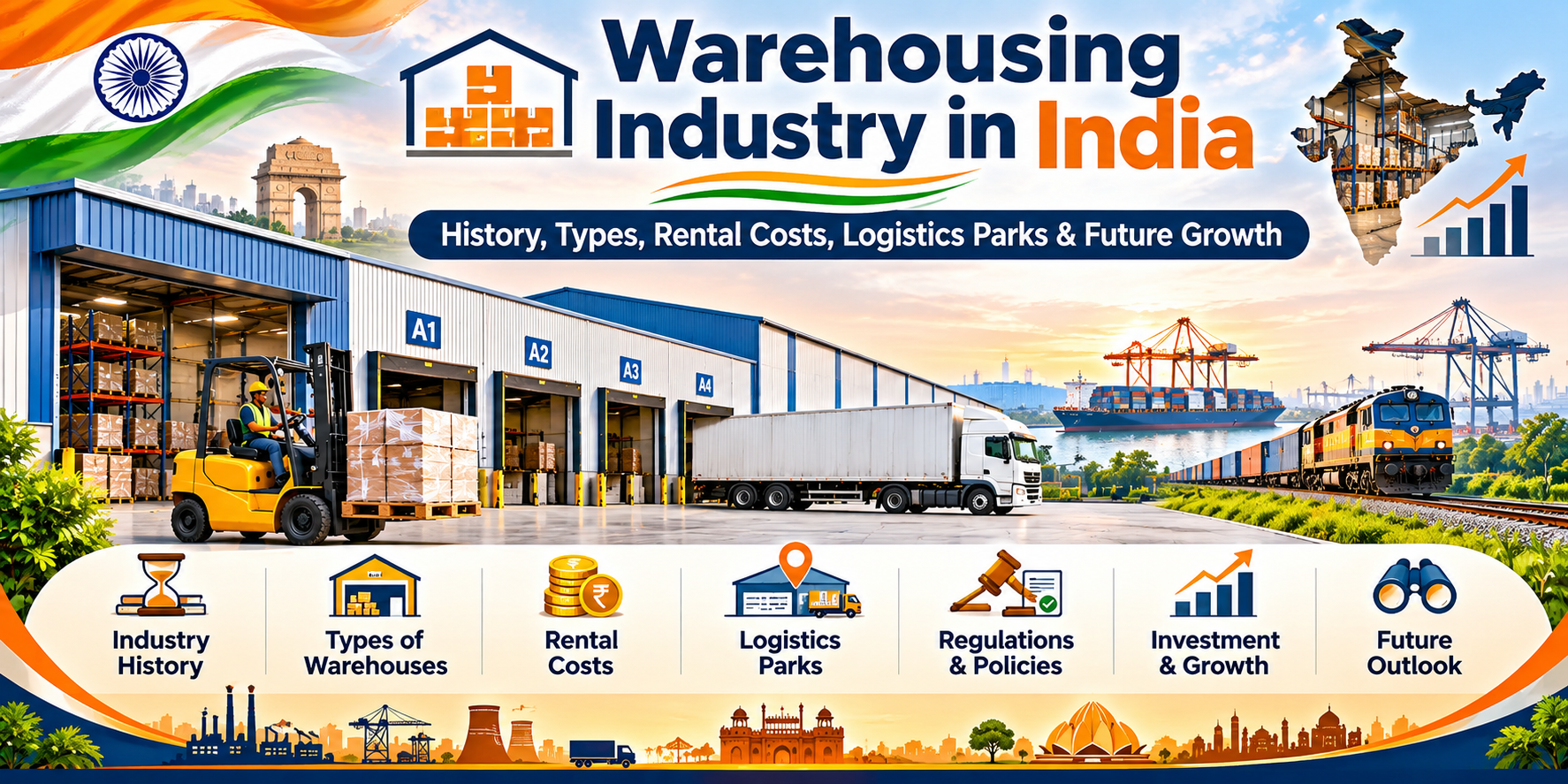
🏭 Warehousing Industry in India: Complete Industrial, Storage & Logistics Guide 2026–27
📦 Why Warehousing Matters to India’s Economy

India’s warehousing industry is one of the essential foundations of its manufacturing, agricultural, trading and logistics economy. Every product travelling from a factory to a customer depends on a series of decisions about storage, inventory, handling, transportation and distribution.
A warehouse is more than a building where goods are kept. In a modern supply chain, it is an operational centre where products are received, inspected, identified, protected, organised and dispatched according to customer requirements.
Warehousing helps manufacturers maintain production continuity, farmers preserve harvested commodities, traders manage seasonal inventory and retailers serve changing consumer demand.
For logistics companies, warehouses also serve as important connection points between road transport, rail freight, ports, factories and final delivery destinations.
The development of industrial corridors, large manufacturing clusters, organised retail and digital commerce has increased the importance of professional warehouse operations in India.
However, the sector remains diverse. Traditional godowns, agricultural storage facilities, modern distribution centres, cold-chain warehouses and specialised industrial yards operate under different commercial and technical conditions.
Understanding these differences is essential for businesses planning to rent, develop, invest in or operate a warehouse.
📊 Warehouse, warehousing, logistics and supply chain: Key differences

| Term | Meaning | Main Function | Example |
|---|---|---|---|
| Warehouse | Physical storage facility | Holds goods | Industrial storage building |
| Warehousing | Activities associated with storing and managing goods | Inventory protection and control | Receiving, stacking and dispatch |
| Logistics | Planning and execution of goods movement and related activities | Transportation and distribution | Factory-to-warehouse delivery |
| Supply Chain | Network of organisations and processes involved in supplying products | End-to-end coordination | Supplier to manufacturer to customer |
| Distribution Centre | Facility focused on receiving and distributing goods | Rapid order processing | Regional FMCG distribution |
| Fulfilment Centre | Facility processing customer orders | Picking, packing and dispatch | E-commerce order fulfilment |
| Logistics Park | Planned location combining logistics-related facilities | Cargo consolidation and services | Warehousing with truck and cargo facilities |
🏛️ History of Warehousing in India: From Ancient Storage to Modern Logistics
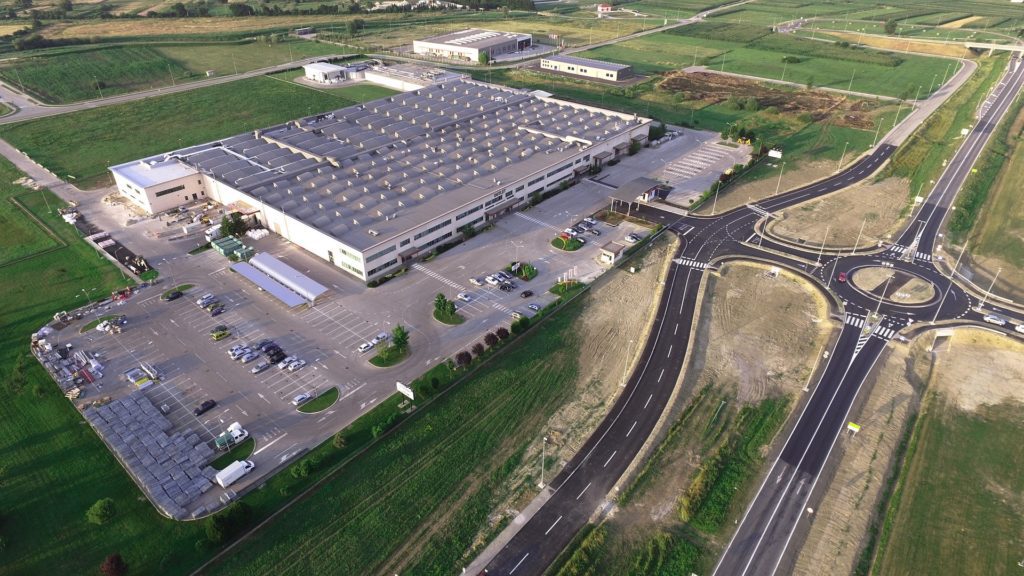
The history of warehousing in India is closely connected with agriculture, trade, transportation and urban development.
Storage existed long before modern industrial buildings or computerised inventory systems.
Ancient agricultural communities required ways to preserve grain between harvests. Merchants needed facilities to protect commodities during long-distance trade. Political authorities also maintained storage arrangements to support administration and food supplies.
Over time, the nature of storage changed as commercial networks expanded.
Traditional agricultural storage
In agricultural communities, storage helped preserve crops for household consumption, future planting, trade and periods of scarcity.
Traditional arrangements included household granaries, community storage and larger facilities associated with merchants or authorities.
These methods varied according to climate, building materials, local agricultural practices and the type of commodity.
Trade routes and commercial godowns
As trade expanded, merchants required secure places to hold goods before sale or onward transportation.
Commercial godowns developed around trading centres, market towns, river routes and ports.
Their primary functions included temporary storage, protection against weather and organisation of merchandise.
Colonial-era railways and ports
Railways and maritime trade significantly influenced the geography of commercial storage.
Goods could be transported over longer distances and consolidated near railway stations, ports and wholesale markets.
Storage facilities increasingly supported organised trade in cotton, grain, textiles, minerals and manufactured products.
Post-Independence institutional development
After Independence, food security, agricultural procurement and public distribution became major national priorities.
The Central Warehousing Corporation and Food Corporation of India became important institutions within the public food-storage and warehousing system.
The Department of Food and Public Distribution continues to oversee policy concerning Central Pool foodgrain storage and scientific storage infrastructure. dfpd.gov.in
📊 Evolution of warehousing in India
| Historical Stage | Dominant Storage Requirement | Typical Infrastructure | Economic Significance |
|---|---|---|---|
| Ancient agricultural communities | Crop preservation | Traditional granaries | Food availability |
| Historical trading networks | Merchant storage | Commercial storage structures | Regional trade |
| Colonial trade expansion | Port and railway cargo | Godowns and depots | Commodity movement |
| Early post-Independence | Foodgrain storage | Public storage facilities | Food security |
| Industrial expansion | Raw materials and finished goods | Factory warehouses | Manufacturing growth |
| Economic liberalisation | Commercial distribution | Private warehouses | Expanding supply chains |
| Organised retail and 3PL growth | Regional inventory management | Distribution centres | Wider market coverage |
| E-commerce expansion | Order fulfilment | Fulfilment facilities | Faster distribution |
| Modern industrial logistics | Integrated storage and transport | Specialised and technology-enabled facilities | Supply-chain coordination |
🏗️ Commercialisation and Industrialisation of Indian Warehousing
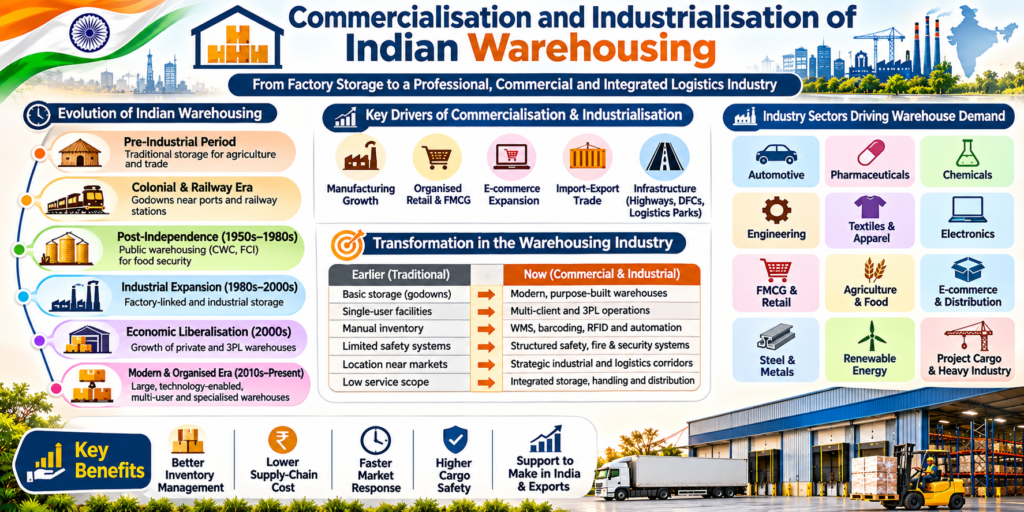
The industrialisation of warehousing occurred alongside the expansion of manufacturing and organised distribution.
Factories require raw materials, spare parts, packaging materials and components. They also need space to store finished products before dispatch.
As industrial production increased, warehousing became a specialised commercial service rather than merely an extension of factory premises.
Third-party warehouse operators began offering storage and inventory services to multiple customers.
Modern industrial warehousing now serves sectors such as automotive manufacturing, pharmaceuticals, chemicals, electronics, steel, textiles, engineering and consumer goods.
📊 Industry-wise warehousing requirements
| Industry | Common Cargo | Warehouse Requirements | Key Operational Concern |
|---|---|---|---|
| Automotive | Components, assemblies, spare parts | Organised inventory and sequencing | Production continuity |
| Engineering | Machinery, fabricated components | Suitable floors and handling equipment | Heavy-load safety |
| Pharmaceuticals | Medicines and materials | Product-specific environmental controls | Quality and traceability |
| Chemicals | Industrial chemicals | Compatibility and safety controls | Hazard management |
| Textiles | Fabrics and garments | Clean and dry storage | Moisture and contamination |
| Electronics | Components and finished products | Secure and suitable storage | Damage and inventory accuracy |
| Food processing | Raw and processed foods | Product-specific storage | Food safety |
| Agriculture | Grains, pulses and produce | Scientific storage | Spoilage prevention |
| E-commerce | Mixed consumer products | Picking and fulfilment systems | Order accuracy |
| Steel and metals | Coils, sections and components | Engineered storage and lifting | Weight and handling |
| Renewable energy | Solar and electrical equipment | Specialised protection and handling | Damage prevention |
🏢 Major Types of Warehouses in India
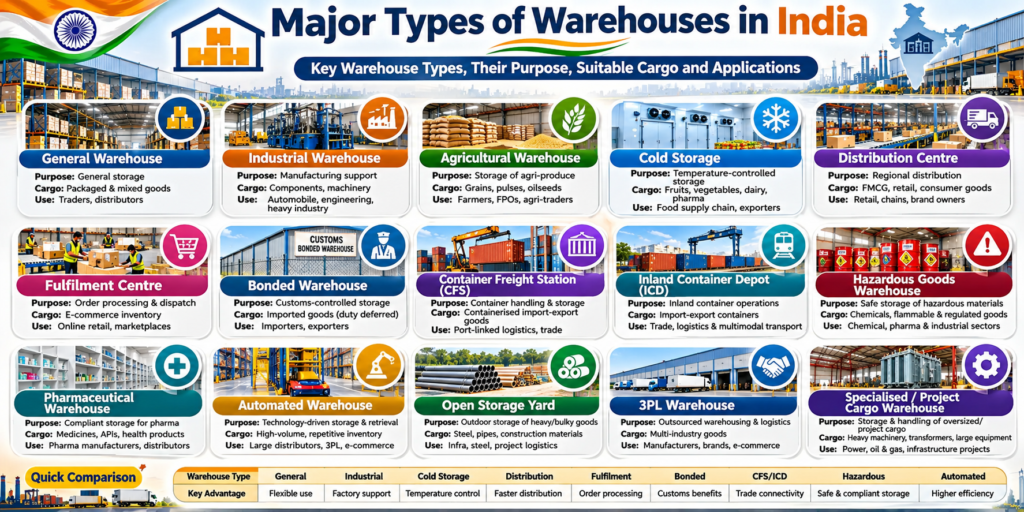
Warehouse classification depends on ownership, cargo type, operational purpose and regulatory requirements.
📊 Types of warehouses and their applications
| Warehouse Type | Main Purpose | Suitable Cargo | Principal Advantage | Main Limitation |
|---|---|---|---|---|
| General warehouse | Commercial storage | Packaged goods | Flexible use | Limited specialisation |
| Industrial warehouse | Manufacturing support | Components and machinery | Factory integration | Cargo-specific infrastructure |
| Agricultural warehouse | Crop storage | Grains, pulses | Seasonal inventory management | Quality preservation |
| Cold storage | Temperature-controlled storage | Selected food and pharmaceutical products | Product protection | Energy cost |
| Distribution centre | Regional product distribution | FMCG and retail goods | Faster order movement | Throughput requirements |
| Fulfilment centre | Customer order processing | E-commerce inventory | Picking and packing efficiency | Operational complexity |
| Bonded warehouse | Customs-controlled storage | Eligible imported goods | Customs-related storage arrangements | Regulatory obligations |
| Container freight station | Container-related cargo operations | Import-export cargo | Port logistics support | Authorisation and infrastructure |
| Inland container depot | Inland container and customs operations | Containerised trade | Inland logistics access | Service availability |
| Cross-docking facility | Rapid cargo transfer | Distribution shipments | Reduced storage time | Precise scheduling |
| Hazardous goods warehouse | Specialised regulated storage | Applicable hazardous materials | Product-specific protection | Strict safety requirements |
| Pharmaceutical warehouse | Healthcare inventory | Medicines and related products | Traceability | Environmental controls |
| Automated warehouse | Technology-supported operations | Suitable repetitive inventory | Potential productivity gains | Capital and integration cost |
| Open storage yard | Outdoor industrial storage | Suitable heavy materials | Large cargo accommodation | Weather exposure |
| 3PL warehouse | Outsourced storage services | Multiple commercial categories | Professional service model | Contract dependency |
The choice of warehouse must be based on actual cargo characteristics rather than a generic property description.
🚛 Warehousing and Transportation: The Foundation of Integrated Logistics
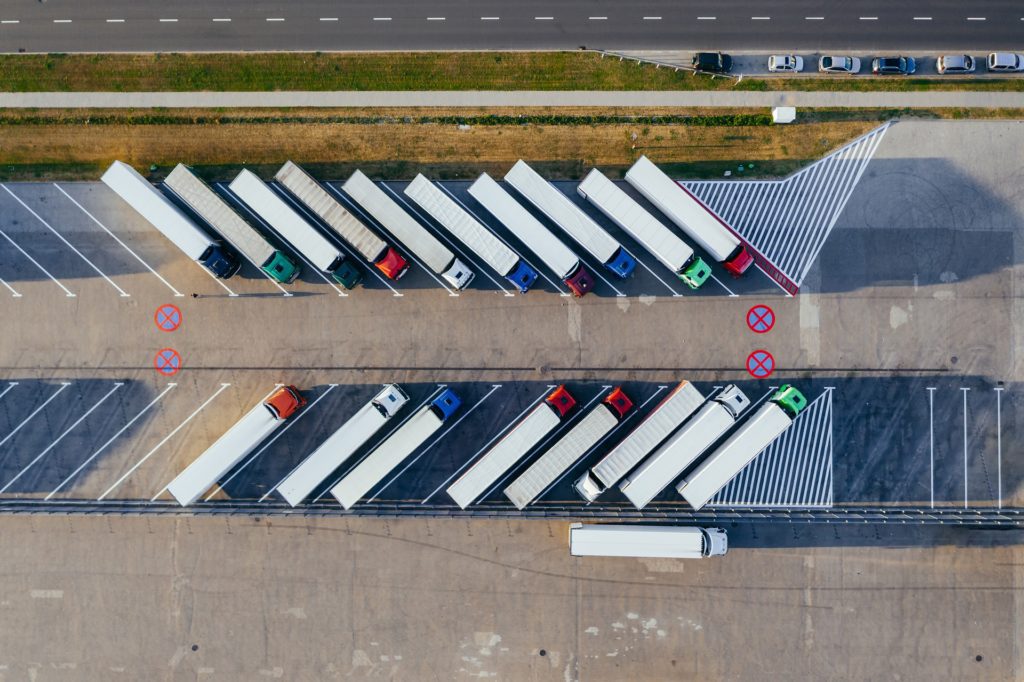
Warehouse efficiency and freight transportation are closely connected.
A warehouse may operate efficiently internally but still create substantial supply-chain costs if trucks face poor access, long queues or repeated loading delays.
Likewise, a transport operator may provide dependable vehicles but experience detention because the receiving warehouse is not prepared for the shipment.
An integrated logistics strategy should therefore coordinate warehouse operations with freight planning.
📊 Transportation requirements by warehouse category
| Warehouse Category | Common Transport Requirement | Typical Equipment | Important Planning Factor |
|---|---|---|---|
| FMCG distribution | Frequent regional dispatch | Suitable goods trucks | Delivery scheduling |
| Automotive warehouse | Factory-linked component movement | Trucks and trailers | Production schedules |
| Container storage | Container movement | Container trailers | Terminal coordination |
| Heavy industrial storage | Machinery transportation | Flatbed, lowbed or suitable trailers | Cargo dimensions and lifting |
| Agricultural warehouse | Seasonal commodity movement | Appropriate goods vehicles | Loading and stock condition |
| Cold-chain warehouse | Temperature-controlled distribution | Refrigerated vehicles | Temperature integrity |
| E-commerce fulfilment | Parcel and line-haul movement | Suitable delivery and line-haul vehicles | Dispatch cut-off times |
| Steel warehouse | Heavy material movement | Suitable heavy goods vehicles | Load distribution and securing |
| Project cargo yard | Oversized equipment movement | Specialised trailers | Route feasibility and permissions |
Why truck access matters
Before selecting a warehouse, operators should evaluate the roads used by incoming and outgoing vehicles.
A facility located near a national highway may still be unsuitable if its final access road has inadequate turning space, restrictions, weak pavement or insufficient clearance.
The design should account for the actual vehicles expected to serve the property.
For heavy machinery and oversized cargo, route assessment may need to consider bridges, overhead obstacles, turning geometry, ground conditions and applicable movement permissions.
🗺️ Major Warehousing Regions and Industrial Clusters in India

India’s warehousing geography reflects the location of manufacturing industries, ports, major highways, agricultural production and consumption centres.
The largest commercial opportunity is not necessarily in the most expensive metropolitan location. Regional facilities may offer advantages where they reduce transport distance, improve customer service or support nearby factories.
📊 State-wise warehousing and logistics industry overview
| State / Region | Major Industrial & Warehousing Locations | Principal Industries | Storage Opportunities |
|---|---|---|---|
| Gujarat | Ahmedabad, Sanand, Vadodara, Bharuch, Dahej, Surat, Vapi, Kutch | Chemicals, engineering, textiles, automotive | Industrial storage, port logistics, project cargo |
| Maharashtra | Mumbai, Bhiwandi, Panvel, Pune, Chakan, Nashik, Nagpur | Automotive, retail, engineering, pharmaceuticals | Grade-A warehouses, 3PL, distribution |
| Delhi NCR | Delhi, Gurugram, Manesar, Noida, Greater Noida, Ghaziabad | Manufacturing, retail, e-commerce | Distribution and fulfilment |
| Haryana | Sonipat, Farukhnagar, Panipat, Manesar | Automotive, textiles, consumer goods | Industrial logistics |
| Uttar Pradesh | Noida, Lucknow, Kanpur, Varanasi, Ghaziabad | Electronics, food processing, manufacturing | Regional distribution |
| Rajasthan | Jaipur, Neemrana, Bhiwadi, Alwar, Jodhpur | Engineering, textiles, minerals | Industrial warehousing |
| Punjab | Ludhiana, Jalandhar, Amritsar, Bathinda | Agriculture, engineering, textiles | Agricultural and industrial storage |
| Himachal Pradesh | Baddi, Nalagarh, Parwanoo | Pharmaceuticals, manufacturing | Factory-linked warehousing |
| Uttarakhand | Haridwar, Rudrapur, Pantnagar, Kashipur | Automotive, pharmaceuticals, FMCG | Manufacturing support |
| Madhya Pradesh | Indore, Pithampur, Bhopal, Dewas, Gwalior | Automotive, agriculture, engineering | Central India distribution |
| Chhattisgarh | Raipur, Bhilai, Korba, Bilaspur | Steel, power, minerals | Heavy industrial storage |
| Odisha | Paradip, Angul, Kalinganagar, Jharsuguda, Bhubaneswar | Steel, minerals, ports, engineering | Industrial yards and port logistics |
| Jharkhand | Jamshedpur, Adityapur, Bokaro, Ranchi, Dhanbad | Steel, mining, engineering | Industrial material storage |
| Bihar | Patna, Hajipur, Barauni, Muzaffarpur | Agriculture, food processing | Regional distribution |
| West Bengal | Kolkata, Howrah, Dankuni, Haldia, Durgapur | Trade, engineering, port cargo | Eastern distribution |
| Assam | Guwahati, Amingaon, Dibrugarh, Tinsukia | Tea, petroleum-related industries, trade | Northeast distribution |
| Meghalaya | Byrnihat, Shillong | Cement, agriculture, consumer goods | Regional storage |
| Tripura | Agartala | Agriculture, trade | Regional distribution |
| Nagaland | Dimapur | Trade and agriculture | Commercial storage |
| Manipur | Imphal | Trade and agriculture | Regional storage |
| Mizoram | Aizawl | Trade and agriculture | Regional distribution |
| Arunachal Pradesh | Itanagar, Naharlagun | Construction supplies, consumer goods | Regional storage |
| Sikkim | Rangpo and selected commercial locations | Pharmaceuticals, agriculture | Specialised and regional storage |
| Karnataka | Bengaluru, Hoskote, Nelamangala, Hubballi, Belagavi | Electronics, engineering, retail | Industrial and fulfilment |
| Tamil Nadu | Chennai, Oragadam, Sriperumbudur, Hosur, Coimbatore | Automotive, electronics, textiles | Manufacturing warehousing |
| Telangana | Hyderabad, Medchal, Patancheru, Shamshabad | Pharmaceuticals, electronics, retail | Specialised and general storage |
| Andhra Pradesh | Visakhapatnam, Kakinada, Vijayawada, Sri City | Port cargo, manufacturing, agriculture | Port-linked storage |
| Kerala | Kochi, Palakkad, Kozhikode, Thiruvananthapuram | Consumer goods, food processing, trade | Distribution and specialised storage |
| Goa | Verna, Ponda, Vasco da Gama | Pharmaceuticals, manufacturing | Industrial storage |
The remaining Union Territories, including Chandigarh, Puducherry, Jammu and Kashmir, Ladakh, Dadra and Nagar Haveli and Daman and Diu, Lakshadweep, and Andaman and Nicobar Islands, have distinct storage requirements related to local industries, geography, distribution and essential supplies.
These locations represent industrial geography, not a verified inventory of available warehouse properties.
🛣️ Dedicated Freight Corridors, Logistics Parks and Multimodal Warehousing
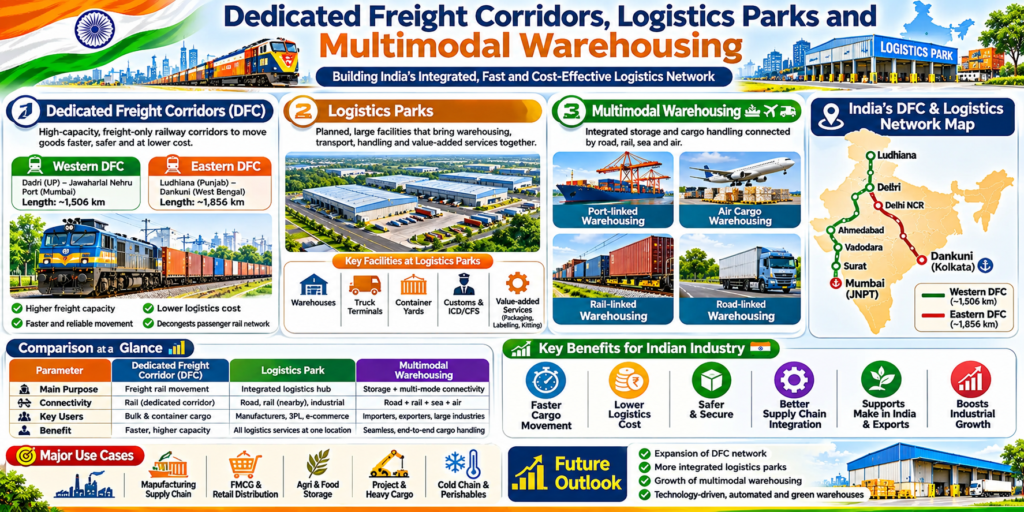
Freight infrastructure influences where warehouses can operate economically.
India’s Eastern and Western Dedicated Freight Corridors are important components of the country’s freight railway infrastructure. Their commercial impact depends on actual terminal access, rail service availability and connectivity to industrial customers.
A warehouse located near a railway alignment does not automatically have access to freight trains.
Similarly, a logistics park may offer several logistics services without necessarily providing operational rail or customs facilities.
📊 Infrastructure comparison
| Infrastructure | Primary Purpose | Warehousing Relevance |
|---|---|---|
| National highways | Road connectivity | Truck movement and distribution |
| Expressways | High-capacity road access | Regional logistics connectivity |
| Dedicated Freight Corridors | Freight rail movement | Suitable rail-linked supply chains |
| Industrial corridors | Industrial infrastructure development | Manufacturing-related warehouse demand |
| Inland Container Depots | Inland container logistics | Import-export cargo support |
| Container Freight Stations | Container handling and related services | Port cargo logistics |
| Multimodal Logistics Parks | Integration of logistics facilities | Cargo consolidation and transfer |
| Ports | Maritime trade | Import-export storage |
| Airport cargo facilities | Air freight | Time-sensitive and high-value cargo |
PM GatiShakti and National Logistics Policy
PM GatiShakti was launched in October 2021 to support coordinated infrastructure planning and multimodal connectivity. The National Logistics Policy followed in September 2022, focusing on logistics services, processes, digitalisation and skills. dpiit.gov.in+1
These frameworks are relevant to the warehousing sector because storage facilities depend on reliable connections with transport infrastructure.
However, individual warehouse investments still require commercial feasibility studies. National policy objectives do not guarantee that a particular logistics park or warehouse will achieve its projected occupancy.
💰 Warehouse Rental Models and Commercial Pricing
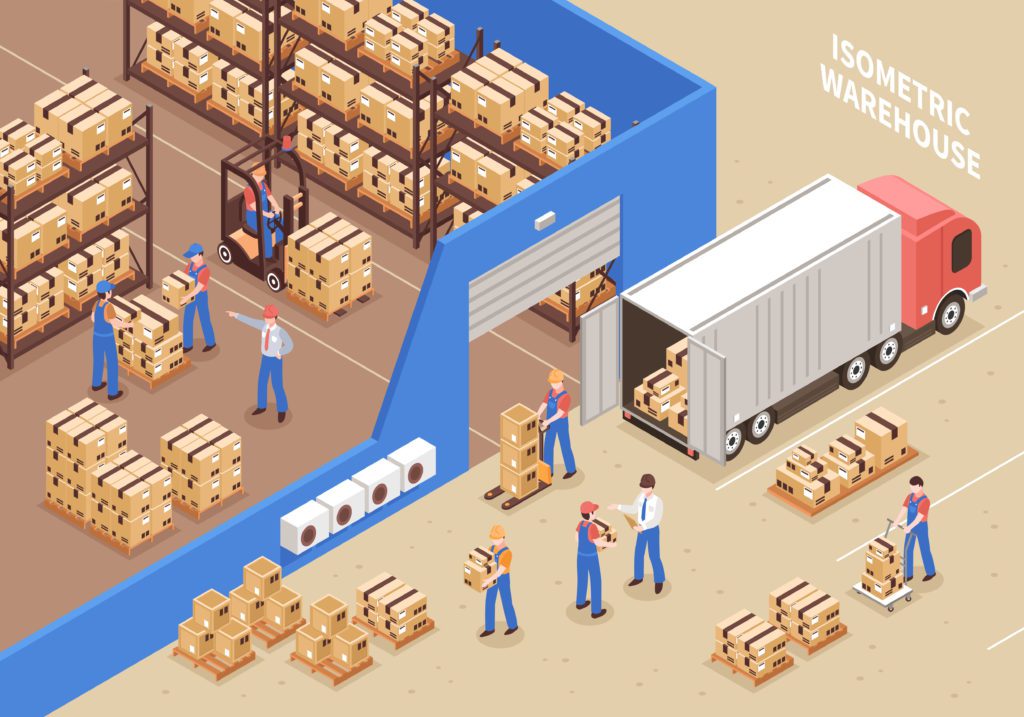
Warehouse rental agreements can differ substantially.
A dedicated warehouse may be leased on a monthly area basis. A shared warehouse may charge for pallets, tonnes, storage days or handling activities.
The correct comparison is the total cost of the service, not simply the advertised monthly rent.
📊 Warehouse rental models
| Model | Pricing Basis | Suitable Customers | Key Consideration |
|---|---|---|---|
| Dedicated warehouse lease | Area and contract duration | Manufacturers and large distributors | Fixed occupancy cost |
| Shared warehousing | Space and services used | MSMEs | Flexible capacity |
| Pallet storage | Pallet positions and time | Packaged goods businesses | Handling charges |
| Per-tonne storage | Commodity weight | Suitable bulk goods | Commodity conditions |
| Per-unit storage | Inventory units | Retail and e-commerce | Inventory accuracy |
| Throughput-based pricing | Goods handled | Distribution operations | Volume variation |
| Built-to-suit lease | Custom property agreement | Large industrial occupiers | Long-term commitment |
| Managed warehouse contract | Property and operational services | Outsourced logistics customers | Service-level obligations |
📊 Illustrative warehouse rent calculator
These are hypothetical examples for budgeting, not verified market rental rates.
| Area | Assumed Monthly Rate | Monthly Rent | Annual Rent |
|---|---|---|---|
| 5,000 sq ft | ₹20/sq ft | ₹1,00,000 | ₹12,00,000 |
| 10,000 sq ft | ₹22/sq ft | ₹2,20,000 | ₹26,40,000 |
| 20,000 sq ft | ₹24/sq ft | ₹4,80,000 | ₹57,60,000 |
| 30,000 sq ft | ₹25/sq ft | ₹7,50,000 | ₹90,00,000 |
| 50,000 sq ft | ₹25/sq ft | ₹12,50,000 | ₹1,50,00,000 |
| 1,00,000 sq ft | ₹28/sq ft | ₹28,00,000 | ₹3,36,00,000 |
| 2,00,000 sq ft | ₹30/sq ft | ₹60,00,000 | ₹7,20,00,000 |
Warehouse quotations should also specify maintenance, deposits, escalation, electricity, fit-out, insurance responsibilities, loading charges and applicable taxes.
🧾 Government Regulations, WDRA and Warehouse Compliance
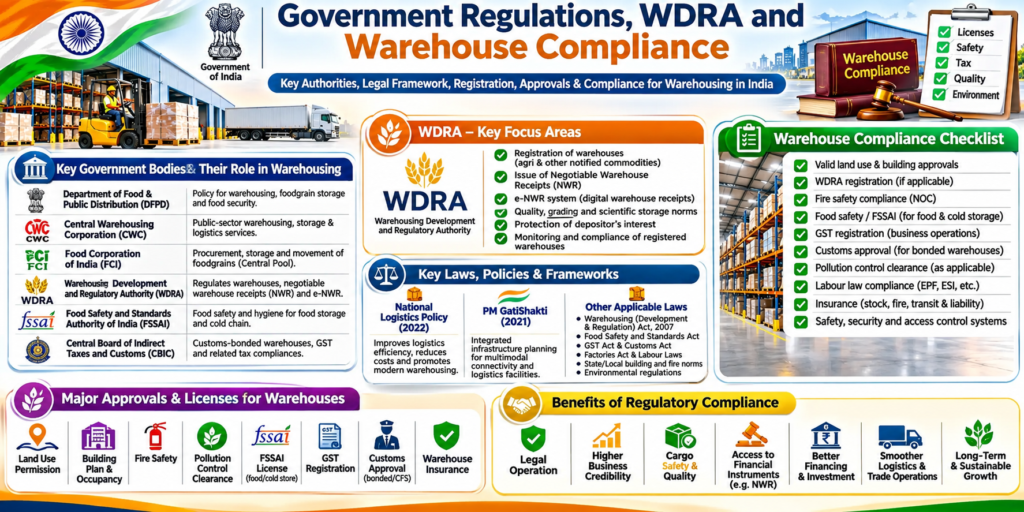
Warehousing activities in India may be subject to central, state and local regulations.
The requirements depend on the type of facility, location, stored commodities and commercial operations.
A food warehouse, customs-bonded warehouse and industrial machinery storage yard should not be assumed to have identical regulatory obligations.
📊 Warehouse regulatory framework
| Authority / Framework | Area of Responsibility | Relevance |
|---|---|---|
| WDRA | Regulated warehouse receipt system | Eligible registered warehousing activities |
| CWC | Public-sector warehousing | Storage and logistics services |
| FCI | Foodgrain procurement and movement | Food security storage |
| FSSAI | Food safety | Applicable food storage |
| CBIC / Customs | Customs and indirect taxes | Bonded facilities and GST |
| State fire authorities | Fire safety | Applicable approvals |
| Local planning authorities | Land use and construction | Permitted use and occupancy |
| State pollution control boards | Environmental requirements | Applicable storage activities |
| Labour authorities | Employment requirements | Workforce compliance |
The Department of Food and Public Distribution identifies CWC, FCI and WDRA as major institutions within its warehousing and food-storage responsibilities. dfpd.gov.in
🌾 Agricultural Warehousing, Food Security and Scientific Storage
Agricultural warehousing is particularly important because production is seasonal while consumption continues throughout the year.
Scientific storage involves appropriate methods for preserving commodity quality, monitoring inventory and reducing avoidable losses.
The Department of Food and Public Distribution describes the development of adequate and scientific foodgrain storage as part of its storage policy responsibilities. dfpd.gov.in
📊 Agricultural storage requirements
| Commodity | Storage Concern | Recommended Management Focus |
|---|---|---|
| Wheat | Moisture and pests | Inspection and suitable dry storage |
| Rice | Moisture and quality deterioration | Commodity-specific preservation |
| Pulses | Infestation | Monitoring and stock rotation |
| Oilseeds | Quality deterioration | Moisture management |
| Cotton | Fire and contamination | Fire protection and suitable stacking |
| Spices | Moisture and contamination | Clean storage and packaging |
| Fruits | Spoilage | Product-specific cold chain |
| Vegetables | Temperature sensitivity | Appropriate environmental control |
| Seeds | Viability | Suitable storage conditions |
💻 Warehouse Management Systems, Automation and Digital Inventory
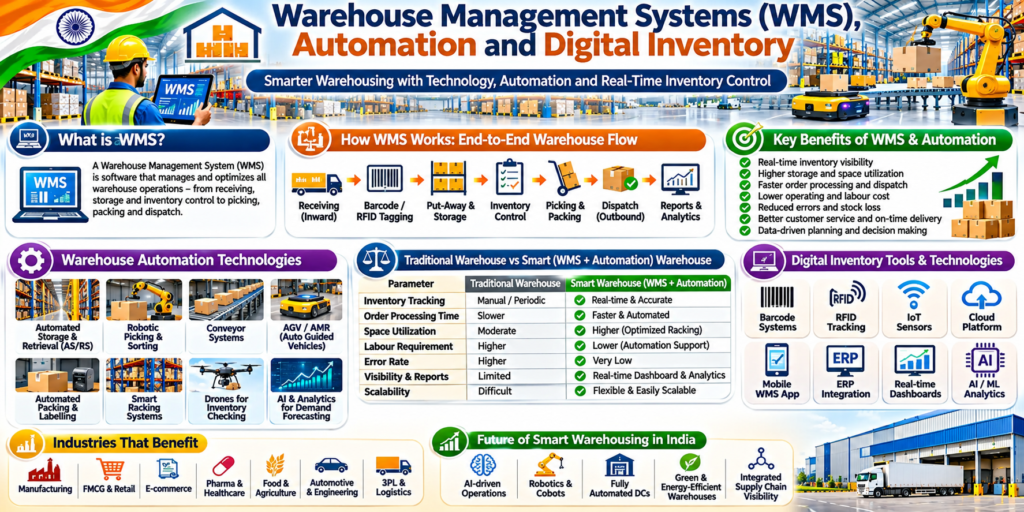
A Warehouse Management System, or WMS, helps organise receiving, storage, stock identification, picking, packing and dispatch.
Modern systems can integrate with enterprise resource planning software and transportation management systems.
Technology should support a clearly defined operational process.
A warehouse with poor inventory discipline will not necessarily become efficient simply by installing expensive software.
📊 Warehouse technology comparison
| Technology | Main Function | Potential Benefit |
|---|---|---|
| WMS | Warehouse process management | Inventory visibility |
| ERP | Enterprise business coordination | Integrated business records |
| TMS | Transportation management | Freight planning |
| Barcode scanning | Item identification | Reduced manual entry |
| RFID | Automated identification | Inventory visibility |
| IoT sensors | Environmental and equipment monitoring | Earlier problem detection |
| AI analytics | Forecasting and operational analysis | Improved planning |
| Robotics | Repetitive handling tasks | Potential productivity gains |
| Automated storage systems | Mechanised storage and retrieval | Space and process efficiency |
Related reading
- https://travel.roadstransporter.com/warehouse-management-system-wms/
- https://travel.roadstransporter.com/types-of-warehouse-management-systems/
These supporting articles can be linked internally from the WMS section to strengthen the site’s topical organisation.
🏗️ Warehouse Construction, Design and Technical Requirements
A warehouse should be designed for the goods it will actually store.
Important considerations include floor loading, building height, structural capacity, loading docks, vehicle circulation, fire protection, drainage, utilities and material-handling equipment.
A general-purpose warehouse may be unsuitable for transformers, steel coils or large industrial machinery.
📊 Warehouse design checklist
| Design Feature | Business Importance | Verification Required |
|---|---|---|
| Land-use approval | Lawful operation | Planning authority |
| Building structure | Structural safety | Qualified engineer |
| Floor capacity | Safe cargo storage | Load assessment |
| Clear height | Storage configuration | Equipment and racking design |
| Loading docks | Vehicle turnaround | Vehicle compatibility |
| Truck turning area | Safe circulation | Swept-path assessment |
| Fire protection | Life and asset safety | Applicable fire requirements |
| Drainage | Flood protection | Site assessment |
| Power supply | Operational continuity | Electrical load study |
| Security | Inventory protection | Risk assessment |
| Racking | Efficient storage | Rated capacities |
| Staff amenities | Workforce welfare | Applicable requirements |
🔥 Warehouse Safety, Insurance and Cargo Protection
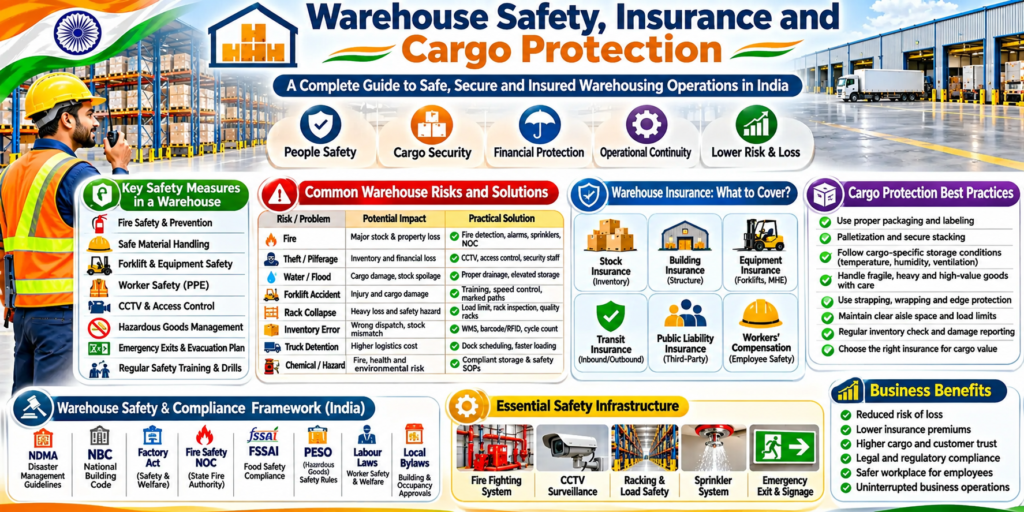
Warehouse risk management involves preventing accidents and preparing for incidents that cannot be completely eliminated.
Common risks include fire, theft, water damage, forklift collisions, falling materials, equipment failure and incorrect cargo handling.
📊 Warehouse problems and practical solutions
| Problem | Potential Impact | Recommended Solution |
|---|---|---|
| Fire | Property and stock losses | Suitable fire protection and emergency planning |
| Theft | Inventory losses | Access control and reconciliation |
| Flooding | Water damage | Drainage and site-risk planning |
| Forklift collision | Injury and damage | Operator training and traffic separation |
| Rack failure | Falling goods | Engineering inspections and load limits |
| Inventory mismatch | Incorrect dispatch | WMS and cycle counting |
| Truck detention | Higher freight cost | Dock appointment systems |
| Labour shortage | Lower productivity | Training and workforce planning |
| Insurance disputes | Financial exposure | Clear policy and contract terms |
| Equipment breakdown | Operational interruption | Preventive maintenance |
Warehouse insurance coverage depends on the actual policy, insured property, exclusions and applicable conditions.
Businesses should establish written responsibility for cargo damage, theft, storage charges and insurance claims before operations begin.
🤝 Captive Warehousing vs 3PL vs 4PL
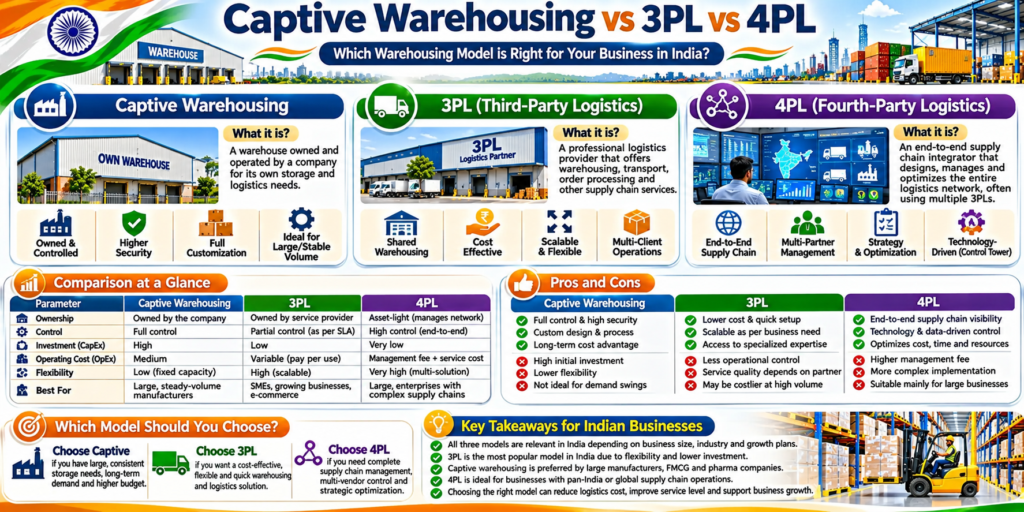
Businesses can operate warehouses internally or outsource storage and logistics management.
📊 Warehousing operating models
| Parameter | Captive Warehousing | 3PL | 4PL |
|---|---|---|---|
| Operational responsibility | Internal team | Logistics service provider | Supply-chain integrator |
| Main advantage | Direct control | Specialist execution | Multi-provider coordination |
| Main challenge | Fixed cost | Provider dependency | Governance complexity |
| Suitable business | Stable internal operations | Outsourced logistics | Complex supply chains |
| Inventory handling | Internal | Usually provider-managed | Coordinated through providers |
| Technology | Internal systems | Provider or integrated systems | Network integration |
The best model depends on cost, operational complexity, customer expectations and contractual responsibility.
📈 How to Start a Warehouse Business in India
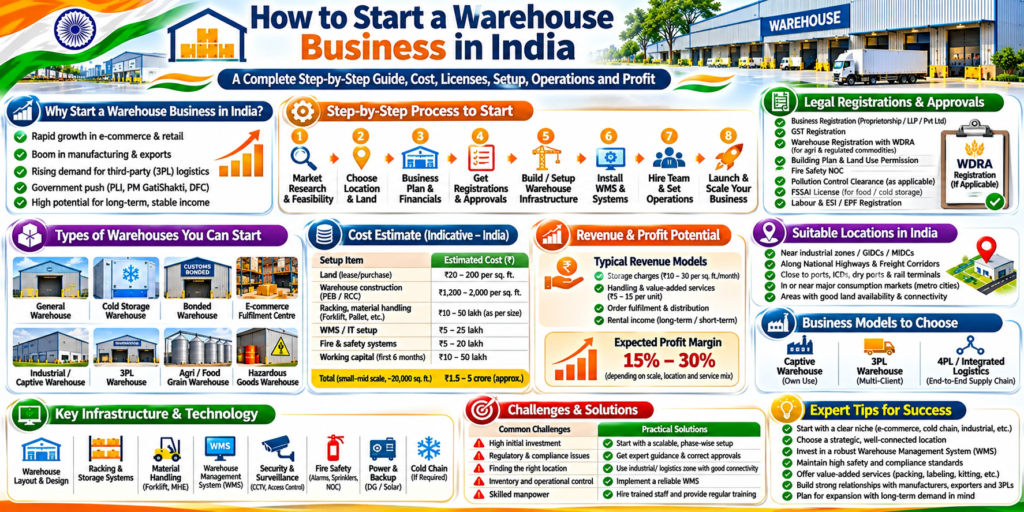
A warehousing business may involve property leasing, storage services, inventory management, cold-chain operations or logistics coordination.
The first step is selecting a business model and identifying genuine customer demand.
📊 Warehouse business startup roadmap
| Step | Activity | Business Objective |
|---|---|---|
| 1 | Identify target customers | Understand demand |
| 2 | Select business model | Define services |
| 3 | Study location | Evaluate connectivity |
| 4 | Verify property | Establish legal suitability |
| 5 | Prepare financial plan | Assess investment |
| 6 | Confirm compliance | Reduce regulatory risk |
| 7 | Design operations | Improve efficiency |
| 8 | Arrange equipment | Support cargo handling |
| 9 | Select technology | Manage inventory |
| 10 | Recruit personnel | Build capability |
| 11 | Arrange insurance | Manage risk |
| 12 | Prepare contracts | Define responsibilities |
| 13 | Conduct trial operations | Test procedures |
| 14 | Launch services | Begin commercial operations |
💸 Warehouse Investment and Profitability
Warehouse investment returns depend on occupancy, rental rates, capital costs, operating expenditure and financing.
A simplified financial model can help investors evaluate different scenarios.
📊 Hypothetical 100,000 sq ft warehouse investment example
| Parameter | Illustrative Value |
|---|---|
| Total area | 1,00,000 sq ft |
| Assumed monthly rent | ₹25/sq ft |
| Monthly rent at full occupancy | ₹25,00,000 |
| Assumed occupancy | 85% |
| Effective annual rental revenue | ₹2,55,00,000 |
| Assumed annual operating expenses | ₹51,00,000 |
| Illustrative net operating income | ₹2,04,00,000 |
| Hypothetical property investment | ₹25,00,00,000 |
| Simplified NOI yield | 8.16% |
This is a calculation example, not an actual investment proposal or forecast. Financing, taxes, depreciation and capital expenditure are excluded.
🌱 Green Warehousing and Sustainable Infrastructure
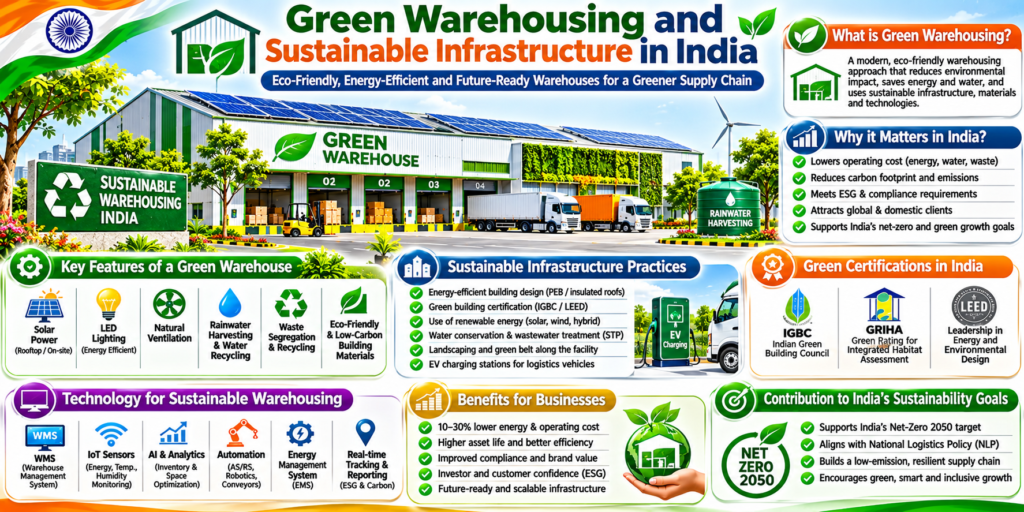
Green warehousing aims to improve resource efficiency and reduce environmental impact while maintaining operational safety.
📊 Sustainable warehouse development opportunities
| Initiative | Potential Benefit |
|---|---|
| Solar rooftop systems | Reduced purchased electricity |
| LED lighting | Improved energy efficiency |
| Roof insulation | Better thermal performance |
| Electric forklifts | Reduced local exhaust emissions |
| Rainwater harvesting | Improved water management |
| Efficient refrigeration | Reduced cold-chain energy consumption |
| Reusable pallets | Reduced selected packaging waste |
| Digital inventory systems | Reduced unnecessary handling |
| Truck scheduling | Less avoidable vehicle waiting |
Actual savings depend on facility conditions, operating patterns and investment costs.
👷 Employment and Entrepreneurship in Indian Warehousing

Warehousing supports employment across operations, technology, transportation, maintenance, engineering and commercial services.
📊 Warehouse jobs and business opportunities
| Job / Business | Main Activity |
|---|---|
| Warehouse manager | Facility operations |
| Inventory controller | Stock management |
| Forklift operator | Material handling |
| Safety officer | Workplace risk management |
| WMS administrator | Warehouse software |
| Transport coordinator | Freight scheduling |
| Warehouse broker | Commercial property transactions |
| Packaging contractor | Cargo protection |
| Equipment rental provider | Handling equipment services |
| 3PL operator | Outsourced warehousing |
| Industrial logistics consultant | Storage and freight planning |
| Warehouse developer | Industrial property investment |
🚀 Future of Warehousing in India: 2027–2035
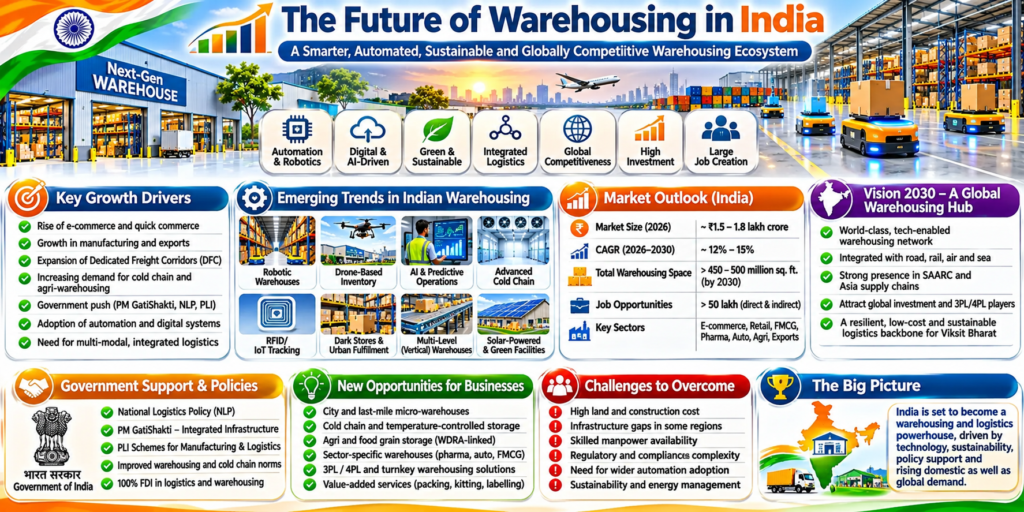
India’s future warehouse development will be influenced by manufacturing, trade, regional consumption, freight connectivity and technology.
The pace and nature of development will vary across regions.
📊 Future industry trends
| Trend | Expected Business Application | Key Challenge |
|---|---|---|
| Smart warehouses | Digital inventory management | Implementation cost |
| AI forecasting | Inventory and demand planning | Data quality |
| Robotics | Repetitive material handling | Capital requirements |
| Cold-chain expansion | Temperature-sensitive goods | Energy and equipment |
| Regional distribution | Improved market access | Network design |
| Multimodal logistics | Road–rail coordination | Terminal availability |
| Green infrastructure | Energy and resource efficiency | Investment feasibility |
| Specialised industrial storage | Machinery and project cargo | Technical infrastructure |
| Warehouse analytics | Productivity measurement | Reliable records |
These are strategic development themes, not guaranteed market forecasts.
❓ Frequently Asked Questions
What is the warehousing industry in India?
It comprises the facilities, businesses and services involved in receiving, storing, managing and dispatching goods.
What are the major warehouse types?
General, industrial, agricultural, cold-chain, distribution, fulfilment, bonded and specialised warehouses.
What determines warehouse rental prices?
Location, building specifications, connectivity, demand, contract duration and services.
Is WDRA registration mandatory for every warehouse?
No universal requirement applies to all ordinary commercial warehouses. Applicability depends on the regulated activity and relevant legal framework.
Can a transporter start a warehousing business?
Yes, provided the chosen operation has suitable infrastructure, expertise, agreements and applicable compliance.
What is the role of a WMS?
It supports inventory management and warehouse processes.
Are warehouse investments risk-free?
No. Occupancy, financing, operational costs and property conditions can affect returns.
Why are logistics parks important?
They can bring together storage, cargo handling and transport-related services.
What is the difference between 3PL and 4PL?
3PL generally performs logistics services, while 4PL coordinates a broader network of providers and resources.
What is the future of warehousing in India?
Further development is likely in organised industrial storage, technology, specialised facilities and integrated logistics, depending on demand and investment conditions.
🏢 ABCC India Project Cargo Corporation – Industrial Warehousing and Transportation Connectivity
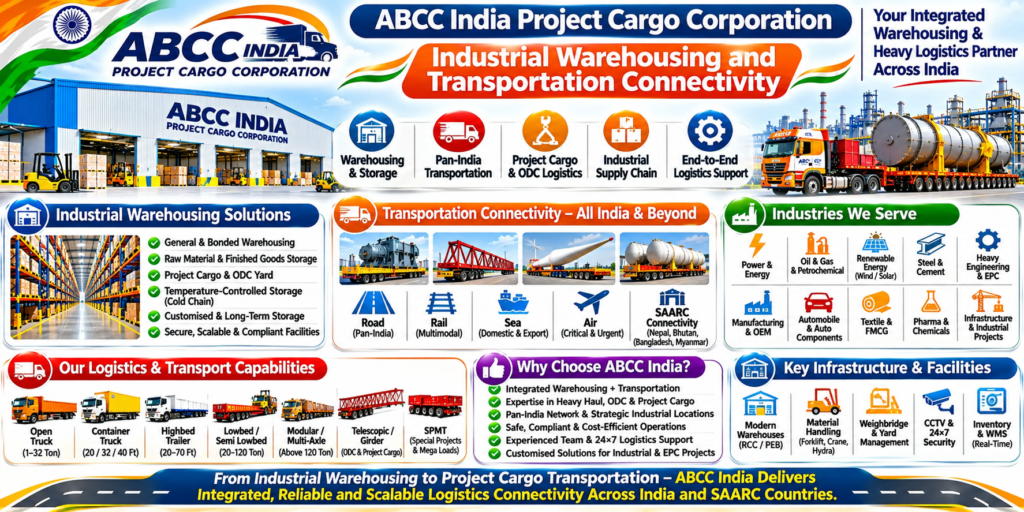
Warehousing and goods transportation form two connected parts of industrial logistics.
Manufacturers need reliable movement of raw materials into storage facilities and timely dispatch of finished products to customers.
ABCC India Project Cargo Corporation’s transportation and project-cargo focus is relevant to industrial cargo movements associated with warehouses, factories and logistics facilities.
These requirements can include conventional goods transportation, container movement, specialised trailer selection, heavy machinery relocation and over-dimensional cargo planning.
The objective of integrated planning is to reduce avoidable handling, detention and transportation inefficiencies while protecting cargo and meeting applicable safety requirements.
📝 How This Guide Was Prepared

This guide has been organised around the principal subjects relevant to Indian warehousing: history, commercialisation, warehouse types, industrial geography, rental arrangements, transportation, government institutions, technology, safety, investment and future development.
The article is intended for manufacturers, logistics businesses, warehouse operators, transporters, investors and entrepreneurs.
Author: R.K. Savarn
Author profile: https://travel.roadstransporter.com/author/admin/
📚 Official reference resources
| Institution / Resource | Reference URL |
|---|---|
| Department of Food and Public Distribution | https://dfpd.gov.in/ |
| Central Warehousing Corporation | https://cewacor.nic.in/ |
| Warehousing Development and Regulatory Authority | https://wdra.gov.in/ |
| Department for Promotion of Industry and Internal Trade | https://www.dpiit.gov.in/ |
| Food Safety and Standards Authority of India | https://fssai.gov.in/ |
| Central Board of Indirect Taxes and Customs | https://www.cbic.gov.in/ |
Final Conclusion: Warehousing as the Backbone of India’s Industrial Supply Chain

India’s warehousing industry is moving beyond traditional storage towards a more integrated industrial and logistics ecosystem.
Agricultural warehouses help preserve commodities. Industrial warehouses support manufacturing. Distribution centres connect businesses with markets. Specialised facilities protect sensitive and oversized cargo.
The future success of this industry will depend on more than warehouse construction.
Businesses must invest in suitable locations, dependable transport connections, accurate inventory systems, cargo protection, workforce capability and sound financial management.
For manufacturers, the priority is uninterrupted material availability and efficient distribution.
For warehouse developers, the priority is building commercially useful facilities supported by genuine demand.
For logistics providers, the opportunity is to connect storage infrastructure with reliable freight movement.
Warehousing protects the value of goods. Transportation connects that value with markets. Together, they support India’s industrial growth.