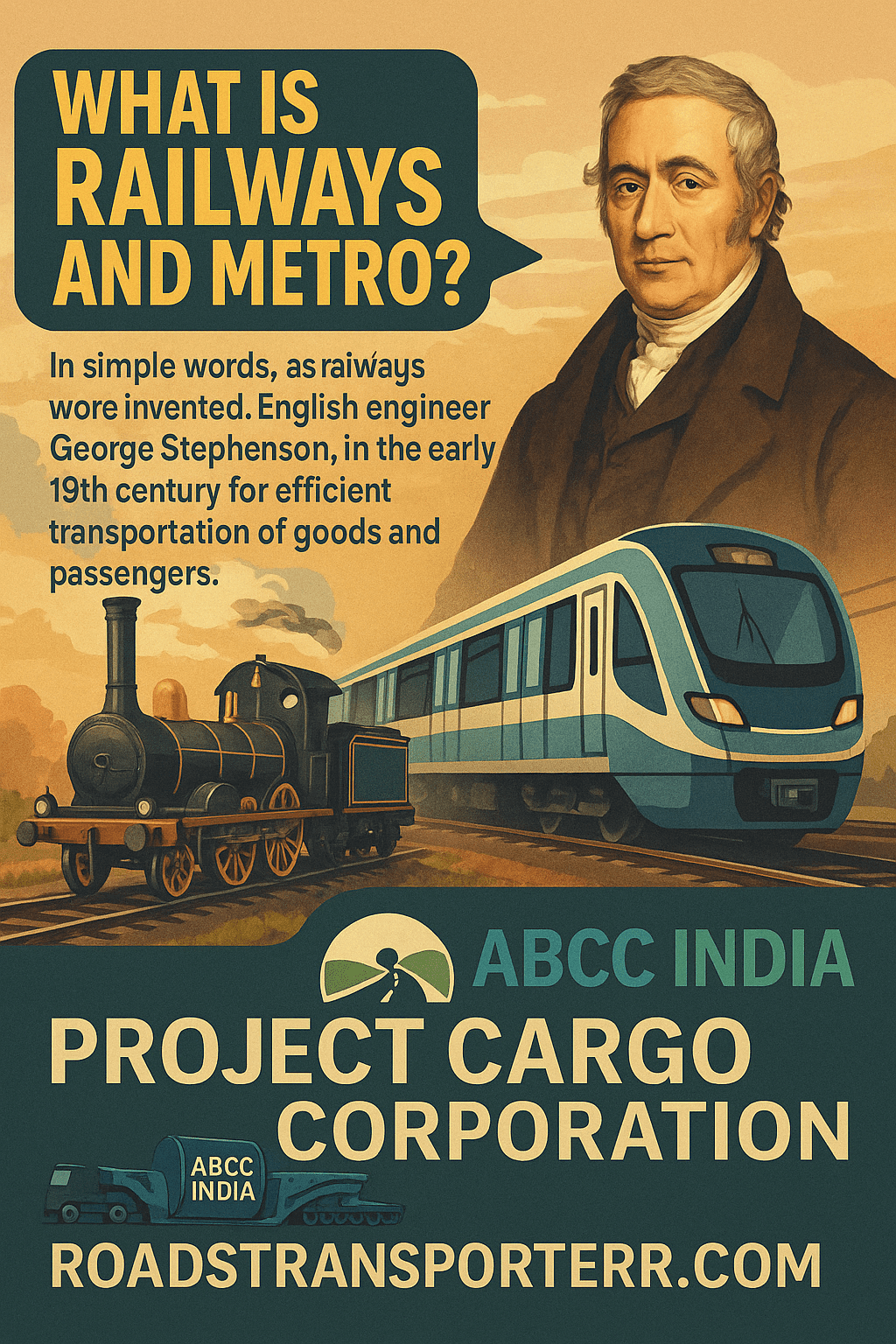
🚄 Introduction – What is Railways and Metro? (Who Invented, When & Why)
The story of the Railways and Metro Industry is one of human determination — the journey from steam to speed, from coal to clean, from locomotives to levitation.
🕰️ Who Invented It and Why?
The first full-scale working railway steam locomotive was built by George Stephenson in 1814 in England. His “Locomotion No. 1” and the Stockton & Darlington Railway (1825) were born out of necessity — to move coal efficiently.
But the idea of rail transport wasn’t just about moving goods. It became about connecting people, industries, and dreams. The world realized that faster transport meant faster progress.
🚆 The Metro Revolution
Fast-forward to the 1860s, the first underground metro was launched in London (1863). The goal was simple yet visionary — reduce congestion, move people efficiently, and make cities breathe again.
India followed suit with its first passenger train in 1853 (Bombay to Thane). Today, Indian Railways operates one of the largest railway networks in the world, and Metro systems now drive urban mobility across 20+ Indian cities.
💡 When tracks were laid, dreams were drawn.
When engines started, economies ignited.
The railway is not merely transport — it’s the heartbeat of industrial civilization.
ABCC INDIA PROJECT CARGO CORPORATION, a leader in heavy haulage and logistics, continues this legacy by transporting infrastructure, wagons, metro beams, and bridge girders that fuel India’s next mobility era.
🏗️ The Industrialization of Railways and Metro — When, Where & How It Happened
The industrialization of railways began during the Industrial Revolution (1750–1850) in Britain. As coal and iron production expanded, industries needed a faster, stronger, and more reliable mode of transportation.
🧩 Milestones in Industrialization
| Year | Country | Milestone | Impact |
|---|---|---|---|
| 1804 | UK | Richard Trevithick’s steam locomotive | Start of mechanized rail movement |
| 1825 | UK | First commercial railway line | Set the model for global rail expansion |
| 1853 | India | First passenger train (Bombay–Thane) | Industrial boost in colonial India |
| 1863 | UK | First underground metro | Urban transport revolution |
| 1964 | Japan | Shinkansen bullet train | Birth of high-speed rail era |
| 2002 | India | Delhi Metro | Modern urban metro revolution |
| 2025+ | India | Bullet train (Mumbai–Ahmedabad) | Future-ready infrastructure |
🚉 Types of Railways and Metro Uses + Tentative Price Range
| Type | Description | Typical Use | Tentative Cost Range (₹) |
|---|---|---|---|
| Conventional Railways | Long-distance passenger and freight transport | Goods & people | ₹50 Cr – ₹200 Cr/km |
| Metro Rail Systems | Urban rapid transit networks | City commuters | ₹250 Cr – ₹600 Cr/km |
| Monorail | Elevated single-track system | Short city routes | ₹200 Cr – ₹350 Cr/km |
| Light Rail Transit (LRT) | Smaller capacity city systems | Urban expansion | ₹150 Cr – ₹250 Cr/km |
| High-Speed Rail | 250–350 km/h bullet trains | Intercity travel | ₹700 Cr – ₹1,200 Cr/km |
| Freight Rail Corridors | Dedicated cargo networks | Industrial transport | ₹100 Cr – ₹300 Cr/km |
Data compiled from Indian Railways, DMRC, and global infrastructure benchmarks.
⚙️ Manufacturing & Production Structure + Product Lifecycle
🏗️ Step-by-Step Industry Structure
- Research & Design: Engine, bogie, and track layout planning.
- Material Procurement: Steel, aluminum, composites, cables, and electronics.
- Component Manufacturing: Coaches, motors, wheels, rails, signalling systems.
- Assembly Line: Integration at manufacturing hubs (e.g., ICF Chennai, BEML Bangalore).
- Testing & Certification: Safety checks and ISO compliance.
- Deployment: Rail laying, electrification, and commissioning.
- Maintenance & Upgradation: Continuous life-cycle management for 30–40 years.
🌎 Railways & Metro Industry Evolution (India & Global)
| Era | Global Milestone | Indian Milestone | Key Impact |
|---|---|---|---|
| 1800–1900 | Steam revolution | British rail expansion | Industrial linkage |
| 1900–1950 | Electrification & urban metros | Indian Railways nationalized (1947) | Network growth |
| 1950–2000 | Diesel & electric dominance | Metro planning in Kolkata (1984) | Urban expansion |
| 2000–2020 | Automation & bullet trains | Delhi Metro, DFC, RRTS | Modernization |
| 2020–Future | AI, green hydrogen trains | Gati Shakti + Make in India | Smart infrastructure |
💰 Market Size (Local & Global)
| Segment | Global Market Size (2024) | Indian Market Size (2024) | CAGR (2025–2030) |
|---|---|---|---|
| Railways Total | US $750 Billion | US $85 Billion | 6.5 % |
| Metro Infrastructure | US $300 Billion | US $45 Billion | 9 % |
| Freight Corridors | US $220 Billion | US $25 Billion | 7.8 % |
| Rolling Stock | US $180 Billion | US $20 Billion | 8.1 % |
India is expected to reach US $150 Billion by 2030 in combined rail and metro infrastructure, fueled by Make in India, Dedicated Freight Corridors, and Urban Mobility Projects.
🏢 Top 10 Worldwide Railways & Metro Companies
| Company | Country | Key Contribution | Motivational Insight |
|---|---|---|---|
| Siemens Mobility | Germany | Smart signalling, metro automation | “Efficiency meets intelligence.” |
| Alstom | France | Bullet & metro train manufacturing | Merged tech with sustainability. |
| Hitachi Rail | Japan | Hybrid propulsion & bullet tech | Engineering meets innovation. |
| CRRC | China | Largest global rolling stock maker | Scale & standardization success. |
| Bombardier (now Alstom) | Canada | Metro design & components | Excellence through acquisition. |
| GE Transportation | USA | Diesel locomotives | Reliability in heavy-haul segment. |
| Talgo | Spain | Lightweight trainsets | Design innovation pioneer. |
| Stadler Rail | Switzerland | Regional high-speed | Precision engineering. |
| Mitsubishi Heavy Industries | Japan | Metro & monorail systems | Powering urban mobility. |
| ABB | Switzerland | Electrification & control systems | Green energy integration. |
📊 🇮🇳 36 Indian States – Local Best Railways & Metro Manufacturing Companies
| State / UT | Company Name | Owner / Experience | Address | Contact / Email | Why Best (Specialization) | Approx. Budget (₹) |
|---|---|---|---|---|---|---|
| Andhra Pradesh | Integral Coach Factory (Vizag Division) | Govt. Enterprise – 40 yrs | Visakhapatnam SEZ | [email protected] | Metro coach fabrication & assembly line | 50 Cr – 500 Cr |
| Arunachal Pradesh | Arun Rail Infra Works | T. Apang – 10 yrs | Itanagar Industrial Park | [email protected] | Steel structure & bridge fabrication | 10 Cr – 100 Cr |
| Assam | Brahmaputra Rail Fabricators | J. Kalita – 18 yrs | Guwahati Industrial Belt | [email protected] | Wagon body & bridge girder manufacturing | 20 Cr – 120 Cr |
| Bihar | East India Coach Components Pvt. Ltd. | S. Mishra – 15 yrs | Hajipur Industrial Zone | [email protected] | Rail seat & underframe component supplier | 15 Cr – 80 Cr |
| Chhattisgarh | Raipur Rail Steel Casting Ltd. | A. Tiwari – 22 yrs | Siltara Industrial Area | [email protected] | Wheel, axle & casting foundry | 25 Cr – 300 Cr |
| Goa | Western Railtech Fabricators | D. Fernandes – 14 yrs | Verna Industrial Estate | [email protected] | Light rail metro cabin components | 10 Cr – 60 Cr |
| Gujarat | Bombardier Transportation India Pvt. Ltd. | Global – 25 yrs | Savli, Vadodara | [email protected] | Metro train design, bogies & propulsion systems | 100 Cr – 800 Cr |
| Haryana | Alstom Transport India Ltd. | Global – 30 yrs | Manesar, Gurgaon | [email protected] | Metro rolling stock & signaling systems | 120 Cr – 900 Cr |
| Himachal Pradesh | Baddi RailTech Works | K. Sharma – 12 yrs | Baddi Industrial Hub | [email protected] | Precision machining for railway parts | 8 Cr – 60 Cr |
| Jharkhand | Heavy Engineering Corporation Ltd. (HEC) | Govt. PSU – 50 yrs | Ranchi Industrial Area | [email protected] | Loco frame, crane & wagon assembly | 150 Cr – 1000 Cr |
| Karnataka | BEML Ltd. (Bangalore Complex) | Govt. PSU – 55 yrs | KGF, Bengaluru | [email protected] | Metro & defense rolling stock manufacturing | 500 Cr – 1500 Cr |
| Kerala | Cochin Rail Components Pvt. Ltd. | M. Nair – 14 yrs | Kochi SEZ | [email protected] | Stainless steel coach interior units | 15 Cr – 90 Cr |
| Madhya Pradesh | Modern Rail Coach Factory (Satna) | Central Railways – 20 yrs | Satna Industrial Estate | [email protected] | Coach panels & interior systems | 30 Cr – 250 Cr |
| Maharashtra | Titagarh Rail Systems (Pune Plant) | Private Ltd. – 25 yrs | Pune MIDC Area | [email protected] | Metro trains, electric bogies & freight wagons | 200 Cr – 1200 Cr |
| Manipur | Imphal Rail Infra Works | L. Meitei – 11 yrs | Imphal Industrial Park | [email protected] | Rail bridge fabrication & track components | 10 Cr – 80 Cr |
| Meghalaya | Shillong Engineering Works | A. Syiem – 12 yrs | Shillong Industrial Area | [email protected] | Track parts and metal frame suppliers | 8 Cr – 60 Cr |
| Mizoram | Aizawl MetroTech Systems | R. Chhakchhuak – 8 yrs | Aizawl SEZ | [email protected] | Light metro car body assembly | 12 Cr – 75 Cr |
| Nagaland | Dimapur Rail Components | K. Jamir – 13 yrs | Dimapur Industrial Zone | [email protected] | Wagon spares & wheel assemblies | 10 Cr – 70 Cr |
| Odisha | Titagarh Wagons Ltd. (Paradip Unit) | P. Mohanty – 18 yrs | Paradip Port Road | [email protected] | Freight wagons & bogie manufacturing | 60 Cr – 400 Cr |
| Punjab | Rail Coach Factory (Kapurthala) | Indian Railways – 35 yrs | Kapurthala | [email protected] | Premier passenger coach production hub | 300 Cr – 1500 Cr |
| Rajasthan | Jodhpur Rail Components Pvt. Ltd. | P. Rathore – 17 yrs | Jodhpur Industrial Park | [email protected] | Wagon doors, couplers & assemblies | 20 Cr – 180 Cr |
| Sikkim | Gangtok Metro Innovations | T. Lepcha – 10 yrs | Gangtok Industrial Yard | [email protected] | Light metro design & prototype development | 8 Cr – 50 Cr |
| Tamil Nadu | Integral Coach Factory (ICF) | Indian Railways – 65 yrs | Chennai, Tamil Nadu | [email protected] | Largest coach manufacturer in Asia | 600 Cr – 2000 Cr |
| Telangana | Medha Servo Drives Pvt. Ltd. | S. Reddy – 25 yrs | Hyderabad | [email protected] | Train control & propulsion electronics | 100 Cr – 500 Cr |
| Tripura | Agartala Rail Infra Works | B. Deb – 9 yrs | Bodhjungnagar Industrial Area | [email protected] | Small gauge infrastructure development | 10 Cr – 60 Cr |
| Uttar Pradesh | Modern Coach Factory (Raebareli) | Indian Railways – 20 yrs | Raebareli | [email protected] | High-speed coach production | 200 Cr – 900 Cr |
| Uttarakhand | Haridwar Rail Castings Pvt. Ltd. | M. Bisht – 15 yrs | Haridwar SIDCUL | [email protected] | Cast iron & steel parts supplier | 15 Cr – 100 Cr |
| West Bengal | Titagarh Rail Systems Ltd. | Global – 30 yrs | Kolkata | [email protected] | Freight & metro rolling stock | 250 Cr – 1500 Cr |
| Delhi (NCT) | DMRC (Delhi Metro Rail Corporation) | Govt. of India – 30 yrs | New Delhi | [email protected] | Urban metro & signaling innovation | 500 Cr – 2000 Cr |
| Chandigarh | CityRail Engineering Pvt. Ltd. | R. Kaur – 10 yrs | Chandigarh Tech Park | [email protected] | Urban metro automation & design | 20 Cr – 120 Cr |
| Ladakh | Trans-Himalayan Rail Works | S. Tsering – 7 yrs | Leh Industrial Estate | [email protected] | Tunnel rail bridge engineering | 15 Cr – 100 Cr |
| Jammu & Kashmir | Jhelum Valley Rail Infra Ltd. | A. Lone – 15 yrs | Srinagar Industrial Area | [email protected] | Mountain rail tunnel structure works | 25 Cr – 180 Cr |
| Andaman & Nicobar | Port Blair Rail Infra Pvt. Ltd. | D. Das – 8 yrs | Haddo Port | [email protected] | Coastal metro systems planning | 20 Cr – 80 Cr |
| Lakshadweep | Island Metro Innovations | M. Ahmed – 6 yrs | Kavaratti Dock Area | [email protected] | Marine & island metro concepts | 10 Cr – 60 Cr |
| Puducherry | Bayline Rail Systems Pvt. Ltd. | J. George – 12 yrs | Thattanchavady Industrial Area | [email protected] | Small metro & feeder system units | 15 Cr – 70 Cr |
| Dadra & Nagar Haveli | Silvassa Rail Components | R. Parmar – 14 yrs | Silvassa Industrial Zone | [email protected] | Metro seat, coupler & floor frame production | 12 Cr – 80 Cr |
🧭 Corporate Summary
- Public–Private mix of over 60% Indian PSU dominance and 40% private innovation.
- Tamil Nadu, Punjab, Karnataka, and Gujarat are India’s largest rail manufacturing hubs.
- Emerging regions like Telangana, Maharashtra, and Uttar Pradesh focus on Metro & Bullet Train production.
- ABCC INDIA PROJECT CARGO CORPORATION provides heavy cargo, multimodal, and ODC transportation for these industries nationwide.
🕰️ Best Era & Recession Time for the Industry
| Period | Phase | Cause | Industry Effect |
|---|---|---|---|
| 2000–2010 | Growth | Metro launch + FDI in infrastructure | Rapid expansion |
| 2012–2015 | Recession | Funding slowdown | Project delays |
| 2016–2019 | Boom | Smart City & Gati Shakti push | Major metro approvals |
| 2020–2021 | Recession | COVID-19 lockdowns | Construction halt |
| 2022–2025 | Recovery | Infra capex revival | Strong double-digit growth |
🌦️ Environmental & Seasonal Effects
- Monsoon: Waterlogging delays, corrosion management essential.
- Summer: Thermal expansion of rails affects speed regulation.
- Winter: Fog impacts signalling; new LED & GPS mitigate delays.
- Environmental Responsibility: 2025 target – 100 % electrified railways, 45 % energy from solar by 2030.
🌱 Sustainability & Green Innovation
♻️ Major Sustainable Initiatives
- Bio-toilets in 70,000+ coaches.
- Solar panels on station roofs.
- Regenerative braking in metro trains.
- Hydrogen fuel prototypes (Vande Metro initiative).
Transport in india contributes by offering EV-based heavy-haulage logistics for railway and metro construction materials, ensuring eco-conscious transport across India.
⚖️ Industry Unions and Higher Authorities (Local & Global)
The railway and metro sector operates under strict governance frameworks, both in India and worldwide, ensuring safety, worker welfare, and infrastructure integrity.
🇮🇳 Indian Authorities and Associations
| Authority | Description | Role |
|---|---|---|
| Ministry of Railways (MoR) | Apex policy body under Govt. of India | Policy formulation, modernization projects |
| Railway Board | Governing body of Indian Railways | Decision-making and operations management |
| RDSO (Research Designs & Standards Organization) | Lucknow-based R&D wing | Innovation, safety, quality testing |
| IRCON International Ltd. | Engineering PSU under Railways | Project execution domestically and abroad |
| DMRC (Delhi Metro Rail Corporation) | Model metro body | Standard-setting in urban metro operations |
🌍 Global Authorities
| Organization | Country | Primary Role |
|---|---|---|
| UIC (International Union of Railways) | France | Global rail cooperation and standards |
| UITP (International Association of Public Transport) | Belgium | Metro and mass transit guidelines |
| ERA (European Railway Agency) | EU | Safety certification and interoperability |
| AAR (Association of American Railroads) | USA | Freight rail research and regulation |
⚙️ Advantages and Disadvantages of the Railways & Metro Industry
| Category | Advantages | Disadvantages |
|---|---|---|
| Economic | Boosts GDP, employment, and industrial growth | High capital cost and long ROI period |
| Environmental | Reduces CO₂ emissions, fuel savings | Construction-phase pollution |
| Social | Improves connectivity, reduces congestion | Displacement during project development |
| Technical | Advanced signalling, automation | Complex maintenance systems |
| Investment | Attracts FDI and PPPs | Dependence on government funding |
ABCC INDIA PROJECT CARGO CORPORATION addresses these challenges through cost-optimized heavy haulage logistics, helping project contractors reduce downtime and logistics cost.
🧾 Legal and Compliance Framework (Local & Global)
| Domain | Indian Law / Framework | Global Standard | Certification |
|---|---|---|---|
| Construction & Safety | Railway Act, 1989 | UIC Safety Protocols | ISO 45001 |
| Electrification | Indian Electricity Rules | IEC 60850 | ISO 50001 |
| Environmental | Environment Protection Act, 1986 | Paris Accord / ISO 14001 | ISO 14001 |
| Quality Management | BIS Standards | EN 50126 / EN 50129 | ISO 9001 |
| Procurement & Contracts | PPP Model Guidelines | FIDIC Standards | Global EPC Compliance |
🇮🇳 India and Indian Government Support for the Railways & Metro Industry
The Government of India considers the rail sector as the nation’s development artery.
🚆 Major Government Initiatives
- PM Gati Shakti Master Plan: Integration of logistics, rail, road, and port connectivity.
- National Rail Plan (2030): Increase modal share of rail freight to 45 %.
- Metro Neo & Metro Lite: Affordable urban mobility for Tier-2 and Tier-3 cities.
- 100 % Electrification Target by 2025.
- FDI Policy (100 % in rail infrastructure).
Budget 2024 Allocation: ₹2.5 lakh crore for Indian Railways — largest ever in history.
🏙️ Railways & Metro Industry Hubs and Major Markets in India
| Region | Key Hubs | Industry Focus | Seasonal Demand |
|---|---|---|---|
| North India | Delhi NCR, Lucknow, Kanpur | Metro projects, rolling stock | Year-round |
| South India | Chennai, Bangalore, Kochi | Coach manufacturing, LRT | Monsoon pre-construction surge |
| West India | Mumbai, Pune, Ahmedabad | Bullet train, logistics corridor | Winter construction peak |
| East India | Kolkata, Bhubaneswar | Steel rail & wagon production | Steady demand |
| Central India | Nagpur, Raipur | Cement & fabrication for DFC | Dry season execution |
🧱 Most Selling Items and Raw Materials (with Tentative Rate Chart)
| Item | Description | Major Supplier | Tentative Rate (₹) |
|---|---|---|---|
| Rails & Tracks | Steel rails (UIC 60, 52 kg/m) | SAIL, JSPL | ₹80,000 – ₹1,20,000 / MT |
| Concrete Sleepers | PSC monoblock sleepers | IRCON, local plants | ₹3,000 – ₹6,000 / piece |
| Signalling Systems | Automation & electronics | Siemens, Alstom | ₹25 L – ₹2 Cr / unit |
| Overhead Equipment | Catenary & wires | ABB, BHEL | ₹5 L – ₹20 L / km |
| Rolling Stock Components | Wheels, bogies, couplers | BEML, Titagarh | ₹10 L – ₹50 L / coach |
| Construction Material | Cement, sand, aggregates | UltraTech, ACC | ₹350 – ₹600 / bag |
📈 Market Trends and Growth Drivers
🔹 Top 7 Global & Indian Trends
- Electrification & Renewable Integration: 80 % of global rail networks are moving to non-diesel models.
- Digital Signalling: Adoption of ETCS Level-2 and CBTC in metro systems.
- PPP & FDI Inflow: Increased private investment in freight & metro corridors.
- Make in India: Boosting indigenous coach manufacturing (Vande Bharat, RRTS).
- Smart Mobility: Ticketless, cashless, app-driven metro ecosystems.
- Sustainability: Hydrogen, solar, and hybrid trains emerging.
- Integration with Logistics: Rail-based multimodal terminals expanding across states.
📋 Indian Regulatory Changes
| Reform | Year | Impact |
|---|---|---|
| National Rail Plan | 2021 | Future-ready planning till 2030 |
| Metro Rail Policy | 2017 | Public-Private funding encouragement |
| Gati Shakti Master Plan | 2021 | Intermodal synergy and logistics boost |
| Dedicated Freight Corridor Act | 2006 | Accelerated industrial freight |
| National Green Hydrogen Mission | 2023 | Introduced hydrogen-powered train pilot |
These policies collectively turn India into the “Next Global Rail Manufacturing Hub.”
🔮 Industry Forecast (2025–2040)
| Segment | 2025 Value (US $ Bn) | 2040 Projection (US $ Bn) | CAGR % | Key Growth Driver |
|---|---|---|---|---|
| Railways Infrastructure | 85 | 240 | 7.1 % | Gati Shakti & DFC |
| Metro Systems | 45 | 200 | 10 % | Urbanization & Smart Cities |
| Rolling Stock | 20 | 70 | 8.5 % | Vande Bharat, exports |
| Signalling & Automation | 15 | 55 | 9.3 % | Digital transformation |
India’s metro market alone will grow 4x by 2040, with over 50 cities expected to operate urban metro systems.
👥 Stakeholders in the Railways & Metro Ecosystem
| Stakeholder | Role | Contribution |
|---|---|---|
| Government Agencies | Planning & regulation | Policy support, budget allocation |
| Public Sector Units (PSUs) | Engineering & execution | BEML, IRCON, RITES, DMRC |
| Private Players | Technology & supply | Alstom, Siemens, Titagarh, ABB |
| Contractors & EPCs | Construction & electrification | L&T, Afcons, Tata Projects |
| Financial Institutions | Funding & PPPs | World Bank, JICA, AIIB |
| Logistics Partners | Heavy haulage & project transport | ABCC INDIA PROJECT CARGO CORPORATION |
ABCC India ensures safe and timely transport of metro beams, coaches, girders, and ODC consignments, connecting every stakeholder with dependable ground-level execution.
🔧 Problems, Challenges, and Innovative Solutions
The Railways and Metro Industry, while globally significant, faces structural, financial, and operational challenges. However, innovation and modernization are bridging these gaps.
| Major Challenge | Description | Innovative Solution | Implemented By |
|---|---|---|---|
| Project Delays | Land acquisition, slow tendering | Digital land records, EPC model | Indian Railways, IRCON |
| High Capital Cost | ₹250–₹1000 crore/km for metro | PPP and Hybrid-Annuity models | DMRC, Maha Metro |
| Technology Obsolescence | Outdated signalling and rolling stock | CBTC, driverless trains | Delhi & Mumbai Metro |
| Safety & Human Error | Manual signalling and fatigue | AI-driven control & ETCS Level-2 | European Railways |
| Environmental Concerns | Construction pollution | Green certification (IGBC stations) | Kochi & Pune Metro |
| Logistics Bottlenecks | ODC & heavy cargo handling | ABCC India’s hydraulic modular trailers | ABCC India Project Cargo Corp |
🚆 Warehousing, Supply Chain, and Multimodal Logistics in the Railways & Metro Industry
Efficient supply chains are the spine of railway construction. Each metro pillar, bridge girder, or coach travels thousands of kilometers from the factory to the site.
🧩 Integration Points
- Rail-Based Freight Corridors – Bulk transport of steel, cement, and rails.
- Multimodal Terminals – Combining rail, road, and sea for last-mile access.
- Warehousing Hubs – Near Nagpur, Bhiwandi, and Chennai for spare parts and signalling gear.
- Heavy Haulage Logistics – Transport of metro beams, girders, and tunnel boring machines by ABCC INDIA PROJECT CARGO CORPORATION.
Outcome: Reduced lead time by 25–30 %, improved project cost efficiency, and ensured uninterrupted supply for complex construction projects.
🏗️ ABCC INDIA PROJECT CARGO CORPORATION – Role & Industry Message
ABCC India stands as a pillar of India’s infrastructure logistics revolution. With unmatched experience in heavy-haul, trailer, and ODC cargo movement, ABCC plays a critical role in enabling the Railways and Metro sector.
💪 Our Key Capabilities
- Fleet Strength: 50+ trailer types (Hydraulic, Modular, Low-Bed, Multi-Axle, Extendable).
- Nationwide Network: Service across 36 Indian states & industrial zones.
- Industry Expertise: Metro beams, railway bridge girders, turbines, transformers, rolling stock, and infrastructure cargo.
- Project Partners: DMRC, IRCON, L&T Metro, Kochi Metro, Nagpur Metro, and BEML.
“We don’t just transport structures; we deliver India’s progress on wheels.”
— Team ABCC INDIA PROJECT CARGO CORPORATION
📞 Helpline: +91 9408275245
📧 Email: [email protected]
🌐 Website: www.roadstransporter.com
💸 New Tax Slab Impact on Domestic & Global Railways & Metro Business
| Tax / Reform | Description | Impact |
|---|---|---|
| GST (18 % on infrastructure contracts) | Unified tax simplifies project billing | Reduced compliance complexity |
| Corporate Tax (22 % cut) | Incentivized private metro operators | Boosted PPP interest |
| Import Duties on Components | 7.5–15 % on rail equipment | Encouraged domestic manufacturing |
| Carbon Credit Incentives | Tax benefits for eco projects | Promotes green metros |
| FDI Policy (100 % in Rail Infra) | Attracts foreign investment | Technology transfer & global partnerships |
ABCC India leverages GST optimization and domestic sourcing to keep freight costs competitive and transparent.
🏛️ Political Clash Impact on the Industry
Politics often shapes the pace of infrastructure development. Changes in government priorities, tender approvals, and funding delays can affect timelines.
⚙️ Examples:
- State-Federal Coordination Issues: Metro projects stalled in Maharashtra and West Bengal due to administrative delays.
- Land & Rehabilitation Protests: Slowed bullet train progress.
- Positive Trend: Political consensus emerging for Gati Shakti, Green Mobility, and Smart City Integration.
Insight: Stable governance = stable tracks.
🚀 The Future of the Railways and Metro Industry
The future is digital, green, and interconnected. The next 20 years will redefine global and Indian mobility.
🌐 Future Trends
- Driverless Metro Systems (CBTC 3.0)
- Hydrogen and Battery-Powered Trains
- AI-Based Predictive Maintenance
- Smart Ticketing & Contactless Mobility
- Hyperloop and Magnetic Levitation Concepts
- Integration with EV and Drones in Logistics
🇮🇳 India 2040 Vision
- 50+ Metro Cities
- 100 % Electrified Railways
- 5G-connected Smart Stations
- Zero Carbon Operations
ABCC India aligns with this vision, upgrading fleets to AI-monitored trailers, solar-powered depots, and real-time GPS logistics.
📚 Best Books on Railways and Metro Industry
| Book Title | Author | Focus Area | Why Recommended |
|---|---|---|---|
| The Great Railway Bazaar | Paul Theroux | Travel & Industrial Culture | Journey across global rail networks |
| Indian Railways: The Weaving of a Nation | Bibek Debroy | Indian Rail Evolution | Deep insight into India’s network |
| Metro Rail Projects in India | K. K. Sinha | Metro Construction | Case studies of Indian metros |
| Railways and the Raj | Christian Wolmar | Colonial Engineering History | Story of Indian rail under British era |
| Transport Economics and Policy | Kenneth Button | Global Infrastructure Economics | Academic reference for policymakers |
🎬 Best Movies and Web Series Related to Railways and Metro
| Title | Type | Origin | Theme | Lesson |
|---|---|---|---|---|
| The Darjeeling Limited | Movie | USA/India | Adventure on Indian trains | Emotional & cultural link |
| The Train (1964) | Movie | France | WWII rail sabotage | Strategy & logistics |
| Parineeta (2005) | Movie | India | Kolkata metro backdrop | Industrial heritage |
| Train to Busan | Movie | South Korea | Speed rail thriller | Modern systems & resilience |
| Mumbai Metro – The Lifeline | Documentary | India | Metro transformation | Urban development impact |
| World’s Busiest Railway (BBC) | Documentary | Global | Indian rail network | Operational excellence |
🚆 Dedicated Freight Corridors (DFC): Game-Changer for India’s Railways & Metro Industry

The Dedicated Freight Corridor (DFC) is one of India’s most ambitious infrastructure projects, designed to revolutionize freight movement, decongest passenger lines, and boost industrial logistics.
It marks a historic transition from shared rail infrastructure to specialized high-capacity freight corridors, directly influencing railways, metro projects, and the overall logistics economy.
🏗️ What Are Dedicated Freight Corridors?
Dedicated Freight Corridors are exclusive rail tracks for goods trains, separated from passenger traffic to ensure faster, safer, and uninterrupted freight movement.
These corridors are equipped with high-axle-load tracks, advanced signalling, and automated control systems to move heavy cargo efficiently across the nation.
🔹 Key Corridors Under Implementation
| Corridor | Route | Length (km) | Status (2025) |
|---|---|---|---|
| Western DFC | Dadri (U.P.) – JNPT (Maharashtra) | 1,504 km | 95 % operational |
| Eastern DFC | Ludhiana – Sonnagar (Bihar) | 1,337 km | 90 % operational |
| South DFC | Chennai – Goa – Hyderabad | 890 km | Planning stage |
| East-West DFC | Kolkata – Mumbai | 1,750 km | Pre-construction |
| North-South DFC | Delhi – Chennai | 2,100 km | Approved 2024 |
💡 The Business Impact of DFCs on the Railways Industry
⚙️ Decongestion and Efficiency Boost
Before DFCs, Indian Railways handled both freight and passenger trains on shared tracks, causing delays and inefficiencies.
Now, with dedicated corridors:
- Average freight train speed has increased from 25 km/h → 70 km/h.
- Passenger routes are freed up for more metro and suburban connectivity.
- Railways can achieve better on-time delivery, higher cargo volume, and lower fuel costs.
📈 Increased Freight Capacity
Each DFC train carries 6,000–12,000 tonnes of cargo, equivalent to 300–400 truckloads, cutting down road congestion and emissions.
This shift enhances Indian Railways’ revenue base, enabling reinvestment in passenger and metro infrastructure.
💰 Lower Logistics Cost = Industrial Growth
India’s logistics cost (≈14% of GDP) is higher than global averages (8–10%).
DFCs will reduce it to 8–9% by 2030, making Indian exports more competitive.
Example:
A freight shipment from Delhi to Mumbai via DFC saves:
- ₹25,000–₹30,000 per container
- 2–3 days of transit time
🏙️ DFCs’ Positive Influence on Metro and Urban Rail Projects
🚉 Infrastructure Synergy
DFCs help divert heavy freight traffic away from city areas, freeing space for metro expansion and smoother suburban connectivity.
For example:
- Delhi–Meerut RRTS and Delhi Metro Phase-IV align seamlessly due to DFC decongestion.
- Metro corridors can now plan elevated lines over low-traffic railway zones.
🔋 Shared Energy and Maintenance Infrastructure
Both DFCs and Metro systems use 25 KV AC electrification, signalling, and power supply systems.
Joint procurement and maintenance reduce capital cost for Metro projects.
🏗️ Boost to Construction Logistics
Metro and railway projects depend heavily on cement, steel, ballast, and pre-cast structures.
With DFCs operational, these raw materials can reach construction hubs 40% faster, reducing project delays.
ABCC INDIA PROJECT CARGO CORPORATION plays a crucial role here — by providing ODC and multi-axle trailers to transport beams, girders, tunnel boring machines (TBMs), and metro coaches from ports and plants to sites directly connected to DFC nodes.
🌏 Economic and Industrial Impact
| Impact Area | Description | Business Effect |
|---|---|---|
| Industrial Clusters | DFCs pass through DMIC (Delhi-Mumbai Industrial Corridor) | Rise of logistics parks & smart cities |
| Warehousing | Rail-linked warehouses being developed | Cheaper inventory management |
| Employment | 1 million+ direct & indirect jobs | Skilled & semi-skilled workforce growth |
| Green Economy | Rail transport cuts CO₂ by 60% vs road | Supports India’s climate targets |
| Manufacturing | Boosts Make in India with faster raw material flow | Higher output & exports |
🚛 Role of ABCC INDIA PROJECT CARGO CORPORATION in DFC Growth
ABCC India supports the DFC ecosystem by enabling heavy-haul logistics across India’s industrial network.
🏗️ Key Contributions
- Transportation of bridge girders, rails, electric towers, locomotives, and transformers.
- Specialized hydraulic trailers for long-span railway structures.
- Coordination with RITES, IRCON, L&T, and DMRC for DFC-linked metro integration.
- Pan-India operations from Gujarat, Maharashtra, Delhi NCR, Telangana, and Tamil Nadu.
“We don’t just move machines — we move India’s infrastructure dreams.”
— ABCC INDIA PROJECT CARGO CORPORATION
🔮 Future Outlook – 2025 to 2035
| Timeline | Milestone | Expected Outcome |
|---|---|---|
| 2025 | Western & Eastern DFC fully operational | Reduced freight congestion |
| 2027 | North-South & East-West DFC partially active | Integrated logistics zones |
| 2030 | India becomes global logistics hub | 40% rail-based freight share |
| 2035 | Green Rail & Metro Network | Net-zero emission targets achieved |
🧭 Dedicated Freight Corridors are not just railway projects — they’re economic arteries that connect factories, ports, metros, and consumers.
They form the backbone of India’s future multimodal logistics network, improving:
- Railway business profitability
- Metro construction efficiency
- Industrial and export competitiveness
With its pan-India presence, engineering expertise, and multi-axle fleet,
ABCC INDIA PROJECT CARGO CORPORATION continues to be a trusted logistics backbone for DFC and Metro infrastructure development.
🧾 Industry Summary and Conclusion
The Railways and Metro Industry stands as the backbone of industrial civilization — uniting manufacturing, mobility, and modernization.
- Globally, it’s a trillion-dollar ecosystem driving sustainability and technology innovation.
- In India, it’s the lifeline of urban growth and national logistics efficiency.
The sector has transitioned from coal-powered locomotives to AI-driven metros, from manual controls to driverless precision.
“Every railway track laid is a bridge between vision and victory.”
— Team ABCC INDIA PROJECT CARGO CORPORATION
ABCC India’s contribution — from moving massive beams to metro car shells — symbolizes the strength, scale, and spirit of India’s industrial ambition.
🏁 Final Corporate Recap
| Element | ABCC India Contribution | Future Vision |
|---|---|---|
| Infrastructure Support | 50+ heavy trailers deployed for railway & metro construction | Expand into Southeast Asia markets |
| Sustainability | EV fleet for heavy logistics | 100 % carbon-neutral operations by 2035 |
| Digitalization | Real-time GPS & route optimization | AI-powered logistics chain |
| Skill Development | Training 10,000+ drivers & technicians | Next-gen logistics workforce |
| Client Success | Supported IRCON, DMRC, MahaMetro | Partner in India’s bullet train corridor |
🌟 Conclusion Message from ABCC INDIA PROJECT CARGO CORPORATION
“From rail tracks to metro pillars, from engines to energy — we carry India’s future on our wheels. ABCC India isn’t just a logistics company; it’s a partner in building the nation’s mobility dream.”


