What is Over Dimensional Cargo (ODC) ?
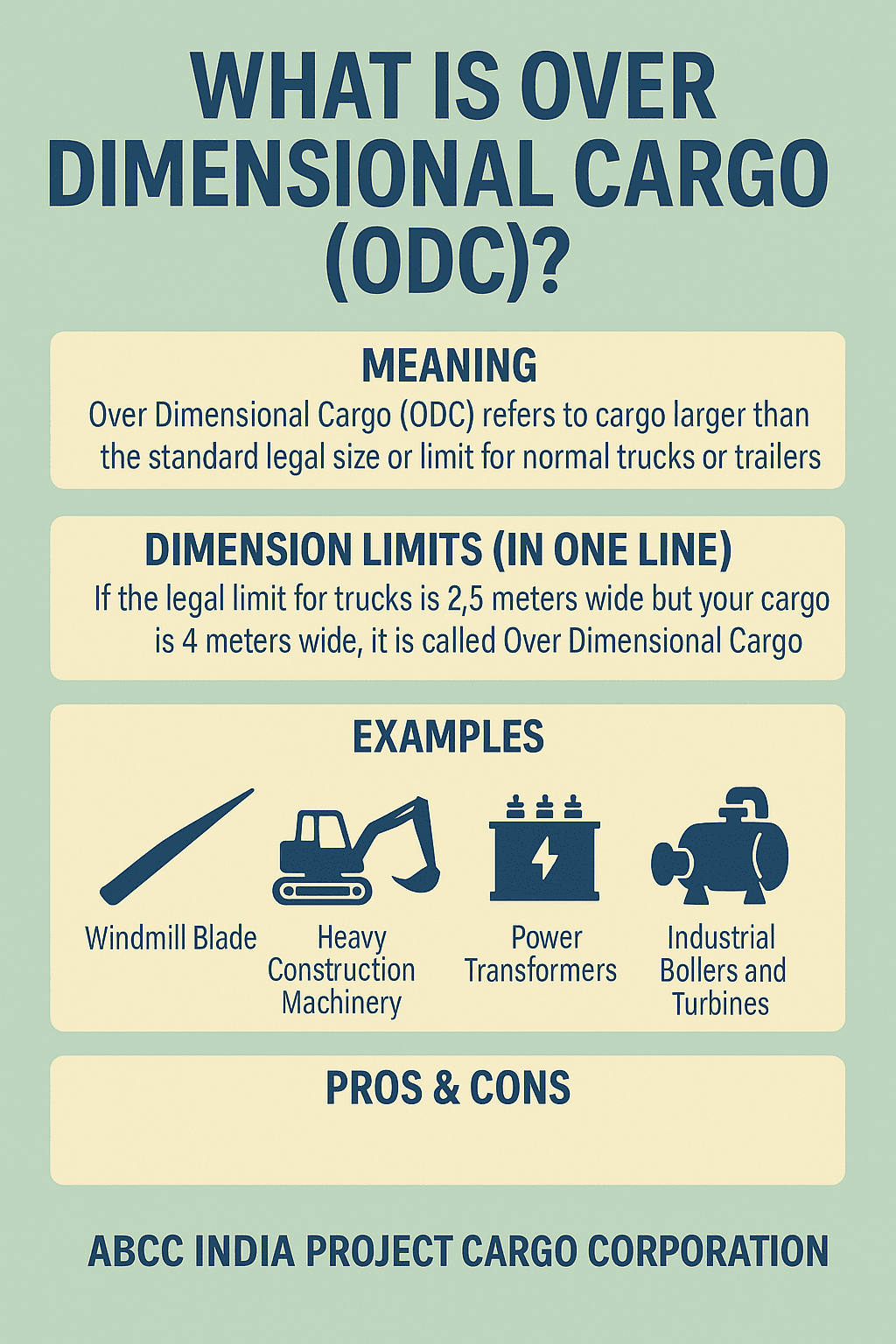
Meaning:
Over Dimensional Cargo (ODC) refers to any cargo or load that is larger (in length, width, height, or weight) than the standard legal size or limit allowed on normal trucks or trailers. These are special loads that cannot be transported in regular vehicles because they exceed normal dimensions.
Key Points :
- Bigger than normal: The cargo is too big or heavy to fit into standard trucks.
- Special trucks needed: These loads require special trailers like low-bed trailers, multi-axle hydraulic trailers, or modular trailers.
- Government permission required: You usually need special permits from transport authorities because the load may block roads, bridges, or pose safety risks.
Examples of ODC:
- Windmill blades (very long and wide)
- Heavy construction machinery (excavators, cranes, bulldozers)
- Power transformers (extremely heavy and large)
- Industrial boilers and turbines
- Large bridge beams or girders
Example in one line:
If a standard truck can legally carry cargo up to 2.5 meters wide, but your cargo is 4 meters wide, it is called Over Dimensional Cargo (ODC).
Types of Over Dimensional Cargo (ODC) and Its Transportation Process

The term Over Dimensional Cargo (ODC) refers to cargo that exceeds the standard dimensions or weight limits permissible for transportation via regular trucks and trailers. Due to its unusual size, shape, or weight, ODC requires specialized planning, equipment, permits, and handling. This cargo type is often associated with large-scale industrial projects, heavy machinery, and construction materials. Below is a detailed explanation of the types of ODC and its transportation process.
1. Types of Over Dimensional Cargo (ODC)
ODC can vary greatly depending on industry requirements, weight categories, and structural specifications. Here are the primary types:1.1 Industrial Machinery
- Includes turbines, generators, compressors, boilers, and large manufacturing equipment.
- Used in power plants, oil refineries, and large-scale industries.
- Characteristics: Heavy, bulky, and often irregularly shaped.
1.2 Construction Equipment
- Bulldozers, excavators, concrete mixers, cranes, and large structural components (e.g., steel beams).
- These items typically exceed standard height and width limits, making them ideal for ODC categorization.
1.3 Wind Energy Components
- Tower sections, wind blades, and nacelles are among the most challenging ODC items due to their extreme length and delicacy.
- Requires special support trailers to ensure stability during transport.
1.4 Aerospace Components
- Aircraft fuselage sections, wings, and satellite launch equipment fall into this category.
- Such cargo demands high levels of precision and safety.
1.5 Oil and Gas Equipment
- Large pipelines, drilling rigs, and refinery vessels are transported as ODC.
- These items can be heavy and long, requiring hydraulic modular trailers.
1.6 Bridge Sections and Prefabricated Structures
- Large prefabricated sections used in bridges, highways, and commercial buildings.
- Often transported on multi-axle or extendable trailers.
1.7 Rolling Stock (Railways)
- Locomotives and rail coaches are examples of ODC items in the rail sector.
1.8 Defense and Military Equipment
- Tanks, artillery guns, missile launchers, and armored vehicles are frequently transported as ODC under strict security.
2. Characteristics of ODC
- Exceeds Standard Dimensions: Either in length, width, height, or weight.
- Special Handling: Requires special lifting gear (cranes, jacks, forklifts).
- Customized Trailers: Lowbed, modular hydraulic, and extendable trailers are used.
- Special Permits: Road transport authorities mandate escort vehicles and permits.
3. Transportation Process of Over Dimensional Cargo
The transportation of ODC is a complex operation that involves meticulous planning, coordination, and execution. Below are the step-by-step details:
3.1 Pre-Transportation Planning
Cargo Assessment:
Detailed measurement of cargo dimensions and weight.
Identification of lifting and securing points.
Route Survey:
Physical inspection of roads, bridges, and underpasses along the route.
Ensures clearance for height, width, and load-bearing capacity of infrastructure.
Survey team documents potential obstacles and plans detours.
Permit Acquisition:
Necessary permissions are obtained from transport authorities for oversize or overweight cargo.
Permits vary for interstate and intrastate movements.
Approval for movement timing (often night or non-peak hours).
3.2 Selection of Transport Equipment
Trailers and Trucks:
Lowbed Trailers: Used for high cargo to maintain ground clearance.
Modular Hydraulic Axle Trailers: For extremely heavy or lengthy cargo.
Extendable Trailers: For items like wind blades or bridge girders.
Multi-axle Vehicles: Distribute weight evenly across roads and bridges.
Lifting and Handling Equipment:
Cranes, forklifts, and jacks are arranged at origin and destination for loading and unloading.
Escort Vehicles:
Front and rear escort vehicles ensure road safety and compliance with regulations.
3.3 Cargo Preparation and Loading
Packing and Securing:
Cargo is securely packed using industrial-grade materials like tarpaulin, steel chains, lashing belts, and wooden blocks.
Prevents movement during transit.
Loading:
Specialized cranes or hydraulic lifting systems are used for heavy cargo.
Loading crew ensures weight distribution to avoid axle overload.
Inspection:
Safety inspection is carried out to verify lashing, trailer integrity, and vehicle fitness.
3.4 Transportation Execution
Movement Timing:
Cargo often moves during night or low-traffic hours for safety and efficiency.
Speed Management:
Due to heavy loads, speed is controlled at 20-30 km/h in most cases.
Constant monitoring by the driver and escort vehicles.
Route Monitoring:
GPS tracking and communication with control rooms for real-time updates.
Adjustments in case of road closures, weather issues, or unforeseen obstacles.
Security and Safety Measures:
Specialized training for drivers.
Adequate signage and lights on vehicles.
Police or private security escorts for defense cargo.
3.5 Unloading and Delivery
Destination Preparations:
Area clearance, ground reinforcement, and availability of handling equipment.
Unloading:
Heavy-duty cranes and jacks are used.
Extra care is taken to avoid damage to cargo and property.
Final Placement:
Cargo is placed in the exact location required for project use.
Post-delivery inspection and documentation are completed.
4. Challenges in ODC Transportation
Infrastructure Limitations: Narrow roads, weak bridges, and low underpasses.
Regulatory Approvals: Time-consuming permit processes across states.
Weather Conditions: Heavy rains, snow, and storms can delay schedules.
Safety Concerns: High risk due to size, weight, and maneuverability challenges.
Cost: Specialized equipment, manpower, and permits make ODC expensive.
5. Role of Professional ODC Transporters
Companies like ABCC India Project Cargo Corporation excel in ODC transportation by providing:
Extensive fleet of hydraulic axles, lowbeds, and modular trailers.
In-house route survey teams.
Nationwide permit and clearance support.
End-to-end project logistics management.
Skilled personnel and advanced safety standards.
6. Conclusion
The transportation of Over Dimensional Cargo is a niche yet critical segment of the logistics industry. It supports infrastructure growth, industrial projects, and strategic defense requirements. Proper planning, the right equipment, and expert execution are essential for the safe and timely delivery of ODC.
ABCC India Project Cargo Corporation plays a pivotal role in this segment by offering tailor-made solutions for heavy haulage and project cargo. With an extensive fleet, advanced technology, and experienced professionals, ABCC India is well-positioned to manage the most challenging ODC operations across India and cross-border regions.

Here is a detailed explanation of vehicles used for Over Dimensional Cargo (ODC) transportation in the Indian and global markets:

1. Hydraulic Axle Modular Trailers
- Description: Multi-axle trailers with hydraulic suspension systems. They can be configured as per load requirements (length/width).
- Usage: Used for ultra-heavy equipment like power transformers, turbines, reactors, and bridge girders.
- Global Market: Widely used worldwide for ODC because of high load-bearing capacity (up to 2000+ tons).
2. Low-Bed Trailers
- Description: Trailers with a lower deck height, allowing tall cargo to pass under bridges.
- Usage: Excavators, large construction machinery, windmill blades, and industrial boilers.
- Global Market: Popular for cargo with height restrictions in cross-country transport.
3. Semi Low-Bed Trailers (SLBT)
- Description: Deck height is higher than low-bed trailers but lower than flatbed trailers.
- Usage: Medium-weight ODC cargo like dumpers, bulldozers, and machinery parts.
4. Flatbed Trailers
- Description: Standard trailers with a flat platform and no sidewalls.
- Usage: ODC cargo with width or length exceeding normal limits, steel beams, pipes, and construction material.
- Global Market: Preferred for port-to-port and short-distance heavy load transport.
5. Extendable Trailers
- Description: Trailers with adjustable length (extendable up to 90 feet or more).
- Usage: Wind turbine blades, long steel structures, bridge girders.
6. Multi-Axle Trucks
- Description: Heavy-duty trucks with multiple axles for weight distribution.
- Usage: Cargo with high gross weight requiring stability on highways.
- Examples: Tata Prima 5530.S, BharatBenz 5528TT, Ashok Leyland 5525.
7. Specialized Heavy Haul Trucks
- Description: Designed for extreme weight ODC transport; often work with modular trailers.
- Usage: Extremely heavy cargo over 100+ tons.
- Global Market: Brands like MAN, Volvo, Mercedes Actros, and Scania dominate.
Indian Market Insight
- Key Companies: ABCC India Project Cargo Corporation, Allcargo Logistics, Agarwal Packers, and DHL Global Forwarding.
- Key Routes: Ports (Mumbai, Mundra, Chennai, Kolkata) to industrial hubs, hydro projects in NE India, and power plants.
- Demand Drivers: Infrastructure projects, wind energy, manufacturing plants, and metro projects.
ODC Cargo Transportation in Indian States
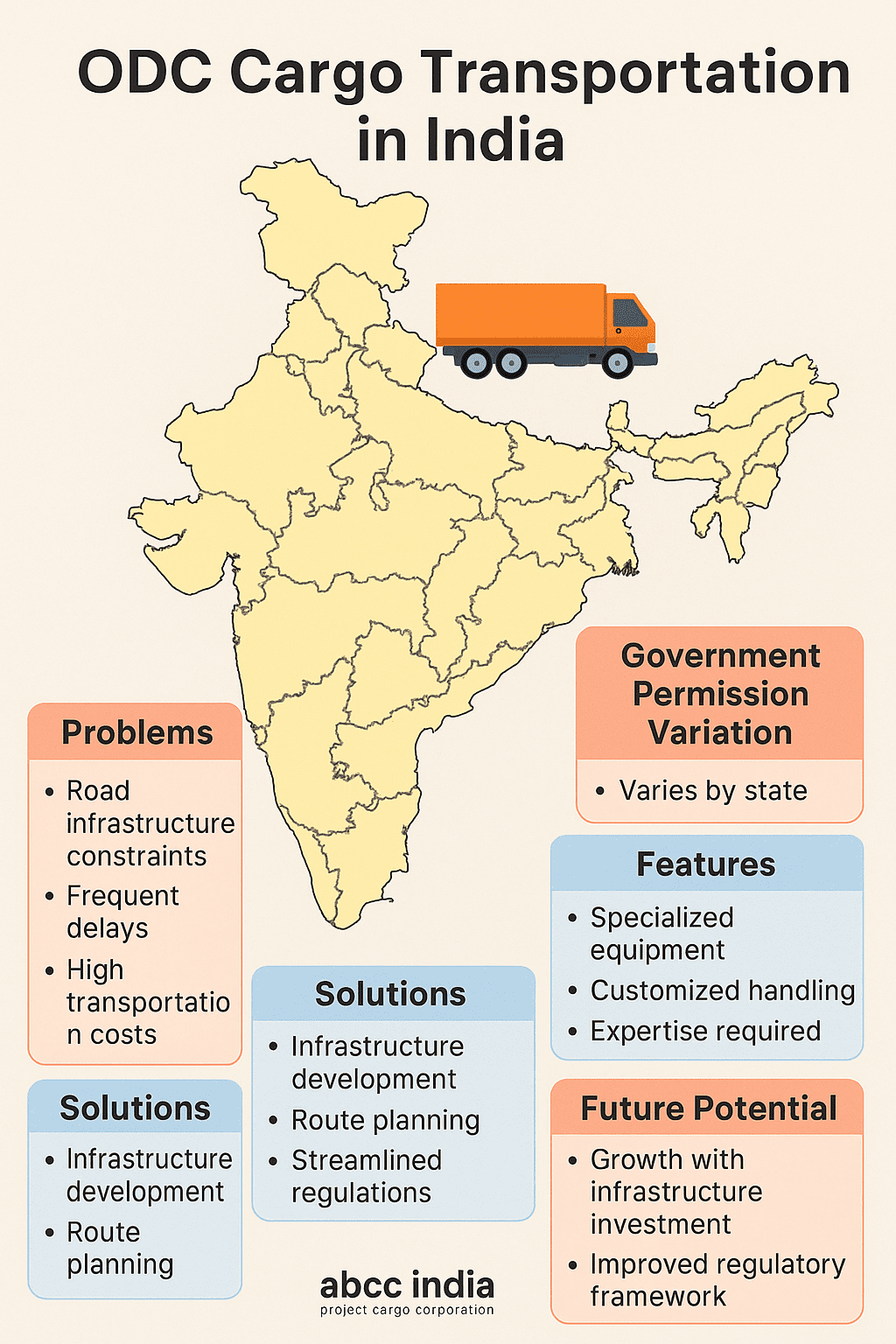
| State | Problems | Solutions | Govt. Permission Variation | Features | Future Potential |
|---|---|---|---|---|---|
| Andhra Pradesh | Poor rural roads, delays at check posts | Use GPS for planning, modular trailers | Requires state RTO & police permits | Coastal access, port proximity | Growth in manufacturing & Vizag port projects |
| Arunachal Pradesh | Narrow hilly roads, landslides | Deploy low-bed trailers, seasonal planning | Special army & border road permission | Border terrain, defense logistics | Hydro & defense projects boost |
| Assam | Floods, weak bridges | Multi-axle trucks, alternative routes | Frequent permit checks due to border routes | Gateway to NE India | High due to refinery, petrochemical projects |
| Bihar | Congested roads, lack of infrastructure | Escorts & route surveys | Standard RTO permission | Industrial zones emerging | Future industrial growth zones |
| Chhattisgarh | Forested terrain, naxal-prone areas | Security escorts, strong coordination | Mining permissions required in some zones | Steel & mining hub | Future steel projects & infrastructure boom |
| Goa | Narrow city roads, tourist congestion | Night movement for ODC cargo | Local police & port permissions | Strong port connectivity | Steady growth due to pharma & shipping |
| Gujarat | Heavy traffic near industrial clusters | Route optimization & port clearances | Single-window clearance in some ports | Best port connectivity in India | Future leader in ODC logistics |
| Haryana | Overloaded highways | Use hydraulic axle trailers | NHAI & state police permits | NCR hub connectivity | Industrial cluster expansion |
| Himachal Pradesh | Mountain terrain, sharp turns | Modular trailers with steering axles | Border road org. permissions | Power projects & hydro plants | Hydro & green energy projects |
| Jharkhand | Weak rural bridges | Route surveys, lighter axle loads | Mining area permits | Steel, power & mining hub | Future potential high due to industries |
| Karnataka | City congestion (Bangalore) | Night movement, police coordination | RTO & city police permits | IT hubs & ports | Renewable energy projects |
| Kerala | Narrow highways, traffic congestion | Low-bed trailers, police support | State police strict checks | Port connectivity (Cochin) | Logistics for manufacturing, ports |
| Madhya Pradesh | Long routes, rural bottlenecks | Use national highways where possible | RTO permissions | Central location for transit | Future logistics hub |
| Maharashtra | Heavy city congestion, toll delays | Night movement, port clearance | Port permissions at Nhava Sheva | Leading ODC cargo volume state | High industrial & metro projects |
| Manipur | Poor infrastructure, security issues | Escorts & route clearance | Special border area permits | NE border trade | Future logistic expansion towards Myanmar |
| Meghalaya | Weak bridges, hilly roads | Modular trailers & route inspection | Border & state police permissions | Cement & mining hubs | Cement industry growth |
| Mizoram | Extreme border terrain | Specialized low-bed modular trailers | Army & state police permits | Border state | Border trade potential |
| Nagaland | Border roads & security | Escorts with defense coordination | Border area permissions | Gateway to Myanmar | Future trade corridors |
| Odisha | Cyclones, weak infrastructure in rural areas | Heavy-duty trailers, route scheduling | State RTO, police permits | Port & steel industry | High growth due to ports & mines |
| Punjab | Congestion at borders | Plan alternate routes | Police & toll barrier permissions | NCR connectivity | Manufacturing & logistics park growth |
| Rajasthan | Desert terrain, extreme temperatures | Night movement & tire protection | Standard RTO permissions | Industrial belts (Jaipur, Jodhpur) | Renewable energy projects |
| Sikkim | Narrow mountainous roads | Hydraulic modular trailers | Army & border permits | Hydro & defense cargo | Future energy projects |
| Tamil Nadu | Traffic in industrial belts | Plan via port access routes | Port & police permissions | Top automobile manufacturing hub | Future EV & industrial growth |
| Telangana | Urban congestion (Hyderabad) | Night movement, police help | Standard RTO permissions | Industrial SEZ hubs | Future tech & infrastructure growth |
| Tripura | Poor border road conditions | Route survey & escorts | Army & state police permissions | Border with Bangladesh | Border trade & energy projects |
| Uttar Pradesh | Congestion, toll delays | Optimize NH routes | Police clearances needed | Top consumer market | Future mega infrastructure projects |
| Uttarakhand | Hilly terrain, landslides | Low-bed modular trailers | Border road org. permissions | Hydro & defense cargo hub | Hydro power potential |
| West Bengal | Port congestion & narrow city roads | Route scheduling via NH | Port & police permissions | Kolkata & Haldia port | Port & industry growth |
| Andaman & Nicobar | Port dependency | Multi-modal (sea+road) transport | Coastal shipping permissions | Remote island logistics | Strategic defense hub |
| Chandigarh | Limited industrial areas | Plan via Punjab/Haryana routes | Standard RTO permissions | Urban logistics | Limited but steady growth |
| Dadra & Nagar Haveli | Industrial hub congestion | Escorts & route mapping | RTO permissions | Industrial cluster | Steady growth |
| Daman & Diu | Coastal port dependency | Multi-modal routes | Coastal permits | Shipping-based ODC cargo | Port growth projects |
| Delhi (NCT) | City restrictions for ODC | Strict night-only movement | Delhi traffic police permits | NCR hub | Infrastructure & metro expansion |
| Jammu & Kashmir | Security & weather disruptions | Escorts & army coordination | Army & border permits | Defense cargo hub | Future logistics growth with infra projects |
| Ladakh | Extreme altitude & border roads | Special modular trailers | Army & BRO permissions | Strategic defense cargo | Border defense logistics |
| Lakshadweep | Island dependency | Multi-modal sea-road-air logistics | Coastal shipping permissions | Remote island cargo | Defense & infrastructure expansion |
| Puducherry | Small city roads | Plan via Tamil Nadu routes | Local police permissions | Coastal port | Steady port & industrial growth |
Key Notes
- Govt. Permission Variation: Each state may require RTO, police, border road organization, or port-specific permissions for ODC cargo.
- Future Potential: Huge growth expected with industrialization, renewable energy projects, metro rail, defense cargo, and port expansion.
Contact for Expert ODC Cargo Transport
ABCC India Project Cargo Corporation
📞 Contact: 9408275245
📧 Email: [email protected]
🌐 Website: www.roadstransporter.com
We specialize in Hydraulic Axle Modular Trailers, Low-Bed, Semi Low-Bed, Flatbed, and Extendable Trailers for all-India and international ODC cargo movement.
Big Issues and Major Road Accidents in Over Dimensional Cargo (ODC) Transportation in India
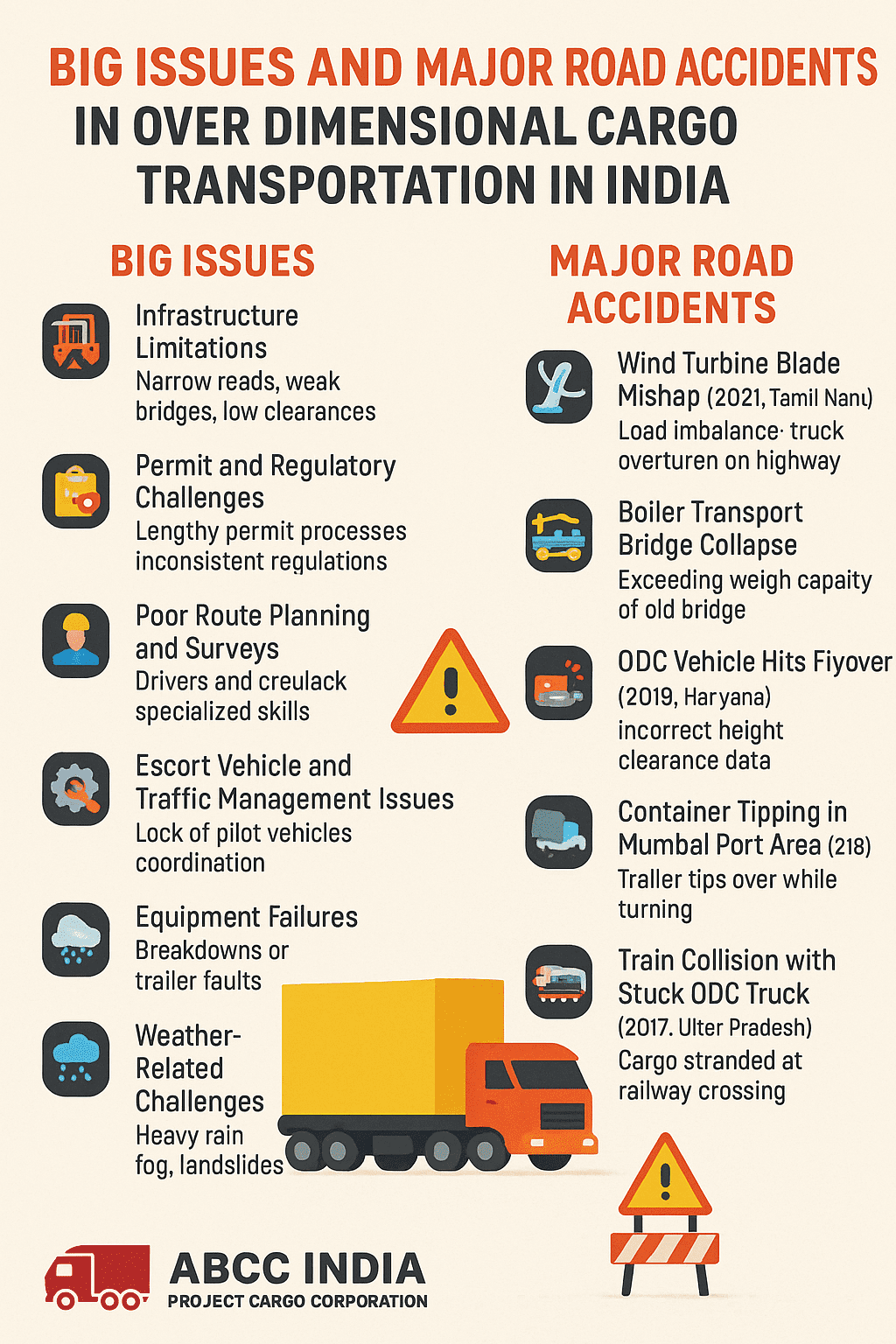
Over Dimensional Cargo (ODC) transportation is an essential component of infrastructure development and industrial growth in India. However, the movement of oversized and overweight cargo poses significant operational, safety, and infrastructural challenges. These challenges, if not managed properly, can lead to major road accidents, loss of life, property damage, and disruptions in supply chains. Below is an in-depth analysis of the big issues and examples of major accidents in India.
1. Big Issues in ODC Transportation
1.1 Infrastructure Limitations
- Narrow Roads and Sharp Turns: Many Indian highways and rural roads are not designed to accommodate vehicles carrying large cargo like turbines, wind blades, or bridge sections.
- Weak Bridges: Older bridges may not be capable of supporting extremely heavy loads.
- Low Clearances: Overhead electric lines, railway crossings, and flyovers often have inadequate clearance for tall cargo.
1.2 Permit and Regulatory Challenges
- Lengthy Approval Processes: Obtaining interstate movement permits for ODC often takes weeks.
- Inconsistent State Regulations: Each state has different permit rules and road conditions, causing delays and route deviations.
1.3 Poor Route Planning and Surveys
- Inadequate route surveys lead to situations where cargo gets stuck in underpasses, narrow lanes, or on weak bridges.
- Lack of real-time infrastructure data further complicates the planning process.
1.4 Untrained Workforce
- Drivers and ground staff may lack specialized training to handle heavy-haul trucks and trailers.
- Poor understanding of braking distances, load balancing, and vehicle dynamics increases accident risk.
1.5 Escort Vehicle and Traffic Management Issues
- Inadequate use of pilot/escort vehicles to guide ODC through traffic-heavy or dangerous stretches.
- Poor coordination with local traffic police, especially in urban areas.
1.6 Equipment Failures
- Faulty trailers, weak axles, or inadequate lashing equipment can lead to load shifts and tipping over.
- Mechanical breakdowns in remote areas prolong exposure to risks.
1.7 Weather-Related Challenges
- Heavy rainfall, landslides (common in hilly terrain), or fog can delay movement and increase accident probability.
2. Major Road Accidents Involving ODC in India
2.1 Wind Turbine Blade Mishap (Tamil Nadu, 2021)
- A truck carrying a wind turbine blade overturned on a highway due to sudden braking, blocking traffic for over 12 hours.
- Blade length exceeded 70 meters and poor lashing caused load imbalance.
2.2 Boiler Transport Bridge Collapse (Madhya Pradesh, 2020)
- A trailer carrying a 150-ton boiler attempted to cross an old bridge without proper route clearance.
- The bridge collapsed, causing fatalities and massive property loss.
2.3 ODC Vehicle Hits Flyover (Haryana, 2019)
- An oversized cargo load hit a flyover due to incorrect height clearance data.
- Resulted in partial collapse of the flyover structure and prolonged traffic jams.
2.4 Container Tipping in Mumbai Port Area (2018)
- A hydraulic axle trailer tipped while negotiating a turn at low speed.
- Cargo worth crores was damaged and port operations halted for hours.
2.5 Train Collision with Stuck ODC Truck (Uttar Pradesh, 2017)
- An ODC truck carrying a transformer was stuck at a railway crossing.
- A passenger train collided with the truck, leading to multiple casualties and injuries.
3. Key Factors Behind These Accidents
- Inadequate Route Survey: Failing to verify bridge strength, road width, and height clearance.
- Improper Load Securing: Loose lashing and incorrect load balancing during transit.
- Non-Compliance with Escorts: Lack of pilot vehicles to clear traffic and alert other drivers.
- Time Pressure: Many logistics companies rush deliveries to meet deadlines, compromising safety.
- Lack of Maintenance: Poor condition of hydraulic axles, trailers, and towing trucks.
4. Safety Solutions and Recommendations
4.1 Comprehensive Route Surveys
- Pre-movement surveys must map all potential obstacles like overhead power lines, bridges, underpasses, and weak road sections.
4.2 Better Equipment
- Use of certified hydraulic modular trailers, lowbeds, and extendable trailers designed for heavy loads.
- Regular maintenance and inspections.
4.3 Skilled Workforce
- Specialized driver training programs focusing on vehicle control, braking techniques, and load securing.
4.4 Regulatory Reforms
- Simplified and uniform permit process across states.
- Mandatory use of GPS trackers and real-time monitoring.
4.5 Use of Escorts and Technology
- Escort vehicles with proper warning lights and road management support.
- Digital tools for route management and live updates on cargo movement.
4.6 Infrastructure Improvements
- Dedicated ODC corridors with stronger bridges and wider roads.
- Removal or raising of low-height electric and telecom lines along major industrial routes.
5. Conclusion
The transportation of ODC in India is fraught with challenges due to inadequate infrastructure, poor planning, and regulatory hurdles. These factors have led to several high-profile accidents, resulting in loss of life, cargo, and infrastructure.
ABCC India Project Cargo Corporation, with its experience and expertise in ODC logistics, is uniquely positioned to address these challenges. Through advanced route surveys, state-of-the-art equipment, trained personnel, and technology-driven solutions, ABCC India can ensure safe and timely delivery of over-dimensional cargo across India.
1. What is Indo-SAARC ODC Cargo Transportation?
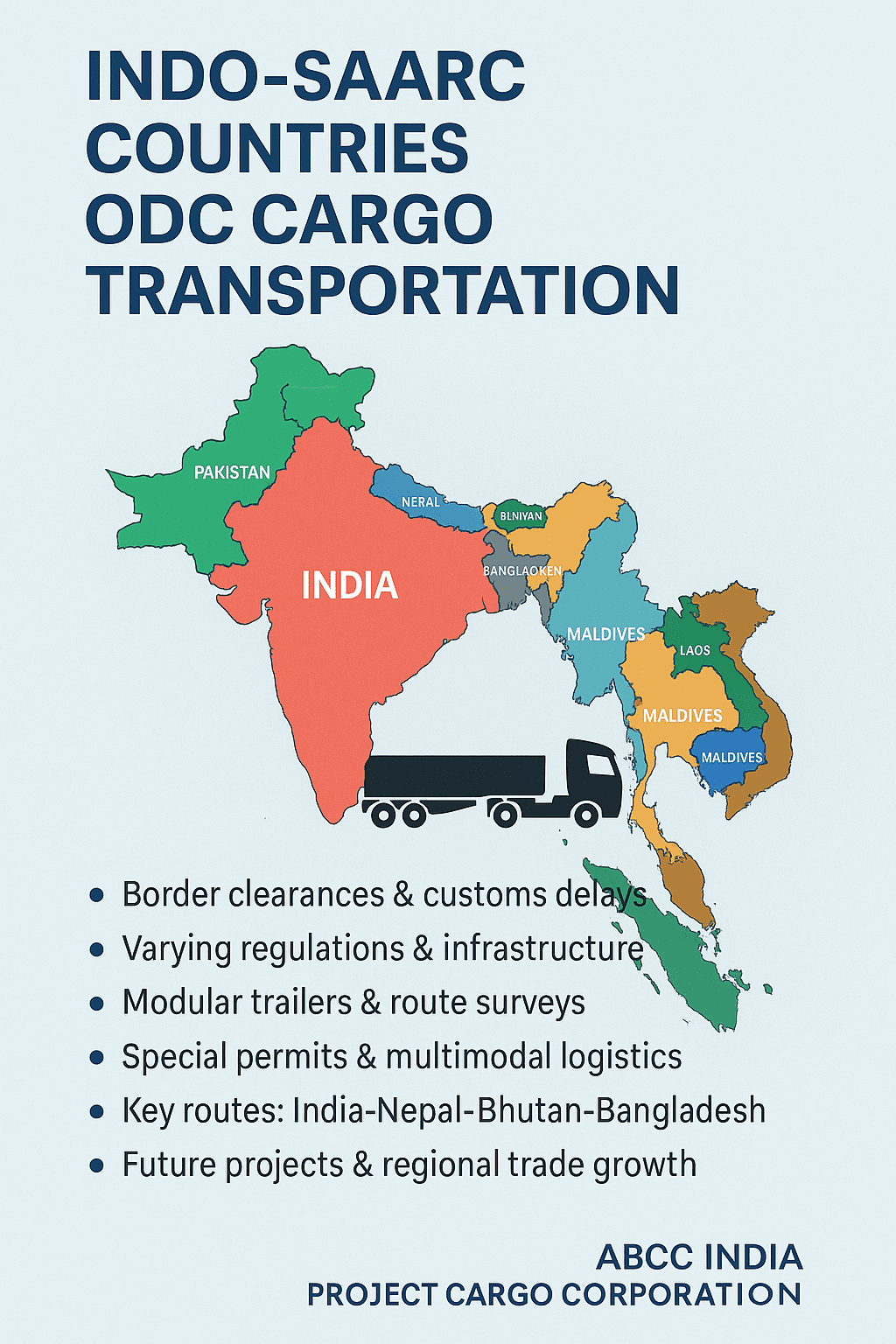
It refers to the movement of Over Dimensional Cargo (ODC) across India and other SAARC (South Asian Association for Regional Cooperation) countries:
- Countries involved: India, Nepal, Bhutan, Bangladesh, Sri Lanka, Maldives, Pakistan, and Afghanistan.
- Cargo is transported cross-border using specialized trucks, trailers, and multimodal transport (road, sea, and sometimes air).
2. Key Challenges in Indo-SAARC ODC Transport
- Border clearances and customs delays
- Different road infrastructure standards (narrow roads in hilly regions like Nepal, Bhutan, and Afghanistan)
- Varying axle load and dimension regulations across countries
- Security risks in certain border zones
- Limited bridge load-bearing capacity in rural or border areas
3. Solutions
- Advance route surveys and feasibility studies
- Special permits from border authorities and state RTOs
- Multimodal logistics solutions (road-sea-road for island nations like Maldives and Sri Lanka)
- Use of modular hydraulic trailers and extendable low-bed trailers
- Partnering with local logistics experts in each SAARC country
4. Vehicle Types Used
- Hydraulic Axle Modular Trailers: For extremely heavy cargo
- Low-Bed Trailers & Semi Low-Bed Trailers: For tall cargo
- Extendable Trailers: For wind turbine blades, long girders
- Multi-Axle Trucks: For part of the route where modular trailers can’t operate
5. Indo-SAARC Key ODC Routes
- India to Nepal: Raxaul–Birgunj border, Banbasa–Mahendranagar
- India to Bhutan: Jaigaon–Phuentsholing, Samdrup Jongkhar
- India to Bangladesh: Petrapole–Benapole, Agartala–Akhaura
- India to Sri Lanka: Chennai & Tuticorin seaports (via sea freight)
- India to Maldives: Kochi & Thoothukudi seaports (via sea freight)
- India to Afghanistan: Attari–Wagah border via Pakistan
6. Features of Indo-SAARC ODC Transport
- Requires multi-country customs documentation
- Specialized drivers & escorts trained for hilly and border terrains
- Involves cross-border insurance and cargo safety planning
- High focus on timely delivery for projects like hydro plants, power transformers, and defense cargo
7. Future Potential
- Growing infrastructure and power projects across SAARC nations
- Regional trade agreements are making cross-border ODC movement faster
- Large-scale projects (hydro, solar, and manufacturing) will increase demand
ODC Cargo Transit Insurance, RTO, and Transit Insurance Laws :

1. What is ODC Transit Insurance?
ODC Transit Insurance covers loss or damage to over-dimensional cargo during transportation.
It protects cargo owners, transporters, and logistics companies from financial loss in case of accidents, theft, fire, natural calamities, or handling damage.
2. RTO Laws Related to ODC Cargo
RTO (Regional Transport Office) is responsible for:
Issuing special permits for ODC cargo exceeding legal dimensions/weight.
Enforcing axle load regulations and road safety standards.
Approving route surveys to ensure the cargo can safely pass bridges, tunnels, and highways.
Non-compliance penalties: Heavy fines, cargo detention, and cancellation of vehicle permits.
3. Transit Insurance Laws
Governed under the Carriage by Road Act, 2007 and Motor Vehicles Act.
It is mandatory for transporters and cargo owners to take insurance when:
Goods are highly valuable or oversized (ODC).
Routes involve cross-border or inter-state movement.
Types of policies:
All-Risk Policy: Covers all types of damage/loss except exclusions.
Specific Transit Policy: Covers a single shipment.
Annual Transit Policy: For companies transporting cargo regularly.
4. Pros & Cons
Pros
- Financial protection: Covers high-value ODC cargo from transit risks.
- Compliance: Helps meet RTO and government regulatory requirements.
- Peace of mind: Covers accidents, theft, fire, and natural calamities.
- Legal support: Helps in claims and reduces disputes.
Cons
- High premium costs: ODC insurance premiums are higher due to high risk.
- Complex paperwork: RTO permits and insurance documentation can be time-consuming.
- Exclusions: Certain damages (like improper packaging or negligence) may not be covered.
- Delay in claims settlement: Especially for large cargo with complex assessment.
5. Best Practices
- Conduct route surveys before applying for RTO permits.
- Choose comprehensive all-risk transit insurance for high-value ODC cargo.
- Work with experienced RTO agents and insurance companies specialized in ODC cargo.
- Ensure drivers and crew are trained for oversized cargo handling.
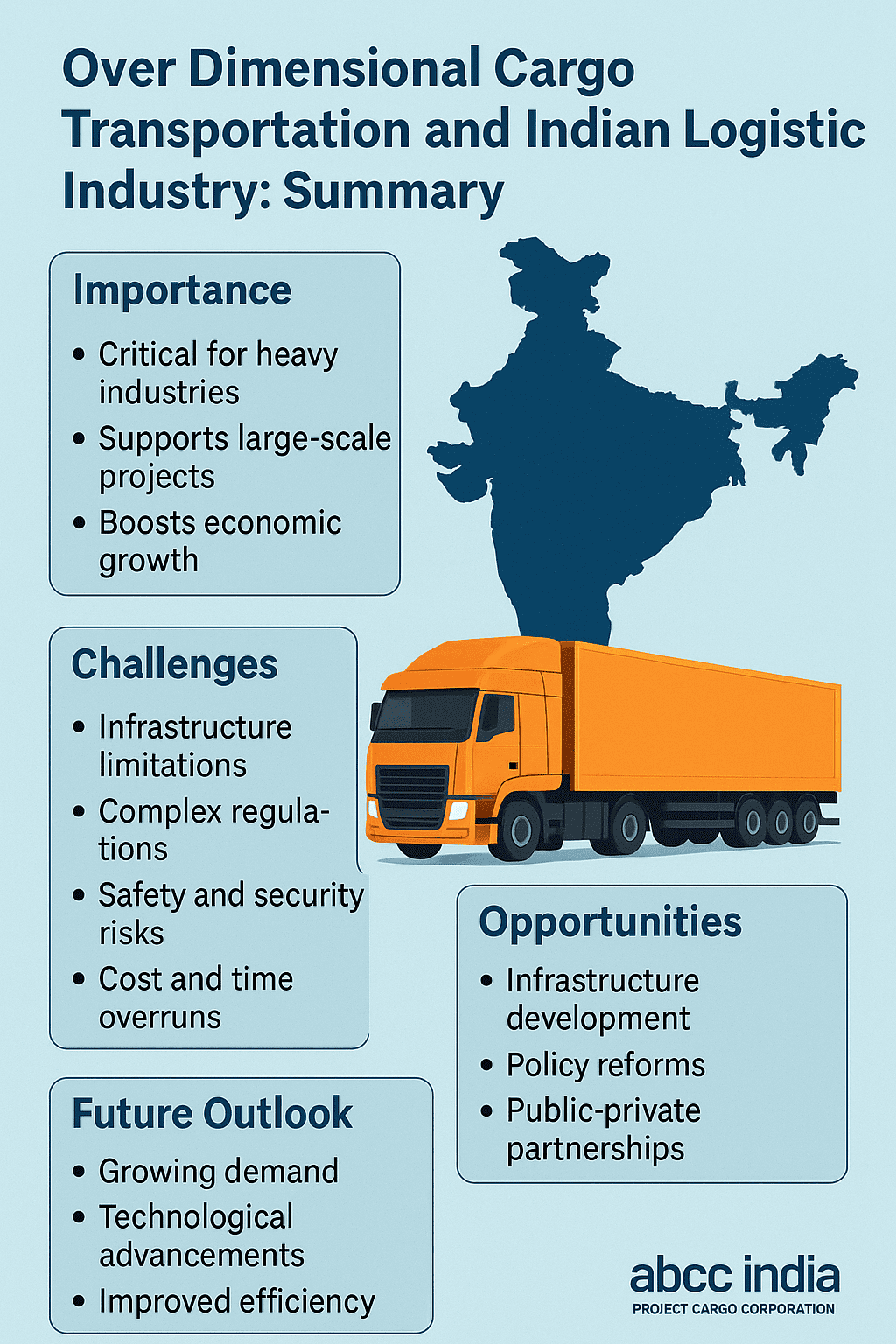
ODC Transportation & Indian Logistics Industry – Summary

| Category | Details |
|---|---|
| Definition of ODC Cargo | Cargo that exceeds the standard legal size or weight limits (length, width, height) allowed on normal trucks/trailers. Requires special vehicles and permits. |
| Examples | Wind turbine blades, heavy transformers, bridge girders, industrial boilers, construction machinery. |
| Vehicle Types Used | Hydraulic axle modular trailers, low-bed trailers, semi low-bed trailers, extendable trailers, multi-axle trucks. |
| RTO Laws | Requires special permits from Regional Transport Office (RTO). Includes route surveys, axle load regulations, and time-bound permits. |
| Transit Insurance | Mandatory for ODC cargo. Covers accidents, theft, fire, natural calamities. Types: All-risk, Specific, Annual policies. |
| Problems in India | Poor infrastructure in rural areas, narrow roads, weak bridges, multiple government permissions, border check delays, high transit costs. |
| Solutions | Advance route planning, modular trailers, multimodal logistics (road-rail-sea), single-window clearance, improved infrastructure. |
| Features of Indian ODC Logistics | Highly specialized, requires trained drivers & escorts, heavy capital investment in vehicles, critical for large industrial projects. |
| Government Initiatives | Bharatmala & Sagarmala projects, Dedicated Freight Corridors (DFCs), Logistics Parks, digital permits. |
| Future Potential | Growing demand from renewable energy, metro projects, smart cities, infrastructure & defense sectors. Expected CAGR of 8-10% in ODC logistics segment. |
| Key Companies | ABCC India Project Cargo Corporation, Allcargo Logistics, TCI, VRL Logistics, DHL India. |
Contact for Expert ODC Cargo Transportation
ABCC India Project Cargo Corporation
📞 Contact: 9408275245
📧 Email: [email protected]
🌐 Website: www.roadstransporter.com
We provide pan-India ODC cargo transport solutions using advanced hydraulic trailers, modular multi-axle vehicles, and multimodal logistics.
Conclusion :

“Over Dimensional Cargo (ODC) transportation demands precision, experience, and the right infrastructure. ABCC India Project Cargo Corporation has built a reputation as a trusted partner by offering specialized equipment, expert route planning, and a skilled workforce dedicated to delivering oversized and heavyweight cargo safely and on time.
With a pan-India presence, cross-border capabilities, and a fleet of advanced hydraulic modular trailers, lowbeds, and extendable trailers, ABCC India ensures the seamless movement of turbines, bridge sections, windmill blades, industrial machinery, and more.
Our mission is simple: to provide safe, efficient, and cost-effective ODC solutions that empower India’s infrastructure and industrial growth.
For professional ODC transportation services, contact ABCC India Project Cargo Corporation today at 9408275245 or visit www.roadstransporter.com. We are here to move your biggest projects with confidence.“